Modern architecture, the birth of a new Kazakhstan -
The history of the city, statehood and the academic environment of the future -
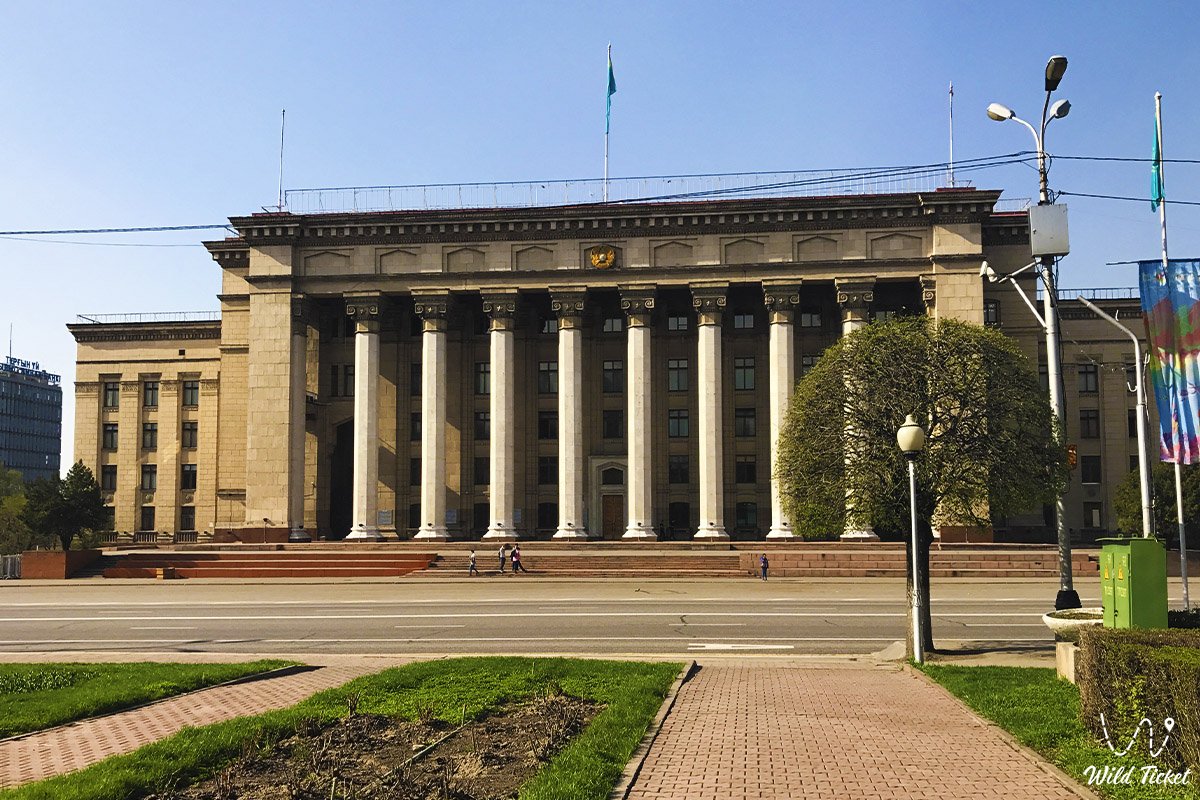
The building of the Kazakh-British Technical University is one of the most recognizable architectural dominants of the center of Almaty, also known as the former Government House. It is located on Tole bi Street, on Astana Square (Old Square), surrounded by beautiful squares and fountains. Today, it is home to one of the country's leading technical universities, established in 2000 with the support of the United Kingdom. The famous Panfilov pedestrian street runs next to the university.
KBTU is a prestigious international platform for science, engineering and high technologies. But more recently, the fate of the republic was being decided within these walls. The Supreme Council met here, key state documents were adopted, and ministers and regional akims worked in independent Kazakhstan.
Born as the Government House, this architectural giant has become a symbol of the transition from the era of government to the era of knowledge management.
History
The history of the building spans almost a century and reflects the development of Almaty as a political, cultural and scientific center.
The idea of building the future Government House appeared in the early 1930s. By 1933, the project was ready, but it was not immediately possible to implement it. It was only in 1938 that the first work began, and almost immediately a huge construction pit was dug, so large that the children of the surrounding areas called it their "underground city."
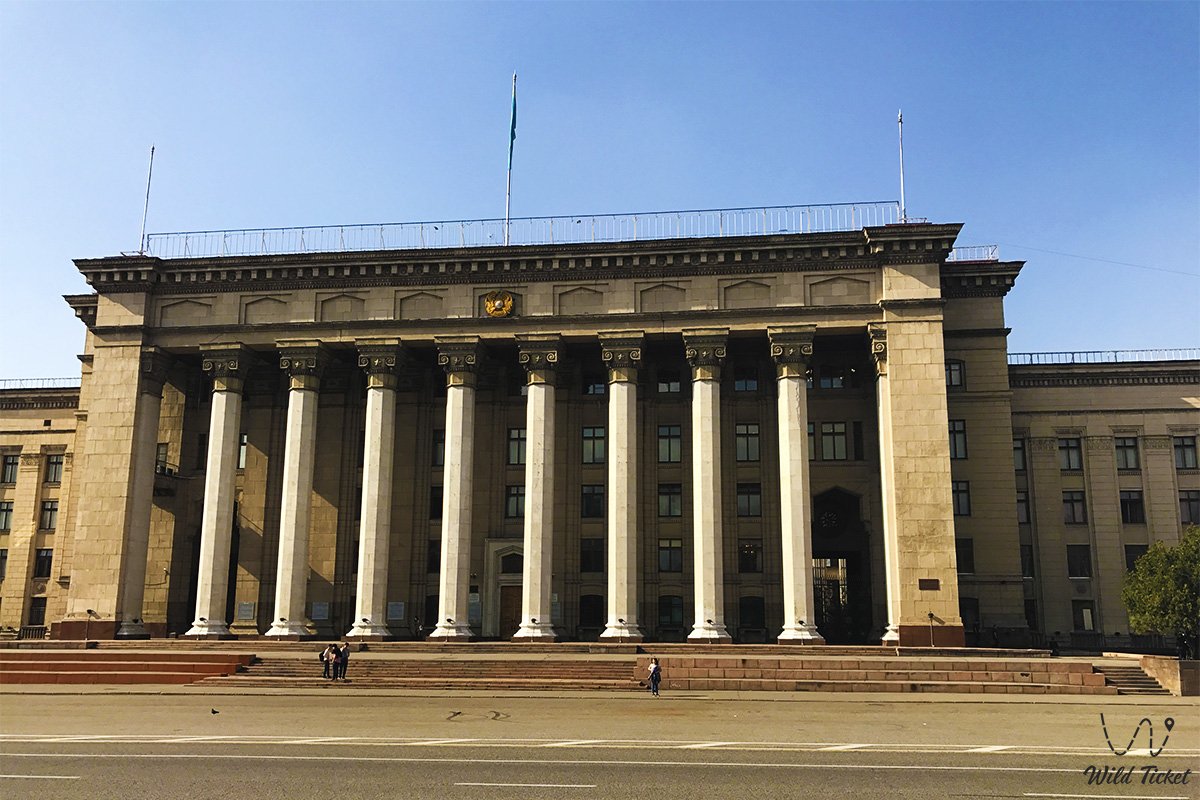
During the Second World War, construction stopped, and only in 1951 the project was resumed. The Mosproekt workshop worked on the architectural part, and the drawings were created by Kazgosproekt architects. It was completed in 1957, when the central part of the building revealed to the public the strict lines of the Stalinist Empire style.
The monumental facades were faced with granite and marble. The interior was designed to simultaneously meet the high requirements for executive rooms and take into account the peculiarities of the Almaty climate. The plenum hall and statesmen's offices received perfect proportions and thoughtful lighting, while large courtyards provided natural ventilation, a rarity in Soviet architecture.
According to the original plan, the building was supposed to be even more expressive: the project provided for a high dome on a massive drum, decorative bas-reliefs, symbolic sculptural groups. However, due to economic constraints, many elements were never implemented.
Until the 1980s, three supreme governing bodies of the Kazakh SSR were located here:
- The Central Committee of the Communist Party;
- The Council of Ministers;
- The Supreme Council of the Republic.
It was within these walls that the Law on the Independence of the Republic of Kazakhstan was adopted in 1991, a moment that went down in the country's history.
After the government moved to a new building on Republic Square, the Akimat of the Almaty region was located here. And in 2001, the monumental structure was destined to start a new life, it became the residence of the Kazakh-British Technical University.
Architecture
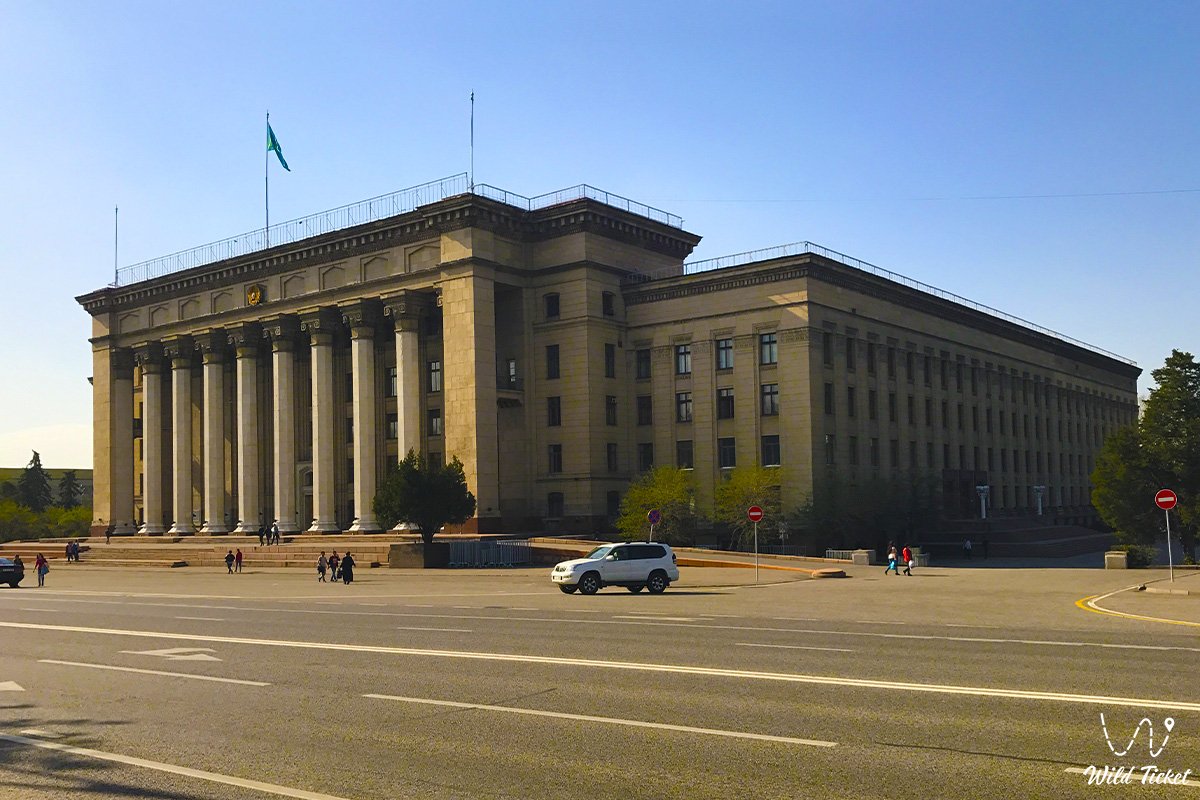
The KBTU building is made in the monumental style of the Stalinist Empire, strict symmetries, wide facades, tall colonnades, massive walls lined with granite and marble. It was conceived as the main architectural accent of the city, and it really forms a whole block between Panfilov, Abylai Khan, Kazybek bi and Tole Bi streets.
Every detail of the building reflects the idea of greatness and state stability. The wide staircase, massive columns, strict symmetrical shapes and the use of noble materials create a sense of solemnity at first glance.
The initial project envisioned a high dome on a drum and sculptural groups that were supposed to emphasize the greatness of state power. However, due to lack of funds, these elements remained on paper.
The complex consists of three buildings united by a central meeting room, around which two large courtyards are organized, designed taking into account the climate, shady galleries, cool passages, green areas.
The interiors have retained their original layout: high ceilings, spacious halls, corridors leading to halls and offices where the country's leaders once worked. The special spirit of old Almaty is felt in literally every corner. Today, students and teachers conduct classes in the premises where ministers used to meet and major national decisions were made. Thus, the building became a link between the past of public administration and the future of the country – a generation of professionals, engineers, IT specialists and scientists.
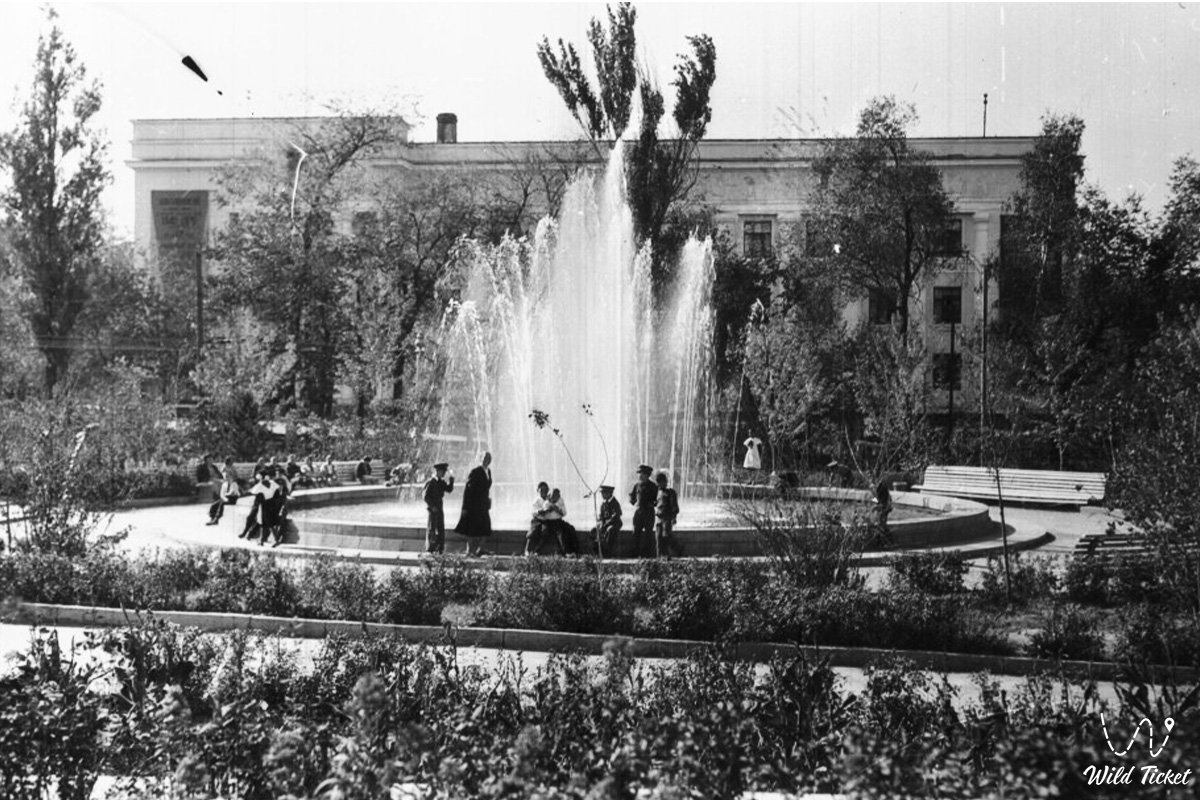
A separate part of the architectural ensemble is the green squares with fountains that are located around the building. There are cozy large squares and fountains on the north and south sides of the building, where you can have a great time and relax both during the day and in the evening.
---------------------------------------------
How to get there and visit -
The Kazakh-British University is located in the center of Almaty at 59 Tole Bi Street, Astana Square, corner of Panfilov Street, Almaly district, Republic of Kazakhstan.
GPS coordinates: 43°15'20"N 76°56'35"E
It is very easy to get to the university due to the developed transport interchange in the city center. In addition to traveling by private car or taxi, you can use buses. № 12, 16, 48, 59, 98, 126, 201, 205, 206, 209, 210, 224 or trolleybuses No. 5, 6.
An excellent alternative is the metro: there are two stations within walking distance. Almaly station is 200 meters from the corner of Bogenbai Batyr and Panfilov Streets, and Zhibek Zholy station is just a two–minute walk from the intersection of Aiteke bi and Panfilov Streets.
Working hours: Monday-Saturday from 09.00 to 18.00 (Sunday is a day off)
Contacts: +7 727 357 42 51 (admissions committee); +7 727 357 42 42 (contact center)
Official website of the University
---------------------------------------------
Atmosphere and meaning
Today, the building looks different, but the sense of scale has not disappeared. Spacious staircases, wide corridors, high ceilings, all this creates an atmosphere of importance and dignity. Once, government decisions were made here, but now these spaces are filled with student voices, lectures and scientific projects.
KBTU has transformed the former Government House into a modern academic venue. Laboratories are open here, conferences and annual ceremonies are held, but the spirit of history is felt in every hall. This is a good example of how architectural heritage can become part of an innovative future.
Legend
Over time, an urban sign appeared around the building. The newlyweds come to the fountains located next to the old government square. They say that if the bride can walk between the jets of water without wetting the hem of her dress, the marriage will be calm, strong and happy.
No one can say whether the legend is true, but weddings are common here, and many consider this place a symbol of a successful family life.
Interesting sights nearby:
• Monument to Alia Moldagulova and Manshuk Mametova;
• Kazakh State Academic Opera and Ballet Theater named after Abai;
• Bust monument to Zhambyl Zhabaev;
• Nedelka Fountain (week);
• Museum of the National Bank of the Republic of Kazakhstan;
• Zhibek Zholy Pedestrian Street;
• Kazpotrebsoyuz Administrative Building;
• Kazakh National Academy of Arts named after Zhurgenov;
• Kurmangazy Kazakh National Conservatory;
• The Almaty Hotel.
Photogallery: