The urban scene of memory and cultural revival -
The house where the traditions of Kore-saram sound in the new language of Kazakhstan -
The Republican State Academic Korean Musical Comedy Theater of the Culture Committee of the Ministry of Culture and Information of the Republic of Kazakhstan is not just a creative platform, but a living cultural symbol of the city of Almaty, which has gone through a long journey together with the people who brought their history, music, language and unique theatrical tradition here.
The theater welcomes guests all year round: the repertoire includes both classic Korean plays and modern dramatizations, including adaptations of world drama in Korean aesthetics. Musical performances and comedies filled with dances, folk melodies and traditional rituals are especially popular.
Despite its specific linguistic orientation, the theater has long been an attraction open to everyone.: The performances are accompanied by simultaneous translations into Kazakh and Russian, and the bright costumes, expressive plasticity and musical design make the productions understandable even without words. For tourists, it is a living bridge between the East and Eurasia – a place where you can experience the spirit of Korea in the midst of the Kazakh capital.
The warmth of human destiny is felt in this theater: the subtle aroma of traditions, the rhythm of modern directing and the deep melody of Korean songs that have been heard in Kazakhstan for almost a century. For Almaty, it has become not just a theater, but a cultural bridge between nations.
History
The history of the Korean Theater is almost a century long, a journey that began far from Almaty, near the cold sea of Vladivostok. In 1932, the world's first professional Korean theater was created here on the basis of amateur troupes and club circles. From the very first days, his stage resounded with the voice of the Koryo-saram people, plays by Korean authors, legends, stories of resistance, stories of love and loyalty.
A few years later, fate changed the direction of the theater. In 1937, after the deportation of the Far Eastern Koreans, the troupe was divided: one part ended up in Kyzylorda, the other in Tashkent. The theater lost its home, but it did not lose its voice. During these years, he became a wanderer – he played in granaries, in collective farm clubs, in schools, and in field camps during harvest. It was then that he became the cultural pillar of those who found themselves in an unfamiliar steppe.
An amazing detail has been preserved: in 1939, Hong Bom Do, the national hero of Korea, a participant in the struggle against Japanese colonization, worked as a theater watchman. Later, the plays "Hong Bom Do" and "Hong Flying through the Centuries" will be dedicated to him, and the theater will become the keeper of his memory.
During the Great Patriotic War, the Korean Theater, like hundreds of stages in the country, became a voice of hope – it staged patriotic plays, performed in hospitals and in front of evacuated families. During these difficult years, the troupe moved to the Taldykorgan region, then to the Ushtobe station, where the Tashkent part of the team arrived in 1950. The two branches, once separated by deportation, have reunited.
Since the middle of the 20th century, the theater has been actively touring the cities of the USSR, performing in Moscow, Leningrad, Siberia, and Central Asia. In 1968, its history took a new turn – the troupe moved to Alma Ata and received the status of the republican musical comedy theater. This is where the theater became what we know it today.
His repertoire has expanded from Korean legends and folk tales to Chekhov, Gorky, modern plays, comedies, and musical performances. Productions of "The Tale of Chun Hyang", "The Bear", "A Poem about Love. Kozy-Korpesh and Bayan-Sulu", "Is it easy to be a queen?" and many others have become iconic.
The band was awarded the Order of the Badge of Honor, toured the DPRK and the Republic of Korea, participated in international festivals, and since the late 1990s and 2000s, it has become a real bridge of cultural exchange between Kazakhstan and Korea.
The troupe worked with Korean universities, participated in Silk Road festivals, initiated joint projects, published books about its history, opened a theater museum, and traveled on a "memory train" along the route of deported Koreans.
In 2017, the theater was awarded the honorary title of "Academic", and in 2018 it received its own building in Almaty, a house that has become a symbol of a completed nine–decade journey. In 2019, President of the Republic of Korea Moon Jae-in visited the theater, confirming the cultural significance of the troupe.
Today, the Korean Theater in Almaty is the oldest national theater in Kazakhstan and the only state academic Korean theater outside the Korean Peninsula. Its 90-year history is a story of perseverance, memory, art and a people who have managed to preserve their cultural heritage through time and distance.
Atmosphere and features
The Korean Theater retains a special energy, calm wisdom and creative movement always reign here. Before the performance, the voices of people of different nationalities can be heard in the lobby, and everyone comes here for their own: someone to get acquainted with Korean culture, someone for childhood memories, someone for subtle and emotional productions.
The theater's performances are a fusion of ancient Korean motifs, modern stage language, music, dance and national drama. Rituals, legends, family stories, historical chronicles, comedies and musical performances come to life on the stage.
A special place is occupied by performances using traditional instruments, national hanbok costumes, fan dance, drum rhythms and folklore melodies. All this creates an atmosphere in which the viewer is transported into the world of Korean culture, but remains in the center of Almaty – in a city where cultures intertwine naturally and vividly.
Architecture and building
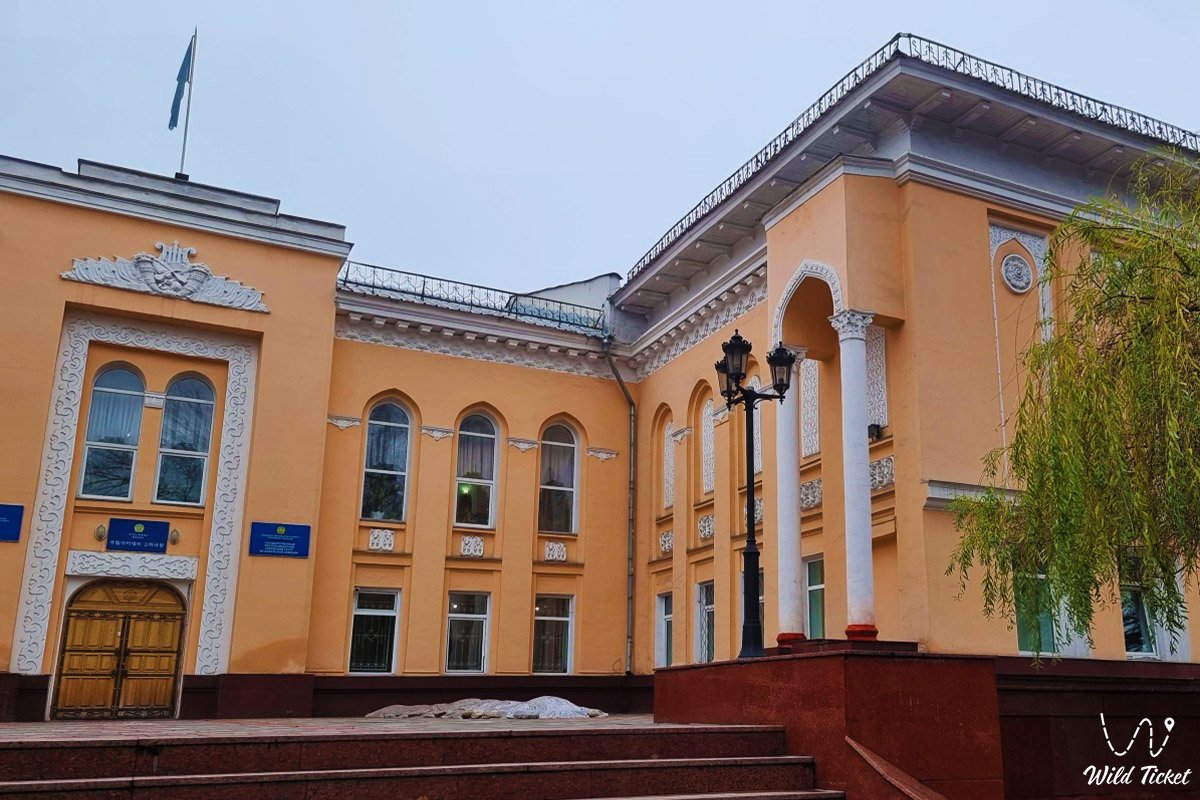
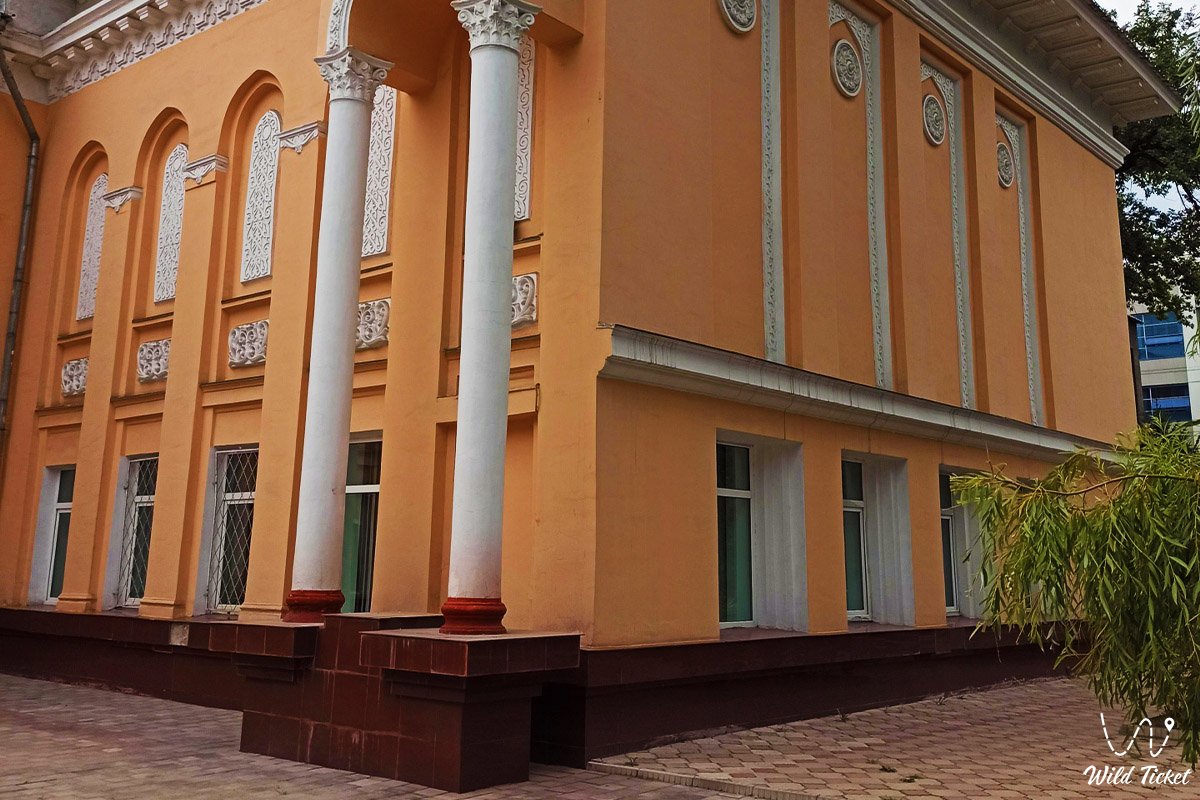
The building of the Korean Theater in Almaty, built in 1968, is a striking example of Soviet modernism with its strict geometric shapes and functional layout designed for the mass audience of that era.
The facade of the building is distinguished by its monumentality and conciseness, and its main architectural dominant is a rhythmic row of tall pylons that create a sense of solemnity and grandeur.
The interior space includes a large auditorium with 700 seats, rehearsal rooms and administrative offices, and the lobby is decorated with decorative elements referring to the Korean cultural tradition.
In the 2010s, the building underwent major repairs and reconstruction, during which the interiors and technical equipment were updated, while the historical appearance of the facade was carefully preserved.
---------------------------------------------
How to get there and visit -
The State Academic Korean Musical Comedy Theater is located in Almaty at 158 Bogenbai Batyr Street, between Masanchi Street and Seifullin Street, Almaly district, Republic of Kazakhstan.
GPS coordinates: 43°15'06"N 76°55'53"E
It is very easy to get to the theater due to its central location. You can get there by private car or taxi, or use public transport. Take buses No. 30, 34, 123 or trolleybus No. 7 to the stop "Seifullina Avenue". From here, you can enjoy a short and pleasant walk to the theater building, which is only 250 meters long.
The theater is open to everyone, both for those who are familiar with Korean culture, and for those who come for the first time, wanting to see the history of koryo–saram in a live performance.
Working hours: Monday-Saturday from 10:00 to 18:00 (Sunday is a day off)
Contacts: +7 727 292 16 63 (reception); +7 727 292 16 73 (Accounting Department)
Official website of the theater
---------------------------------------------
Legend and legend
There is a beautiful story among the artists: they say that the first cast of the theater kept a small bronze bell, which was brought back from the Far East. Every time before the premiere, one of the senior actors called him, and that's how the play began. It was believed that this ringing connects the troupe with the ancestors, helps to preserve the voice of the people and protects the artists in difficult moments.
They say that even today, before the most important productions, you can hear a barely discernible ringing somewhere behind the scenes - as a reminder of the beginning of the journey and reverence for those who built the theater out of nothing.
There is a legend among the theater's employees about the "Blue Mask", an artifact allegedly brought from Hamgyongdo (a province in north Korea) even before the deportation. It is said that this mask was used in ritual dances of shamans and had the ability to "revive" the actor: the one who put it on could speak pure Korean, even if he only knew a few words before. During the resettlement, the mask was miraculously preserved, it was hidden in a chest with children's clothes. Today, it is supposedly kept in the director's safe, and before each premiere performance, the actors bow towards its storage, asking for inspiration.
The Korean Theater in Almaty is not just a cultural institution, but a living symbol of friendship between peoples, the resilience of the human spirit and the incredible power of art. Visiting it is a unique chance to experience the amazing history and rich culture of the Korean people without leaving Kazakhstan.
Interesting sights nearby:
• Akhmet Baitursynov Square;
• Monument to Akhmet Baytiursynov;
• Akhmet Baitursynov House Museum;
• Tselinny Center for Contemporary Culture;
• Museum of the History of the city of Almaty;
• Karagaily Park;
• Kuddus Kuzhamyarov State Republican Academic Uighur Musical Comedy Theater.
Photogallery: