Where to walk and what to see in Astana -
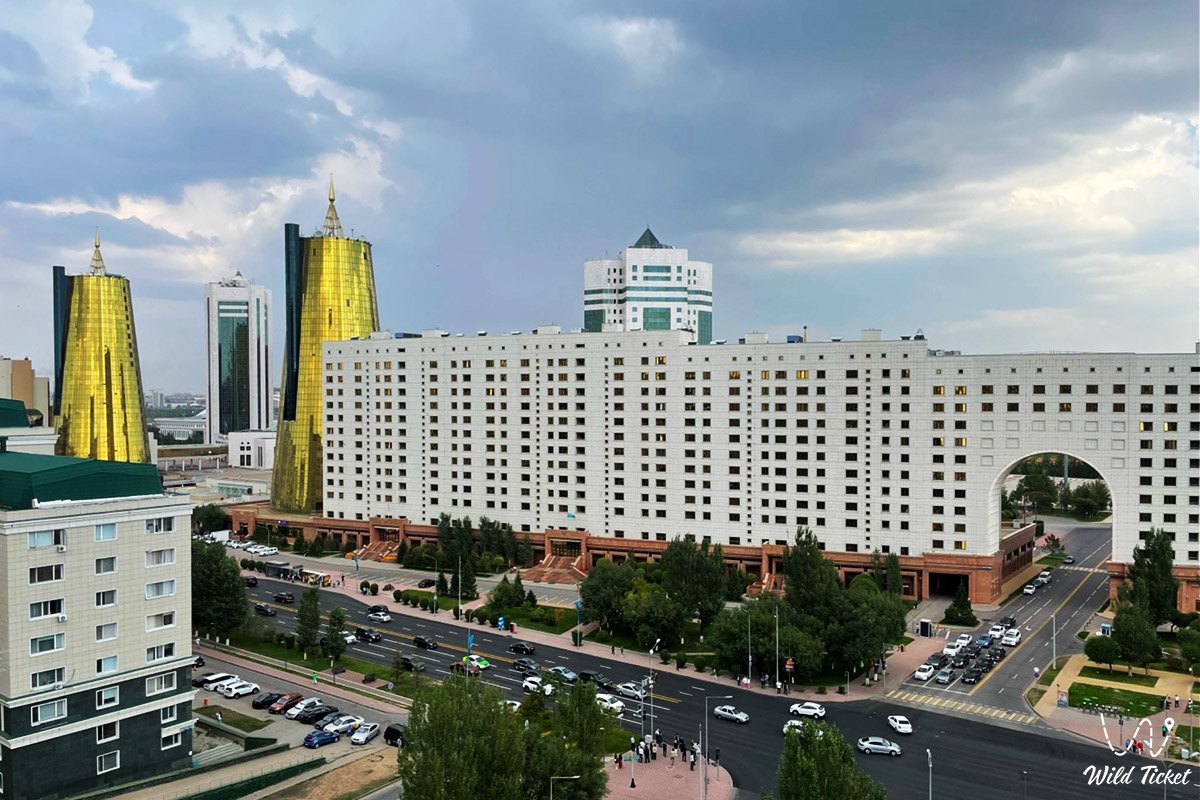
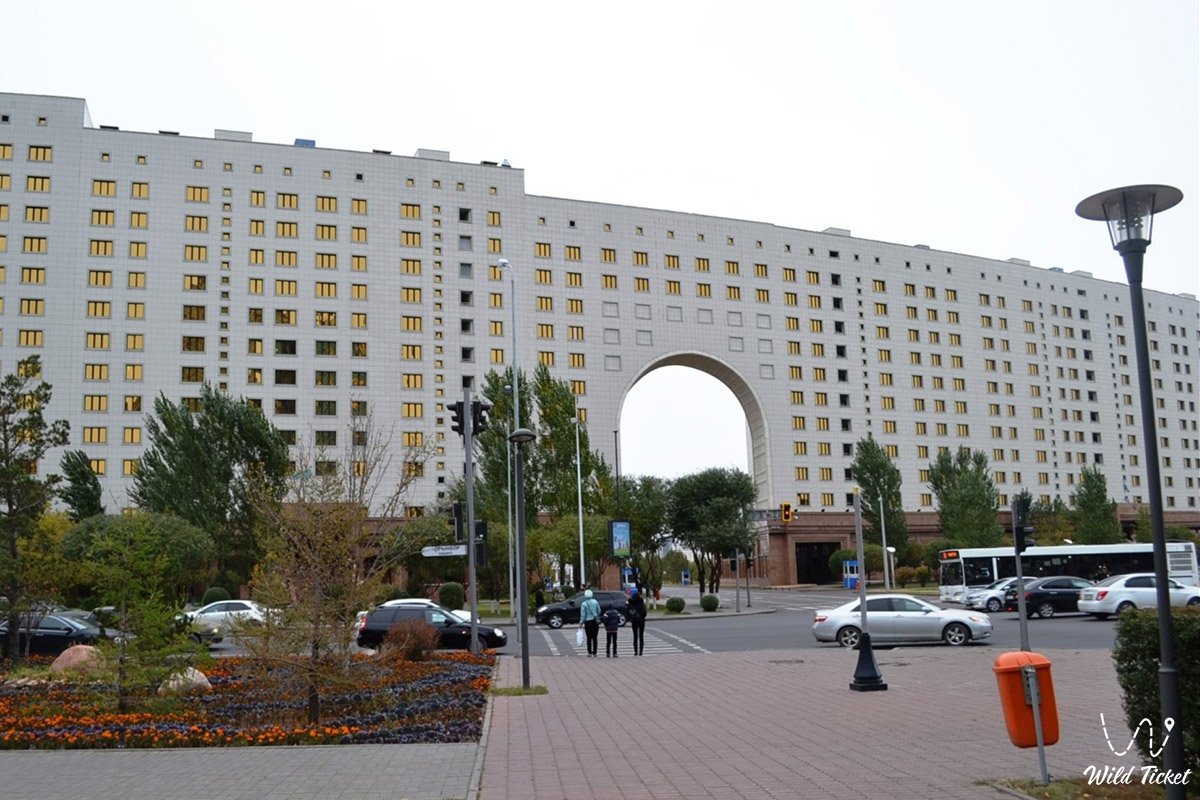
House of Ministries – is a unique architectural complex with a length of one and a half kilometers, which serves as a visual boundary between the residential area and the official center of the left bank. Located mirror-opposite the "Akorda" Presidential Residence, it forms a majestic "gateway" to the city.
The building was designed as a single organism, where ministries are interconnected vertically and horizontally, which ensures maximum efficiency of the state machine in the conditions of a dynamically developing capital. Next to the building is located the Bayterek Monument, from which the Nurzhol pedestrian boulevard begins.
Initially, the complex was conceived as an administrative and residential array, but during the construction process, the architects decided to make it completely governmental. Today it is the epicenter of business life, where the bustle of meetings and the strictness of suits create a unique atmosphere of a "city within a city." Walking in this area, you can visit the Round Square and Lovers Park by walking to them along the pedestrian boulevard.
The building does not just perform office functions; it shapes the urban planning ensemble of the square, acting as a large-scale backdrop for major state ceremonies and the daily life of the political elite of Kazakhstan. On both sides of the building at a short distance are located Zhetysu Park and the Linear Park, which are also interesting for a walk through them.
---------------------------------------------
How to get there and visit -
The House of Ministries is located at: 8 Mangilik El Avenue, left bank of the Ishim River (embankment), Yesil district, Astana city, Republic of Kazakhstan.
GPS coordinates: 51°07'26"N 71°26'21"E; 51°07'45"N 71°26'29"E
The complex is situated in the very heart of the city's administrative center, dividing Nurzhol Boulevard into two parts.
You can reach the House of Ministries by a vast number of buses: No. 10, 12, 15, 18, 19, 21, 28, 30, 32, 35, 40, 46, 50, 52, 54, 70, and others to the eponymous "House of Ministries" stop.
Due to its central location, it is easy to reach on foot from the "Baiterek" monument in just 5–7 minutes. It should be noted that during peak hours (9:00 and 18:00), the largest traffic jams in the city are observed here due to the huge flow of employees.
---------------------------------------------
History
The construction of this large-scale project began in 2004 and was completed in 2007. The "KUAT" corporation acted as the designer, and the concept was adjusted literally "from the page."
The idea to make the building entirely administrative came when some blocks were already built up to the 5th floor, which required quick and complex decisions from architects, including Shokan Mataibekov. The main requirement for the facades was the use of light and optimistic tones that would set the mood for the entire square.
Interestingly, the status of the longest building in Astana was acquired by the complex accidentally. The authors did not aim to set records – such length was dictated by the need to organize the space around the main state objects: the Parliament, the Government, and Ak Orda.
Today, this building is a monument to the era of accelerated construction of the capital, when bold urban planning ideas were embodied in the shortest possible time, forever changing the face of the former steppe.
Information
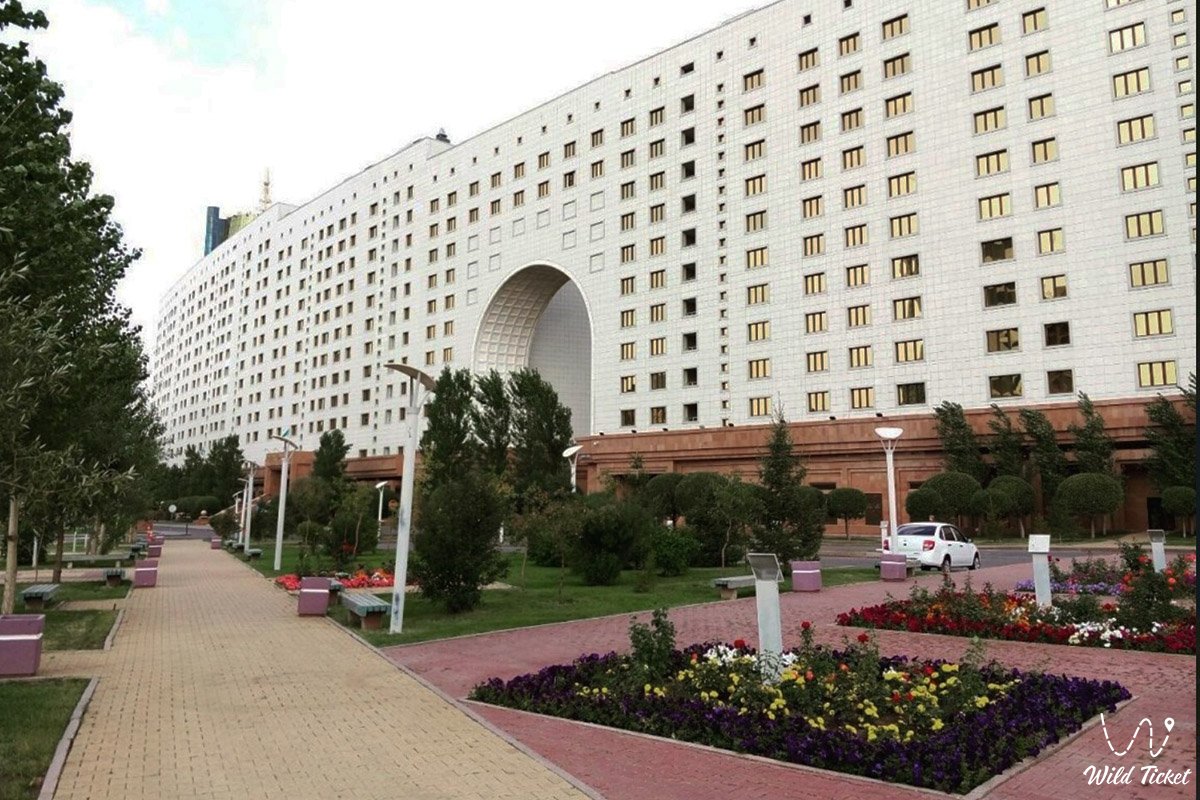
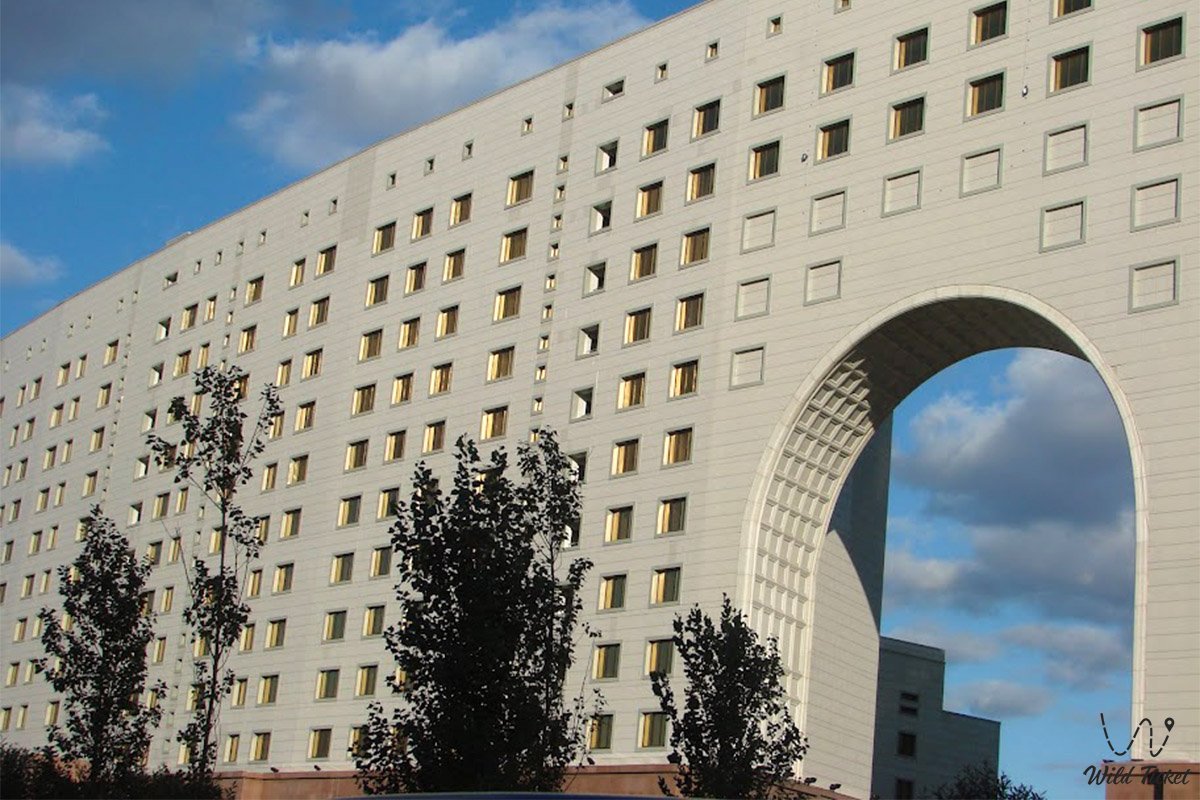
The total area of the object is an impressive 228 thousand square meters. The building has a stepped cascade shape, where the number of floors varies from 8 to 10, creating an effect of dynamic movement. The complex consists of 20 interconnected blocks and is clad in modern porcelain stoneware of light shades.
In addition to working offices, inside there are archives, a museum, a departmental clinic, numerous conference halls, and canteens serving an army of civil servants.
The central element of the composition is the two 120-meter high golden towers, which form a symbolic passage to the presidential residence. According to Shokan Mataibekov's idea, these towers symbolize the "Golden Man" – a great archaeological heritage and symbol of Kazakhstan's independence.
The construction of the building is made of monolithic reinforced concrete, which provides it with exceptional strength and durability in the conditions of harsh capital winds.
Detailed description of the object
From a bird's-eye view, the House of Ministries resembles the silhouette of a soaring eagle or a huge arc embracing the city center. Its facades, executed in a golden-beige palette, reflect sunlight, creating a warm glow even on cloudy days.
The wide passage in the center of the building serves as the main "gates" on the way to Ak Orda, through which thousands of people pass daily, creating a living flow between the business and cultural parts of the left bank.
Inside, the building is highly functional: endless corridors and office spaces are designed to provide convenient logistics between various departments. Despite the absence of ornate decorative halls, the complex impresses with its scale and organization. It is a true "beehive" of executive power, where each block is responsible for its own sphere of the country's life, and the overall architectural line emphasizes the unity and stability of state management.
Architecture
The architecture of the House of Ministries is an example of pragmatic modernism integrated into Kisho Kurokawa's master plan. The main task of the architects was to create a backdrop that would not overshadow but highlight the significance of Ak Orda and Baiterek.
The stepped cascade of floors avoids the monotony of such a long wall, and the golden towers add the vertical accent necessary for the capital's scale. The use of light porcelain stoneware combined with mirror glazing makes the building visually lighter, despite its colossal size and "fortress-like" character.
Legend
In Astana, the House of Ministries is called the "Golden Belt of the Capital." There is a legend that if you pass under its central arch exactly at noon when shadows disappear, you can receive a blessing for the resolution of any bureaucratic issue.
They say that the building in the shape of a soaring eagle was designed so that the "wings" protect the city from evil winds and attract luck to state affairs. Old-timers say that in one of the blocks, a "Time Office" is hidden, where blueprints of the Astana of the future, which no one has seen yet, are kept.
Among employees, there is a belief: whoever can walk all one and a half kilometers of corridors without getting lost is destined for a brilliant political career.
For citizens, this complex is a symbol that power is always in motion, and the "Golden Gates" are always open for new ideas and achievements. It is a place where real statistical figures meet the myths of the young capital, creating the special energy of the country's main administrative bridge.
Interesting sights nearby:
• Kazakhconcert named after Roza Baglanova;
• Nazarbayev Center: Museum – Library and Archive;
• Presidential Park;
• Palace of Peace and Reconciliation;
• Triathlon Park;
• Parliament and Government of the RK;
• Supreme Court of the Republic of Kazakhstan;
• Arkhar Bridge;
• Syganak Bridge.
Additional information:
• Useful information about Astana;
• Where to go and what to see in Astana.
• Akmola region - information and photos.
Photogallery: