The scientific heart of the country, the birth of ideas and discoveries -
The history of Kazakh science, the formation of intelligence and statehood -
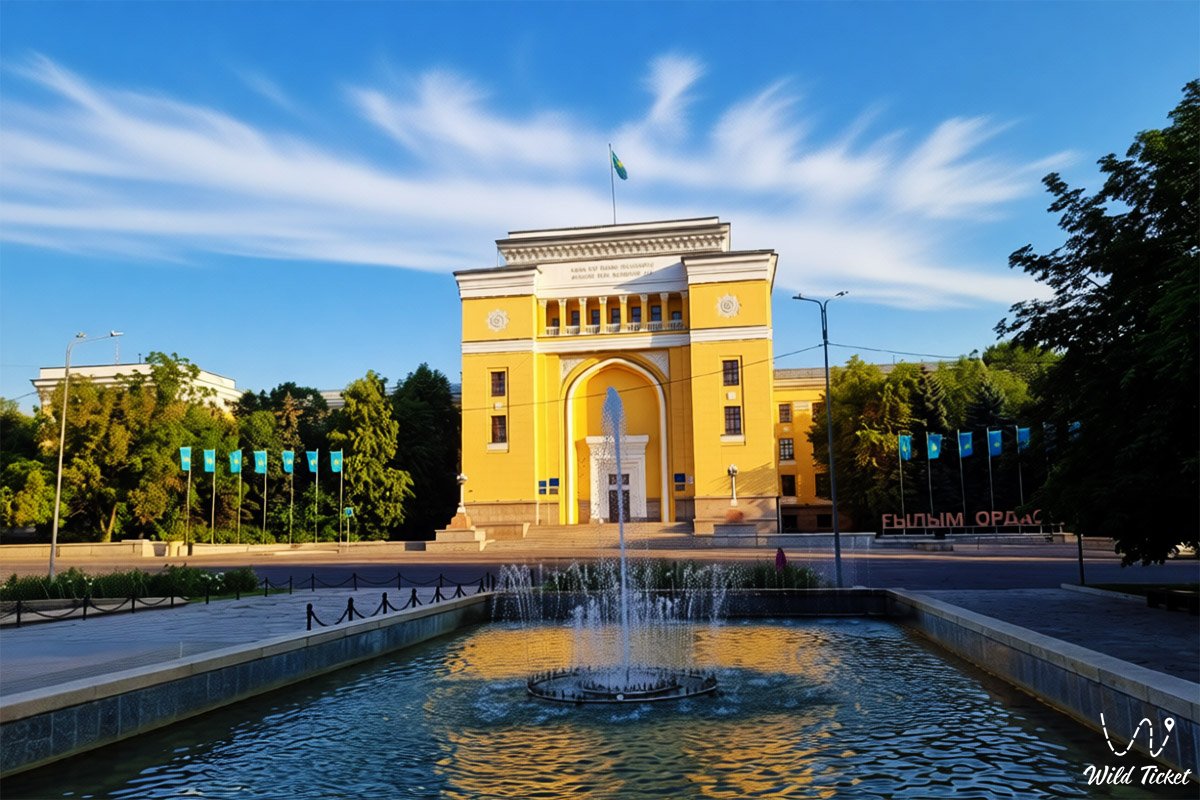
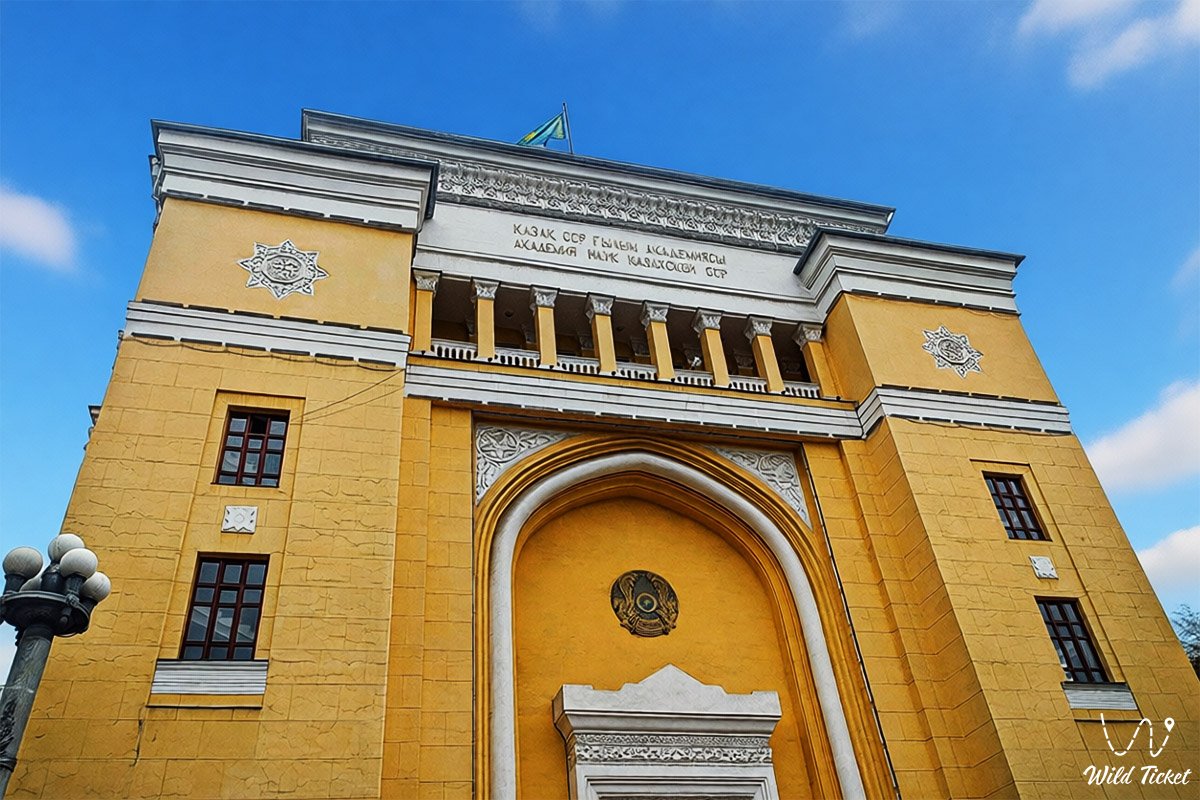
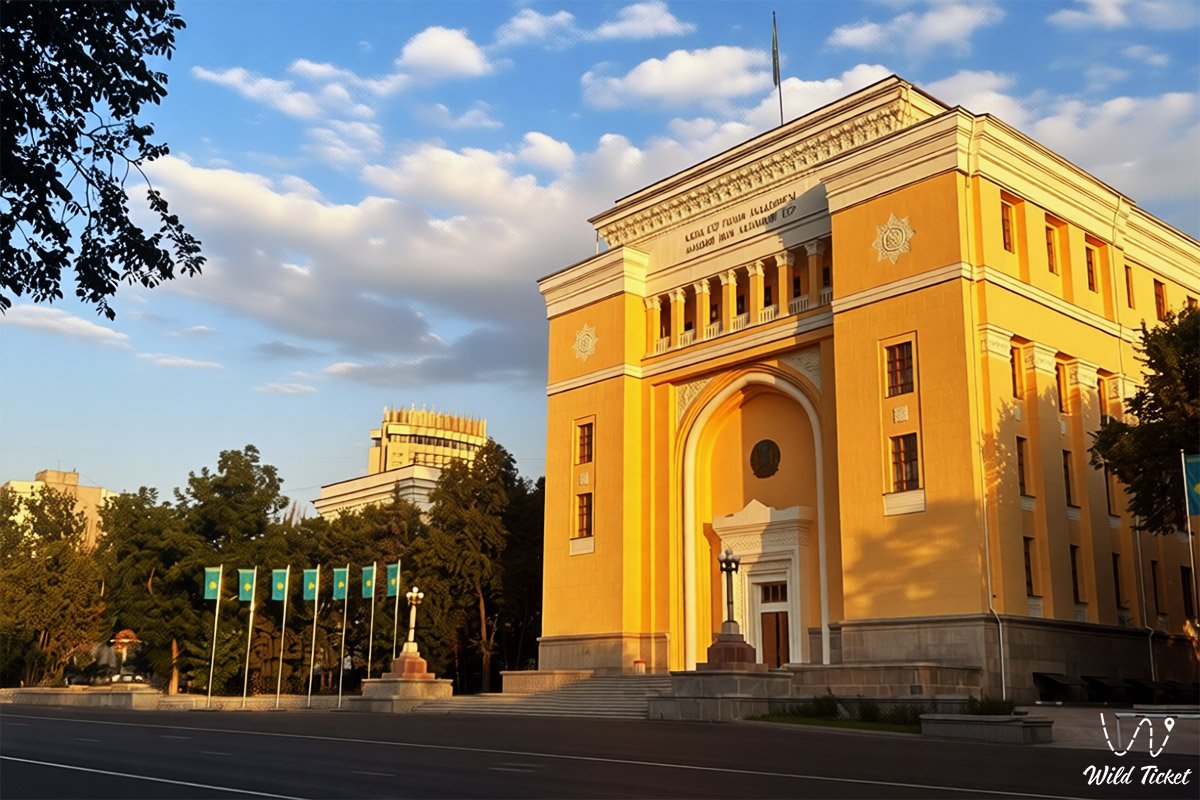
The National Academy of Sciences of the Republic of Kazakhstan (NAS RK) is the country's highest scientific body, located in the very center of Almaty, on Shevchenko Street. This is not just an administrative building, but a symbol of Kazakhstan's intellectual potential, where strategies for the development of science, education and technology are being formed.
This building witnessed the formation of independent Kazakhstan, the maturity of the Soviet scientific school and the development of modern research centers. And today, passing by the mighty facades of the Academy, do you understand: This is not just an architectural object, it is a monument that preserves the memory of the people who created the foundation of our knowledge. The famous Zodiac Signs Fountain (Oriental Horoscope) is located next to the building.
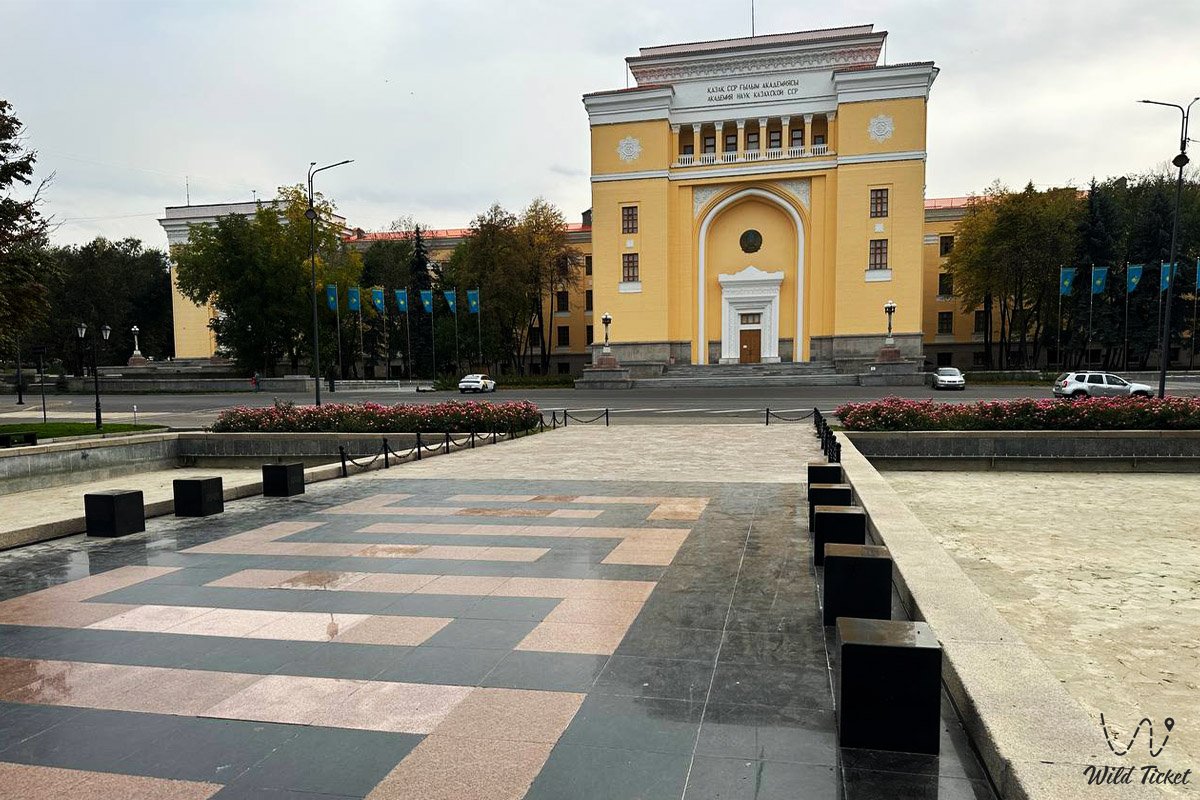
The Academy of Sciences is open to visitors only by prior arrangement (for example, for scientific delegations or organized excursions), but its appearance and architecture attract the attention of tourists. Due to its monumental style, green area and central location – opposite the famous Chokan Valikhanov Square – the academy often becomes part of cultural routes around the city. There is also a monument to Chokan Valikhanov in the park.
History
The history of the Academy is the history of the formation of science in Kazakhstan. Already in the 1920s, the academic center of the People's Commissariat of Education appeared in the republic, and in 1925 the first sanitary and bacteriological institute was opened in Alma Ata. It was these steps that became the foundation for the creation of the Kazakh base of the USSR Academy of Sciences in 1932. It included the zoological and botanical sectors and became the first platform for systematic scientific research in the region. In those years, it was led by outstanding scientists, including Alexander Fersman, Alexander Samoilovich and other researchers who stood at the origins of the study of the Kazakh land.
In 1938, the base was transformed into the Kazakh branch of the USSR Academy of Sciences. Before the Great Patriotic War, more than a hundred researchers worked here, creating the first strong scientific school in the republic. By the early 1940s, Kazakhstan already had twelve universities, research organizations, design institutes, experimental stations, a botsad and a zoo - a powerful infrastructure that made it possible to take the next step.
On June 1, 1946, the Council of Ministers of the Kazakh SSR approved the first composition of the Academy of Sciences of the Kazakh SSR. Among the academicians were such legendary scientists as Mukhtar Auezov, Akhmet Zhubanov, Nikolai Kassin, Kanysh Satpayev, a man who became the first president of the Academy and a symbol of Kazakh scientific thought. It is with his name that the birth of a full-fledged republican fundamental science is associated.
In the following decades, the Academy went through difficult and important stages. In the 1990s, science faced a reduction in funding, but the Academy retained its intellectual foundation. In 1996, it was merged with a number of scientific structures into the Ministry of Science, then separated again, going through a stage of institutional transformation.
In 2022, the Academy was officially returned to state status. At the anniversary session, President Kassym-Jomart Tokayev emphasized its key role and the need to strengthen the country's scientific authority. As a result, a state scientific organization was established, the National Academy of Sciences of the Republic of Kazakhstan under the President of the Republic of Kazakhstan. In 2023, the final registration of its legal status was completed, which consolidated the Academy as the central scientific institute of the republic.
Architecture
The Academy of Sciences building itself is a monument of history and culture, protected by the state since 1982. His project was created by the outstanding architect Alexey Shchusev, the author of the Lenin Mausoleum. In 1947, Kanysh Satpayev, Mukhtar Auezov, Nurtaz Undasynov and other representatives of the Kazakh intelligentsia took part in laying the foundation.
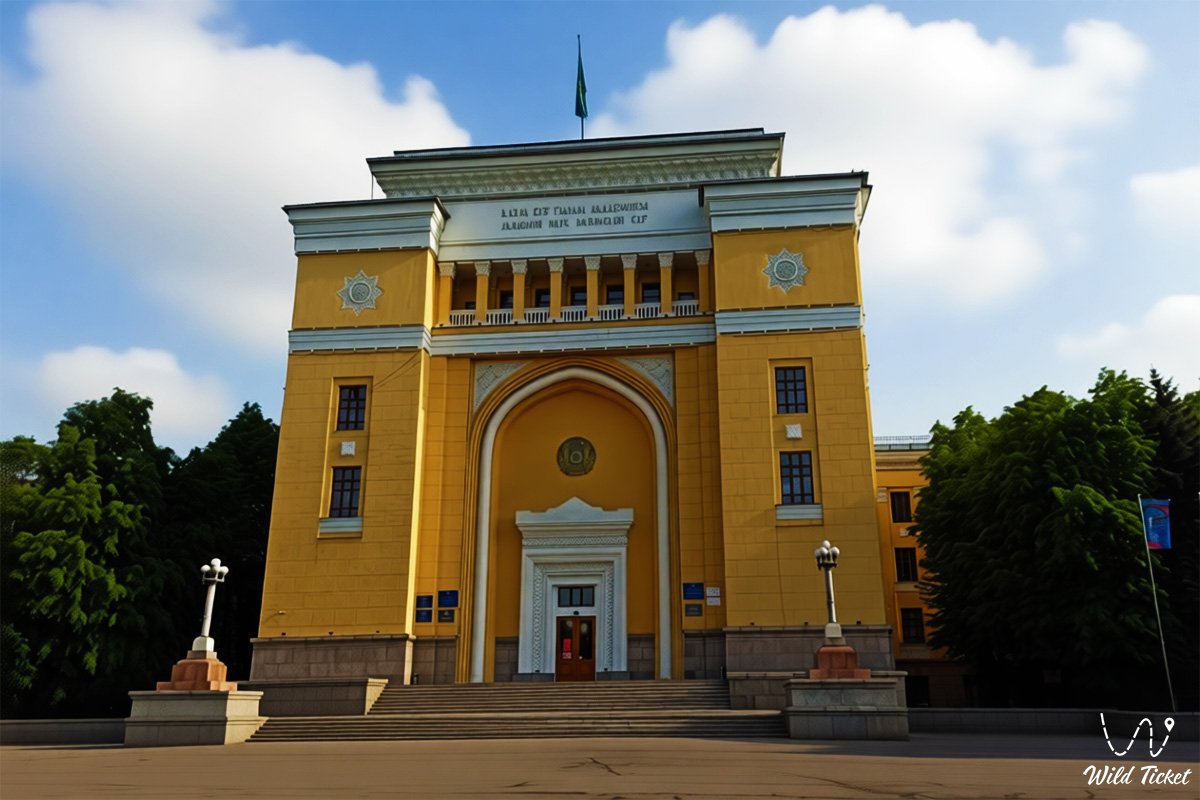
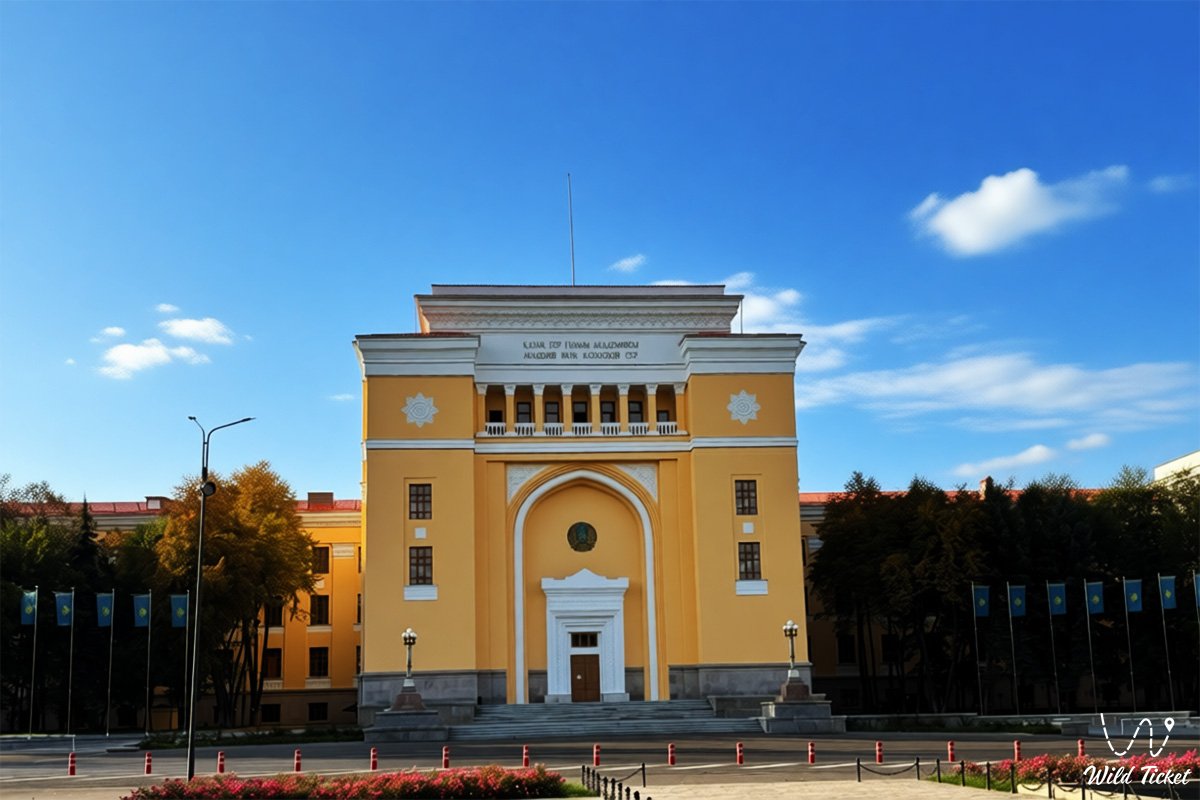
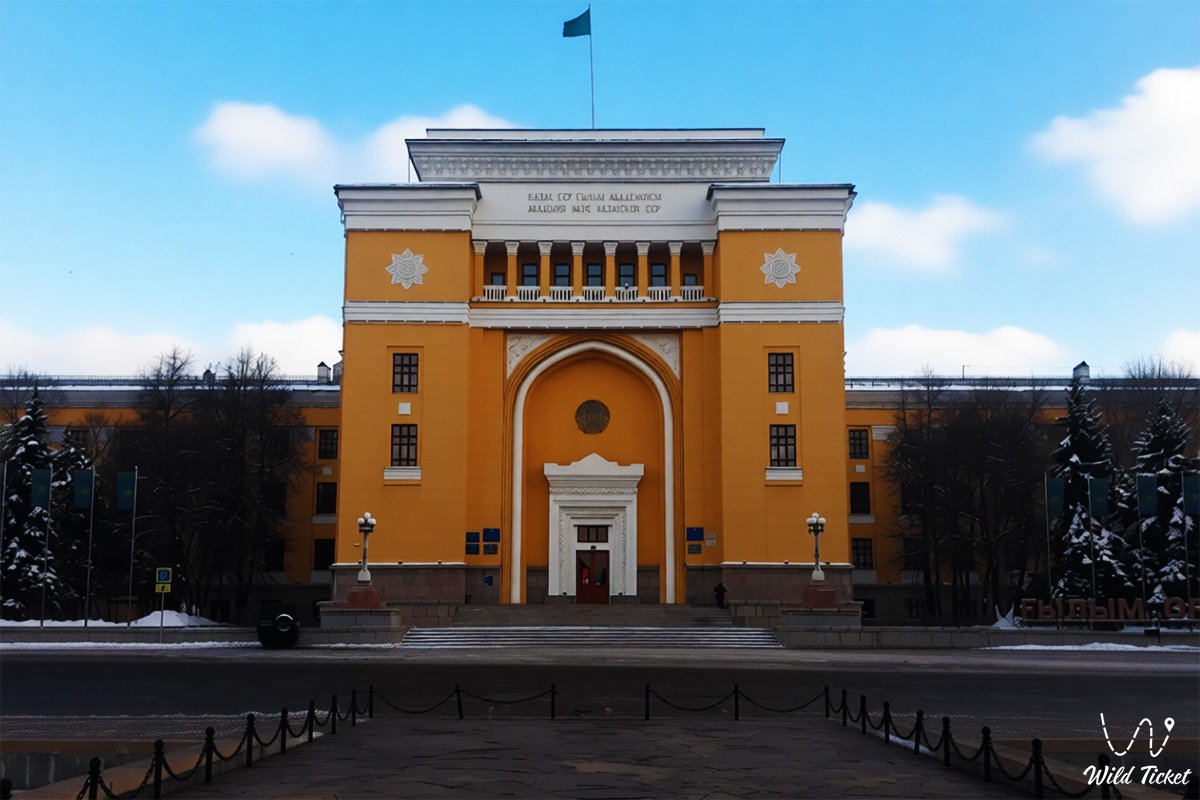
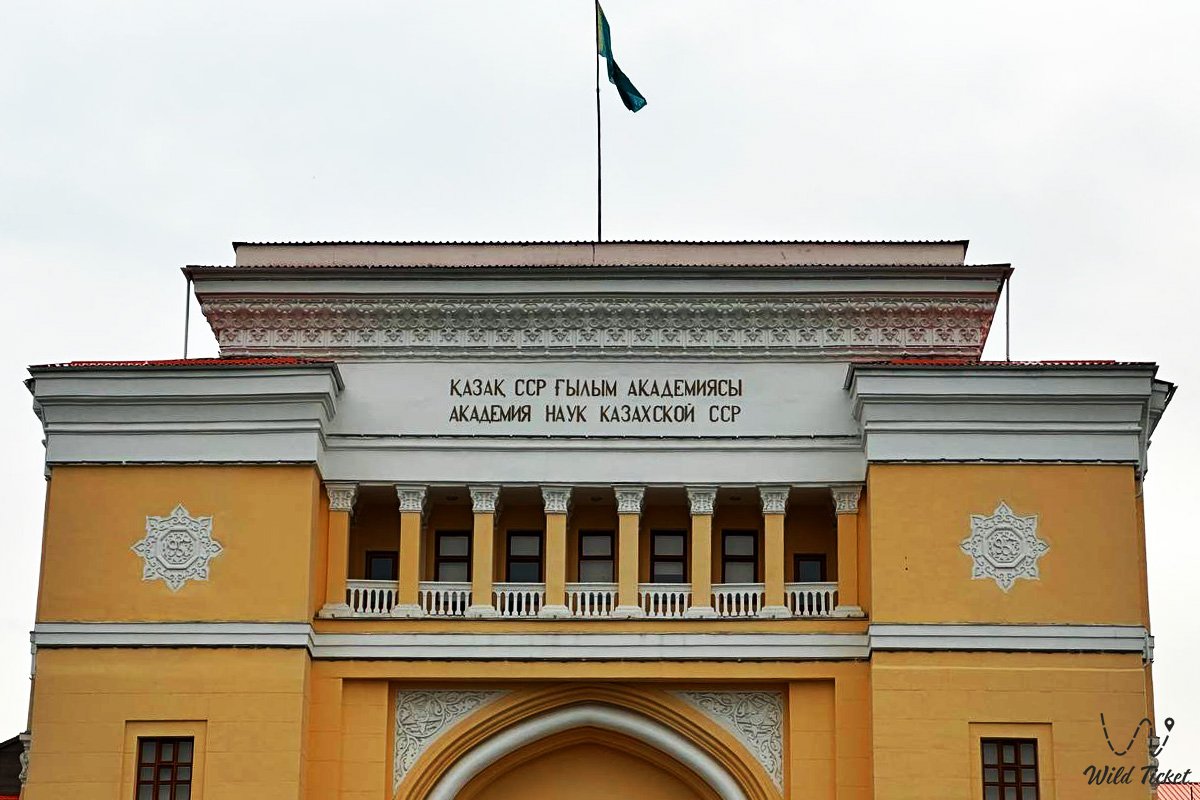
The architecture of the building is a harmony of classical motifs and national Kazakh architecture. The three-storey "W"-shaped structure consists of six pavilions separated by antiseismic seams. The facades are made of reinforced concrete frames with brick filling, the basement is lined with gray granite. The complex occupies an entire block between Pushkin, Shevchenko, Kunaev and Kurmangazy streets.
The main entrance is decorated in the tradition of the eastern portal of Peshtak with rich decor. The interiors are decorated with marble, wood, plaster ornaments, decorative panels. The conference hall on the second-floor sparkles with Florentine mosaics made of semiprecious stones of Kazakhstan. The winter garden is filled with monumental art, stained glass windows and frescoes.
In 1979, a park was created near the building and the famous Oriental Calendar fountain was installed. And in 2010, the scientific center "Gylym Ordasy" was located here with museums of nature, archeology, rare books, history of science and the Central Scientific Library.
---------------------------------------------
How to get there and visit -
The National Academy of Sciences of the Republic of Kazakhstan is located in Almaty at 125 Pushkin Street; 29 Kurmangazy Street; 144 Kunaev Street, Medeu district, Republic of Kazakhstan.
GPS coordinates: 43°14'45"N 76°57'11"E
It is very convenient to get to the building of the Academy of Sciences of the Republic of Kazakhstan in Almaty by public transport. A large number of bus routes follow Dostyk Avenue and Shevchenko Street: these are Nos. 5, 5A, 5B, 29, 29P, 48, 65, 66, 120, 121 and 141. Alternative options are to take bus No. 12 to the Kazakhstan Hotel or take route No. 112 along Kunaev Street. Trolleybuses No. 11, 19 and 25 regularly run along Shevchenko Street itself. For those who prefer the metro, the closest station is Abaya, which is 800 meters from the Academy, and a pleasant walk from the metro will take no more than 10-12 minutes.
Working hours: Monday-Friday from 09.00 to 18.00 (Saturday-Sunday weekend)
Contacts: +7 727 272 55 61; +7 727 261 00 25
Official website of the Academy of Sciences
---------------------------------------------
Atmosphere and features
Today, the Academy unites the country's leading scientists and strives to become an autonomous, authoritative center for scientific development. Its mission is to conduct fundamental research that solves strategic tasks of the economy and society, form scientific priorities of the state and ensure decision–making based on objective, evidence-based data.
The Academy's vision is based on the idea of open, international, deep scientific integration. It creates its own databases, develops analytical tools, and cooperates with universities, research centers, and associations of scientists around the world. Its activities are based on the principles of fairness, autonomy, professionalism, objectivity and efficiency, which emphasizes the scientific nature of all decisions made.
There is an atmosphere of concentrated silence inside the Academy, which can be felt in its long corridors, library, and researchers' offices. This is a place where thought has been stored for decades, where scientific debate is born and where each new generation feels a connection with those who stood at the origins of Kazakh science. From the outside, the Academy is surrounded by a peaceful cultural and intellectual area, formed around scientific institutes, museums and universities.
Legend and legend
There is a quiet legend associated with the Academy, which the staff likes to tell. It is said that in the early morning, when the mountains turn pink, a light haze can be seen above the roof of the building, as if a misty breath. Old-timers joke that these are the spirits of great academics gathering in an invisible council and discussing the fate of future research. If a student sees this morning flicker, it means that the path of a true scientist awaits him, a long, deep and inspiring one.
Interesting sights nearby:
• Scientific and Museum Center "Gylym Ordasy" at the Academy of Sciences of the Republic of Kazakhstan;
• Kazakh State Academic Opera and Ballet Theater named after Abai;
• Monument to Viktor Tsoi;
• Palace of the Republic;
• Monument to Abai Kunanbayev;
• Hotel "Kazakhstan";
• Monument to Alexander Sergeevich Pushkin.
Photogallery: