Sacred 19th-century memorial complex on the site of the legendary Battle of Karagan-Bosaga –
Baluaniyaz Musrepuly Mausoleum represents a revered historical, cultural, and sacred monument in the Karakiya district of the Mangistau Region, situated deep within the desert Ustyurt plateau approximately 100 kilometers east of Senek settlement.
This majestic domed mausoleum was erected on the Karagan-Bosaga elevation (known in olden times as Kalmakuigen and Karaoba) – directly on the site of the bloody 1856 battle where folk hero Baluaniyaz Batyr and his comrades-in-arms defended the peaceful auls of Mangyshlak against a devastating raid at the cost of their own lives.
From a geological perspective, the boundless steppe expanses and escarpments of the Ustyurt plateau surrounding the memorial complex represent the ancient seabed of the vanished Tethys Ocean and the Sarmatian Sea, which covered Western Kazakhstan millions of years ago. Shell-rock limestone formed from the deposits of this prehistoric marine basin served for centuries as the principal building material for erecting the sacred structures and tombstones of Mangystau.
Today, the Baluaniyaz Musrepuly Mausoleum is included in the nationwide register of the "Sacred Geography of Kazakhstan" project and serves as an important site of pilgrimage, spiritual strength, and historical memory.
Within the geographic and sacred space of southeastern Mangystau, the mausoleum stands in a remote, nearly untouched desert zone of the Ustyurt plateau surrounded by iconic natural and spiritual landmarks:
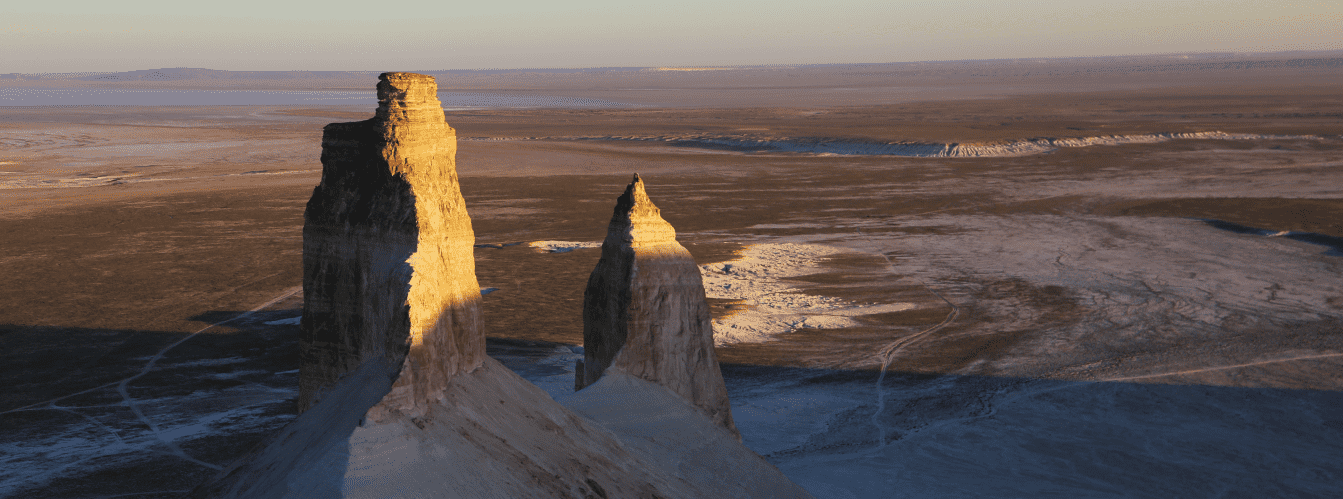
– to the northwest along the western sheer chink of the Ustyurt plateau lie the region's foremost sanctuary – the underground Beket-Ata mosque (Oglandy) and the Oglandy-Ata necropolis-tract, as well as the fantastical chalk residual buttes of the Bozzhyra tract and Mount Bokty;
– to the southwest stretch the expansive Kenderli salt marsh (sor), the scenic mountains of the Karamaya ridge, the territory of the Ustyurt Nature Reserve, the Tuyesu sands, the remote village of Akkuduk, and the grandiose basin of the Karynzharyk depression with the Three Brothers mountains;
– to the northwest along the road toward Zhanaozen stands another ancient sanctuary of the region – the underground Shopan-Ata mosque and the Shopan-Ata necropolis.
--------------------------------------------
How to get there and visit –
Baluaniyaz Musrepuly Mausoleum is located in the eastern part of the Karakiya district of the Mangistau Region within the territory of the Ustyurt plateau, 100 km east of Senek settlement. The distance from the regional administrative center of the city of Aktau is around 280–300 km via motor roads and steppe tracks, and from the city of Zhanaozen – about 145–155 km.
GPS geographic coordinates of Baluaniyaz Musrepuly Mausoleum:
43°23'34"N 54°33'41"E
43.392861, 54.561314
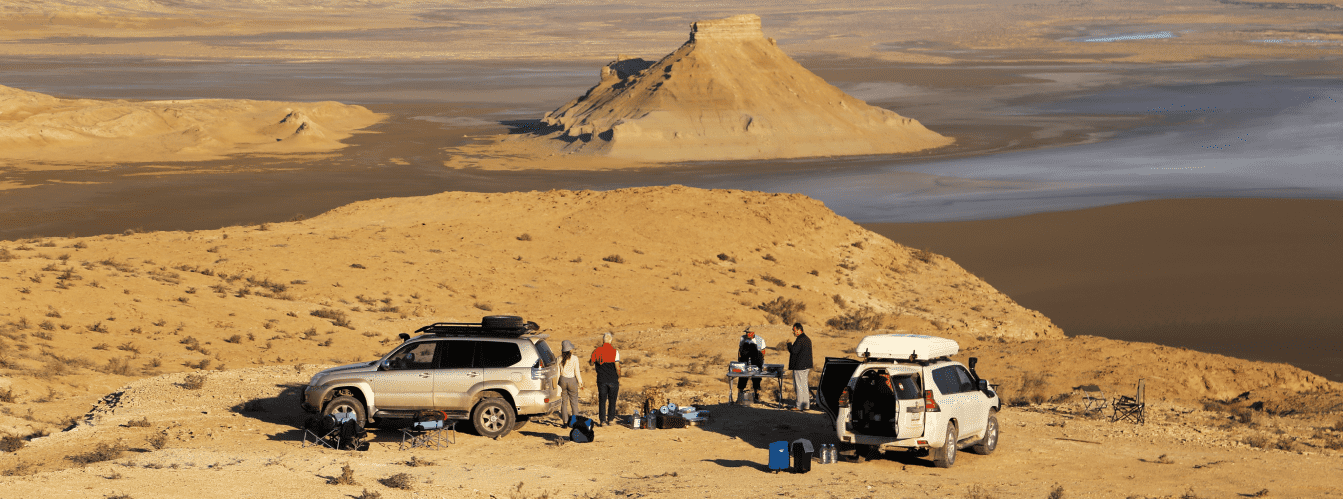
Route from Aktau and Zhanaozen: the drive from the city of Aktau takes about 4.5–5.5 hours. The first leg of the route runs southeast along the paved highway through Zhetibay settlement and the city of Zhanaozen to Senek settlement. Beyond Senek settlement, the paved road ends, and the onward journey stretching about 100 km runs east deep into the Ustyurt plateau along worn steppe dirt tracks and graded roads past the spurs of the Karamaya ridge and the Kenderli salt marsh toward the Karagan-Bosaga tract. Public transport does not operate here, so the site can only be reached by private or rented off-road vehicle or as part of a pilgrimage expedition.
Vehicle requirements: a trip to the Baluaniyaz Mausoleum requires a reliable four-wheel-drive 4x4 off-road vehicle with high ground clearance, a serviceable spare tire, and an extended fuel reserve. Beyond Senek settlement, the route crosses remote semi-desert terrain with rocky stretches, salt-marsh lowlands, and sand drifts, where the track becomes difficult to pass after rains or spring snowmelt.
Safety rules and pilgrimage etiquette:
Baluaniyaz Musrepuly Mausoleum is a revered sanctuary located in a remote desert zone near the borders of the Ustyurt Nature Reserve:
– when visiting the mausoleum and the mass graves of the batyrs, maintain silence, respect pilgrim traditions, and dress modestly (covered shoulders and knees, and a headscarf for women);
– climbing onto the walls and dome of the mausoleum, damaging tombstones, and leaving household litter on the grounds are prohibited;
– when driving near the Kenderli salt marsh (sor), do not leave the packed track onto the damp salt crust to avoid getting the vehicle stuck;
– mobile reception and internet are completely absent across this stretch of the Ustyurt plateau, so download offline maps and GPS tracks in advance, and carry a satellite tracker or two-way radio when traveling in a group;
– set out with an ample supply of drinking water (at least 5 liters per person per day) and jerrycans of extra fuel, as the nearest gas stations are located only in the city of Zhanaozen.
Infrastructure: directly beside the Baluaniyaz Mausoleum, any tourist infrastructure, shops, cafes, or hotels are completely absent – it is a solitary memorial amidst the open steppe. All basic services are available in the city of Zhanaozen (about 150 km west) or in Senek settlement (100 km away).
Seasonality: visiting the monument is possible during the snow-free and dry periods of the year. The most comfortable seasons for pilgrimage and steppe expeditions are spring (April – May) and autumn (September – October). In summer, daytime heat on the Ustyurt plateau reaches +42...+46 °C, while in winter severe frosts down to -30 °C and snowdrifts occur.
--------------------------------------------
History
The name of Baluaniyaz Musrepuly (1818–1856) holds a special place in the heroic chronicle of Mangystau and all of Western Kazakhstan. Baluaniyaz hailed from the Aday tribe (Kelimberdy-Shybyntai subclan) and won renown as an outstanding military commander, warrior-hero, and defender of his native land, honored with the ancestral title "Balykshy."
In the mid-19th century, the population of Mangyshlak found itself caught between two aggressive forces – the expansion of the Russian Empire and constant plundering raids from the Khanate of Khiva. The culmination of this confrontation was the famous Battle of Karagan-Bosaga in 1856. When a large invading force swept into peaceful Kazakh auls, pillaging settlements, driving off livestock, and taking women and children captive, the 38-year-old batyr Baluaniyaz Musrepuly raised a small detachment of 60 courageous warriors (dzhigits) and set out in pursuit.
By the Karagan-Bosaga elevation, the handful of Kazakh batyrs engaged in an unequal battle against an adversary outnumbering them three to one. Displaying extraordinary courage and martial skill, Baluaniyaz's detachment routed the enemy, put them to flight, and saved roughly 10,000 peaceful residents and herds of livestock from captivity and death. Yet victory came at a heavy price: in that fierce battle fell Baluaniyaz Batyr himself, his younger brother Korganbek, as well as his loyal friends and comrades-in-arms Mailybay, Oraz, and other warriors.
The heroic feat of the batyrs was immortalized in folk poetry. Campaign chronicler and akyn Kalniyaz Zhyrau Shopykuly composed the celebrated historical epic "Baluaniyaz Batyr," extolling not only the commander himself, but also his companions – the Sufi warrior Turmambet, the wrestler Balta, and the standard-bearer Asar. Later, Omirzak Kalayuly's tale of the 60 batyrs was carefully recorded by Sabyr-Zhyrau.
The fallen heroes were buried directly on the battlefield in the Karagan-Bosaga tract, and the elevation itself has borne the name of Baluaniyaz ever since. In 1992, grateful descendants led by Sarishan Seinkanuly and Sirpi Mamayuly erected a majestic domed mausoleum over the grave of the folk defender, which entered the list of 100 nationwide sanctuaries of the "Sacred Geography of Kazakhstan" project.
Information
Baluaniyaz Musrepuly Mausoleum is a sacred monument of history and culture located in the Karakiya district of the Mangistau Region of the Republic of Kazakhstan.
Main historical and administrative parameters:
– status: monument of history and culture, site of the nationwide "Sacred Geography of Kazakhstan" project;
– hero's lifespan and date of battle: Baluaniyaz Musrepuly (1818–1856), Battle of Karagan-Bosaga (1856);
– year the modern mausoleum was erected: 1992;
– geographic reference: Karagan-Bosaga elevation (historical names – Kalmakuigen, Karaoba) on the Ustyurt plateau, 100 km east of Senek village in the Karakiya district, near the Ustyurt Nature Reserve, the Kenderli salt marsh, and the Karamaya ridge.
Geology and landscape:
– the memorial complex stands on a gentle rise of the endorheic plain of the Ustyurt plateau, composed of sedimentary carbonate rocks (shell-rock limestones and marls) formed on the floor of the ancient Tethys Ocean and the Sarmatian Sea;
– pale sawn shell-rock limestone from Mangystau quarries served as the primary facing material during the construction of the domed mausoleum in 1992.
Detailed site description
The memorial ensemble on the Karagan-Bosaga elevation comprises the following key elements:
• Domed Mausoleum of Baluaniyaz Musrepuly (1992) – a monumental light-colored structure built from local shell rock and crowned with a tall helmet-shaped dome, clearly visible from afar against the flat Ustyurt steppe.
• Mass graves of the 60 batyrs – the burial sites of the hero's younger brother Korganbek, his friends Mailybay and Oraz, and other warriors who fell in the 1856 battle and rest beside their commander.
• Memorial grave of the batyr's faithful horse – a grave unique in steppe memorial architecture located beside the hero's tomb, where, according to legend, the skull of Baluaniyaz's warhorse was buried with full honors.
• Karagan-Bosaga steppe necropolis – ancient tombstones and commemorative steles surrounding the mausoleum, recalling the heroic past of Mangyshlak.
Legends
The feat of Baluaniyaz Batyr gave rise to one of the most touching and famous legends of Mangystau – the story of the inseparable loyalty of a warhorse to its master.
The Tale of Baluaniyaz Batyr's Faithful Steed:
Elders and storytellers pass down from generation to generation the story of why the great Beket-Ata himself and folk zhyrau placed loyalty on par with martial valor. Following Baluaniyaz's death at the Battle of Karagan-Bosaga, his beloved warhorse was taken as a trophy by enemies and led far south into the lands of Khiva. For eleven full months, the steed was kept locked inside a dark barn, never let out into the free steppe wind. When, nearly a year later, the horse managed to break free, it crossed hundreds of versts of waterless desert without losing its way and galloped back to its native Mangyshlak. On those very days, the inhabitants of the auls were preparing to hold the commemorative feast (as) marking the first anniversary of Baluaniyaz's death. The sacred steed unerringly found its master's grave in the steppe, bowed its head over the mound, and breathed its last. Moved by such devotion, the people buried the faithful horse with honors befitting a warrior: with the words "Inseparable in life – remain inseparable in death," the elders buried the steed's skull beside the batyr's grave.
--------------------------------------------
Conclusion
Baluaniyaz Musrepuly Mausoleum is a majestic symbol of courage, martial valor, and selfless love for one's native land in the very heart of the Ustyurt plateau. A trip to this secluded monument deep within the Karakiya district, combined with exploring the Karamaya ridge, the Kenderli salt marsh, and the borders of the Ustyurt Nature Reserve, makes a profound and memorable itinerary for admirers of history, Kazakh heroic epics, and the austere beauty of Mangystau's untouched deserts.
Nearby attractions:
• Ustyurt Plateau;
• Ustyurt State Nature Reserve;
• Kenderli Salt Marsh (Sor);
• Karamaya Mountains (Ridge);
• Senek Settlement;
• Bozzhyra Tract;
• Mount Bokty;
• Karynzharyk Depression;
• Akkuduk Village;
• City of Zhanaozen;
• Karagiye Depression;
• City of Aktau;
• Underground Beket-Ata Mosque;
• Necropolis in the Oglandy Tract.
Photogallery: