Monumental memorial ensemble of the 13th–20th centuries with helmet-shaped domes and tombs of warriors –
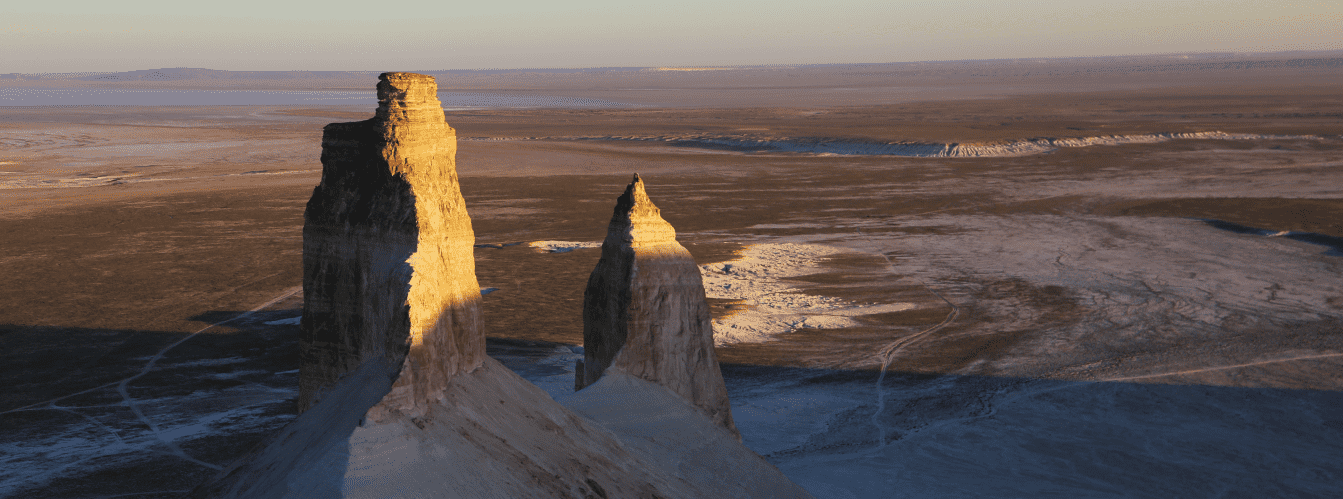
Sisem-Ata necropolis is an outstanding historical, architectural, memorial, and sacred complex dating from the 13th to early 20th centuries, recognized as the primary national "pantheon of batyrs" of the Junior Zhuz. The monument is situated in the Mangystau district of western Kazakhstan, occupying a semi-desert area along the edge of the western chink of the Ustyurt plateau, 34 km north of the railway station and settlement of Saiotes.
In the folk memory of the Kazakhs, this majestic ensemble is revered as the sacred heart of military valor, ancestral unity, and the centuries-long struggle of steppe nomads for independence.
The necropolis owes its sacred status to the figure of the holy Sufi Sisem-Ata – an Islamic preacher and spiritual leader of the community who, according to tradition, granted a sacred blessing (bata) to the Kazakh Aday clan to settle the expanses of Mangyshlak and Ustyurt. Following his death, a widespread tradition of interring prominent figures around the holy tomb emerged.
Laid to rest here are legendary commanders, biys, and batyrs who defended the borders of the Kazakh steppes from raids by the Khiva khans: Suyunkara Urgeshbaiuly, Tolep Anetuly, Konai Kenzheuly, Zhetimek Zhanuzak-batyr, Labak-batyr, Shotan-batyr, as well as prominent statesmen Kozhanazar-bai, Eskeldi Sanazar-biy, and many others.
Measuring 430 × 250 meters, the funerary complex comprises over 2,000 monuments from various periods (with more than 1,300 objects placed under strict state scientific documentation). The spatial structure of the necropolis clearly reflects the succession of nomadic epochs: its core emerged in the Oghuz-Kipchak period (13th–18th centuries), when Turkmen clans left smaller stone-carving forms featuring stylized tamgas of the Chowdur, Afshar, Jebni, Bayandur, and Yomut clans. Nearby lie the famous Kaidak inlet and the Dead Kultuk salt marsh bay.
From the second half of the 18th century, the necropolis became the primary ancestral pantheon of the Kazakh clans of the Aday tribe, covering more than two-thirds of the ensemble's territory. Monumental domed mausoleums, richly decorated saganatams, vertical stelae-kulpytases, and three-dimensional koytases were erected here by renowned folk architects Turlymurat Satybaldyuly, Zhylkybai Doraluuly, and masters of the Sakhi dynasty. Roads lead to the necropolis from the Bozzhyra tract or from the Caspian Sea via Mount Sherkala.
A distinctive architectural feature of the necropolis is the striking abundance of headstones and mausoleums crowned with helmet-shaped domes and stone sculptures representing 14th-century combat helmets, highlighting the martial valor of the interred warriors.
On the western hill before the entrance to the complex lies the Az-Aulie sanctuary – the tomb of Saint Sisem-Ata's mother, where pilgrimage visits traditionally begin with acts of veneration.
Since 1982, the Sisem-Ata necropolis has been protected by the state as a monument of national significance, with an extensive protected zone of 58 hectares in Mangystau.
--------------------------------------------
How to get there and visit –
Sisem-Ata necropolis is situated in the northwestern part of the Ustyurt plateau within the Mangystau district of the Mangistau Region. The distance from the regional administrative center of the city of Aktau is around 315–320 km (via motor roads), about 180 km from the settlement of Shetpe, 34 km due north along steppe graded tracks from the railway station and village of Saiotes (Sai-Utes), and about 45 km from the Man-Ata mausoleum (Manat pass).
GPS geographic coordinates of Sisem-Ata necropolis:
44°37'16"N 53°34'59"E
44.620933, 53.580583
Route from Aktau: departure leads northeast along the paved national highway A-33 through the settlements of Zhetybai and Shetpe to Saiotes station (approximately 283 km of paved road, taking around 3–3.5 hours). Near the village of Saiotes, leave the asphalt and turn north into the open steppe. The final 34-kilometer stretch runs along unpaved dirt ruts along the western chink of the Ustyurt plateau. Driving time along the steppe section takes about 50–60 minutes.
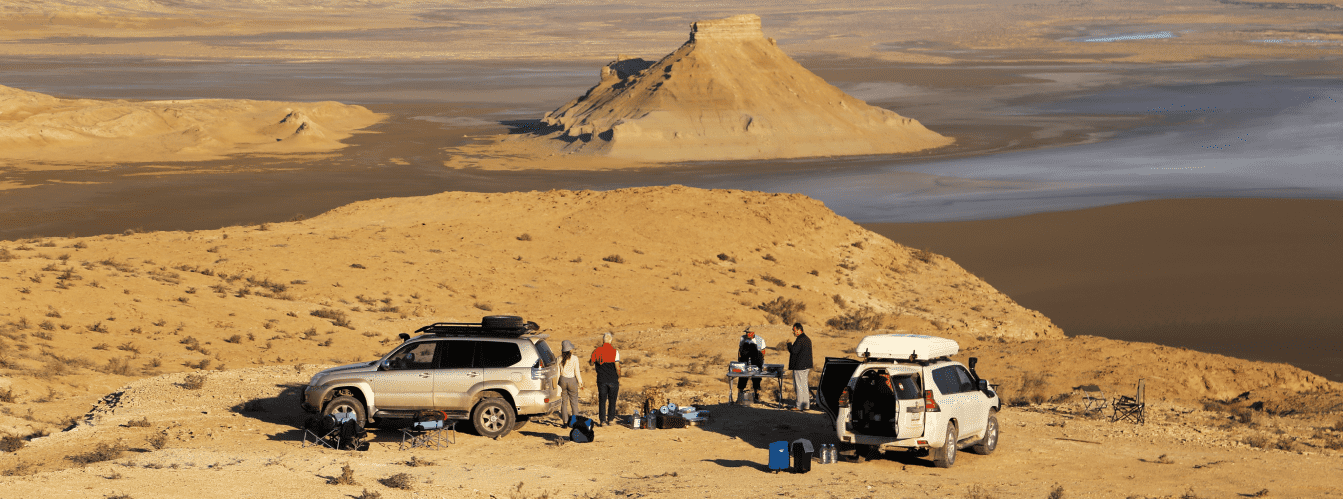
Vehicle requirements: after leaving the highway at Saiotes, the road consists of a typical Ustyurt steppe graded track with sections of crushed rock, clay ruts, and washboard surfaces. A body-on-frame four-wheel-drive 4x4 off-road vehicle or a crossover with high ground clearance and durable tires (AT/MT) is strongly recommended for this route. In dry weather, standard passenger cars can manage the drive with careful handling; however, during autumn rains or spring thaws, the clay across the plateau softens, making transit impossible for single-axle vehicles.
Ritual order and pilgrimage etiquette:
Visiting the Sisem-Ata necropolis is governed by ancient traditions of the steppe ziyarat:
– spiritual custom requires pilgrims to first visit the Az-Aulie sanctuary (the tomb of Sisem-Ata's mother on the western hill), offer a prayer, and seek a blessing before entering the main necropolis;
– if traveling via the Man-Ata area, pilgrims stop at the Man-Ata mausoleum;
– attire must be modest and conservative: women wear long skirts or dresses and cover their heads with a scarf; men are strictly prohibited from entering in shorts and sleeveless tops;
– stepping on grave slabs, walking across burials, and climbing onto the domes of mausoleums are strictly prohibited;
– touching, shaking, or damaging weathered limestone kulpytas stelae and sandyktas sarcophagi bearing ancient epigraphy is forbidden;
– a reverent prayerful silence must be maintained across the pantheon; loud conversations, laughter, alcohol consumption, and smoking are strictly forbidden;
– all personal waste must be carried away by pilgrims and tourists.
Infrastructure: near the boundaries of the necropolis stands an established pilgrim guest lodge (shyrakshy / mihmankhana), where the custodian welcomes visitors, recites memorial prayers honoring the warrior spirits (aruakhs), and offers rest after the journey. The lodge provides facilities for ritual ablutions and tea gatherings.
Basic fueling stations, shops, tire repair services, and a railway station are available in the settlement of Saiotes (34 km). Mobile cellular coverage across the necropolis remains unstable and depends on weather conditions.
Seasonality: visits to the necropolis are possible throughout the year; however, April – May and September – October are considered the most favorable months. In the height of summer, daytime temperatures on the open plateau expanse exceed +40 °C with hot, dry winds, while winter brings severe steppe blizzards. Viewing stone carvings is best done in the slanting rays of the morning or evening sun, which accentuate the delicate relief of the carvings.
--------------------------------------------
History
The history of the Sisem-Ata necropolis spans over seven centuries of continuous memorial construction, serving as a chronicle of nomadic migrations, martial glory, and the zenith of monumental art on the Ustyurt plateau.
Scholars trace the founding of the necropolis to the Golden Horde period (13th–14th centuries). During this era, key branches of trans-Eurasian caravan routes crossed the Ustyurt plateau, linking the Lower Volga region with the oases of Urgench and Khiva. An early cemetery took shape near the caravan road, permanent wells, and nomadic winter encampments. According to oral tradition, Saint Sisem-Ata – a respected Sufi spiritual teacher and community leader – was laid to rest here in the 14th century.
Historical legend relates that Saint Sisem-Ata blessed the Kazakh clans of the Aday tribe for perpetual possession of the lands of Mangyshlak and Ustyurt, imparting his sacred guidance (bata). Among nomads, interment near the saint's tomb was believed to secure divine intercession for the souls of the deceased following the principle of "gonam bashi" ("closer to the holy tomb").
From the 13th to 18th centuries, the cemetery evolved as a Turkmen burial ground: the Chowdur, Afshar, Jebni, and Yomut clans left compact groups of koytas markers and chest-like stone sarcophagi (sandyktases) in the southern and northern sectors, adorned with clan tamgas, curved saber bas-reliefs, and horse harness motifs. From the late 18th century, as Aday clans established themselves across Ustyurt, the necropolis transformed into the primary martial and spiritual pantheon of the Junior Zhuz.
The 18th and 19th centuries were marked by continuous struggles among Kazakhs to defend pasture lands and maintain independence from Khiva Khanate expansion and tsarist military detachments. Fallen warriors were carried hundreds of versts by their clansmen to be committed to their native earth near the Sisem-Ata mausoleum. Resting here are Konai-batyr Kenzheuly (a legendary comrade-in-arms of Khan Abulkhair), Tolep-batyr Anetuly (conqueror of Khivan armies), commander Suyunkara Urgeshbaiuly, uprising leaders Zhetimek Zhanuzak-batyr and Shotan-batyr, as well as influential biys Seyit Yesenuly and Anet Tekeiuly.
In the mid-19th to early 20th centuries, the necropolis experienced the peak of folk architectural expression. The renowned Ustyurt school of stonemasonry developed: craftsmen progressed from rough masonry to delicate work on sawn blocks of coquina limestone, raising monumental mausoleums with helmet-shaped domes and elaborate saganatams adorned with polychrome paintwork and Arabic-script Old Kazakh epitaphs.
History of scientific research:
The necropolis was first recorded in written sources in the report of the 1825–1826 Russian military-topographical expedition commanded by Colonel Fyodor Berg, which surveyed Ustyurt. In 1832, the site was described by naturalist G. S. Karelin, and in 1851–1852 by military surveyor Second Lieutenant Alekseev.
Systematic scientific study of the complex began in the second half of the 20th century through expeditions led by the prominent architectural historian Malbagar Mendikulov (1950s–1970s), who demonstrated the evolutionary link between the helmet-shaped domes and 14th-century carved stone knightly helmets. In 1977 and 1979, surveys were continued by teams from the Ministry of Culture of the Kazakh SSR (A. O. Itenov, M. S. Nurkabaev), and in 1988 by the "Kazproektrestavratsiya" Institute (T. Dzhanysbekov).
By Resolution No. 38 of the Council of Ministers of the Kazakh SSR on January 26, 1982, the Sisem-Ata necropolis was placed under state protection of national significance. In October 2012, a comprehensive expedition was conducted by the Ch. Ch. Valikhanov Institute of History and Ethnology under the direction of Doctor of Historical Sciences Professor S. E. Azhigali. Extensive scientific restoration works were carried out on the monuments in 2006–2010 and in 2017. Currently, the necropolis is undergoing preparation for inscription on the UNESCO World Heritage List.
Information
Architecturally and spatially, the Sisem-Ata necropolis represents a densely built open-air memorial complex spread across the upland surface of the western Ustyurt chink, occupying over 10 hectares (within an official state protected zone of 58 hectares).
Morphometric parameters of the ensemble:
– dimensions of the necropolis: 430 meters long and 250 meters wide;
– total historical and cultural protected area: 58 hectares;
– total recorded burials: over 2,000 monuments;
– monuments under state scientific documentation: 1,328 units;
– number of domed mausoleums: 22 monumental structures;
– number of carved saganatams: 155 structures;
– headstones of the kulpytas with koytas type: 382 complexes;
– stone chest-sarcophagi (sandyktases): 129 units;
– monuments bearing Arabic-script epigraphy: over 150 stelae;
– primary construction materials: local grey and cream sandstone-limestone and sawn coquina limestone.
Structural typology of mausoleums:
Scholars classify three primary stages and structural types among the monumental tombs of the necropolis:
– first type (early): monumental structures of roughly broken sandstone-limestone slabs bonded with clay mortar, featuring conical corbelled domes and arched entrance openings;
– second type: mausoleums with facades clad in large, smoothly dressed coquina slabs and open unclad domes topped with carved spire finials;
– third type (mid-18th to early 20th centuries): portal-domed tombs built from high-grade sawn slabs and blocks. The walls feature a two-layer structure with rubble infill, while domes take on refined helmet-like contours echoing warriors' combat headgear. Surfaces are detailed with shallow relief carving and polychrome ornamental painting.
Epigraphy and ornamental decoration:
Sisem-Ata necropolis serves as an unmatched archive of steppe heraldry. Clan tamgas of the three tribal unions of the Junior Zhuz are carved into the stone slabs: Baiuly (particularly the Aday clan), Zhetiru, and Alimuly, as well as Oghuz-Turkmen lineages. Facades are decorated with realistic renderings of warrior weapons: curved sabers (kylysh), matchlock muskets (bilte myltyk), pistols, daggers, lances with horsehair standards (naiza), saddles, and saddlebags (korzhyn).
Detailed site description
The historical memorial complex of the Sisem-Ata necropolis encompasses the following key architectural sectors, clan tombs, and sacred landmarks:
• Tomb of the holy preacher Sisem-Ata – the sacred core of the necropolis set on an ancient low kurgan, marked by a pole with a finial (tu) and horns of sacred argali.
• Az-Aulie sanctuary – the venerated burial site of Saint Sisem-Ata's mother on the western hill, where visits to the necropolis traditionally begin.
• Mausoleum of Bai Kozhanazar Zhanaiuly (late 18th century) – a monumental centric mausoleum of the early Kazakh period with expressive proportions and a conical corbelled vault.
• Hexagonal mausoleum of Yermek Tenizbaiuly – a rare example of a centric hexagonal tomb featuring fine sawn stone detailing and an elegant drum.
• Mausoleum of Agatai Tokabaiuly – a masterpiece of folk architecture from the second half of the 19th century with a balanced helmet-shaped dome and ornamental wall murals.
• Tombs of Aday clan batyrs – a memorial avenue containing the graves of Konai-batyr, Tolep-batyr, Suyunkara-batyr, and Zhetimek Zhanuzak-batyr, decorated with bas-relief weapons.
• Saganatam of Akmyrza-Sopy – a spacious rectangular roofless stone enclosure whose facade walls are filled with continuous relief carvings.
• Saganatam of Sugir Akhmedzhanuly – a refined work of stone-carving art from the turn of the 19th and 20th centuries with polychrome murals on the interior surfaces.
• Turkmen medieval sector of the 13th–18th centuries – the west-southwestern area with ancient stone chest-sandyktases, upright stelae, and clan heraldry of Oghuz tribes.
• Colony of carved kulpytases with koytases – hundreds of vertical stelae with Arabic epigraphy paired with stepped bases bearing carved argali horns.
• Pilgrim house (Mihmankhana) – a guest shelter at the eastern approach featuring rest quarters, a kitchen, and a space for memorial prayers.
Legends
Central epic traditions are associated with the Sisem-Ata necropolis, forming a spiritual foundation of self-identity for the Kazakhs of the Junior Zhuz.
The Legend of the Blessing of the Aday Clan:
Oral tradition recounts that when Kazakh nomadic clans sought new pastures and advanced toward the rugged chinks of Ustyurt, their elders met the holy sage Sisem-Ata. As a discerning Sufi righteous man and spiritual guardian of the land, Sisem-Ata recognized the newcomers' resilience and devotion to steppe traditions. The elder raised his hands to heaven and granted the Kazakhs of the Aday clan his sacred bata (blessing): "May this land become your enduring home, may your swords know no defeat, and may the spirit of your ancestors protect your herds." Since that era, the territory of Mangystau and Ustyurt became the native homeland of the Aday people, and after Sisem-Ata's passing, his resting place grew into the premier clan pantheon where the finest warriors and thinkers were brought for burial.
The Tale of the Stone Helmets of the Batyrs:
Folk bards (zhyrau) explain the unique contours of the domes and tombstones at Sisem-Ata through the memory of great battles. In the 14th century, during a period of fierce resistance against invading forces, a young commander fell heroically near the tract, saving his people from destruction. His comrades buried the hero and carved an exact replica of his battle helmet with mail camail out of solid stone atop his grave. This stone helmet form became an emblem of eternal military honor. Centuries later, folk stonemasons transformed the helmet shape into the majestic helmet domes of monumental mausoleums, signaling across the open steppe that an undefeated batyr who gave his life for the freedom of his homeland rests here.
The Tradition of the Mother's Blessing of Az-Aulie:
Deep reverence surrounds the sanctuary of Az-Aulie. According to legend, Sisem-Ata's mother was a holy woman whose prayers shielded the steppe from drought and pestilence. Before her passing, she instructed her son never to place himself above the maternal source. Since then, an enduring rule took root: no traveler or pilgrim steps onto the grounds of the Sisem-Ata pantheon without first paying respect at his mother's resting place in the Az-Aulie sanctuary. Steppe belief holds that maternal grace frees the seeker's heart from pride, opening the path to honor and justice.
Conclusion
Sisem-Ata necropolis stands as a grand triumph of folk architecture, a monument to unyielding resolve, and a sacred treasury of the martial history of Kazakhstan. The extraordinary concentration of carved mausoleums, helmet-shaped domes, and weapon-bearing stelae elevates the complex into an outstanding heritage landmark of Eurasian nomadic civilization. For travelers and pilgrims crossing the Ustyurt plateau, visiting the Sisem-Ata pantheon offers a profound encounter with the heroic memory of the people, the spirit of ancestors, and the timeless stillness of the ancient steppe.
Nearby attractions:
• Man-Ata mausoleum;
• Kaidak inlet;
• Dead Kultuk salt marsh bay;
• Airakty-Shomanai mountains (Valley of Castles);
• Mount Sherkala residual butte;
• Medieval fortified town of Kyzylkala;
• Samal rock canyon with a freshwater spring;
• Relict oasis of the Akmysh tract;
• Otpan-Tau historical and cultural complex with the Aday-Ata memorial;
• Settlement of Shetpe;
• City of Aktau on the Caspian Sea;
• Az-Aulie sanctuary (tomb of Sisem-Ata's mother);
• Settlement and railway station of Saiotes (Sai-Utes);
• Settlement of Zhetybai.
List of necropolises in Mangyshlak:
• Shopan-Ata necropolis;
• Karaman-Ata necropolis;
• Shakpak-Ata necropolis;
• Masat-Ata necropolis;
• Kenty-Baba necropolis;
• Koshkar-Ata necropolis;
• Yesen-Ata necropolis;
• Karatobe necropolis;
• Seydi Islam Ata necropolis;
• Great Tulep necropolis;
• Senek necropolis;
• Kydyrsha Ata necropolis;
• Toksan necropolis;
• Tobekuduk necropolis;
• Kyrgyn necropolis;
• Beltoran necropolis;
• Beki necropolis;
• Akuyek necropolis;
• Kamysbai necropolis;
• Karagashty necropolis;
• Kyzylsu necropolis;
• Oglandy-Ata necropolis;
• Shili necropolis;
• Ushtam necropolis;
• Demeu necropolis;
• Zhambaul necropolis;
• Sherkala necropolis;
• Beisenbay necropolis;
• Kalyn Arbat necropolis;
• Kalipan necropolis;
• Esmambet Ata necropolis;
• Doly Apa necropolis;
• Old Beyneu necropolis;
• Uali necropolis.
Photogallery: