Ancient 10th–20th-century sacred complex with a steppe mosque and mausoleums –
Kenty-Baba Necropolis represents an outstanding historical, architectural, and sacred complex in the northeast of the Tyub-Karagan peninsula in the Tupkaragan district. Located approximately 40 kilometers northwest of Tauchik village and 55 kilometers northeast of the city of Fort-Shevchenko, this ancient memorial ensemble numbers around 120–130 monuments dating from the 10th to the 20th centuries.
Translated from the Kazakh language, the name "Kenty-Baba" is often interpreted as "sacred city of the departed" ("kent" – city, settlement; "baba" – revered ancestor, holy elder) and is associated with the name of the 14th-century Sufi preacher Kenty-Baba. The architectural appearance of the central mausoleum, its polished stone cladding, and its intricate bas-relief carving attest to the close cultural ties between medieval Mangyshlak and the urban planning traditions of Khwarezm. Directly opposite the main mausoleum stands a rare open-air steppe mosque laid out with stones in the shape of a protective circle.
Today, the necropolis is included in the State List of Monuments of History and Culture of Local Significance of the Mangistau Region and is listed among the sites of sacred geography of Kazakhstan. Surrounded by the quiet, boundless steppe far from noisy highways, the complex preserves the pristine atmosphere of solitude and spiritual tranquility of Western Kazakhstan.
Within the geographic and sacred space of the Tyub-Karagan peninsula, the Kenty-Baba necropolis occupies a key place in a unified pilgrimage and excursion cluster:
– just 1.5 kilometers to the southwest, hidden inside a picturesque ravine, lies the famous underground Sultan-Epe mosque, while 3 kilometers away stands the ancient Ushtam necropolis;
– to the northwest and west along the Caspian Sea coast lie the narrow chalk canyon Kapamsay, the gigantic geological fault of the Zhygylgan sinkhole, and the green oasis of Tamshaly canyon;
– to the east on the shore of Sarytash Bay rises the unique rock-cut Shakpak-Ata mosque;
– 55 kilometers to the southwest lie the historic coastal town of Fort-Shevchenko and the port settlement of Bautino.
--------------------------------------------
How to get there and visit –
Kenty-Baba Necropolis is located in the northeastern part of the Tyub-Karagan peninsula in the Tupkaragan district of the Mangistau Region. The distance from the regional administrative center of the city of Aktau is around 148–160 km via motor roads and steppe dirt tracks, from the nearest large settlement of Tauchik village – about 40 km northwest, and from the city of Fort-Shevchenko – approximately 55 km northeast.
GPS geographic coordinates of the Kenty-Baba necropolis:
44°27'47"N 50°59'41"E
44.463056, 50.994722
Route from Aktau: the drive from the city of Aktau takes about 3.5–4.5 hours. First, head northeast along the paved highway toward Tauchik village (via the Kyzan / Kiyakty settlement area). Beyond Tauchik village, the asphalt ends, and the onward route stretching about 40 km runs along worn steppe dirt tracks northwest toward the Sultan-Epe gorge and the Kenty-Baba necropolis. Public transport does not operate here, so the site can be reached by private vehicle or as part of an organized pilgrimage or excursion group.
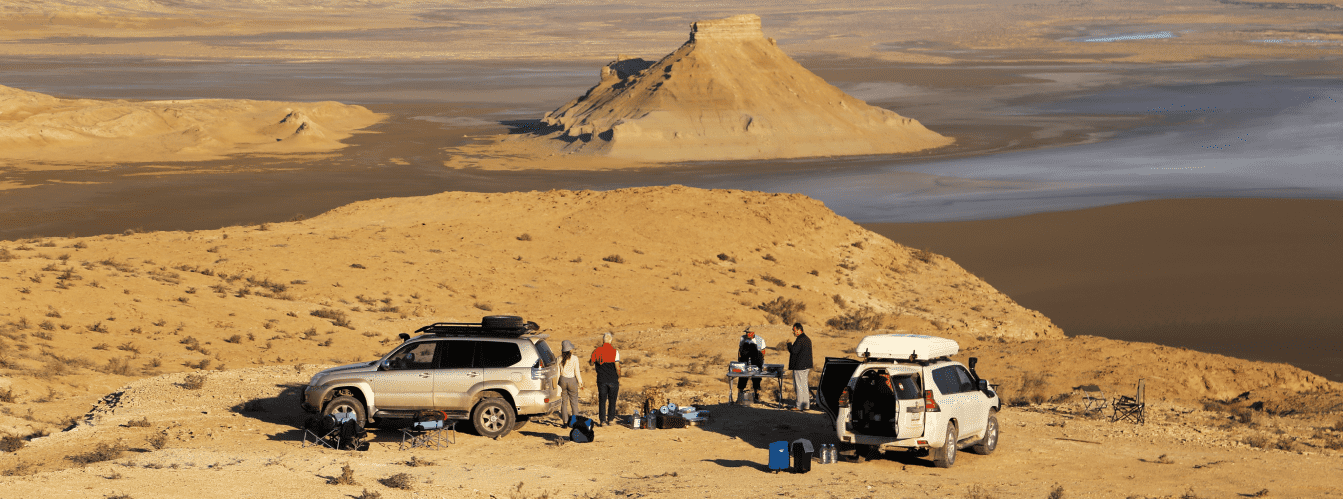
Vehicle requirements: for an independent trip, a four-wheel-drive 4x4 off-road vehicle with high ground clearance is recommended. Although steppe ruts on the Tyub-Karagan plateau are fairly firm in dry weather, rocky sections, washouts, and steep descents into neighboring canyons require reliable suspension, while after rains or spring snowmelt, clay sections of the road become difficult to pass.
Safety rules and pilgrimage etiquette:
Kenty-Baba Necropolis is an active Islamic sanctuary and a state-protected architectural monument:
– when visiting the necropolis grounds and the open-air mosque, maintain silence, respect the feelings of pilgrims, and dress modestly (covered shoulders and knees, and a headscarf for women);
– climbing onto the ancient mausoleums, saganatams, koytases, or the stone enclosure of the steppe mosque, moving sacred stones, or leaving inscriptions on carved slabs is strictly prohibited;
– cellular reception in the necropolis area is unstable or absent, so download offline maps in advance and bring a supply of drinking water;
– all household litter must be carried back with you.
Infrastructure: directly beside the Kenty-Baba necropolis, any tourist infrastructure, shops, and gas stations are absent (near the neighboring Sultan-Epe mosque, there is a caretaker's lodge – shyrakshy – and an equipped rest area for pilgrims). The last gas stations, cafes, and stores along the route from Aktau are located in Tauchik village.
Seasonality: visiting the sanctuary is possible year-round. The most comfortable times for excursions and pilgrimage are spring (April – May), when the steppe of the Tyub-Karagan peninsula is covered with greenery and wild tulips, as well as autumn (September – October). In summer, daytime air temperatures rise to +38...+42 °C, while in winter cold winds blow from the Caspian Sea.
--------------------------------------------
History
The history of the Kenty-Baba necropolis dates back to the early and high Middle Ages (10th–15th centuries), when the Mangyshlak peninsula served as an important bridge between the nomadic steppe, the oases of Khwarezm, and the trading ports of the Caspian Sea.
Согласно историческим данным и народным преданиям — According to historical records and folk traditions, in the 14th century, the revered Islamic preacher and Sufi saint Kenty-Baba arrived in the lands of Mangystau, founding a mosque and spiritual sanctuary here. Over several centuries – from the 10th–15th to the 20th century – an extensive ancestral and pilgrimage pantheon took shape around his burial site. Across the centuries, nomadic tribes traveling along the steppe roads of Tyub-Karagan stopped at the necropolis to recite prayers, perform commemorative rites, and rest.
The first scientific survey of the complex was conducted by an expedition of the Ministry of Culture of the Kazakh SSR in 1979. Given the monument's exceptional historical and architectural value, scientific restoration and conservation works were carried out on the territory of the necropolis in 1983, 2004–2005, 2013, and 2014. Craftsmen reinforced the stone masonry of the mausoleums and cleaned the carved tombstones, striving to preserve the authentic appearance of medieval architecture as faithfully as possible.
By Decree of the Akimat of the Mangistau Region No. 3 dated January 5, 2018, the Kenty-Baba necropolis was officially included in the State List of Monuments of History and Culture of Local Significance, as well as entered into the nationwide register of sacred sites of Kazakhstan.
Information
Kenty-Baba Necropolis is a monument of history, urban planning, and architecture of local significance of the Republic of Kazakhstan, located in the Tupkaragan district of the Mangistau Region.
Main historical and administrative parameters:
– status: monument of history and culture of local significance (Decree of the Akimat of the Mangistau Region No. 3 dated 05.01.2018), site of sacred geography of Kazakhstan;
– dating of the complex: 10th–20th centuries (the core of the monuments dates to the 10th–16th centuries);
– number of memorial structures: about 120–130 monuments of various types (mausoleums, saganatams, koytases, kulpytases, stone enclosures, and an open-air mosque);
– geographic reference: northeastern part of the Tyub-Karagan peninsula, 40 km northwest of Tauchik village, 55 km northeast of the city of Fort-Shevchenko, 3 km from the Ushtam necropolis, and 1.5 km southwest of the underground Sultan-Epe mosque.
Architectural and artistic features:
– central mausoleum: a square-in-plan single-chamber structure (with its main facade oriented southwest), whose walls taper slightly upward, giving the building a trapezoidal silhouette and visual slenderness;
– construction technique: a combination of roughly dressed stone slabs in the main masonry with carefully hewn and polished facing slabs adorned with bands of relief, contour, and bas-relief carving in the traditions of medieval Khwarezm.
Detailed site description
The architectural ensemble of the Kenty-Baba necropolis includes the following key elements:
• Central ancient mausoleum – the primary historical structure of the complex, erected over the saint's grave. It stands out for its upward-tapering walls, carved ornamental bands across the facade, and a surviving staircase to the right of the entrance, which mullahs ascended in olden times to give the call to prayer. According to legend, a sacred pole crowned with argali horns was once installed inside the mausoleum.
• Open-air steppe mosque – a unique religious structure directly opposite the mausoleum, laid out from natural stones in the form of a protective circle with a prayer stone (mihrab) facing east.
• Small architectural forms (koytases and kulpytases) – over a hundred traditional stone tombstones, including distinctive stylized sculptures (koytases) and steles with delicate relief engraving, among which are gravestones shaped like small triangular pyramids.
• Wall bas-reliefs and protective amulets – ancient depictions carved into the walls of mausoleums and tombstones showing horses, two-humped camels, open palms, floral motifs, and sacred triangular amulets ("tumars").
Legends
The solitary ancient necropolis with its stone mosque circle amidst the steppe has long been revered by travelers as a place of miraculous protection against all adversities.
The Tale of the Protective Circle of the Kenty-Baba Mosque:
Local elders recount that the holy Sufi Kenty-Baba, who came to Mangyshlak to bring the light of faith and peace, laid out a circle of sacred stones opposite his sanctuary and consecrated it with prayer. Since then, the belief took root among the people that any traveler overtaken in the steppe by a blizzard, downpour, the darkness of night, or pursuit need only step across the threshold of this stone circle and recite a prayer to come under the invisible protection of the saint himself. Nomads believed that inside the circle of Kenty-Baba, neither wild beast nor steppe storm could harm a person, while the soul found peace and blessing for the journey ahead.
--------------------------------------------
Conclusion
Kenty-Baba Necropolis is an outstanding spiritual and architectural monument of the Mangyshlak peninsula, preserving a thousand-year history of stone-carving art and Sufi traditions of Western Kazakhstan. Visiting this tranquil sacred ensemble in combination with the neighboring underground Sultan-Epe mosque and the canyons of the Tyub-Karagan peninsula offers a profound encounter with the cultural heritage of the Mangistau Region.
Sacred pilgrimage sites in Mangystau:
• Underground Sultan-Epe Mosque;
• Ushtam Necropolis;
• Rock-cut Shakpak-Ata Mosque;
• Underground Beket-Ata Mosque;
• Underground Shopan-Ata Mosque;
• Underground Karaman-Ata Mosque;
• Sisem-Ata Necropolis;
• Underground Masat-Ata Mosque;
• Beisenbay Necropolis.
Nearby attractions:
• Tyub-Karagan Peninsula;
• Cape Tupkaragan;
• Tupkaragan Bay;
• Sultan-Epe Canyon;
• Caspian Sea;
• Kapamsay Canyon;
• Fossilized Tracks in the Zhygylgan Tract;
• Zhygylgan Sinkhole;
• Tamshaly Canyon;
• City of Fort-Shevchenko;
• Bautino Settlement and Port;
• Tauchik Village;
• Mangyshlak Peninsula;
• City of Aktau.
Photogallery: