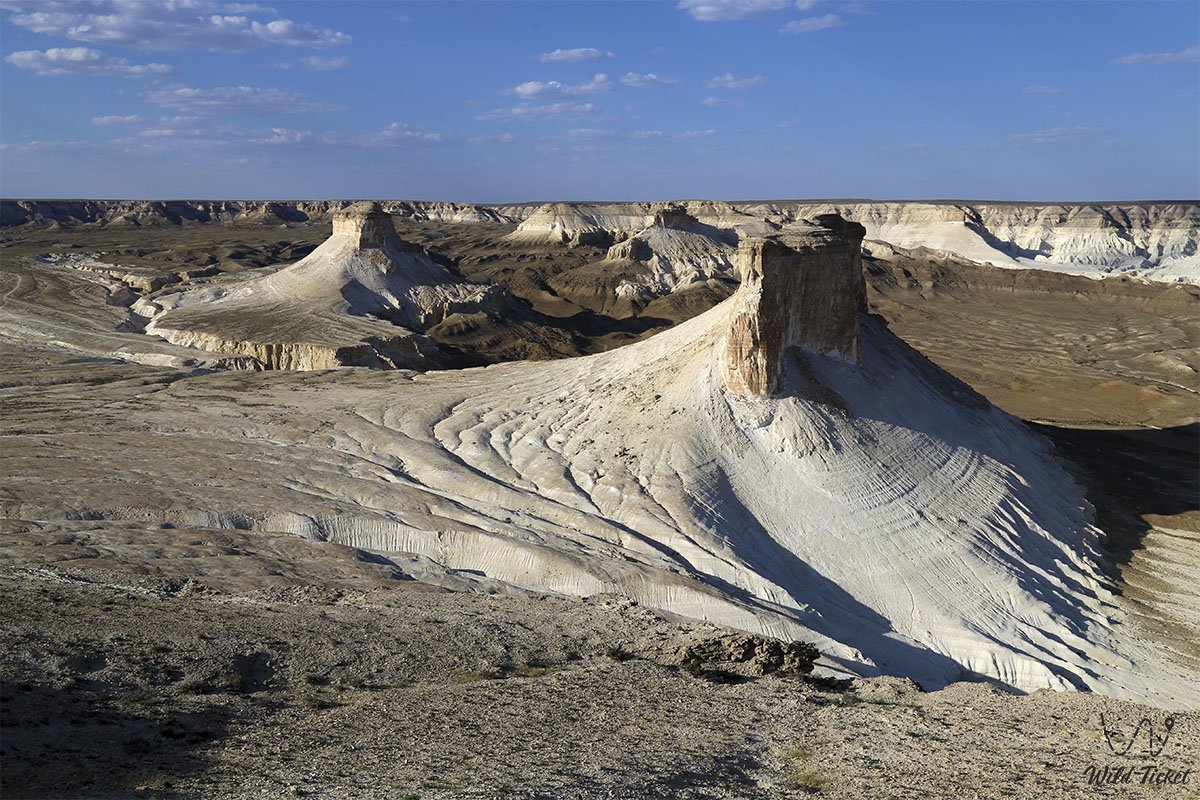
Legendary limestone remnant outliers Azu tisteri –
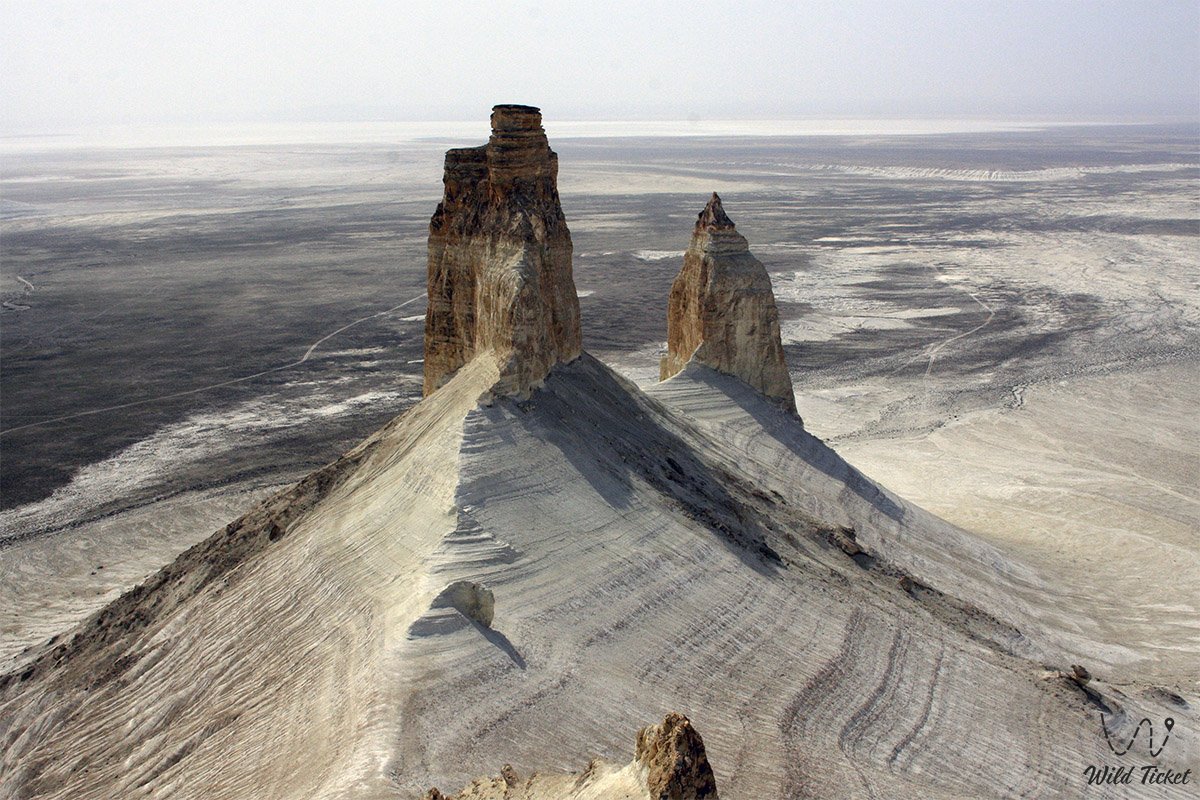
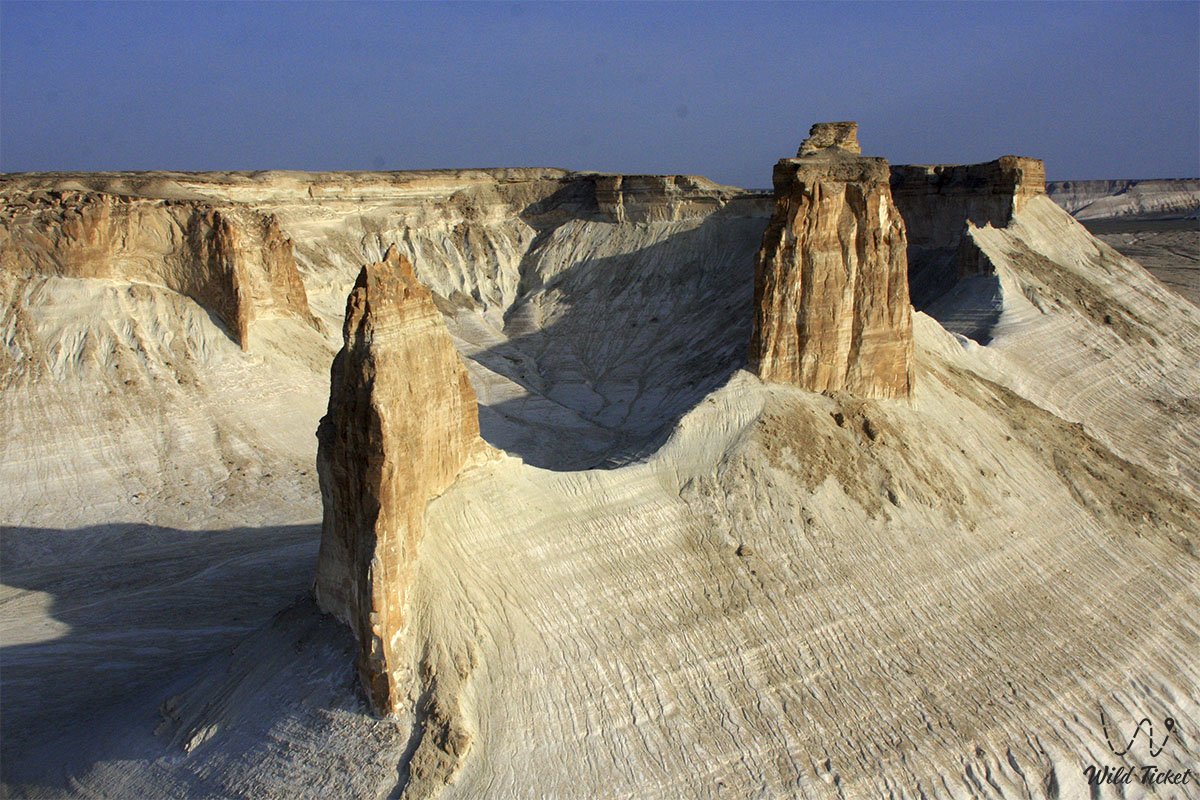
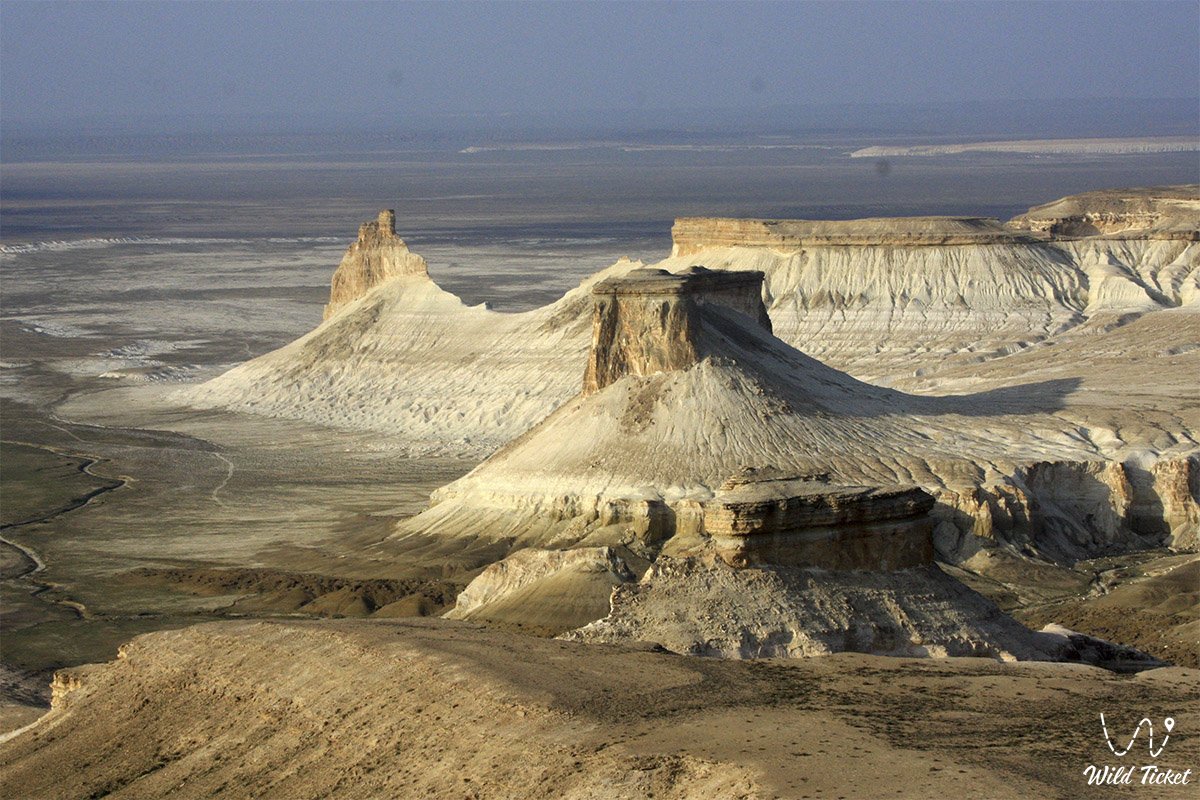
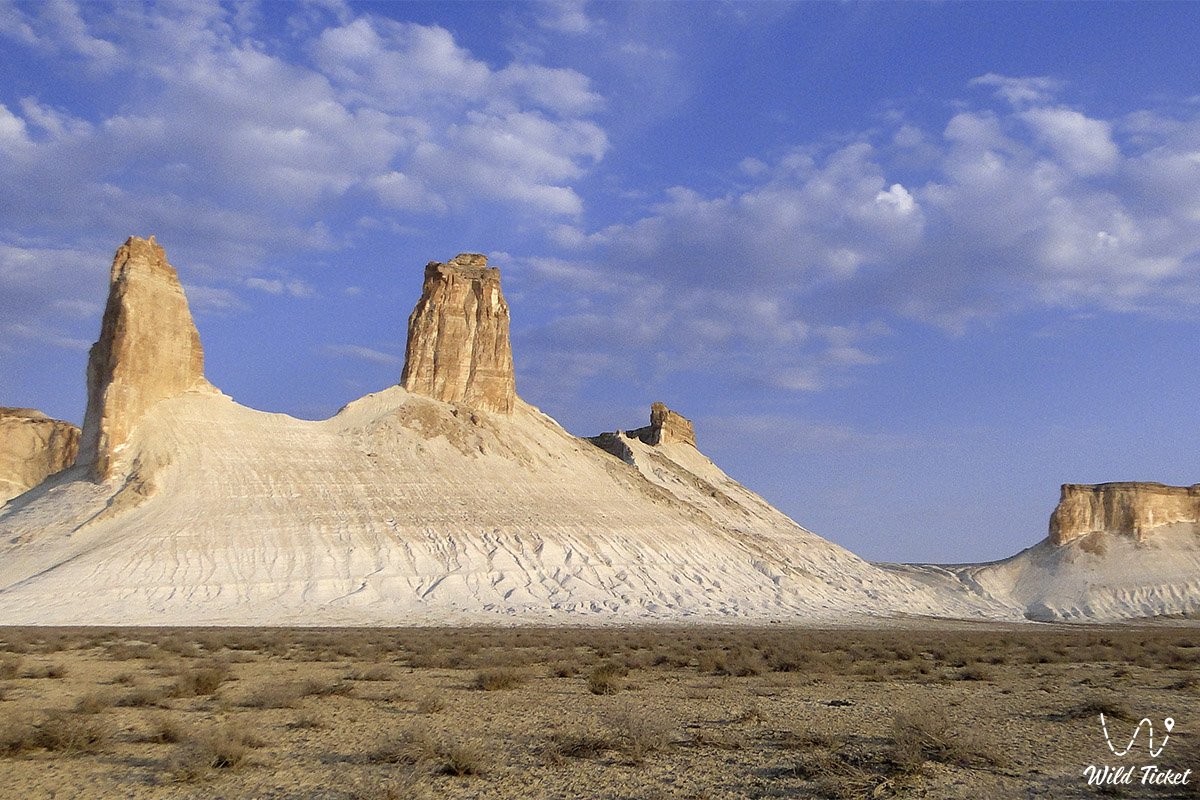
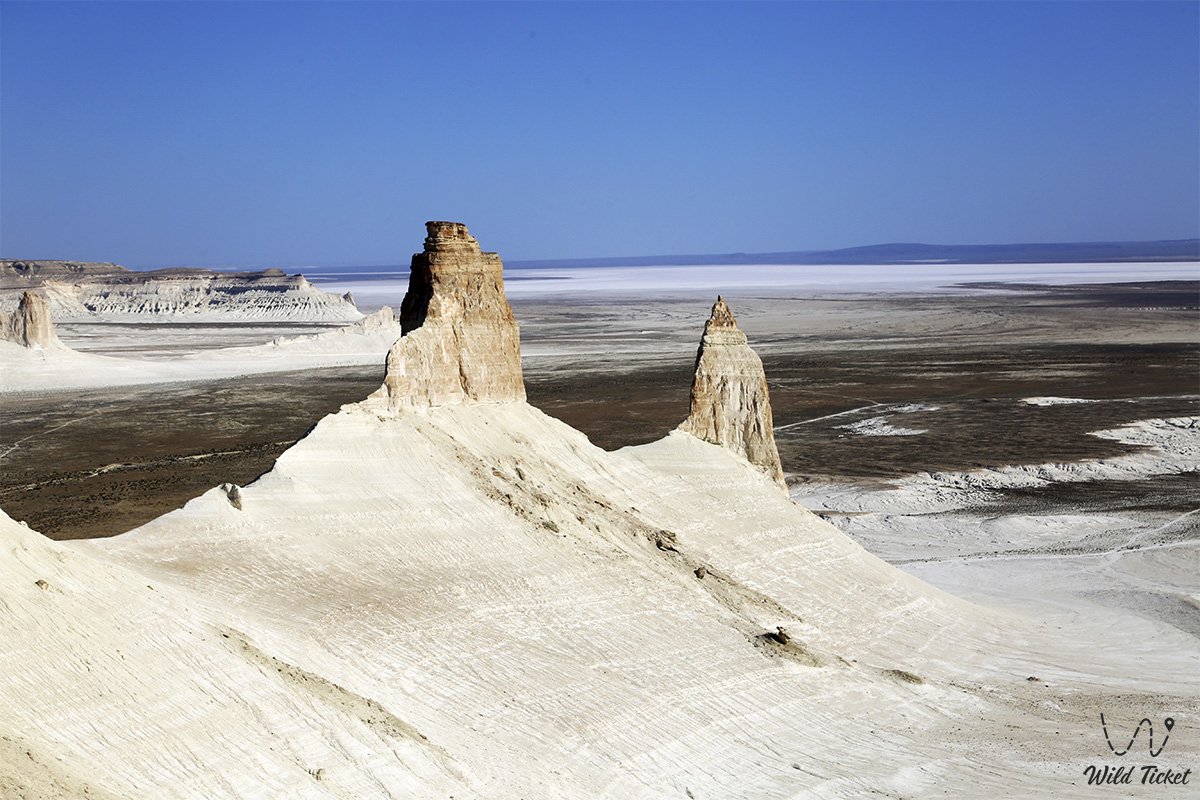
The "Fangs of Bozzhira" outliers (Kaz. Bozzhyra azulary or Azu tisteri – "predator's teeth", "incisors", also known among travelers as the "Feathers") represent an iconic geomorphological monument and the main visual symbol of the Bozzhira tract in the Karakiyan district of the Mangystau region. Located at the bottom of a gigantic erosional canyon at the foot of the western chink of the Ustyurt Plateau, these colossal limestone peaks soar into the sky for more than 200 meters when measured from the lower section of the plateau, dominating the dazzlingly white plain.
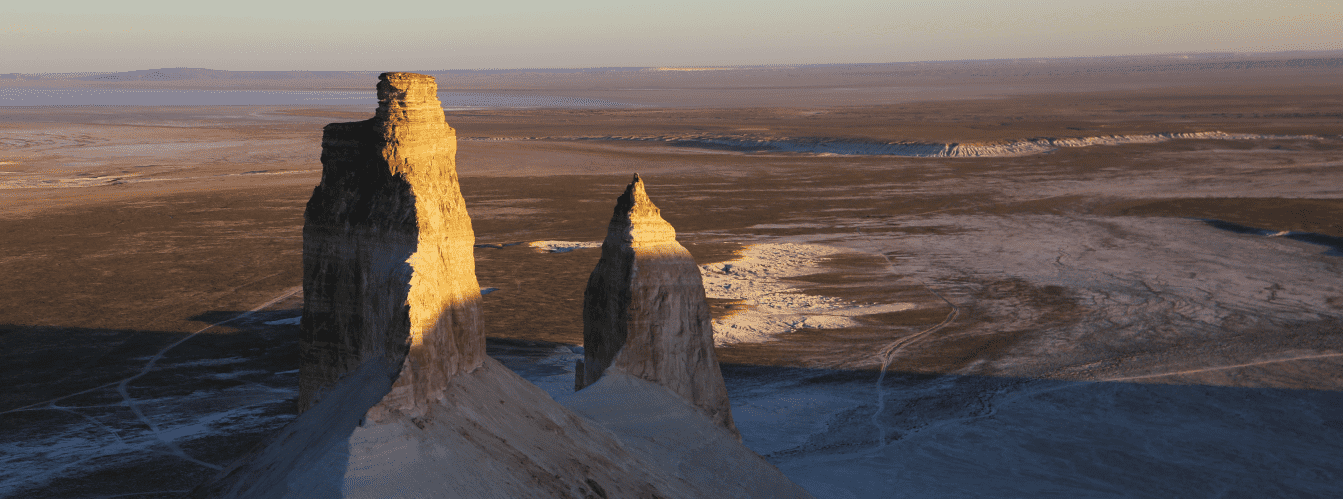
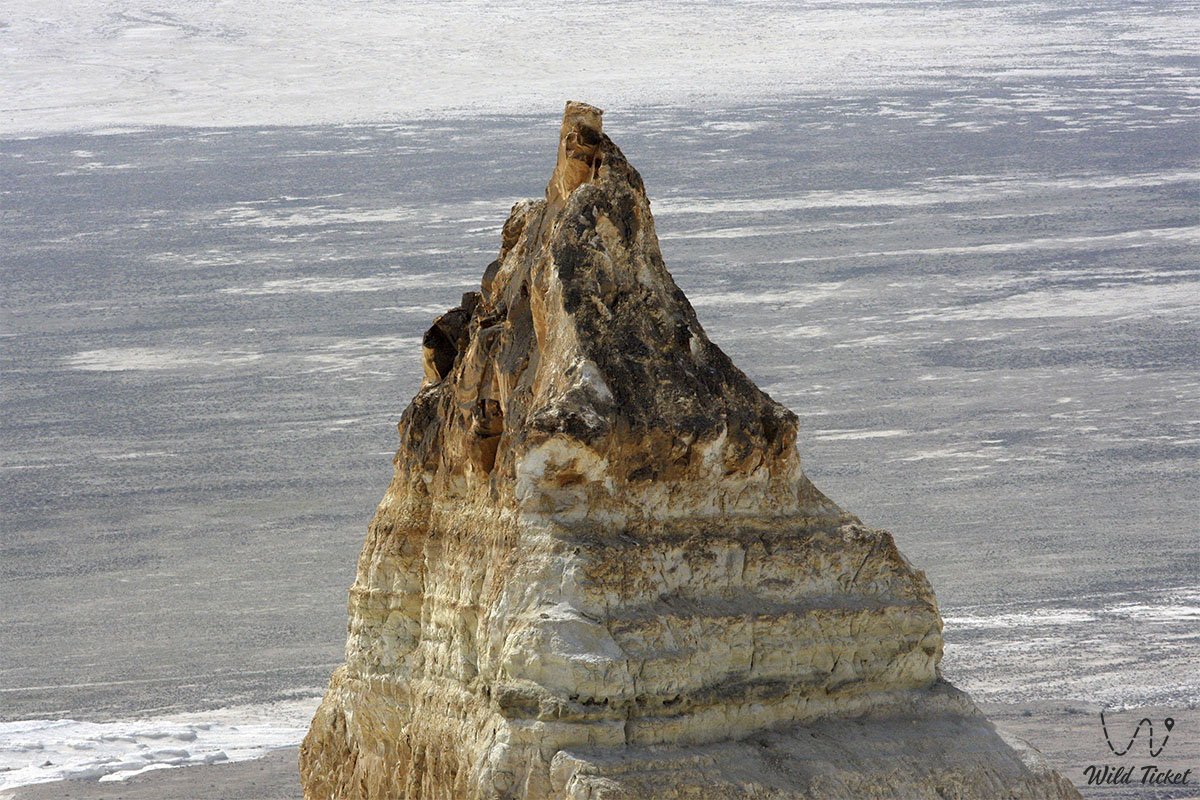
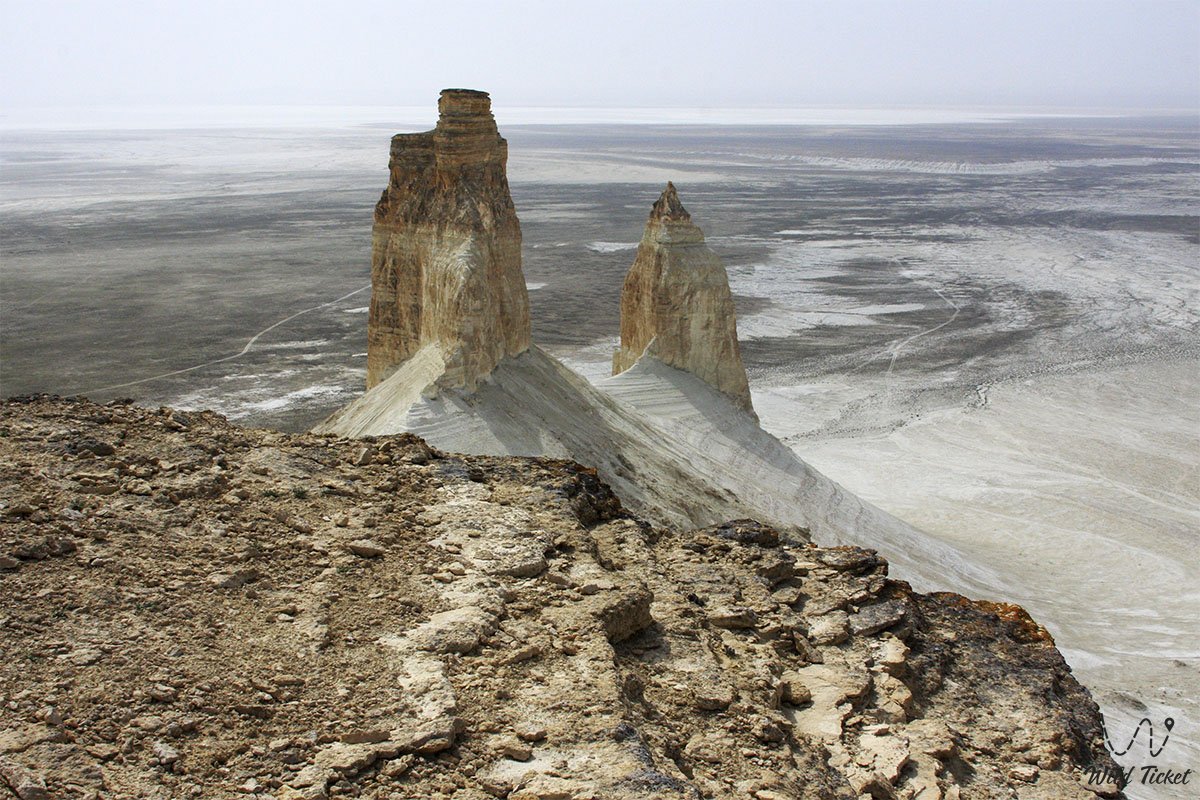
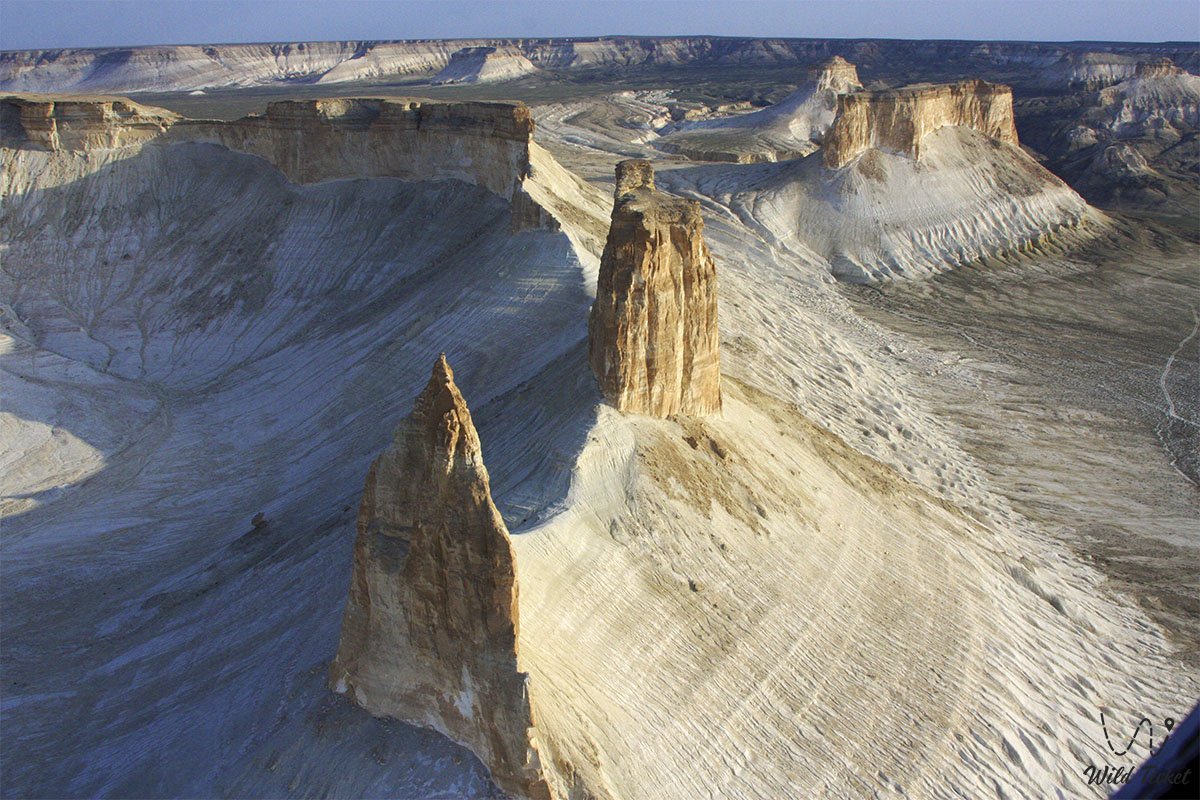
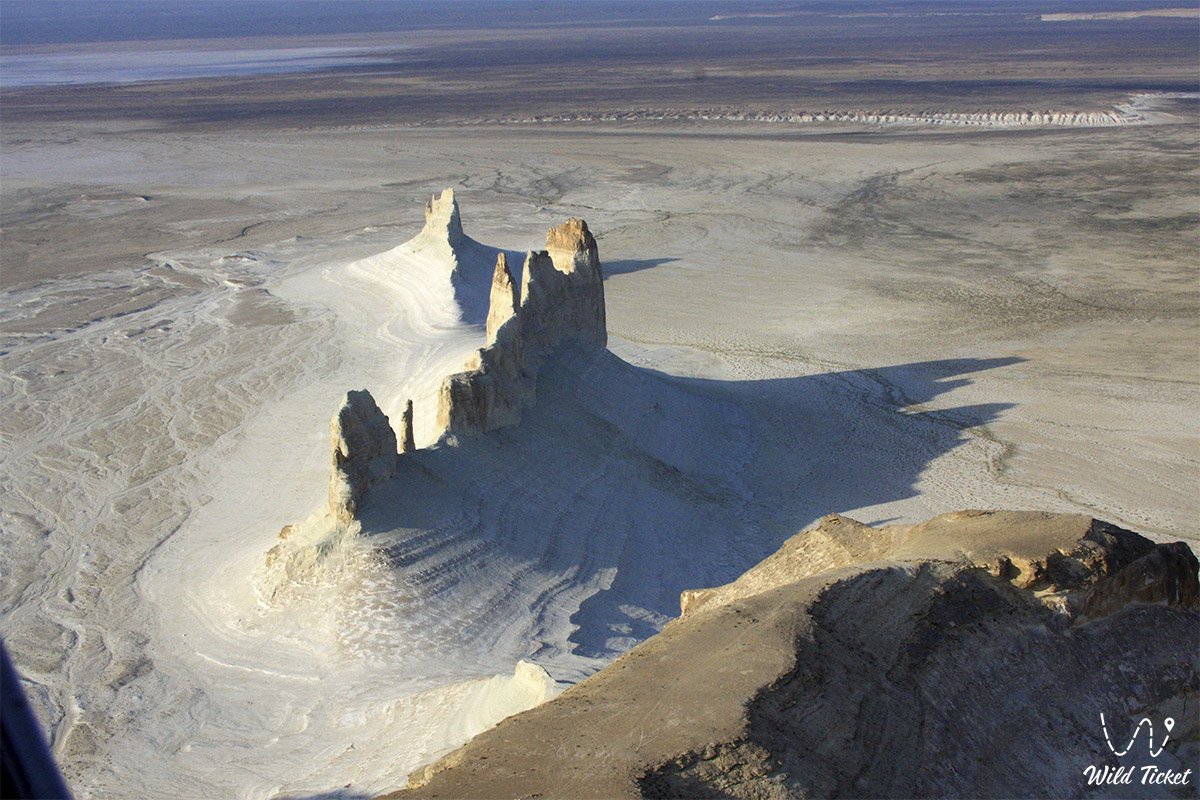
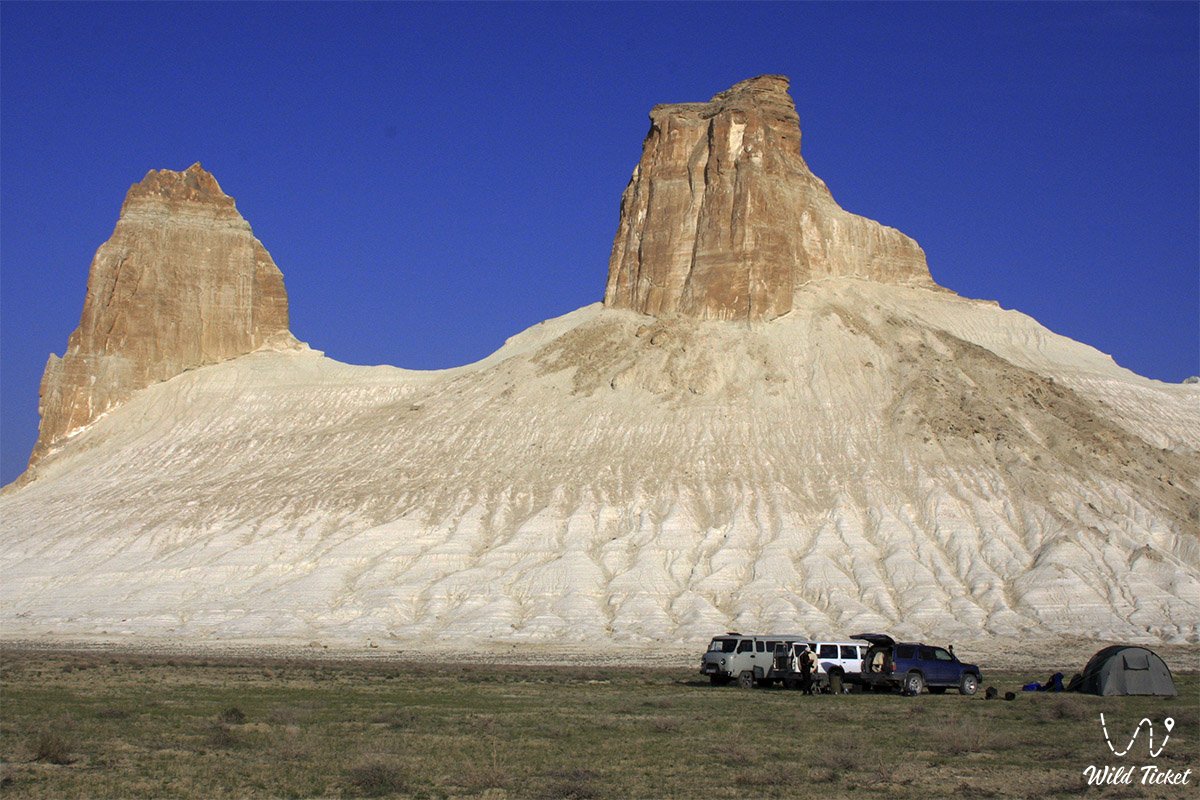
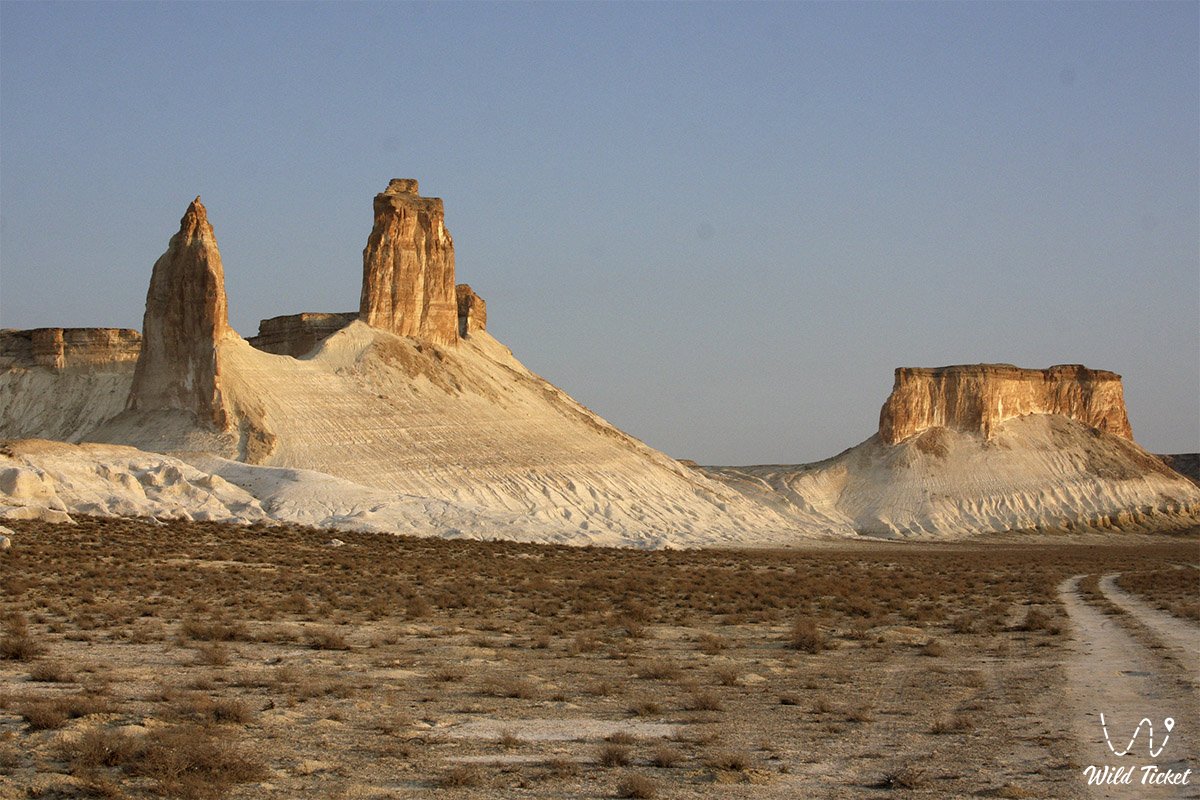
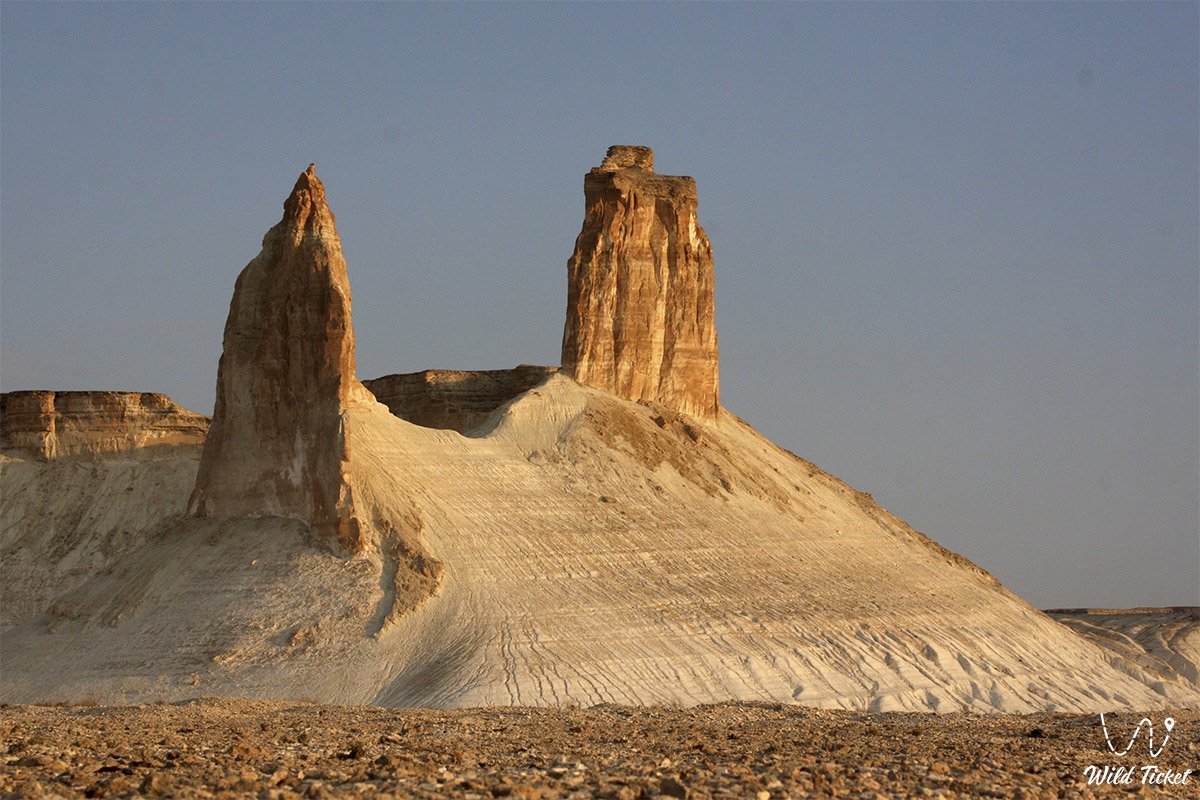
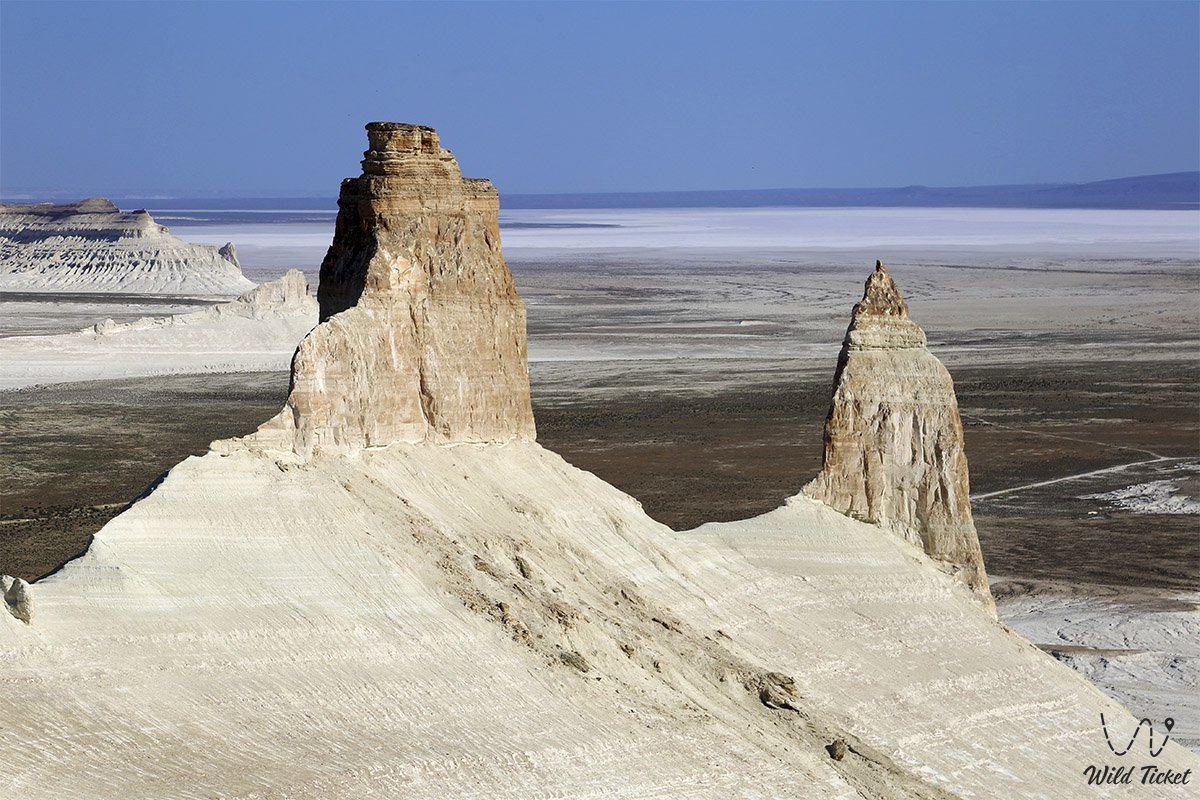
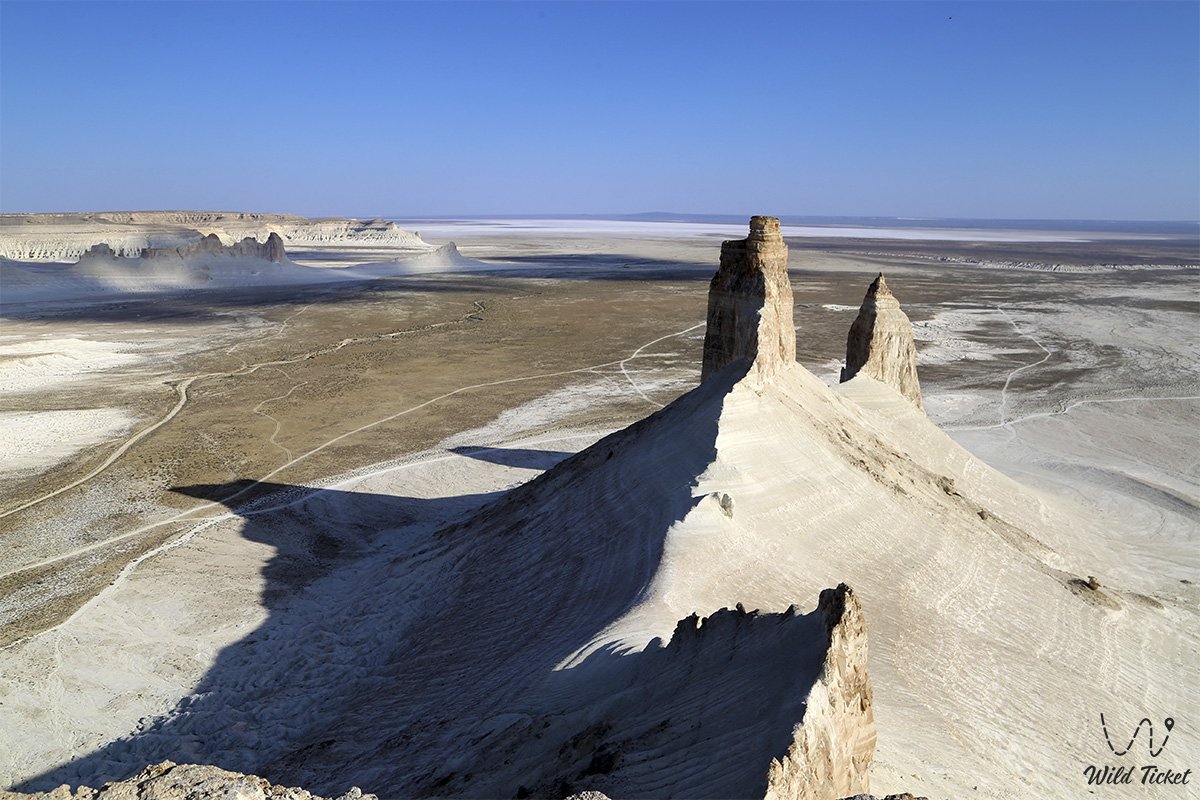
The natural monument represents a pair of vertically rising rock towers carved by millions of years of weathering out of carbonate sediments of the prehistoric Tethys Ocean: Ontustik-Azu-Tisteri (49 meters high) and Soltustik-Azu-Tisteri (25 meters high). They are situated in the western part of the Ak-Shatkal gorge and the Oynak-Bozzhira clearing, 1.4 km south (and slightly west) of Mount Borly-Tau, 3 km southwest of the "Fourth panorama of Bozzhira" point, and 3.2 km northeast of Mount Shoky-Tau. Depending on the angle of incidence of sunlight, the contours of the outliers resemble the fangs of a giant predator, unfurled stone sails, or the towers of a Gothic cathedral. The base of the "Fangs" serves as a traditional staging ground for expeditions and overnight stays beneath the dome of the Milky Way.
The "Fangs" outliers serve as the nucleus of the entire natural ensemble of Ustyurt and are harmoniously linked to key attractions of Mangystau: the colored stratified hills of the Kyzylkup tract ("Tiramisu"), striped Mount Bokty, the sacred Beket-Ata underground mosque in the Oglandy tract, and the Shopan-Ata underground mosque. Below you can view the list and coordinates of panoramic points in the Bozzhira tract: (panorama No. 1, panorama No. 2, panorama No. 3, panorama No. 4, panorama No. 5, panorama No. 6).
Today, the limestone fangs of Bozzhira are recognized as one of the most identifiable landscape brands of Kazakhstan, attracting geologists, photographers, and overland travelers from all over the world with their pristine scale and cosmic energy.
--------------------------------------------
How to get there and visit –
The chalk outliers "Fangs of Bozzhira" are located in the central lowland of the Bozzhira tract, approximately 290–300 kilometers east of the city of Aktau and 150 kilometers from the city of Zhanaozen. A trip to the outliers combines perfectly with visiting neighboring iconic locations: on the way from Zhanaozen, travelers pass by the village of Senek, where the sacred Senek necropolis and the pilgrimage site Nurbergen Kalyshev mausoleum are located.
GPS geographical coordinates: 43°25'00"N 54°04'21"E
The main part of the route from the city of Aktau runs along a high-speed paved highway through the city of Zhanaozen and Uzen settlement. Having reached the fork on the plateau, travelers turn off onto stony steppe tracks. Viewing the "Fangs" is possible in two ways: from the upper observation deck on the edge of the chink (which offers a dizzying top-down vista of the peaks) or by descending to the bottom of the canyon directly to their base, which requires a challenging off-road drive of about 40–60 km along graded gravel tracks.
IMPORTANT: DO NOT APPROACH CLOSE TO THE EDGE OF THE LEDGE, GROUND COLLAPSE IS POSSIBLE.
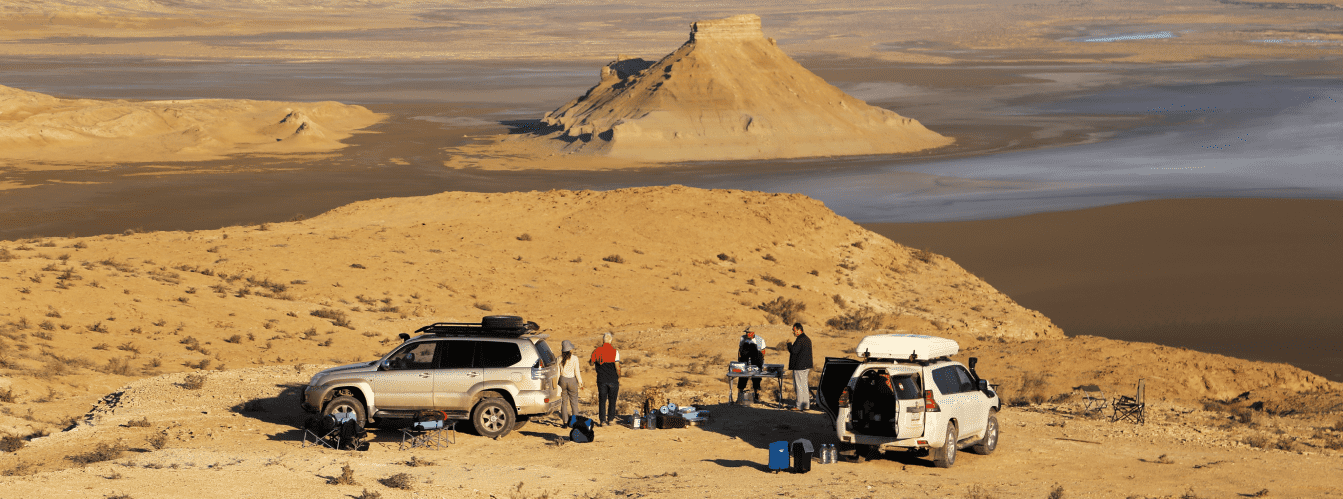
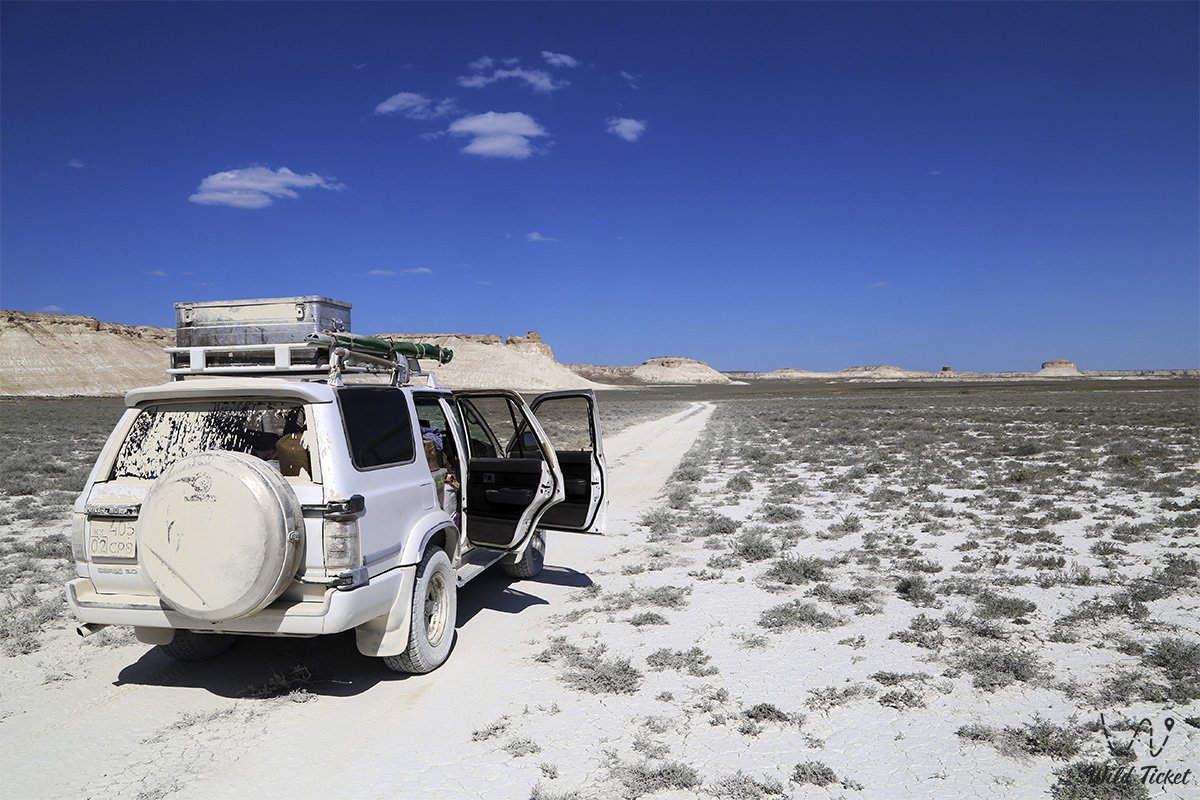
Traveling to the base of the "Fangs" requires an exclusively prepared four-wheel-drive frame-based off-road vehicle (4x4) with high ground clearance, underbody protection, and durable All-Terrain or Mud-Terrain tires. Descents from the chink are steep and rocky, and the ground is strewn with sharp flint chips that carry a risk of tire punctures. The vehicle must carry two spare wheels, a high-lift jack, an air compressor, and a tire repair kit.
Traveling across Ustyurt is safe only in a convoy of at least two vehicles under the guidance of an experienced guide. Cellular reception at the base of the outliers is absent; therefore, it is necessary to have a satellite phone, offline navigation, a fuel reserve for 600 km of autonomous range, and a water reserve of at least 5 liters per person per day. When climbing to the upper deck, do not approach the very edge of the precipice: thin limestone cornices can collapse.
The best time to visit is spring (May – early June) and warm autumn (September – October). At the height of summer, daytime temperatures on the white bottom of the canyon exceed +40...+45 °C, the chalk is blinding to the eyes, and open shade is absent. During the rainy season, the clay approach to the "Fangs" turns into impassable mud.
Infrastructure at the location is absent. Overnight stays are possible only in personal tents at the foot of the cliffs or in the guest houses of the Beket-Ata pilgrimage center 20 km from the tract.
--------------------------------------------
History
The geological history of the origin of the "Fangs" outliers spans over one hundred million years. During the Mesozoic and early Cenozoic eras, the territory of the modern Ustyurt Plateau was the floor of the gigantic prehistoric Tethys Ocean. Throughout epochs, calcareous muds, shells of microorganisms, and carbonate sediments were continuously deposited here, forming a thick, monolithic sequence of pure marls, chalk, and dense coquina limestones.
Around 40–60 million years ago, the tectonic uplift of the Turan Plate forced the ocean to retreat, exposing the seabed. Strata of carbonate rocks emerged onto the surface, where they were subjected to the massive action of exogenic forces: rainwater torrents, wind, and frost wedging. Over millions of years, water streams incised the soft marls, forming a deep canyon.
The "Fangs" outliers survived in the midst of the eroded massif thanks to the denser structure of their limestone core and local tectonic joints along which the initial division of the stratum took place. Erosional processes continue unabated: according to scientists' estimates, in a few millennia the slender spires of the cliffs will gradually crumble under the impact of wind and water.
In historical epochs, the surroundings of the outliers served as hunting grounds and seasonal camps for nomads. On the plateau, archaeologists find flint tools of primitive humans and ancient corral hunting structures made of stone – the "arrows of Ustyurt." Caravan branches of the Great Silk Road ran along the chink, connecting the oases of Central Asia with the Volga steppes.
In the 18th century, a few kilometers north of the rocks, the Sufi saint Beket-Ata established his sacred underground hermitage, frequently ascending the inaccessible ledges of Bozzhira for spiritual contemplation. During the Soviet years, the tract was explored by topographic and geological expeditions, and in the early 21st century the image of the "Fangs" became a global symbol of Kazakhstan's pristine nature.
Information
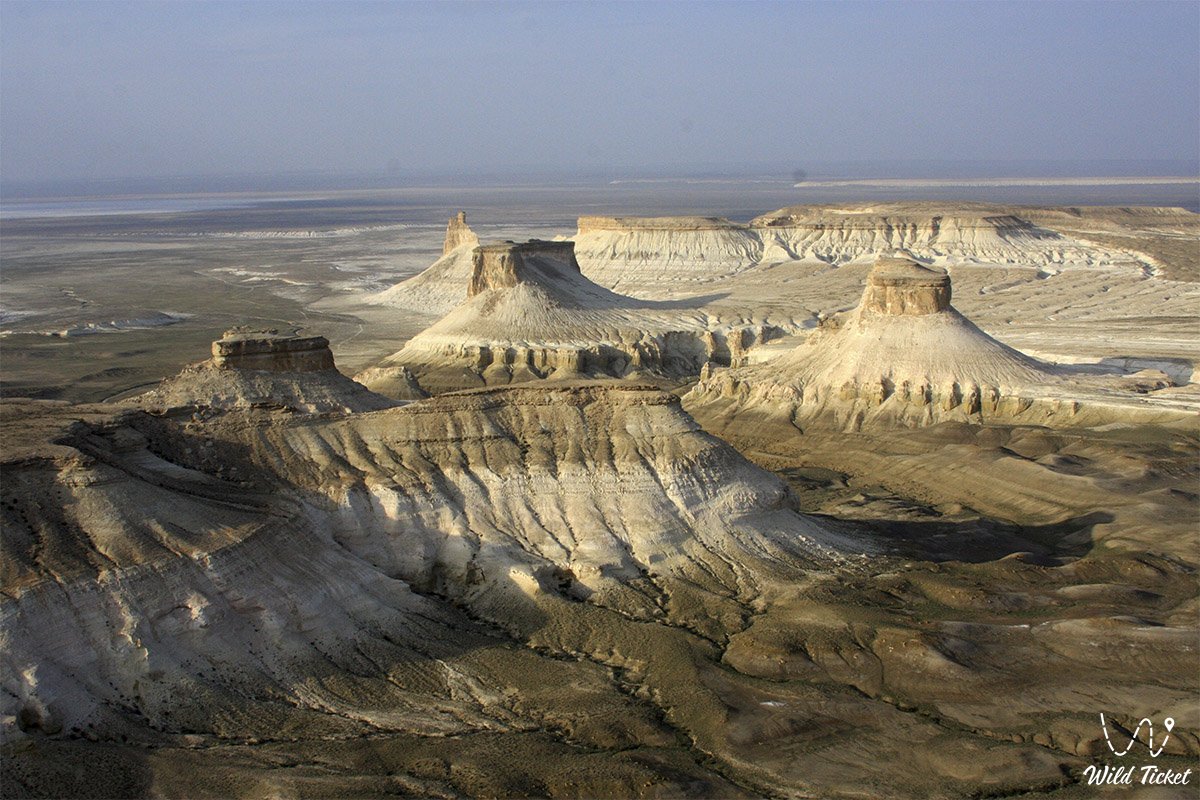
Geomorphologically, the outliers represent denudation pillar-like witness rocks up to 200 meters high relative to the salt-pan floor of the valley. The height of the upper plateau above the canyon floor reaches 250 meters.
The body of the outliers is composed of Late Cretaceous and Paleogene sedimentary rocks with a distinct horizontal structure. The lower tier consists of dazzlingly white soft chalk, the middle tier is composed of pinkish and cream marls, and the upper crests are reinforced with dense coquina layers that restrain rock deflation.
The surroundings of the "Fangs" possess colossal paleontological value. In screes at the foot of the towers, researchers and tourists everywhere discover fossils of the ancient Tethys Ocean fauna: fossil shark teeth, ammonites, belemnite rostra ("devil's fingers"), imprints of marine mollusks, and silicified shells of sea urchins.
The climate of the area is sharply continental and semi-desert. Winds blow here almost constantly, intensifying toward evening. Due to the whiteness of the chalk rocks, a blinding glare occurs at clear midday, making reliable ultraviolet eye protection essential.
The ecology of the monument is extremely fragile. It is prohibited to make inscriptions on the chalk, chip off rock slabs, or drive motor vehicles onto the soft chalk aprons around the towers.
Detailed description of the venue
The landscape complex of the "Fangs of Bozzhira" outliers includes several key visual and spatial zones:
• Northern outlier – a massive limestone tower with a wedge-shaped summit facing the canyon exit, resembling the prow of a gigantic ship.
• Southern outlier – a narrower and sharper rock spire soaring upward like a stone needle or the incisor of a prehistoric beast.
• Saddle between outliers – a low pass between the two towers covered with white marl screes, reached by a steep walking path for a panoramic view.
• Base of the outliers – a flat salt-pan clearing where overland travelers set up base camps to contemplate sunsets and the starry sky.
• Upper chink viewpoint – a rock outcrop at an elevation of 200 meters above the outliers, opening a textbook view of the two white towers against the background of the boundless depression.
• Western chalk apron – gentle snow-white billows at the base of the cliffs, dissected by gullies of temporary rain streams.
Flora and fauna
The plant world around the "Fangs" outliers is shaped by the conditions of the extremely arid clay-and-salt desert of the Ustyurt Plateau. Rare xerophytes and saltworts survive on chalk screes and dry plains: Turanian and gray-soil wormwood, salt-marsh biyurgun, boyalych, itsegek (anabasis), spiny bean caper, and sparse bushes of black saxaul. Thickets of tamarisk (saltcedar) and camelthorn occur in ravines. In spring, the stony ground turns green briefly: wild Sogdian tulips, wild onions, and desert irises bloom, with their vegetation ending by June.
The animal kingdom of the cliffs is unique. The primary inhabitant of the vertical precipices of the chink and the ledges of the "Fangs" is the Ustyurt mountain sheep (mouflon), listed in the Red Book of Kazakhstan. These graceful animals move confidently along inaccessible limestone cornices. Goitered gazelles and saigas can be encountered on the plain at the foot of the cliffs.
Predators roaming the area include the corsac fox, steppe wolf, badger, marbled polecat, and the rare caracal. Jerboas, gerbils, Ustyurt geckos, toad-headed agamas, whipsnakes, and the swift arrow snake inhabit sandy-clay sections.
Large birds of prey soar in the sky above the summits of the "Fangs": golden eagles, steppe eagles, long-legged buzzards, saker falcons, and Egyptian vultures, utilizing constant updrafts of air over the chalk walls.
Legend
An ancient Kazakh legend about the defenders of the sacred land is associated with the "Fangs of Bozzhira" outliers. Lore tells that during the retreat of ancient waters, giant batyrs lived on the plateau, guarding the tranquility of the nomadic clans. When a countless enemy army advanced upon the peaceful lands, two giant brothers stood shoulder to shoulder at the entrance to the gorge, shielding the retreat of women and children.
The battle lasted three days and three nights. Unable to break the warriors with weapons, enemy sorcerers cast a curse upon the gorge, turning the heroes into white stone fangs. Yet even after turning to stone, the batyrs remained forever guarding the entrance to the canyon.
Another belief links the cliffs to the spiritual power of the Sufi saint Beket-Ata. Local elders believe that the prayer of the righteous man on the summits of the chink endowed this place with a special grace: a person who stays at the foot of the "Fangs" alone with the silence of the night desert attains inner peace and is freed from worldly anxieties.
Conclusion
The "Fangs of Bozzhira" outliers are a majestic natural monument of Earth's geological history, embodying the grandeur of the ancient Tethys Ocean and the austere beauty of the Ustyurt Plateau. The contrast of blindingly white limestone, deep shadows, and an endless horizon leaves an indelible impression on the heart of every traveler.
Visiting the "Fangs" grants an incomparable self-sufficient expedition experience, uniting the romance of overnight stays beneath the Milky Way, searching for prehistoric fossils, and the majesty of Mangystau's wild nature.
Interesting sights nearby:
• Ustyurt State Nature Reserve;
• Fort Shevchenko;
• Karagiye Depression;
• Karynzharyk Depression;
• Mount Borly-Tau;
• Mount Otpan-Tau and Aday-Ata Monument;
• Shomanay Mountains;
• Akespe Tract on Mangyshlak;
• Mount Sherkala;
• Shatkal Canyon;
• Mount Shokytau;
• Utebay Cave;
• Balayuk Cave;
• Silicon Valley in Mangistau;
• Mount Ushkirtaw;
• Utebay Tract;
• Kokala Tract;
• Kenderli Steppe Salt Marsh.
Photogallery: