Crystal weeping waterfall and blossoming relict oasis on the Caspian –
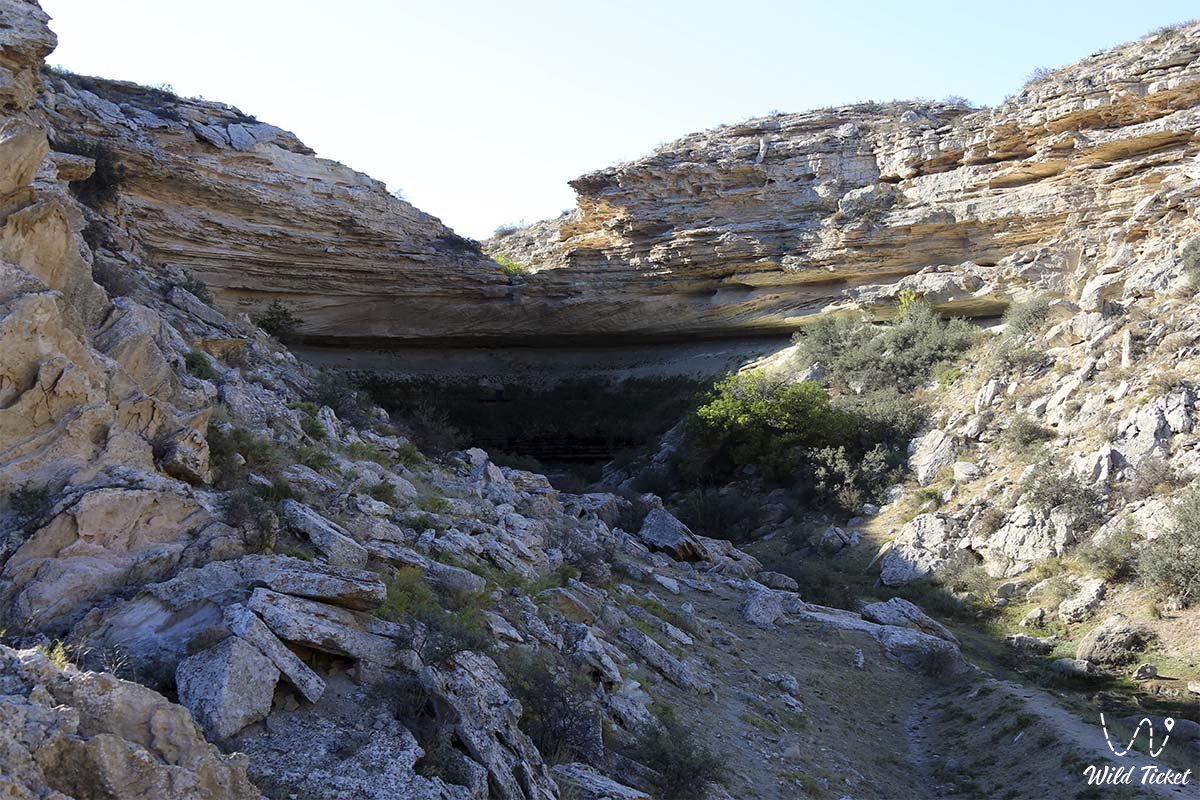
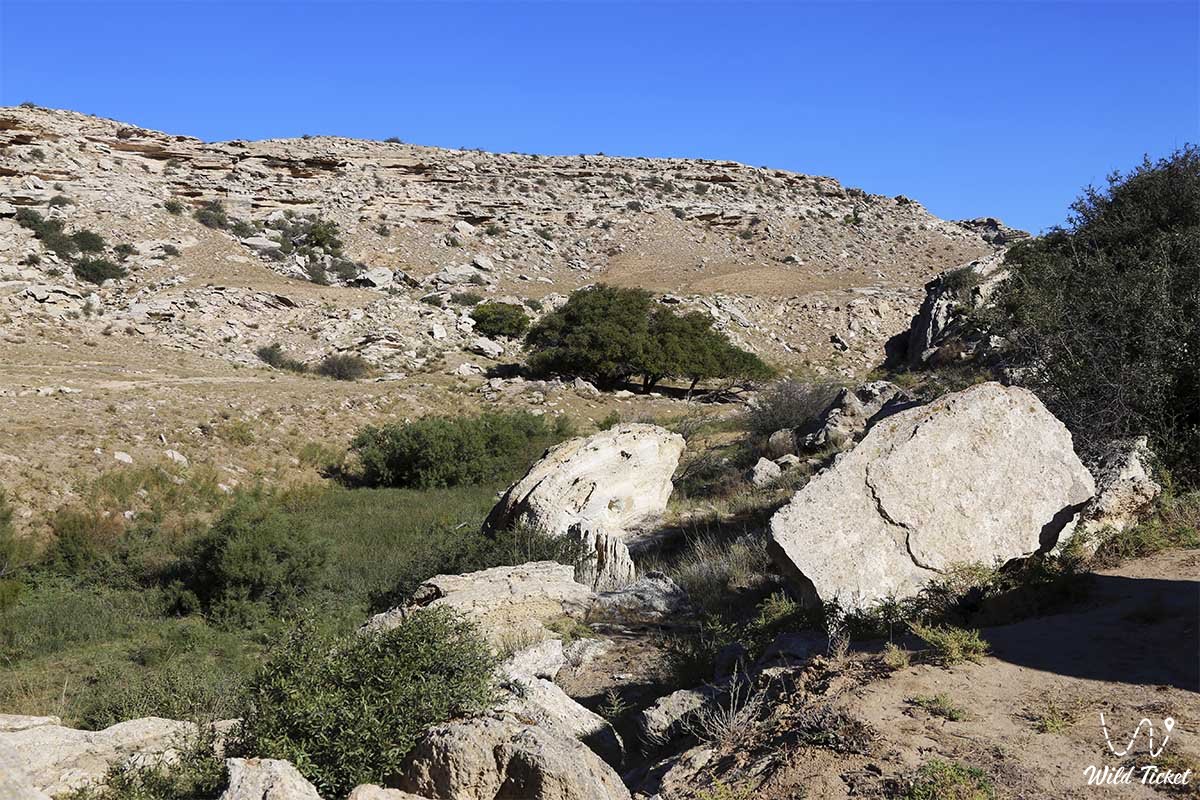
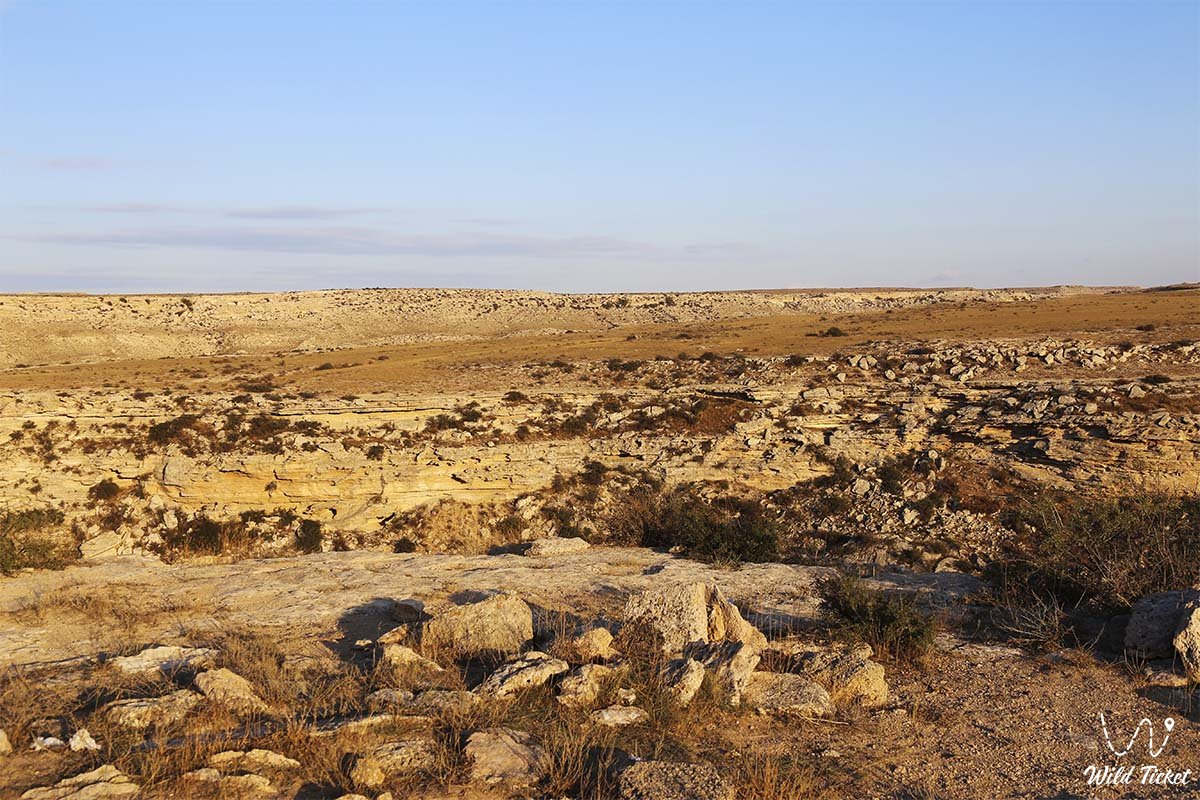
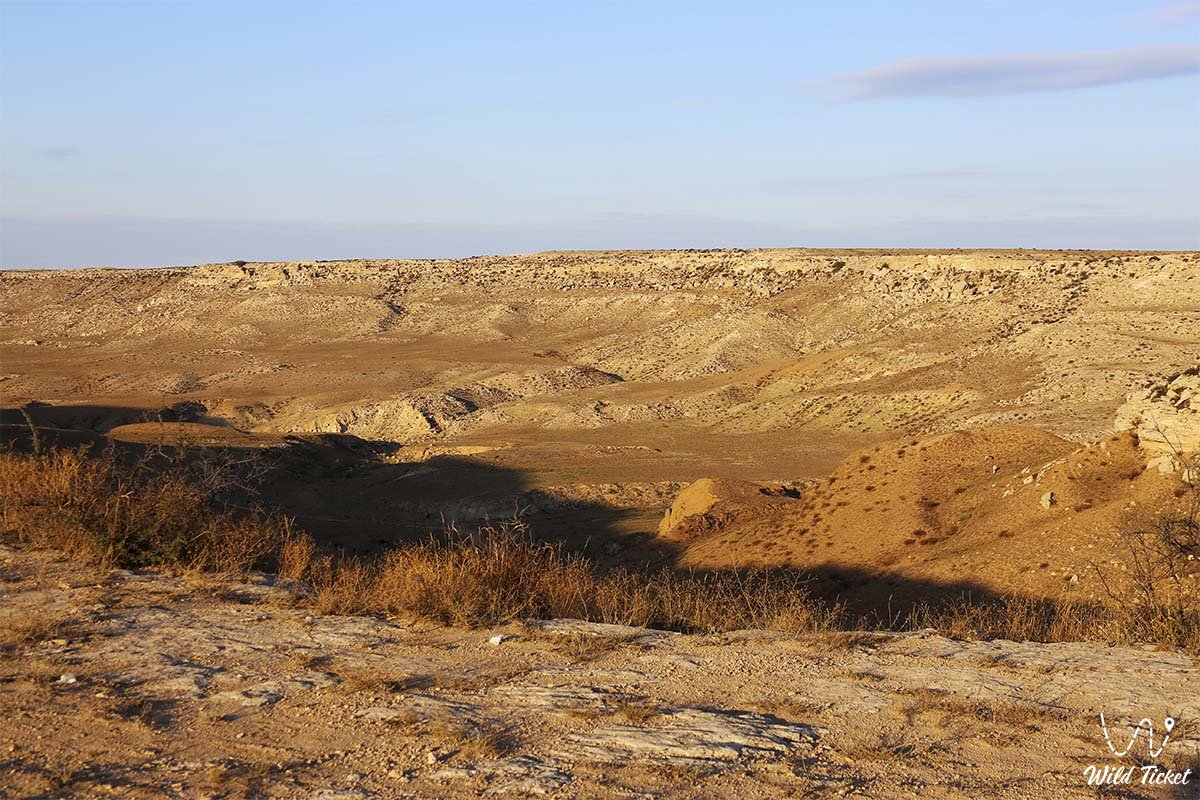
Tamshaly Canyon (Kaz. Tamshaly shatqaly) represents a grandiose erosional-karst canyon featuring a unique overhanging rock amphitheater and freshwater springs in the west of Kazakhstan. This shaded oasis is tucked within a deep ravine of the limestone plateau along the northern coast of the Tupkaragan district, creating a striking contrast with the surrounding arid steppes.
The tract stands as an essential landscape and ecological gem of the Mangystau region, sheltering groves of wild mint, mulberry, and blackberry beneath its cornices. Just one and a half kilometers to the north stretch sandbars and wild lagoons where the stormy Caspian Sea gently murmurs, receiving the sweet spring runoff of the gorge into its saline embrace.
In the excursion and travel geography of the Tupkaragan cluster, Tamshaly Canyon is one of the most popular and accessible natural sites. Approximately 160–170 kilometers to the southeast along the coastal highway lies the regional center Aktau, while just 25–30 kilometers to the west stands the region's oldest historical outpost – the town of Fort-Shevchenko alongside the seaport of Bautino.
East of the gorge open other remarkable landmarks of the Tupkaragan coast: the colossal geological Zhygylgan sinkhole with fossilized tracks of saber-toothed cats, wild rocky Cape Tyub-Karagan, the relict oasis of the Khanga-Baba tract, the tranquil turtle lake of Saura Canyon, and the sheltered basin of Koshak Bay.
The geological foundation of the canyon is built of horizontal beds of Sarmatian limestones deposited in warm shallow waters of the vanished prehistoric Tethys Ocean and hollowed over millions of years by subterranean groundwater flows. From Tamshaly, caravan trails and driving routes lead deep into the Mangyshlak Peninsula: toward the sacred height of Mount Otpan-Tau with the Aday-Ata memorial, the mystical stone balls of the Torysh Valley, solitary residual Mount Sherkala, the colorful clay hills of the Kokala tract, and the narrow slate gorge of Karadayirmen.
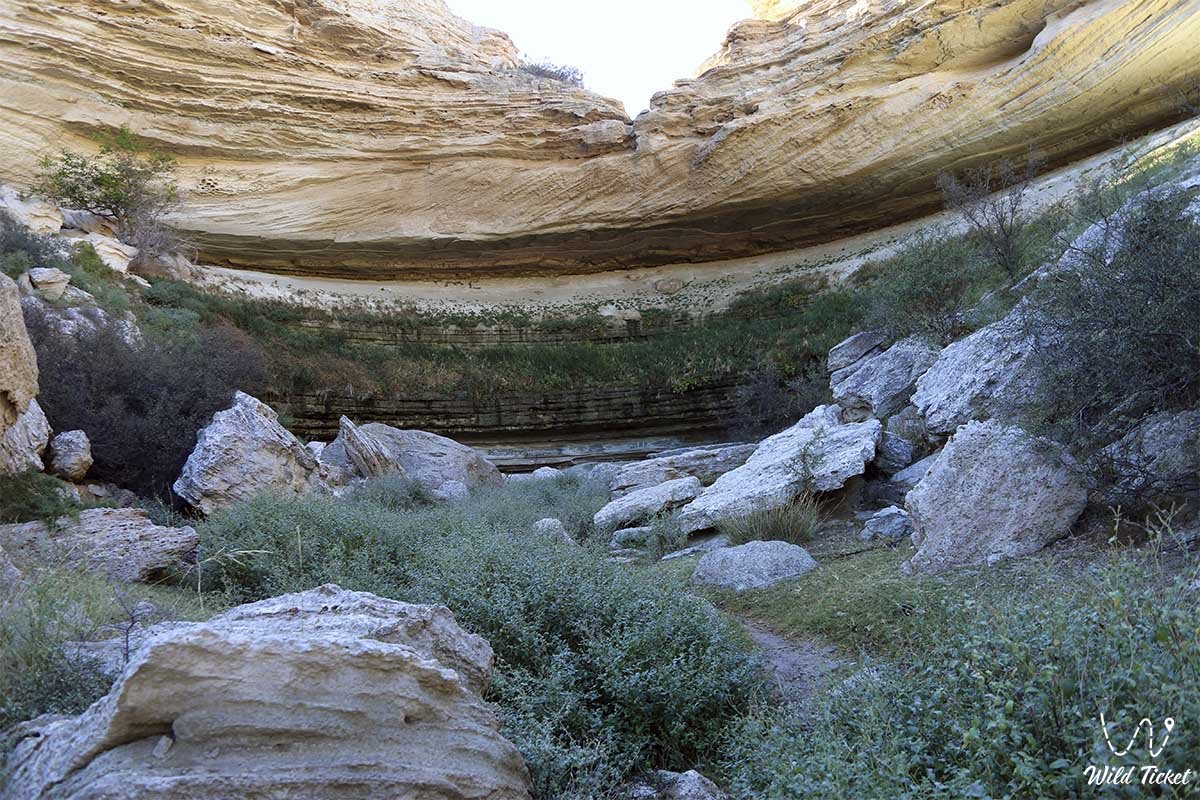
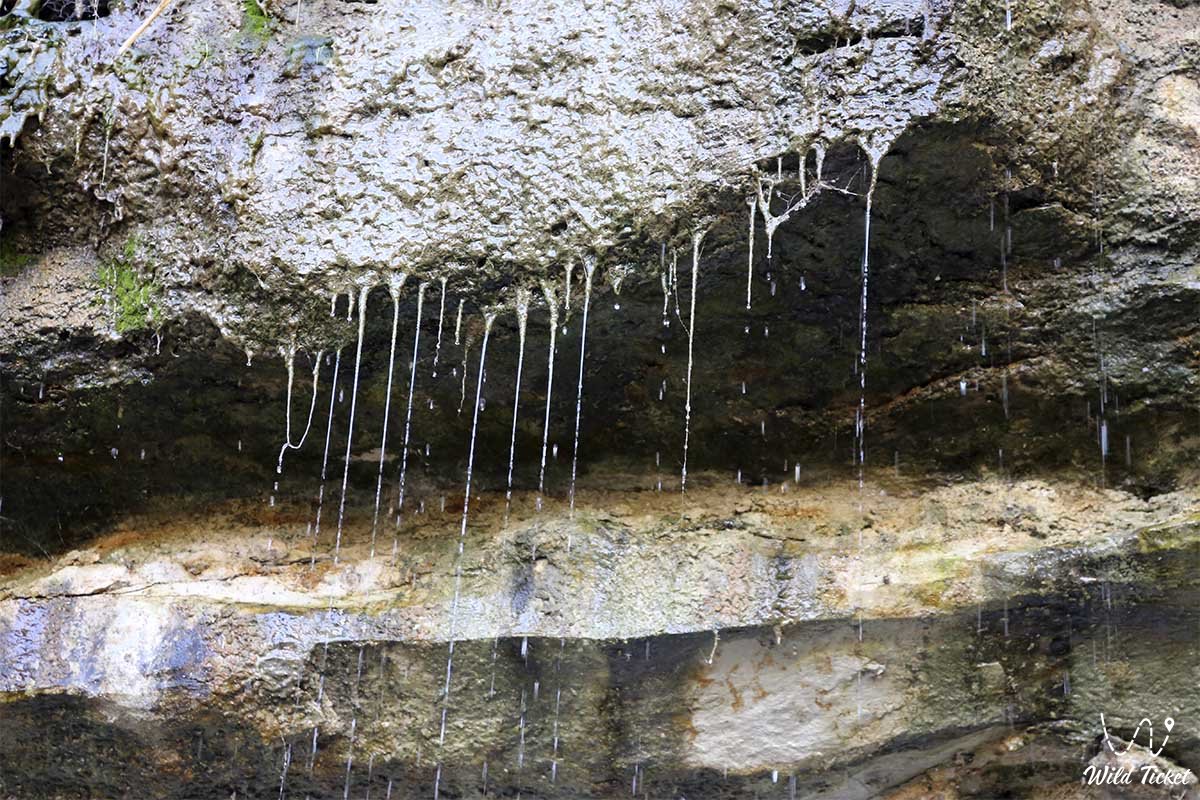
The crown jewel of the canyon is a cyclopean semicircular rock canopy, from whose lower stratum millions of crystal-clear drops continuously stream, forming the famous "weeping waterfall" that feeds a pool of cool fresh water. After resting under the murmur of Tamshaly's gentle cascades, overland travelers steer their 4x4 vehicles southeast toward the chalk castles of the Bozzhira tract, the glistening Tuzbair salt flat, banded Mount Bokty, the boundless Karynzharyk depression, and the strictly protected grounds of the Ustyurt Reserve.
For road-trippers and travelers, Tamshaly Canyon serves as an ideal seaside refuge: people travel here for the refreshing cool of natural spring waters beneath scorching desert skies, peaceful campsites framed by sea and stone, and the unforgettable sensation of standing under a curtain of crystal droplets echoing against ancient rock walls. Today, Tamshaly Canyon on Mangyshlak is recognized as a hallmark life-giving oasis of Mangystau and a favored destination for tourists, researchers, and explorers, beckoning with cool pure water, the sweet fragrance of blooming herbs, the shade of old trees, and proximity to secluded Caspian beaches.
--------------------------------------------
How to get there and visit –
Tamshaly Canyon is situated on the northern coast of the Tupkaragan Peninsula within the boundaries of the Tupkaragan district. The distance from the district center, the town of Fort-Shevchenko, is roughly 25–28 km to the northeast, from the village of Bautino – about 20–22 km, from the settlement of Tauchik – around 75 km, and from the regional administrative center of the city of Aktau – approximately 160–170 km along the paved coastal highway.
GPS geographical coordinates of Tamshaly Canyon:
44°35'18"N 50°35'33"E
The road route from Aktau leads north along the quality paved motorway Aktau – Fort-Shevchenko (via Akshukur and Sayyn Shapagatov) to Fort-Shevchenko or the settlement of Bautino (about 135–140 km). From Fort-Shevchenko and Bautino, a hard-packed gravel and dirt track heads northeast along the plateau rim toward the sinkhole of the Zhygylgan tract, where at kilometer 25 a distinct branch descends toward the upper reaches of Tamshaly Canyon. Total travel time from Aktau by car takes about 2–2.5 hours.
Access roads and terrain capability: standard passenger cars easily reach the upper parking area at the cliff edge during dry weather. However, descending to the very floor of the canyon down the steep rocky track, or driving through the dry wash to the Caspian coast, strictly requires a four-wheel-drive vehicle with high ground clearance (crossover or 4x4 SUV): sand by the sea is soft, and descents feature limestone boulders and rain gullies.
Foot route: most travelers leave their vehicles at the upper parking area and walk down to the canyon floor along a gentle foot trail cut into the stone. The walk to the weeping grotto and spring pool takes no more than 10–12 minutes at an easy pace. The trail is manageable for children and seniors, but requires sturdy footwear with good grip (sneakers or trekking sandals), as mossy slabs under the dripping waterfall can be slippery.
Environmental safety regulations: the Tamshaly tract is a fragile desert oasis.
Within the canyon, the following are STRICTLY PROHIBITED:
– Washing dishes, clothes, or using chemical soaps in the spring pool and stream;
– Breaking branches of relict trees (mulberry, poplar, willow) or lighting open campfires beneath them (portable gas camping stoves only);
– Leaving plastic trash, bottles, or food scraps;
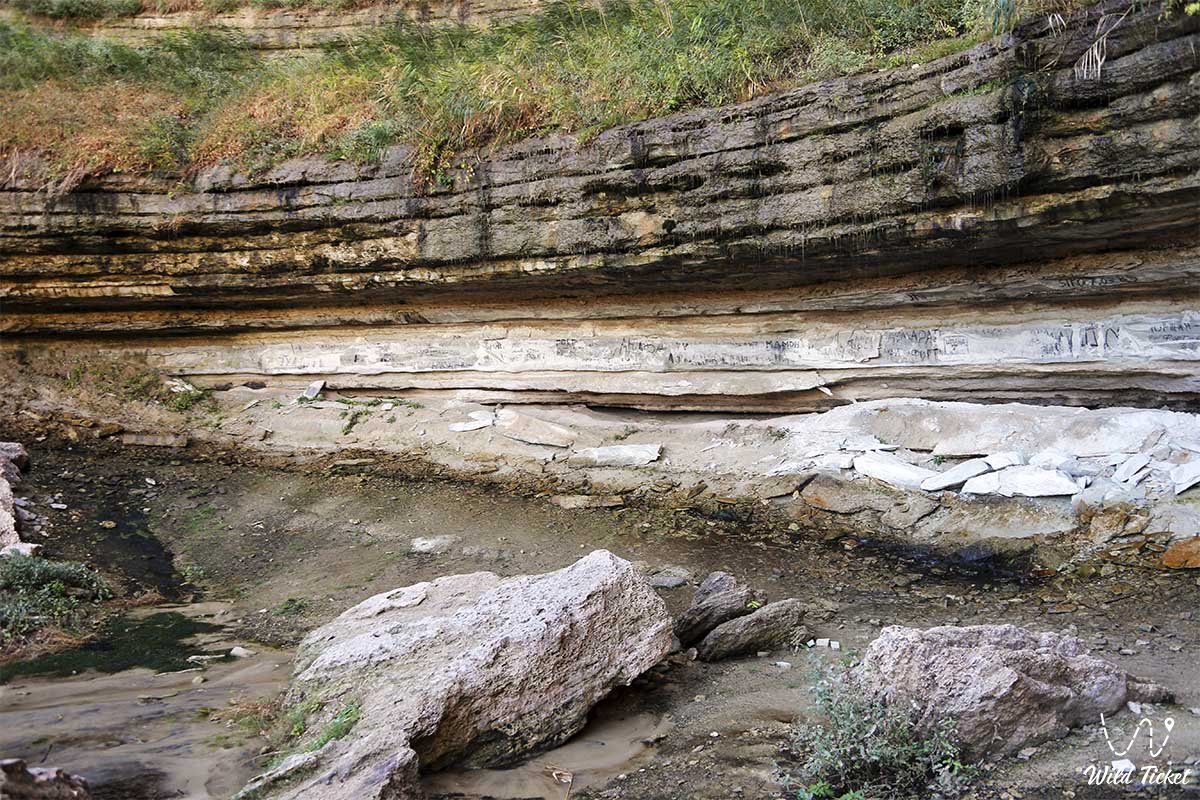
– Painting graffiti or scratching names onto the soft limestone walls of the amphitheater;
– Driving motor vehicles into the brook bed or onto the green grass of the oasis.
Infrastructure: the tract is an undeveloped natural reserve. Permanent hotels, cafes, and organized campgrounds are absent. The nearest brand-name gas stations, supermarkets, pharmacies, tire repair shops, and guesthouses are in Fort-Shevchenko and Bautino (20–25 km). For a day picnic or tent camping along the shore, travelers need an independent supply of food, drinking water (at least 4–5 liters per person), sun canopies, and warm layers for nighttime sea breezes. 4G mobile coverage is reliable on the upper plateau, but signal can drop under the overhanging limestone roof near the waterfall.
The best season to visit is spring from late April to early June: springs flow at their strongest, canyon slopes are bright with wildflowers, and the air carries the scent of wild mint. Summer months (July – August) are enjoyable because deep shade inside the amphitheater protects against forty-degree heat, and the Caspian Sea warms up nicely for swimming. Early autumn (September – October) is prime for quiet exploration: tourist crowds thin, the foliage of mulberries and poplars turns golden, and temperatures remain mild.
--------------------------------------------
History
The history of Tamshaly Canyon reaches back millennia, closely linked to maritime navigation, caravan trade, and nomadic life of Tupkaragan's Aday clans. The name "Tamshaly" originates from the Turkic word "tamshy" (drop) or the verb "tamshylau" (to drip, trickle), translating literally as "The Dripping Place", "Place of Drops", or "The Weeping Spring".
Since ancient times, this secluded source of fresh water served as a vital landmark for nomads and seafarers. In the parched climate of Mangyshlak, where fresh water was valued above gold, Tamshaly offered genuine sanctuary. On the upper plateau and gorge terraces, archaeologists have discovered Neolithic flint flakes and remnants of Bronze Age encampments.
During the Middle Ages, a busy caravan route passed through Tamshaly, connecting ancient roadsteads of Tupkaragan with inland routes toward Volga Bulgaria and cities of the Khiva Khanate. Caravans rested beneath the overhanging stone canopy to water camels, fill leather waterskins with sweet water, and shelter from sandstorms.
In the late 19th century, the canyon drew the interest of explorers. During his exile on Mangyshlak, Ukrainian poet Taras Shevchenko visited neighboring spring-fed oases of Tupkaragan, drawing inspiration from their wild scenery for his watercolors and sketches.
During the mid-20th century, Soviet hydrogeologists surveyed the water discharge of Tamshaly's springs, confirming the uniqueness of this closed water-bearing lens that captures condensation and precipitation across the limestone plateau. In recent decades, Tamshaly has become an emblem of regional nature tourism, drawing travelers from across the globe with its picturesque waterfall and serene atmosphere.
Information
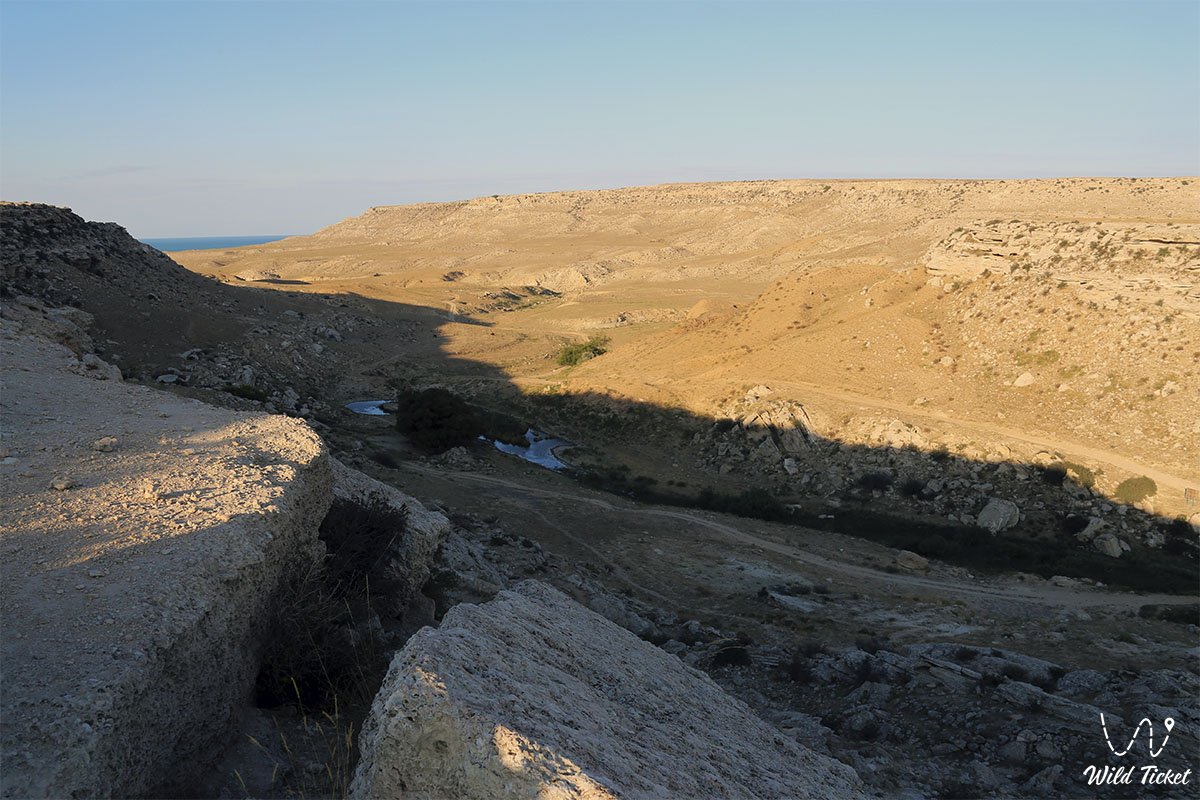
Morphometrically, Tamshaly Canyon is an erosional rocky wash running 2.5–3 kilometers in length, originating in the heart of the Tupkaragan Plateau and opening into a wide alluvial fan along the Caspian shore. The canyon depth ranges from 20 to 40 meters, while floor width varies from 15–20 meters in narrow clefts to 80–100 meters in wider basins. The elevation of the plateau rim stands at +20...+30 meters above sea level, whereas the canyon floor descends to the Caspian datum (-28 meters below world sea level).
The geological structure of the gorge exposes Neogene sedimentary strata from the ancient Tethys Ocean. Canyon flanks are formed by horizontal layers of porous, yellowish-brown Sarmatian coquina limestones, oolitic limestones, and underlying impermeable clays.
The primary landscape phenomenon is a cyclopean stepped amphitheater where the upper limestone stratum cantilevers over the floor like an immense wave-shaped canopy projecting out 10–12 meters. The aquifer lies directly at the contact between permeable limestones and underlying clays: groundwater filters through porous rock and pours continuously from the overhanging lip in hundreds of fine rivulets and droplets.
The hydrological regime is distinctive: spring water falls from the stone arch in a broad crescent, creating a natural weeping waterfall 4–6 meters high. Beneath the arch lies an emerald pool up to 1.5 meters deep, from which a brook winds through dense thickets down the rocky canyon floor, sustaining the entire oasis. The water is fresh, low in minerals, cool year-round (+12...+15 °C), and pleasant to taste.
Soil cover on the canyon floor consists of moist, dark-brown alluvial-meadow soils rich in leaf mold and humus, contrasting sharply with thin, stony gray-brown desert soils across the plateau.
The climate is temperate desert with noticeable maritime moderation. On open plateau plains, summer heat often exceeds +36...+38 °C, yet inside Tamshaly's sheltered cove evaporation and deep shade keep temperatures at +24...+27 °C. Winters are moderately cold, averaging -2...-5 °C in January; on freezing days, falling water droplets solidify into a curtain of giant icicles.
Detailed description of the venue
The natural landscape complex of Tamshaly Canyon encompasses the following morphological features, hydrological zones, and viewpoints:
• Overhanging rock amphitheater – a semicircular limestone wall with a projecting cornice that creates the impression of an enormous natural dome.
• Weeping waterfall cascade – a veil of millions of falling water droplets and slender streams echoing musically inside the canyon.
• Emerald spring lake – a sheltered stone basin of clear water under the dripping roof, fringed by mossy boulders and algae.
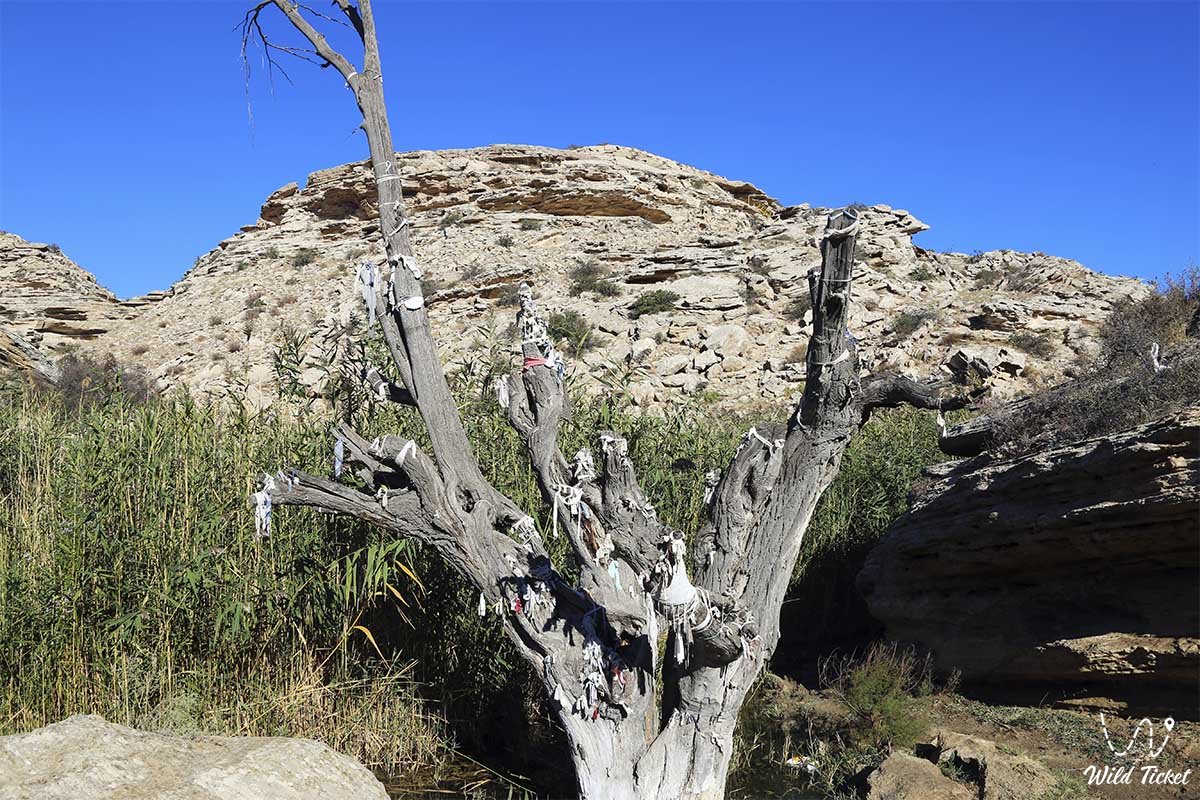
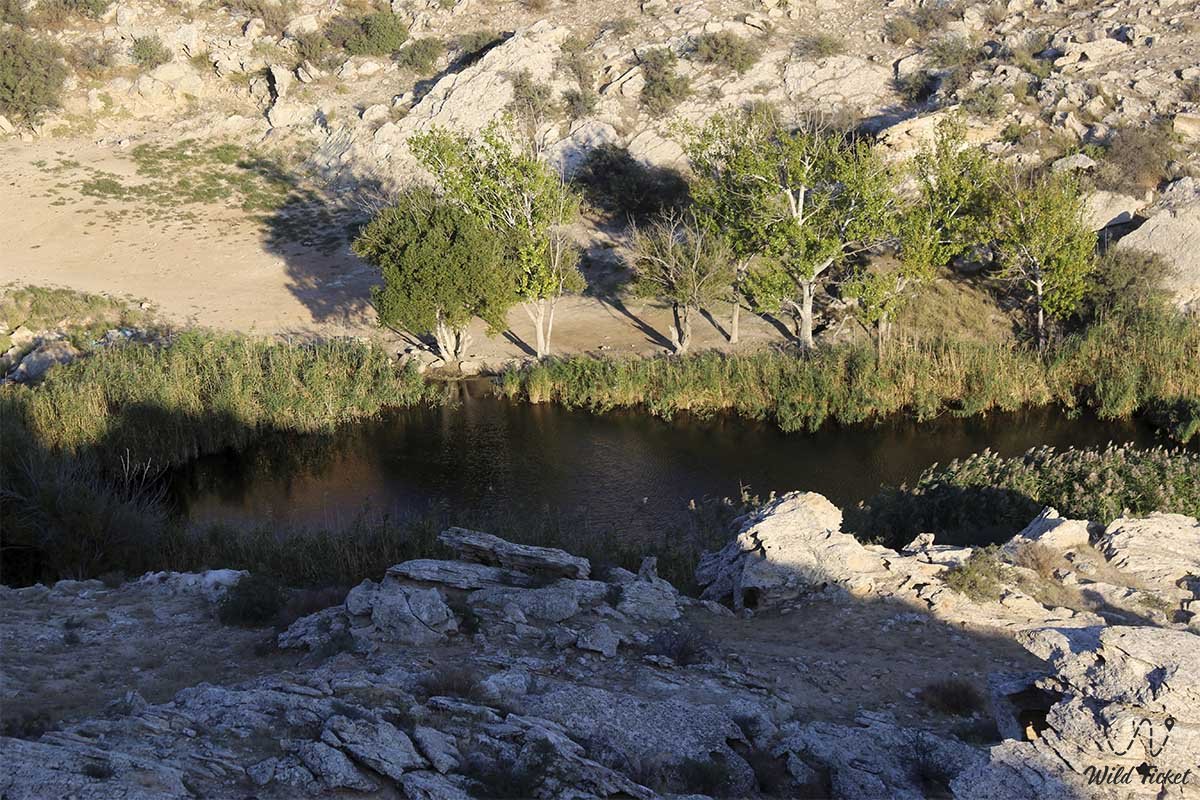
• Relict oasis grove – dense stands of old black and white mulberry trees, Dzhungarian willows, and silverberries forming a cool canopy.
• Stream bed of Tamshaly – a rocky-gravelly wash winding 1.5 km down the canyon through mint and reeds toward the sea.
• Marine beach at the canyon mouth – a secluded sand-and-coquina cove on the Caspian Sea featuring clear water and a gentle slope for swimming.
• Upper panoramic plateau rim – a natural viewing ledge along the chink edge opening onto sweeping vistas of the green canyon ribbon and the blue Caspian.
Flora and fauna
The vegetation of Tamshaly Canyon forms a lush green haven amidst the parched wormwood semi-desert of Tupkaragan. The pride of the gorge are centuries-old black and white mulberry trees that fruit abundantly in midsummer, accompanied by spreading Dzhungarian willows, gray-leaved poplars, and Russian olive trees. Amphitheater walls and mossy ledges are carpeted with liverworts, mosses, and maidenhair ferns (Adiantum). Thickets of fragrant peppermint, watercress, common reed, cattail, and wild blackberry trace the brook. Along the dry upper plateau rim grow gray-soil wormwood, boyalych, Anabasis salsa (biyurgun), and tamarisk shrubs.
Fauna in the oasis is diverse due to abundant fresh water, shade, and cover. Rock crevices and thickets harbor corsac foxes, badgers, steppe polecats, long-eared hedgehogs, and tolai hares. In the early morning, cautious bands of Ustyurt mountain sheep (mouflons / urials), listed in the Red Data Book of Kazakhstan, occasionally emerge along the cliffs.
Avifauna makes the gorge vocal. Mulberry and willow canopies shelter singing common nightingales, Eurasian golden orioles, European turtle doves, Turkestan shrikes, warblers, and pied wheatears. Rock niches in the amphitheater host colonies of rock doves, barn swallows, crag martins, and chukar partridges. Raptors such as the long-legged buzzard, lesser kestrel, saker falcon, and desert raven nest on upper cliffs. Along the sea shore forage Caspian gulls, mallards, ruddy shelducks, and great cormorants.
Herpetofauna includes the agile steppe agama, toad-headed agama, Caspian gecko, and dione snake. Dice snakes and marsh frogs inhabit the lake and brook, while green toads call in the evening.
Among invertebrates on dry stony slopes, solifuges (camel spiders), tarantulas, and steppe scorpions shelter beneath flat limestone slabs during the day.
Legend
A touching Kazakh legend tells of Beautiful Meret and the Droplets of Eternal Love in connection with Tamshaly Canyon.
Tradition recounts that long ago, a wealthy aul stood upon this plateau, ruled by a wise bi. He had an only daughter named Meret, celebrated for her rare beauty, gentle spirit, and compassionate heart. The maiden fell in love with a humble yet brave horse-herder, and the youth pledged his eternal devotion to her.
A devastating drought struck the land: wells dried up, pastures turned to gray dust, herds perished, and people languished with thirst. At that time, a proud and cruel khan from distant lands came to woo Meret, promising to save the aul from starvation in exchange for her hand in marriage. Refusing to betray her love, and knowing her beloved had departed into deep steppes to search for water, Meret descended to the floor of the deep ravine, knelt beneath the overhanging cliff, and prayed fervently to heaven to save her people.
She wept so inconsolably and purely that her tears began to seep through the solid stone. With every beat of her faithful heart, crystal droplets fell from the rock cornice. The drops multiplied into a benevolent waterfall that filled the oasis basin with pure spring water.
Meret herself transformed into the enduring spirit of the spring. The aul was saved, the cruel khan departed empty-handed, and when her beloved returned, he remained in the gorge as guardian of the weeping rocks. Ever since, people have called this canyon Tamshaly, believing its droplets are tears of devoted love that soothe inner sorrow, restore hope, and grant peace to every wanderer who visits with a pure heart.
Conclusion
Tamshaly Canyon is a treasured gem and life-giving symbol of Tupkaragan, where the austere majesty of limestone cliffs blends with the delicate melody of crystal water droplets, the deep shade of old mulberries, and the open horizon of the Caspian Sea. A journey to Tamshaly offers restful hours in the cool natural amphitheater, a refreshing taste of living springs, and serene beach relaxation on the edge of Mangystau's untouched wilderness.
Interesting sights nearby:
• Zhygylgan Sinkhole with tracks of saber-toothed cats;
• Rocky Cape Tyub-Karagan;
• Tyub-Karagan Bay;
• Tupkaragan Peninsula;
• Bautino Seaport Village;
• Fort-Shevchenko Town-Museum;
• Khanga-Baba Tract Oasis;
• Khanga-Baba Necropolis;
• Saura Canyon (Lake Karakup);
• Koshak Bay;
• Buzachi Peninsula;
• Cape Bagarzhik;
• Blue Bay;
• Torysh Valley;
• Mount Sherkala;
• Kokala Tract.
Sacred sights and pilgrimage destinations:
• Beket-Ata Underground Mosque;
• Karaman-Ata Underground Mosque;
• Shakpakty-Ata Underground Mosque;
• Sultan-Epe Underground Mosque;
• Kolbas Ishan Mosque;
• Koben Mosque;
• Zholaskan Mosque;
• Nurbergen Kalyshev Mausoleum;
• Zhaman Sauran Mosque;
• Ishan Khozha Mosque;
• Itolla Mosque;
• Sonabay Underground Mosque;
• Masat Ata Mosque;
• Uytoly Ata Underground Mosque;
• Bayte Sanctuary.
Photogallery: