19th-century architectural masterpiece with 22 rooms and 28 domes –
Korkembay-Akhun Mosque represents an outstanding 19th-century monument of urban planning, architecture, and spiritual enlightenment in the Beyneu district of the Mangistau Region. Located approximately 40 kilometers southwest of Beyneu village within the "Manashi" State Complex Nature Sanctuary (part of the "Kyzylsai" Regional Nature Park), this majestic multi-domed mosque-madrasah is the largest above-ground religious structure of its era in the north of the region.
Commissioned by a wealthy member of the Aday tribe (Akbota-Zhemeney subclan), the mosque impresses with the scale and complexity of its engineering design: the rectangular-in-plan building without a deep foundation, erected on a single-stepped plinth, unites 22 interior rooms and is crowned with 28 distinct domes. The walls of the structure are built from mudbrick (adobe) and carefully faced on the exterior with slabs of local shell-rock limestone – a sedimentary rock formed millions of years ago on the floor of the ancient Tethys Ocean and the Sarmatian Sea.
Until 1928, the mosque bore the name of its spiritual mentor Bekturlyuly Korkembay-Akhun and served as the principal educational center of northern Mangyshlak and Ustyurt, where the most prominent akhuns and ishans of their time taught.
Within the geographic and sacred space of the Beyneu district and the northern chink of the Ustyurt plateau, Korkembay-Akhun Mosque sits surrounded by iconic historical and natural landmarks:
– directly within the boundaries of the "Manashi" Nature Sanctuary and the eponymous gorge lie the ancient Kyzyltas fortification and the famous pantheon of Mangystau – the Sisem-Ata necropolis;
– 40 kilometers to the northeast lies the district administrative center – Beyneu village, near which the underground Beket-Ata Mosque (Old Beyneu) is concealed inside a chalk ravine, while further east within the district stands Akzhigit settlement;
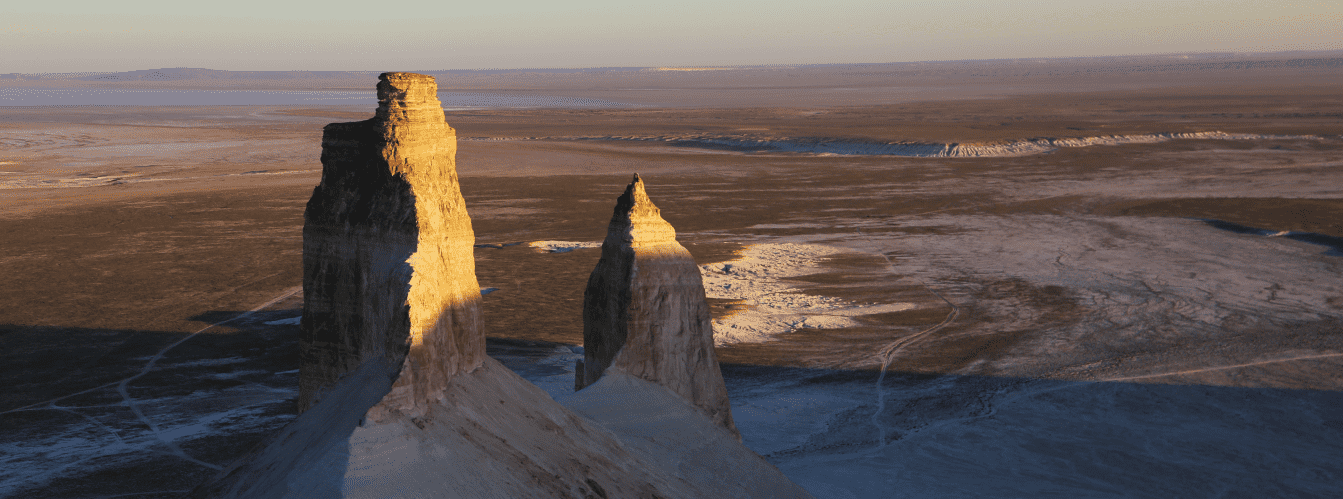
– to the west and northwest beyond the cliffs of the northern chink of the Ustyurt plateau stretch the grandiose Pre-Caspian lowlands – the Kaidak bay and salt marsh and the vast shallow Dead Kultuk Bay;
– to the southwest across the steppes and escarpments of Ustyurt run routes toward Saiotes village, the Tuzbair salt marsh, and the central ridges of the Mangyshlak peninsula.
--------------------------------------------
How to get there and visit –
Korkembay-Akhun Mosque is located in the Beyneu district of the Mangistau Region within the "Manashi" Nature Sanctuary, approximately 40 km southwest of Beyneu village. The distance from the regional administrative center of the city of Aktau is around 430–450 km via motor roads and steppe dirt tracks, and from Saiotes village – about 165–180 km.
GPS geographic coordinates of Korkembay-Akhun Mosque:
45°01'34"N 54°59'27"E
45.026111, 54.990833
Route from Beyneu and Aktau: the most convenient route to the monument starts from Beyneu village, which can be reached from Aktau, Atyrau, or Aktobe via paved highway or by passenger train to Beyneu station (a road from the direction of Akzhigit settlement also passes through Beyneu). From Beyneu village, head southwest along the highway toward Saiotes village and Aktau, then turn onto a steppe track heading toward the "Manashi" gorge and sanctuary. The entire journey from Beyneu takes about 1–1.5 hours. Public transport does not serve the mosque, so the trip can be made in a private off-road vehicle or as part of an organized excursion.
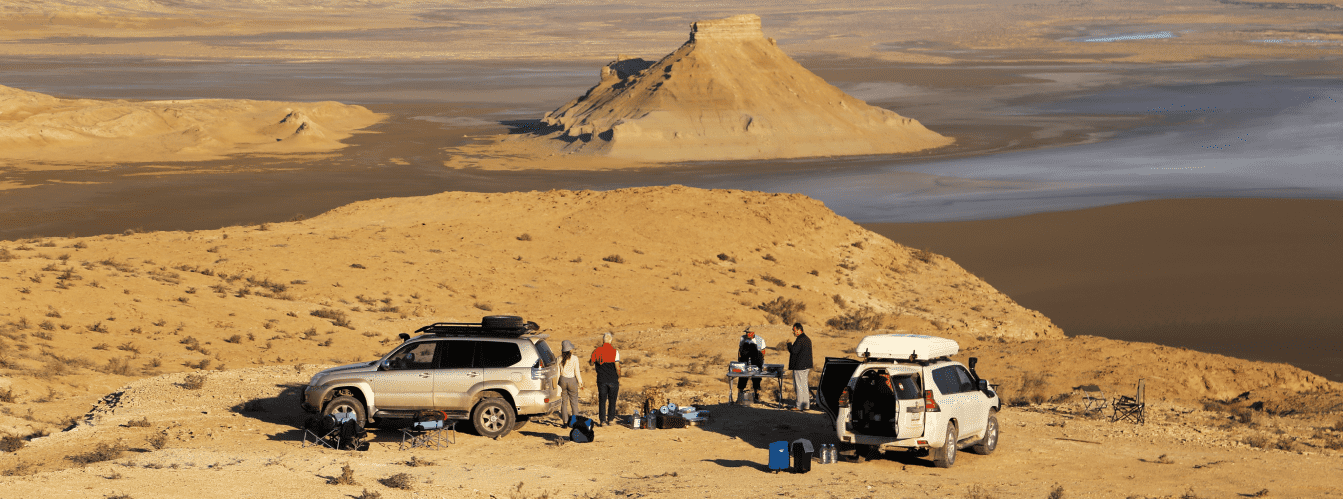
Vehicle requirements: a four-wheel-drive 4x4 off-road vehicle with high ground clearance is recommended for visiting Korkembay-Akhun Mosque. The final stretch of the route runs along steppe ruts and stony-clay sections of the "Manashi" sanctuary, which become difficult for standard passenger cars to pass after rains and spring snowmelt.
Safety rules and pilgrimage etiquette:
Korkembay-Akhun Mosque is a state-protected architectural monument located within a nature sanctuary:
– when touring the mosque, maintain silence, respect pilgrim traditions, and wear modest, covered clothing (covered shoulders and knees, and a headscarf for women);
– given the fragility of the mudbrick walls and the condition of individual domes (some of which have suffered from time and precipitation), climbing onto the roof, domes, and walls of the monument is strictly prohibited;
– within the "Manashi" sanctuary, leaving worn tracks, lighting campfires, hunting, and leaving household litter are prohibited;
– mobile reception in the gorge area is unstable, so download offline maps in advance and bring a supply of drinking water.
Infrastructure: directly beside Korkembay-Akhun Mosque, any tourist infrastructure, shops, cafes, and gas stations are absent (the grounds are enclosed by a stone wall, and three ancient wells stand nearby). All necessary services – hotels, cafes, supermarkets, gas stations, auto repair shops, and a railway station – are located 40 km northeast in Beyneu village.
Seasonality: visiting the monument is possible year-round in dry weather. The most comfortable times for excursions and pilgrimage are spring (April – May), when the steppes of the "Manashi" sanctuary turn green and bloom with wild tulips, as well as autumn (September – October). In summer, daytime heat on the Ustyurt plateau reaches +42...+45 °C, while in winter icy winds blow amid frosts down to -30 °C.
--------------------------------------------
History
The history of Korkembay-Akhun Mosque reflects the flourishing of spiritual, educational, and architectural traditions in Mangystau during the second half of the 19th century, as well as the dramatic events of the Soviet repressions of the 1920s.
The monumental mosque building was erected in the 19th century at the expense and commission of a wealthy local resident from the Aday tribe (Akbota-Zhemeney subclan). The complex received its name in honor of the distinguished theologian, preacher, and educator Bekturlyuly Korkembay-Akhun. Until 1928, the mosque served as a major spiritual and educational center for the entire Beyneu region: a madrasah operated alongside it, where children and youths from all across the surrounding lands studied literacy, the Arabic language, the fundamentals of Islam, and ethics. Respected religious mentors of the region taught within the walls of this madrasah – Abdulla-Khazret, Shaudyr-Ishan, Karakalpak Matkarim, and other learned akhuns.
In 1928, during the anti-religious campaign and Bolshevik persecutions, the educational activities of the complex were forcibly halted: the mosque was closed, teachers and pupils were dispersed, and Korkembay-Akhun himself, fleeing repression, was forced to leave his homeland and relocate to Tajikistan. Exact records of the date of his passing and burial place in foreign lands have not survived, yet the memory of the wise mentor has remained forever among the people.
In 1991, large-scale restoration work was carried out on the monument: craftsmen restored damaged sections of the walls and domes and erected a protective flagstone wall around the complex. In 1992, the site was thoroughly surveyed by an expedition of the Kazakh Research Institute for Problems of Nomadic Cultural Heritage led by A. M. Kogalbayeva. The mosque was first placed under state protection by Decision of the Regional Akim No. 362 dated January 7, 1993, and by Decree of the Akimat of the Mangistau Region No. 279 dated July 28, 2010, it was officially entered into the State List of Monuments of History and Culture of Local Significance.
Information
Korkembay-Akhun Mosque is a monument of urban planning and architecture of local significance of the Republic of Kazakhstan, located within the "Manashi" State Complex Nature Sanctuary in the Beyneu district of the Mangistau Region.
Main historical and administrative parameters:
– status: monument of history and culture of local significance (Decree of the Akimat of the Mangistau Region No. 279 dated 28.07.2010);
– dating: 19th century (operated as a mosque-madrasah until 1928; restored in 1991);
– geographic reference: "Manashi" gorge and sanctuary ("Kyzylsai" Nature Park), 40 km southwest of Beyneu village, near the northern chink of the Ustyurt plateau and the Kaidak and Dead Kultuk salt marshes.
Architectural and structural features:
– layout and composition: a large rectangular-in-plan single-story building without a sunken foundation, set upon a single-stepped stone plinth; comprises 22 interior rooms and is crowned with 28 domes of varying sizes;
– building materials and geology: load-bearing walls are constructed from mudbrick (adobe), plastered on the interior, and faced on the exterior with hewn slabs of local shell-rock limestone formed on the floor of the ancient Tethys Ocean and Sarmatian Sea;
– facade decor: entrances are placed on the main eastern and western facades, window openings are cut into the walls, and the corners and wall planes of the facades are adorned with paired decorative pilasters.
Detailed site description
The architectural and historical complex of Korkembay-Akhun Mosque is shaped by the following key elements:
• Four central prayer and study halls – the core of the mosque building, roofed with tall domed vaults supported by massive square-section interior columns.
• Enfilade of perimeter rooms (22 rooms in total) – study cells (hujras) and auxiliary chambers encircling the central halls along the perimeter, interconnected by arched openings and crowned by 28 domes.
• Exterior limestone cladding with pilasters – a protective shell of marine limestone slabs from the Tethys Ocean epoch with paired vertical pilasters at the corners and facades, lending the building a monumental appearance.
• Three ancient steppe wells – hydraulic structures beside the mosque that supplied water to students, pilgrims, and caravans (historically, one well yielded pure fresh water for drinking while two were used for watering livestock; currently, water in two of the wells is suitable for drinking, while the third is bitter-salty).
• Flagstone perimeter wall – a protective enclosure built during the 1991 restoration to safeguard the complex.
Legends
The name of the educator Korkembay-Akhun and the three wells beside his 28-domed mosque have been preserved in the oral traditions of Beyneu district residents as a symbol of the thirst for knowledge and spiritual fortitude.
The Tale of the Twenty-Eight Domes of Light and the Three Wells of Korkembay-Akhun:
Elders of Beyneu recount that when a wealthy bay from the Akbota-Zhemeney clan decided to erect a grand mosque in the steppe, he invited the wise mentor Korkembay-Akhun to choose the site and guide the builders. The akhun pointed to a quiet hollow in the Manashi tract and said: "Let a house of knowledge rise here, where every dome will be like a star illuminating the path for those lost in the darkness of ignorance." Craftsmen raised 22 spacious rooms and crowned them with 28 domes, while digging three deep wells nearby – one with crystal-sweet water for pupils thirsting for knowledge, and two for the horses and camels of wayfarers. It is said that when foreign authorities forced the akhun to leave his native steppe for distant Tajikistan in 1928, he embraced the stone wall of the mosque before parting and spoke: "These stones remember the prayers and voices of children – as long as these domes stand, the light of knowledge will never fade from the land of Mangyshlak."
--------------------------------------------
Conclusion
Korkembay-Akhun Mosque is a unique 19th-century architectural and spiritual monument attesting to the high level of building craftsmanship and educational traditions in the Mangistau Region. Visiting this 28-domed ensemble in the "Manashi" Nature Sanctuary will be a vivid discovery for travelers exploring the Beyneu district, the Ustyurt plateau, and the ancient sanctuaries of Western Kazakhstan.
Nearby attractions:
• Beyneu Village;
• Akzhigit Settlement;
• Kaidak Bay and Salt Marsh;
• Dead Kultuk Bay;
• Ustyurt Plateau;
• Tuzbair Salt Marsh (Sor);
• Mangyshlak Peninsula;
• Sisem-Ata Necropolis;
• Underground Beket-Ata Mosque (Old Beyneu);
• Saiotes Village;
• "Manashi" Nature Sanctuary ("Kyzylsai" Nature Park);
• Kyzyltas Fortification.
Photogallery: