Monument of Kazakhstan's sacred geography and white-stone mazar on Tupkaragan –
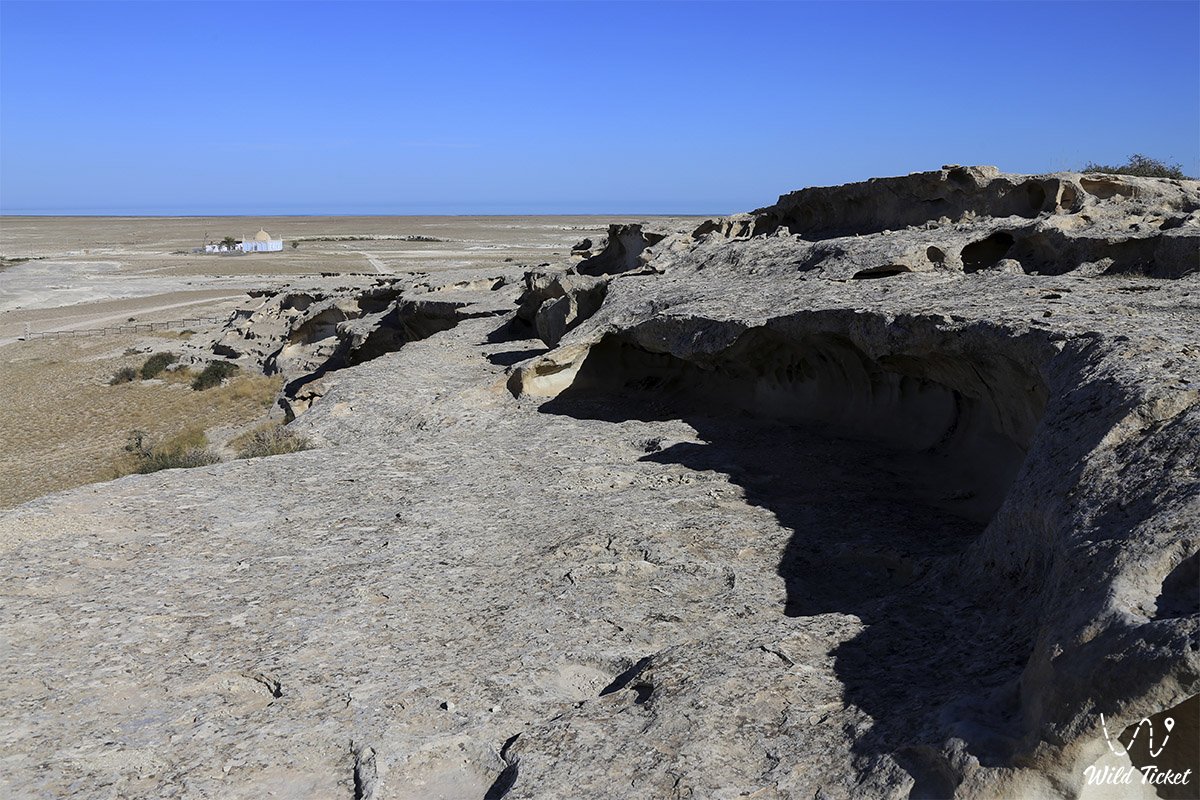
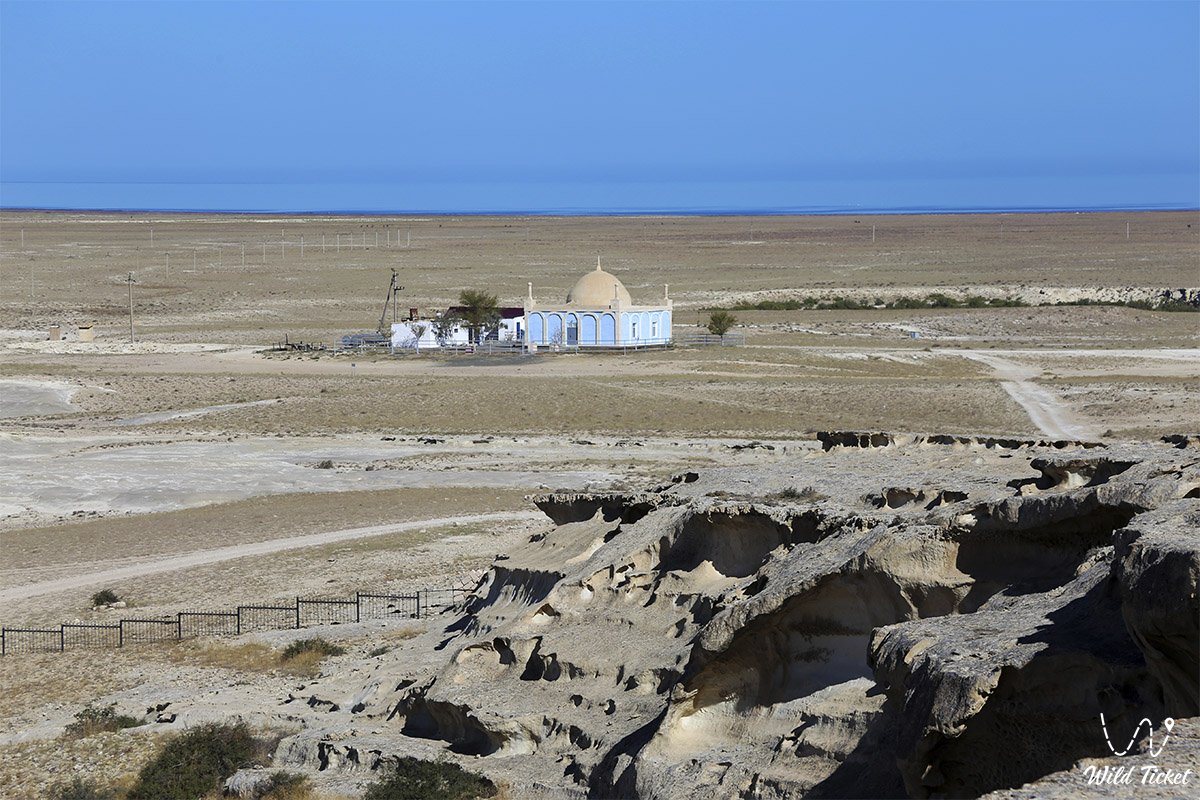
The Bektemis Yerzhan Khazret Mausoleum (Kaz. Bektemis Erzhan khaziret kesenesi) represents a revered spiritual and historical memorial complex in the west of Kazakhstan. This monument of sacred architecture is erected upon the open desert elevations of the Mangyshlak Upland in the eastern sector of the Tupkaragan district, approximately 30 kilometers northeast of Tauchik village.
This entire holy area serves as an acknowledged spiritual landmark of the Mangystau region: by resolution of the regional akimat on January 5, 2018, the complex was inscribed onto the State List of Historical and Cultural Monuments of Local Significance and integrated into the national register of the "Geography of Sacred Places of Kazakhstan" project.
A few kilometers to the north stretch the shelving shores and shallow inlets of Sarytas Bay, where the Caspian Sea rolls its waves, tempering the parched desert atmosphere of the coastal plateau.
In the expedition and pilgrimage logistics of Northern Mangystau, the burial of Bektemis Yerzhan Khazret occupies an important place as a spiritual waystation en route to the ancient shrines of Tupkaragan. Approximately 130–140 kilometers to the southeast along motor highways lies the regional administrative center of Aktau, from where overland groups depart through the seaside village of Akshukur toward Tauchik.
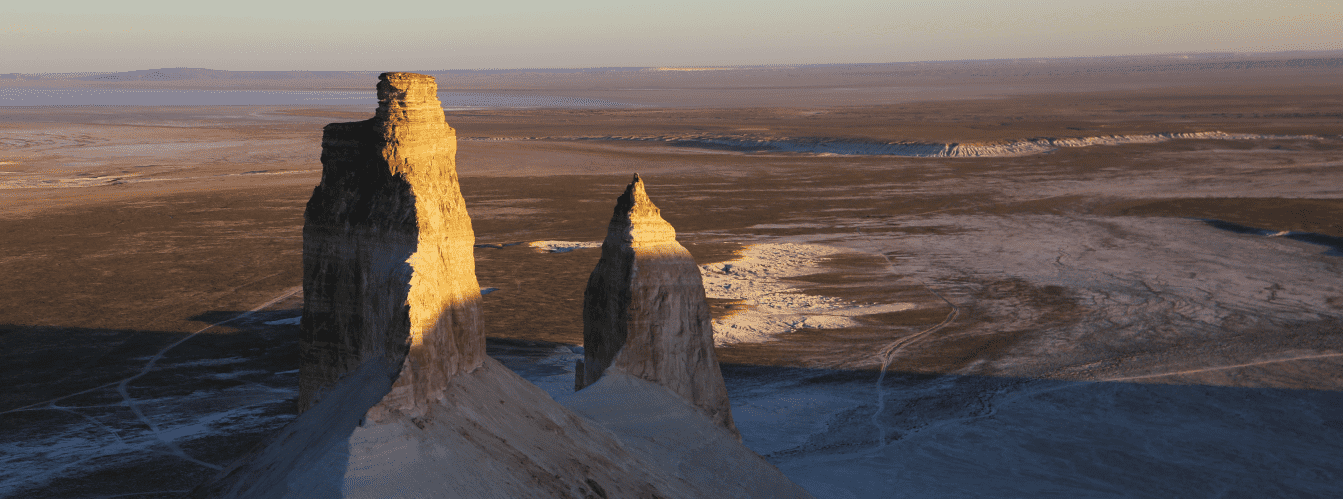
Directly adjacent to the complex lie deep chalk defiles: the grandiose Shakpaktysay Canyon with the rock-cut underground Shakpak-Ata mosque (UNESCO site) and necropolis, the triad of the Ungoza table mountains, the snow-white Kapamsay Canyon with its mulberry grove in a grotto, Kokbulaksay cleft, the Zhygylgan sinkhole, the spring-fed Tamshaly gorge with weeping cliffs, the Turtle Lake of Saura Canyon, and Cape Tyub-Karagan.
The geological basement of the adjacent plateau is formed of dense strata of chalk, marls, and Sarmatian coquina limestones deposited at the bottom of the vanished ancient Tethys Ocean. From the mazar, steppe ruts lead east and southeast into the core of the Mangyshlak Peninsula: toward the sacred peak of Mount Otpan-Tau with the Aday-Ata complex, the mystical spherical concretions of the Torysh Valley, the solitary residual Mount Sherkala, the colorful Jurassic clays of the Kokala tract, and the narrow slate gorge of Karadayirmen.
The primary draw of the complex is the memory of the religious figure, scholar-educator, and polyglot Yermukhammed Tolegenuly (Bektemis Yerzhan Khazret), a graduate of Bukhara's Kukeldash Madrasah who followed the spiritual tradition of Beket-Ata and preserved his faith through decades of Stalinist labor camps and exile.
Following prayer at the holy site, pilgrims and researchers travel southeast toward the chalk chinks of the Bozzhira tract, the gleaming Tuzbair salt flat, Mount Bokty, the Karynzharyk depression, and the strictly protected lands of the Ustyurt Reserve.
Today, the Bektemis Yerzhan Khazret Mausoleum is recognized as a place of inner quiet and living historical remembrance. Pilgrims, historians, local researchers, and road travelers visit seeking prayerful seclusion, blessings for benevolent deeds, and communion with the heritage of an unyielding educator of Mangystau.
--------------------------------------------
How to get there and visit –
The Bektemis Yerzhan Khazret Mausoleum is situated in the desert terrain of the Mangyshlak Upland, in the eastern sector of the Tupkaragan district, roughly 30 km northeast of the hub village of Tauchik and near Shakpaktysay Canyon. The distance from the city of Aktau is around 130–140 km, from the district center town of Fort-Shevchenko – roughly 95–100 km, and to the shoreline of Sarytash Bay – approximately 5–6 km.
GPS geographical coordinates of the Bektemis Yerzhan Khazret Mausoleum:
44°26'15"N 51°08'08"E
44.433783, 51.137719
The road route from Aktau runs north along a quality paved highway via Akshukur to the large village of Tauchik (about 95–100 km of asphalt). Near Tauchik, the route turns northwest onto a well-traveled gravel and steppe dirt road toward the Shakpak-Ata complex and Sarytas Bay (an additional 30–35 km across the plateau). The road crosses level and gravelly stretches of steppe directly to the memorial complex. Travel time from Aktau by car takes about 2–2.5 hours.
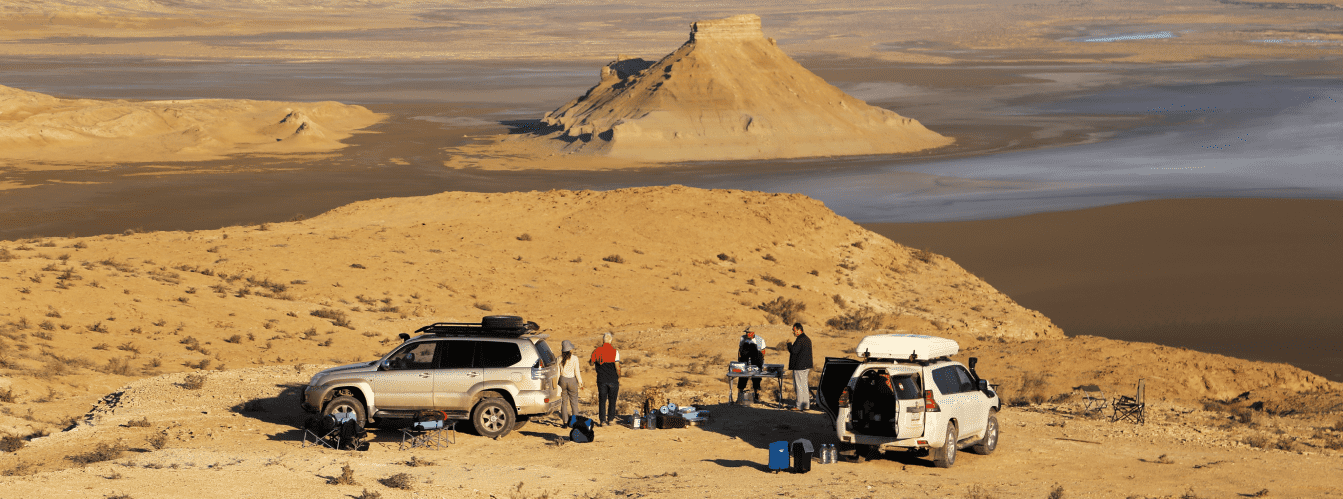
Access roads and terrain capability: during dry weather, passenger crossovers and high-clearance sedans can carefully reach the burial complex. However, for safe travel across the steppe tracks of Tupkaragan, crossing sandy washes, and driving after precipitation, a four-wheel-drive vehicle (4x4) is strictly recommended. During rare spring or autumn downpours, the clay steppe tracks turn slick, posing a hazard of bogging down.
Visiting regulations and sacred etiquette: the mausoleum is an active Islamic sanctuary and a landmark of sacred geography.
During a visit, the following are STRICTLY MANDATORY:
– Dressing modestly: men are prohibited from entering in shorts or sleeveless shirts; women must cover their shoulders and knees, and wear a headscarf;
– Maintaining reverent silence, refraining from raising voices, silencing phones, and avoiding disturbances to worshippers;
– Removing shoes before entering prayer halls and interior chambers;
– Defacing walls with paint or scratching inscriptions into the stone is strictly forbidden;
– Damaging ancestral stone masonry in the adjacent necropolis is prohibited;
– Refraining from lighting open campfires in the wind (portable gas burners only for tea preparation);
– Packing out all domestic waste to preserve the cleanliness of the holy ground.
Infrastructure: a pilgrim guest house (tunehana) operates at the complex, where travelers can rest from the road, lodge overnight, draw fresh water, and recite prayers. Commercial shops, cafes, and fuel stations are absent on site. Along the Caspian shore near the mausoleum stands the "Sartas" visitor center, which features guest yurts for overnight stays and a cafe.
Core town amenities (network gas stations, supermarkets, pharmacies, automotive repair, and tire shops) are situated in Tauchik (30 km). For self-contained road travel, maintain a supply of potable water (at least 5 liters per person per day), reserve fuel, provisions, and warm layers for cool desert nights. 4G cellular service connects periodically on the elevated plateau around the mazar, though weather shifts can weaken reception.
The best season to visit is the dry shoulder period: spring from late April to early June and early autumn in September – October. During these months, temperatures remain pleasant (+20...+25 °C), intense steppe heat is absent, and tracks remain dry. In July and August at midday, temperatures reach +38...+40 °C, so visits are best scheduled for early morning or pre-sunset hours.
--------------------------------------------
History
The history of this sacred site is intertwined with the tragic and heroic chronicles of the 20th century, spiritual endurance, and educational work on Mangyshlak.
The Islamic scholar Yermukhammed Tolegenuly, remembered as Bektemis Yerzhan Khazret, was born in 1887 in the Kerel locality of present-day Mangystau. Having received his primary spiritual schooling in his native land, the young man journeyed to Bukhara—the recognized center of Islamic learning in Central Asia. There he entered the famous Kukeldash Madrasah (with historical accounts also noting study at Mir-i Arab), graduating in 1926 with the title of teacher and the spiritual rank of khazret.
Returning to the Mangyshlak steppe, Yerzhan Khazret dedicated himself to education. Fluent in Arabic, Persian, Chagatai, and Uzbek, he assembled an extensive library of rare manuscripts and books, constructed mosques (including in the Sorkudyq tract), and taught children literacy, sciences, and ethics. Following the spiritual path of Beket-Ata, the khazret championed peaceful community life, justice, mutual assistance, and an end to inter-clan discord.
During the Soviet era and periods of state atheism, the khazret's religious and teaching work faced harsh persecution. Yerzhan Khazret was subjected to unfounded arrests and trials four times for remaining steadfast in his beliefs: in 1932, 1936, 1937, and 1941, he was sentenced on charges of religious activity and anti-Soviet agitation. In the final instance, he received a ten-year sentence in corrective labor camps.
Having endured the harsh labor camp system, he was released under amnesty, yet remained under official surveillance until the end of his life. Despite prohibitions, the khazret remained a man of integrity, quietly guiding the faithful and youth. Yerzhan Khazret passed away in 1966 and was laid to rest with deep honors in his ancestral burial ground. In 2018, the site was granted official status as a historical and cultural monument.
Theologian-scholar and educator Bektemis Yerzhan Khazret
Yermukhammed Tolegenuly (Bektemis Yerzhan Khazret) endures in the annals of Mangystau as an emblem of spiritual resilience, scholarly learning, and humanism.
Contemporaries remembered him as a person of few words, distinguished by quiet dignity, kindness, and humility. Fluent in several Eastern languages, he held encyclopedic knowledge in Quranic studies, Islamic jurisprudence, oriental medicine, philosophy, and natural sciences. His writings and translations were preserved by students during years of suppression.
A remarkable facet of the khazret's work was his practical assistance with survival in the arid desert. Alongside theology, he brought advanced irrigation and plant-breeding methods from Bukhara. In the waterless Qundyqudyq tract, Yerzhan Khazret used an agricultural technique: he made small slits in the root systems of wild camelthorn (dzhantak)—whose roots delve deep into groundwater—and grafted melon seeds into them. Sweet Bukhara melons ripened across the unwatered steppe, perceived by his kin as a miracle.
The khazret taught people to live by honest labor, value learning, and prioritize compassion. Pilgrims believe that prayer at his resting place brings clarity of mind, inner fortitude to face hardship, and blessings for studies and honest endeavors.
Architecture and information
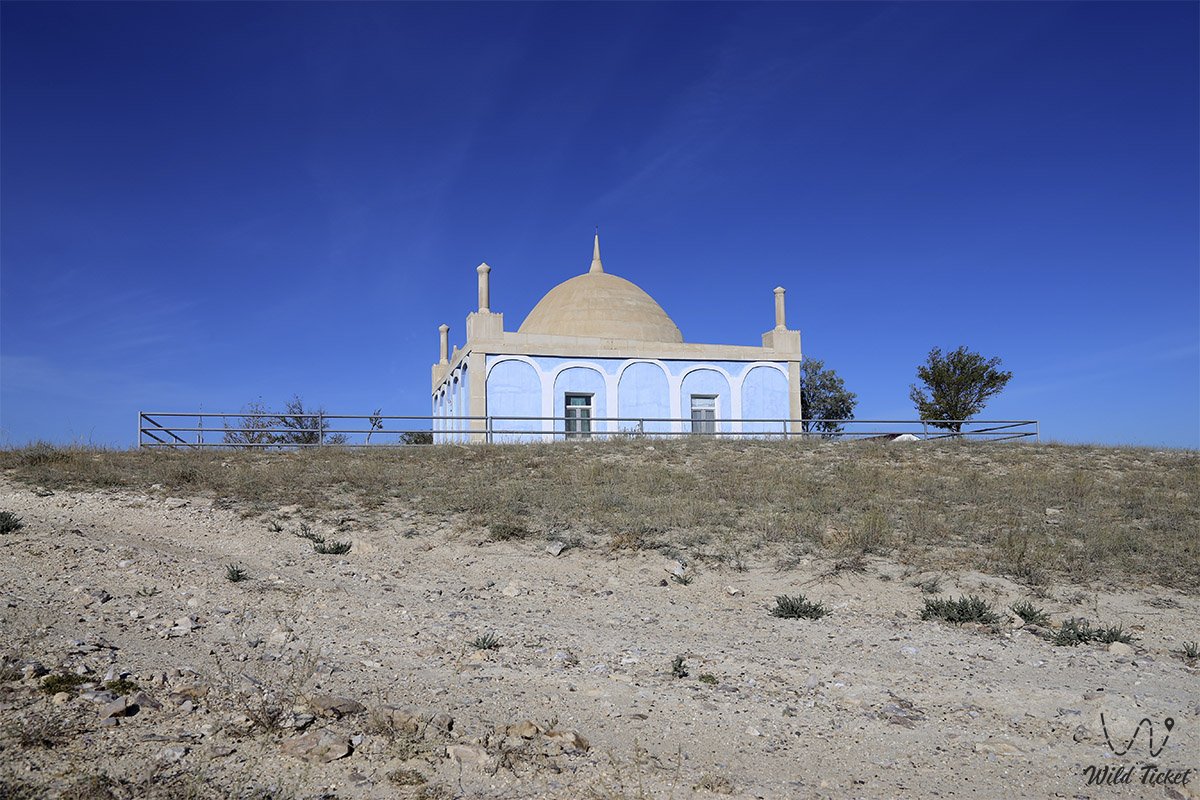
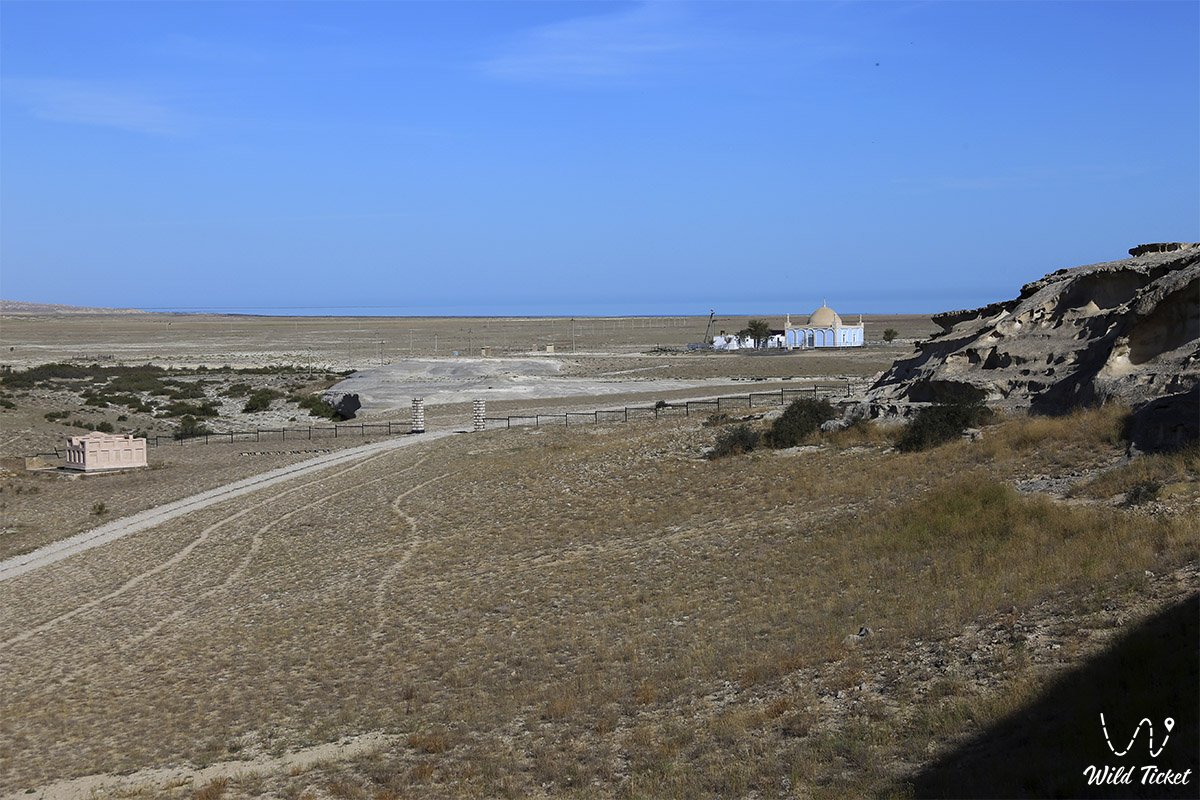
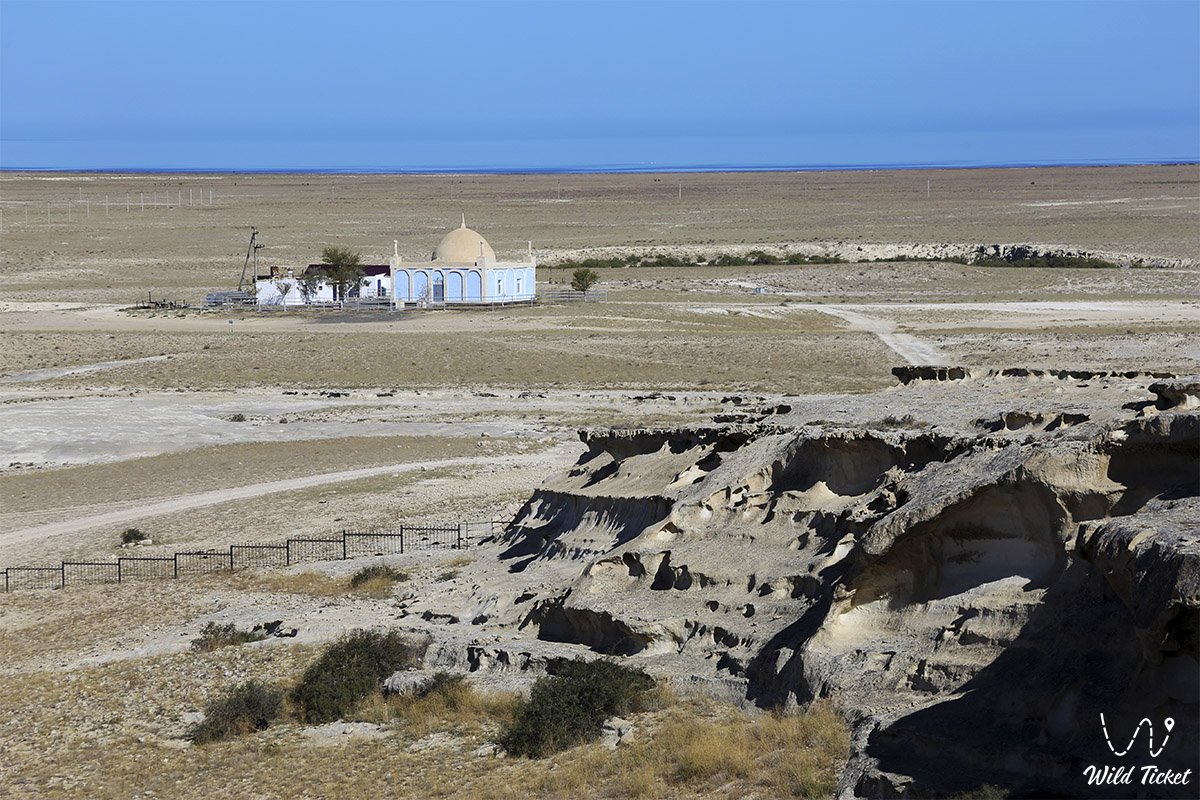
Architecturally and spatially, the memorial complex of Bektemis Yerzhan Khazret consists of a white-stone mazar, an ancestral necropolis, an active mosque, and a pilgrim house. The memorial is situated on open desert upland at absolute elevations of +60...+80 meters above sea level.
The mausoleum was constructed by stonemasons in harmony with Mangystau's sacred building traditions. In plan, the building represents a portal-domed structure built of blocks of dressed sandstone and coquina limestone. The main entrance features a formal portal with a pointed arch, while the mazar is crowned by a dome bearing a crescent finial. The pale stone blends with the ochre tones of the surrounding landscape.
Inside the mausoleum rests a stone sagana, ornamented with carved bands and Arabic calligraphy displaying Quranic verses and the name of the holy man. The masonry provides thermal insulation, maintaining shade in summer and shielding against steppe winds in winter.
The geological base of the foundation is set upon bedrock of the Paleogene and Neogene periods from the Tethys Ocean. The surrounding terrain is composed of erosional clay-gravel deposits.
The hydrological supply of the pilgrim complex is maintained by an artesian well drilled to an underground freshwater aquifer.
The climate is sharply continental with distinct seasonal contrasts. Summers are dry and hot, with average July temperatures of +28...+30 °C (daytime peaks exceeding +40 °C). Winters are windy and cold, averaging -4...-8 °C in January. Annual precipitation is sparse at roughly 130–150 mm.
Detailed description of the venue
The sacred memorial complex of Bektemis Yerzhan Khazret encompasses the following key structures, facilities, and commemorative areas:
• White-stone domed mausoleum – a portal-domed mazar of carved coquina stone erected over the resting place of Yermukhammed Tolegenuly.
• Interior commemorative sagana – the stepped stone tomb of the khazret, decorated with calligraphic inscriptions and carved relief ornament.
• Complex prayer mosque – a separate hall for daily prayers by pilgrims and memorial services.
• Traditional pilgrim house (tunehana) – a guest complex providing a dining room, resting quarters, ablution areas, and an on-site caretaker.
• Ancestral necropolis – the historic cemetery surrounding the mazar, featuring traditional Kazakh headstones, koytas stelae, and stone enclosures.
• Artesian well of fresh water – a drinking source used for pilgrims' needs and ablutions.
• Upland viewing platform – an elevated terrace opening onto views across Mangyshlak and the blue line of the Caspian to the north.
Legend
A regional legend concerning the Burning Word and the Unburnt Book is linked to Bektemis Yerzhan Khazret.
Tradition tells that during the years of repression, when armed detachments confiscated religious manuscripts and burned sacred texts, security agents raided the khazret's home in the Sorkudyq tract. They demanded he surrender his library and renounce his faith. The khazret answered calmly: "You may strip a person of clothing and bread, but you have no dominion over what is written in the heart."
Enraged, the pursuers gathered the manuscripts along with a rare Bukhara Quran, piled them in the courtyard, and set them ablaze. The fire flared up, but a sudden whirlwind swept through, lifting sparks and circling them around the khazret as he stood in prayer without harming him.
When the flames died down, the onlookers discovered that the antique Quran lay among the embers uncharred, its white pages free of soot. The pursuers retreated in awe.
Since then, folk belief holds that the righteousness and learning of Bektemis Yerzhan Khazret remain sheltered by divine grace, and that whoever visits his mazar with a sincere soul receives enduring strength of faith to face adversity and injustice.
Conclusion
The Bektemis Yerzhan Khazret Mausoleum is a sacred gem of cultural heritage and sacred geography of Mangystau, embodying unyielding spiritual fortitude, the triumph of true knowledge, and devotion to ancestral values. A pilgrimage to this white-stone mazar on the plateau and the Tupkaragan Peninsula fills the heart with deep peace, grants clear hope, and links the modern traveler with the great spiritual chronicle of Kazakhstan.
Interesting sights nearby:
• Shakpak-Ata Underground Mosque;
• Shakpaktysay Canyon;
• Sarytas Bay;
• Ungoza Table Mountains Massif;
• Kapamsay Canyon;
• Zhygylgan Sinkhole;
• Tamshaly Canyon;
• Saura Canyon;
• Cape Tyub-Karagan;
• Tupkaragan Bay;
• Tauchik Village;
• Torysh Valley of Stone Balls.
Sacred sights and pilgrimage destinations:
• Sultan-Epe Mosque;
• Kenty-Baba Necropolis;
• Khanga-Baba Necropolis;
• Karaman-Ata Mosque;
• Sisem-Ata Necropolis;
• Shopan-Ata Mosque;
• Beket-Ata Mosque.
Photogallery: