Flocks of thousands of greater flamingos and the primary ornithological oasis of the Caspian coast –
Lake Karakol (Kaz. Qarakol) represents a unique shallow brackish water body of anthropogenic-natural origin, which has become an internationally significant wetland in western Kazakhstan. This expansive mirror-like water body is located directly adjacent to the southern outskirts of the city of Aktau within the Munaily district. One can observe greater flamingos on the lake.
This entire vibrant water area serves as a key natural landmark of the Mangystau region, forming part of the Karagiye-Karakol Zoological Sanctuary of republican significance and serving as a permanent home and resting haven for hundreds of bird species. Just a few hundred meters to the west surge the waves of the rugged Caspian Sea, with which the lake maintains continuous engineered water exchange, creating a warm, ice-free microclimate year-round.
In the tourism and ecological geography of the Caspian cluster, Lake Karakol serves as the primary center for birdwatching and wildlife photography. From the central promenade of the regional center of Aktau to the lake's observation points runs an excellent high-speed paved motorway, taking no more than 15 minutes of relaxed driving. Along the coastal road heading south open routes toward the seaside settlement of Kuryk, Port Kuryk, the picturesque Cape Tokmak, and the turquoise beaches of the Kenderli Bay resort area, as well as the colossal tectonic drop of the Karagiye depression (-132 meters below sea level) with the Batyr salt flat.
The formation of the lake's hydrological regime is tied to regional industrial development and the careful utilization of marine waters from the ancient Tethys Ocean. From the shores of Karakol heading east and northeast through the steppe settlement of Zhetybay begin classic routes toward the sacred Mount Otpan-Tau with the Aday-Ata complex, the spherical concretions of the Torysh Valley, the solitary residual Mount Sherkala, and the colorful Jurassic clays of the Kokala tract.
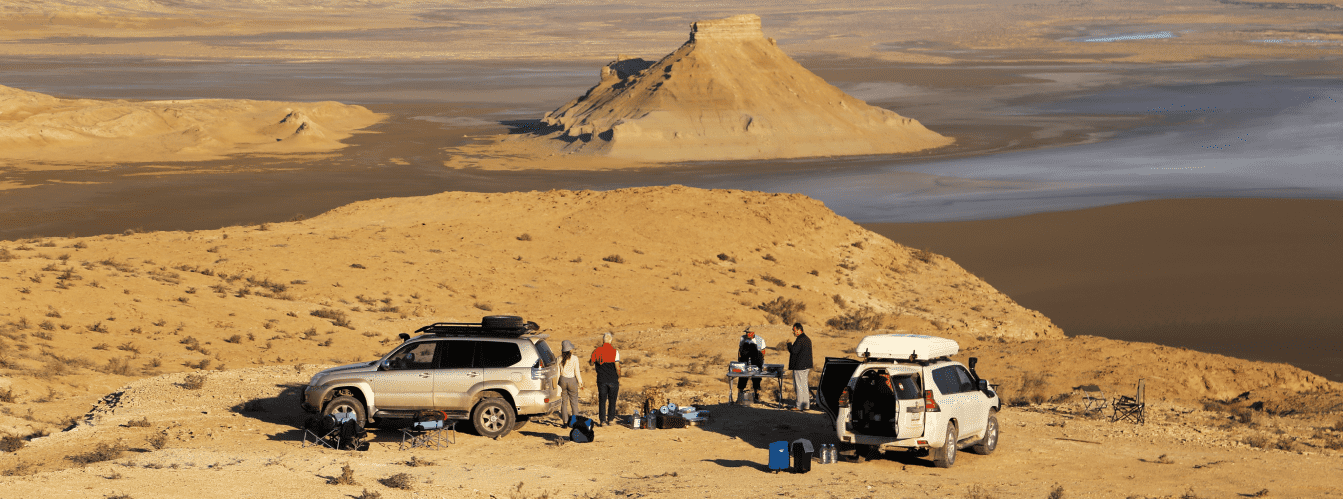
Due to the discharge of treated, warm technological marine waters from the power plant complex, the lake does not freeze even during harsh winters, attracting massive gatherings of swans, pelicans, and cormorants. Leaving the lake's environs, expedition 4x4s journey further east toward the chalk cliffs of the Bozzhira tract, the Tuzbair salt flat, Mount Bokty, the Karynzharyk depression, and the strictly protected lands of the Ustyurt Reserve.
For road-trippers and travelers, Lake Karakol serves as an ideal seaside refuge: people travel here for exceptional birdwatching, peaceful stays by the water, and the chance to observe thousands of pink flamingos and graceful swans gathering against the glow of Caspian sunsets. Today, Lake Karakol in Mangystau is recognized as one of the most vivid, accessible, and astonishing ornithological phenomena in Kazakhstan, drawing tourists, ecological researchers, and photographers worldwide with fantastic views of hundreds of feeding greater flamingos against turquoise waters and Caspian horizons.
--------------------------------------------
How to get there and visit –
Lake Karakol is situated in the southwestern part of the Munaily district, Mangystau region, immediately adjoining the southern industrial zone of the city of Aktau (near MAEK and CHP-1). The distance from central Aktau is only 10–15 km, from the village of Kuryk – roughly 55 km, and from the city of Zhanaozen – about 135 km.
GPS geographical coordinates of Lake Karakol:
43°32′06″N 51°18′30″E
The driving route from the city of Aktau leads south along the paved coastal highway Aktau – Kuryk (an extension of the 1st microdistrict and Primorsky Boulevard). The road is a high-grade multi-lane asphalt highway accessible to any vehicle type year-round, including standard passenger sedans and tour buses. Travel time from the city center takes around 15–20 minutes.
For observing the lake, dedicated viewing pull-offs and environmental observation decks (birdwatching towers) have been built along the highway, offering an unobstructed view across the shallow waters without disturbing nesting birds.
Visiting regulations and safety rules: Lake Karakol is a specially protected natural area of republican significance (Karagiye-Karakol Sanctuary).
Across the entire lake territory, the following are STRICTLY PROHIBITED:
– Hunting, fishing, and capturing any wildlife species;
– Driving cars or motorcycles onto the sandy-silt shoreline fringe;
– Flying quadcopters and drones over the water surface, as propeller noise triggers mass panic among flamingos and swans;
– Lighting campfires, pitching tents within reed beds, and playing loud music;
– Approaching bird flocks closer than 100 meters on foot (always use binoculars, spotting scopes, or telephoto lenses with focal lengths of 400 mm or more).
Infrastructure: being in the suburbs of Aktau, visitors enjoy full access to city amenities. Gas stations, supermarkets, cafes, and tire repair services operate alongside the highway. Information boards of the nature sanctuary are installed along the lakeside road. Mobile reception and high-speed 4G/5G data from all mobile carriers in Kazakhstan remain stable along the entire coast.
The best season to visit is autumn and spring (from late September through November, and from March through May), when peak migratory flights cross the lake and avian populations reach hundreds of thousands of birds.
Karakol is especially celebrated in late autumn and winter (November – February), when thousands of snow-white mute swans, whooper swans, and large colonies of greater flamingos congregate over the warm ice-free waters. Prime hours for observation and photography are early morning at sunrise and pre-sunset hours, when the water reflects mother-of-pearl and pink tones.
--------------------------------------------
History
The history of Lake Karakol is a rare and striking example of how large-scale human industrial activity did not degrade nature, but created a fertile artificial oasis in the arid Caspian semi-desert. Until the mid-20th century, the site of the present lake was merely a shallow, periodically desiccating salt marsh called Karakol ("Black Lake"), encrusted with mineral salt.
A decisive turning point occurred in the late 1960s with the construction and commissioning of the energy cluster of Shevchenko (now Aktau) – the Mangyshlak Atomic Energy Combine (MAEK), which featured desalination plants and the BN-350 fast-neutron reactor.
To cool the technical condensers of the power station, seawater was pumped directly from the Caspian Sea, passed through heat-exchange loops, and discharged via gravity channels into the dry basin of the Karakol salt marsh. Clean, moderately warmed, and oxygen-enriched seawater filled the depression, creating a permanent flowing lake with a stable thermal regime.
By the 1970s, Soviet biologists recorded an explosive development of the ecosystem: microscopic algae, planktonic crustaceans, mollusks, and fish flourished in the warm brackish water, turning the lake into a premier transit staging hub along the avian flyway connecting Siberia and Northern Kazakhstan with Iran, India, and Africa.
In 1986, by decree of the Council of Ministers of the Kazakh SSR, Lake Karakol together with the Karagiye depression was incorporated into the Karagiye-Karakol State Republican Zoological Sanctuary. In subsequent decades, the lake attained status as an Important Bird Area (IBA) of global significance, becoming a living symbol of ecological harmony across Mangystau and the Mangyshlak Peninsula.
Information
Morphometrically, Lake Karakol is an elongated, shallow coastal-industrial lagoon extending along the Caspian shoreline from northwest to southeast for roughly 18–19 kilometers with an average width of 1.5 to 3 kilometers. The total surface area varies between 40 and 50 square kilometers depending on water discharge volumes. The lake surface sits at elevations around -27...-28 meters below world sea level, separated from the open sea by a narrow coastal barrier between 200 meters and 1.5 km wide.
The hydrological regime is artificially regulated and continuously flowing year-round. The lake is continuously replenished with discharged seawater from the MAEK power station via a main delivery channel, while excess water returns to the Caspian through overflow outlets in the south. The average depth is only 1.0–1.5 meters, with maximum channel depths not exceeding 2.5–3 meters. Water temperature even during January frosts stays between +6 and +12 °C, warming in summer to +28...+32 °C, completely preventing ice formation. Water salinity is brackish, close to that of the Caspian (10–13 parts per thousand).
The geological bed consists of Quaternary marine clays, fine silts, and thick layers of coquina shell detritus from the ancient Tethys Ocean. The shores are formed by sand-and-shell spits and low clay terraces.
Soil cover of the perimeter features hydromorphic sor solonchaks, silted sandy soils, and patches of gray-brown desert soils across elevated spots.
The climate is temperate desert with marked maritime moderation. Summers are hot and dry with average July temperatures of +27...+31 °C (reaching highs of +42 °C), while winters are mild and windy, averaging -1...-4 °C in January. Annual precipitation is sparse at roughly 130–150 mm. Constant sea breezes and the open water body create a humid, refreshing local microclimate.
Detailed description of the venue
The natural and aquatic complex of Lake Karakol encompasses the following key sectors, hydrological features, and viewing areas:
• Ornithological observation decks – dedicated wooden towers and pavilions along the Aktau – Kuryk highway equipped with informational stands for safe and comfortable birdwatching.
• Northern warm inlet – the mouth zone of the main feeder canal from the power station where warm seawater flows into the lake, fostering growth of plankton and aquatic plants.
• Reed labyrinths and marshlands – expansive thickets of common reed along the eastern and southern shores, providing protective shelter and nesting habitat for hundreds of bird species.
• Shallow shell banks and islets – natural silt and coquina shoals in the center of the lake where thousands of greater flamingos, cormorants, and waders congregate to rest.
• Southern overflow discharge canal – an engineered outlet in the south where surplus water cascades back into the open waters of the Caspian Sea.
• Coastal barrier spit between lake and sea – a natural sand-and-shell barrier partitioning the cold surf of the Caspian from the warm haven of Karakol.
Flora and fauna
The plant life of Lake Karakol consists of hydrophytic and halophytic assemblages. Along the shoreline and inlets dominates the common reed (Phragmites australis), forming dense thickets 3–4 meters high. Growing alongside are narrowleaf cattail, sea club-rush, and European glasswort. Dense underwater meadows of charophyte and filamentous algae, eelgrass (Zostera), and widgeonweed (Ruppia maritima) thrive in the water column, providing forage for herbivorous birds and fish. Dry clay margins support gray-soil wormwood, Halocnemum strobilaceum, tamarisk, and Caspian saltwort.
The wildlife is world-renowned for its phenomenal bird concentration: over 175 avian species have been recorded here, with more than 20 listed in the Red Data Book of Kazakhstan and the IUCN Red List. The lake's signature species is the greater flamingo, with flocks numbering up to 10,000–15,000 birds at a time. The lake also hosts wintering and nesting Dalmatian and great white pelicans, mute swans, whooper swans, tundra swans, Eurasian spoonbills, glossy ibises, squacco and cattle egrets, pygmy cormorants, and the rare Pallas's gull.
Ichthyofauna, having entered from the Caspian and adapted to warmed water, is diverse: Caspian mullet (singil), common carp, crucian carp, Caspian roach, rudd, pike-perch, and several goby species flourish here.
Mammals sheltered in the reed beds include wild boars, raccoon dogs, corsac foxes, badgers, steppe polecats, tolai hares, and muskrats. Birds of prey soaring overhead include the white-tailed eagle, osprey, western marsh harrier, and lesser kestrel.
Herpetofauna includes the dice snake, marsh frog, green toad, and the rapid fringe-toed lizard on sandy berms.
Legend
A poetic Mangystau legend tells of the Black Lake and the Bird of Happiness – Ak-Ku.
Tradition recounts that in ancient times, only a parched salt depression called Karakol existed here. Nomads bypassed its dark floor, believing it to be a dried tear shed by the earth for the vanished ocean. Elders said the land was locked in deep slumber, awaiting a sacred spark of fire to restore its vitality.
When people arrived in the waterless desert in the mid-20th century, they lit an enduring beacon of science and industry, building a white-stone city by the sea and harnessing the atom alongside the marine tide. Warmed sea currents, flowing through human labor, filled the dead hollow of Karakol with life.
The legend tells that during the first warm winter, a flock of pink fairy-birds, flying through fierce northern blizzards, lost its way above the desert. The exhausted flock leader sighted a steaming, warm lake amid the frozen plains of Mangyshlak and landed upon its waters. Here the birds found abundant food, shelter from cold, and peace.
In token of gratitude, the flock left its most beautiful pink feathers on the lake, tinting the waters with the hues of morning dawn. Ever since, people have believed that Lake Karakol is a sacred site where human endeavor made peace with wild nature, and that whoever beholds the dance of flamingos across its mirror will find inner peace and a blessing of long life.
Conclusion
Lake Karakol is a jewel of eco-tourism in Mangystau, demonstrating harmony between contemporary industry and wild nature. A visit to Karakol offers travelers the joy of connecting with the avian world, the thrill of observing graceful flocks of pink flamingos and snow-white swans, and memorable photography of Caspian scenery against coastal horizons.
Interesting sights nearby:
• Karagiye Depression;
• Port Kuryk;
• Aleksandrbay Gulf;
• Kenderli Resort Bay;
• Kenderli Recreation Area;
• Rocky Cape Tokmak;
• Saura Canyon;
• Tamshaly Canyon;
• Rocky Cape Tyub-Karagan;
• Zhygylgan Geological Sinkhole;
• Basgurly-Zhazgurly Depression System;
• Kenderli Salt Flat;
• Three Brothers Mountains (Three Batyrs);
• Coastal Cape Zhylandy;
• Radon spring near the village of Kuryk.
Sacred sights:
• Beket-Ata Underground Mosque in Oglandy Tract;
• Karaman-Ata Underground Mosque;
• Shakpakty-Ata Underground Mosque;
• Sultan-Epe Underground Mosque;
• Otpan Tau Complex on Mount Otpantau;
• Kolbas Ishan Mosque;
• Koben Mosque;
• Zholaskan Mosque;
• Nurbergen Kalyshev Mausoleum;
• Zhaman Sauran Mosque;
• Ishan Khozha Mosque;
• Itolla Mosque;
• Sonabay Underground Mosque;
• Masat Ata Mosque;
• Uytoly Ata Underground Mosque;
• Bayte Sanctuary.
Photogallery: