Karynzharyk Depression
Grandiose tectonic rift of Kazakhstan with the mirror salt flat of Kenderli –
The Karynzharyk Depression (in scientific works and guidebooks also Karyn-Zharyk, Kaz. Qarynzhyryq) represents a cyclopean endorheic tectonic depression and one of the most remote natural attractions of the Mangystau region.
Located in the south of the region within the Karakiyan district, this depression serves as a natural geomorphological boundary between the Mangyshlak Peninsula and the Ustyurt Plateau, stretching from north to southwest for 130–160 kilometers (about 85 km along the latitudinal profile of the cliff base) with a width ranging from 10–15 to 24–40 kilometers and a total area of approximately 2,000 square kilometers.
The bottom of the basin lies deep below world sea level, plunging to elevations between -63.3 and -75 meters, while the overarching rim of the Western Chink of Ustyurt soars to absolute elevations of 200–340 meters (near the Kugusem well), creating a grandiose relief drop of 280–300 meters.
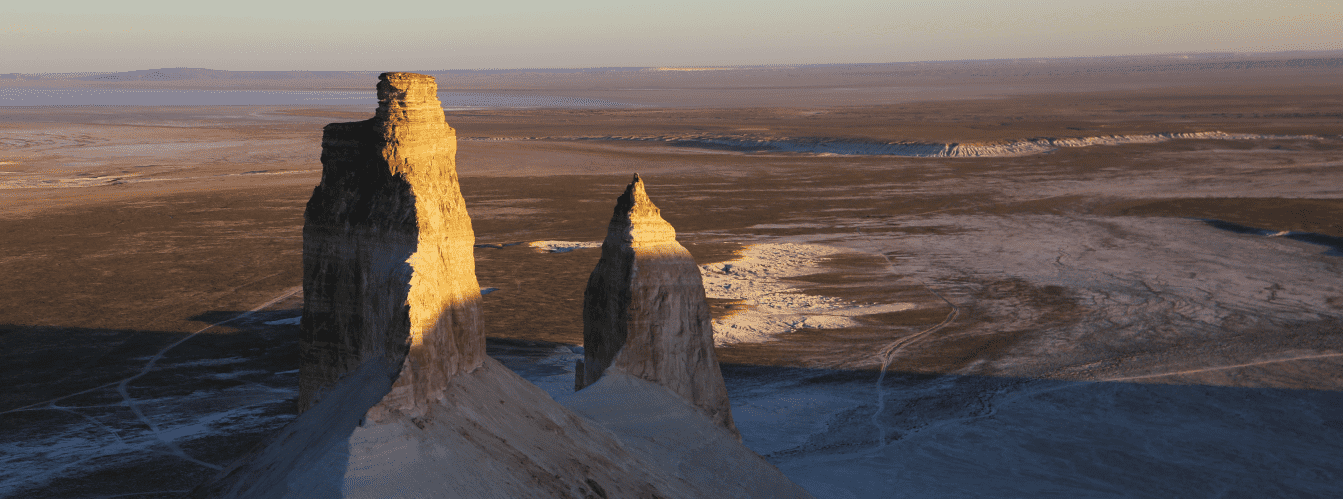
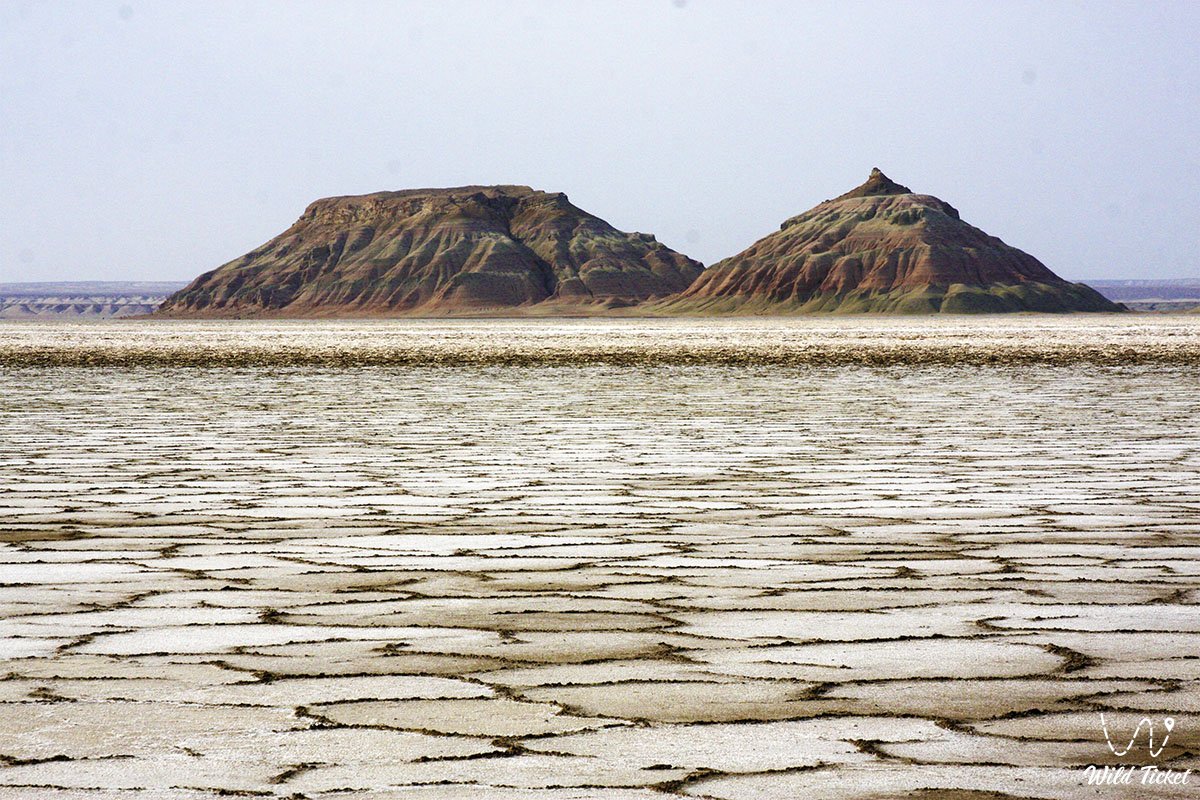
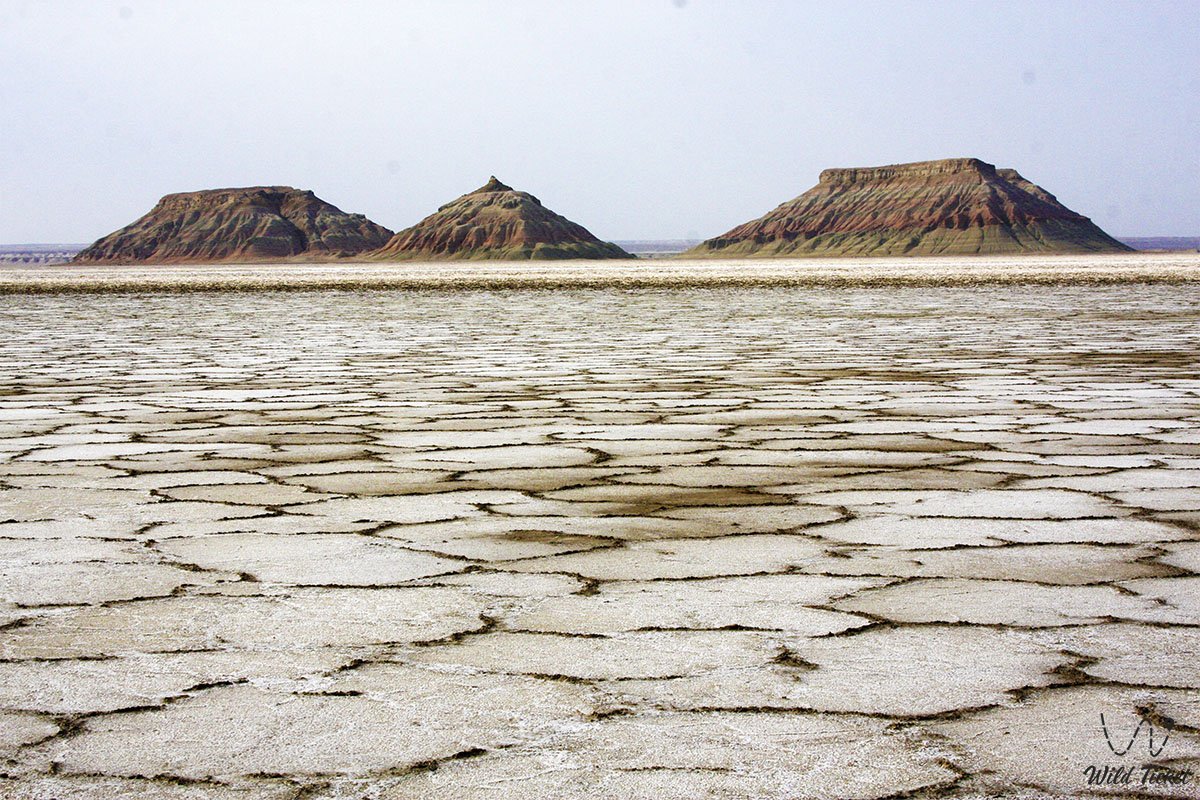
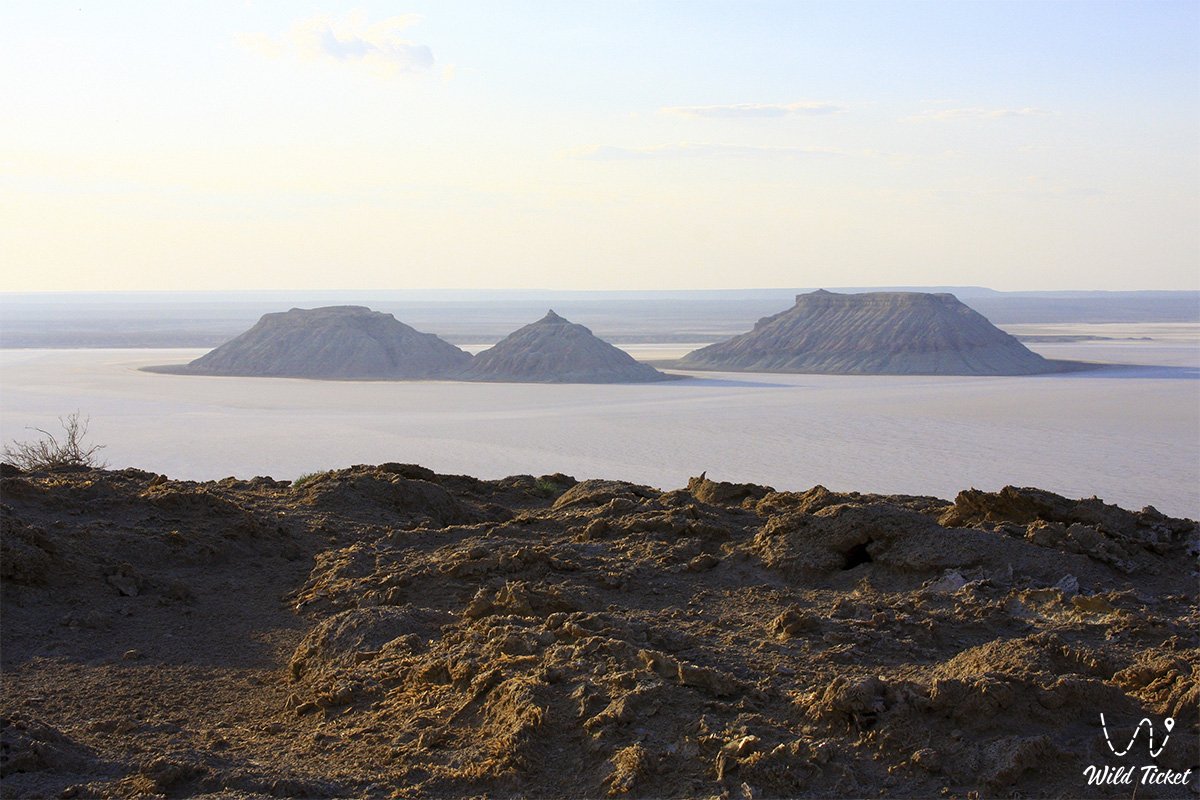
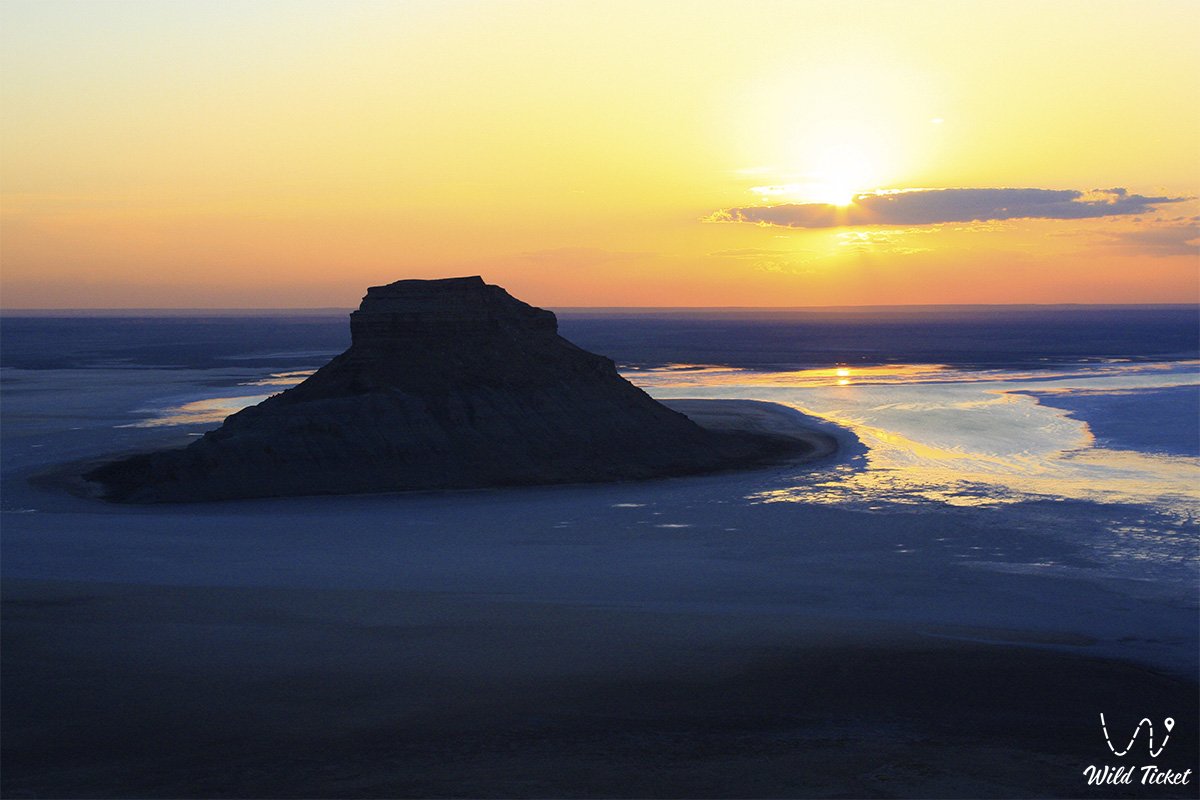
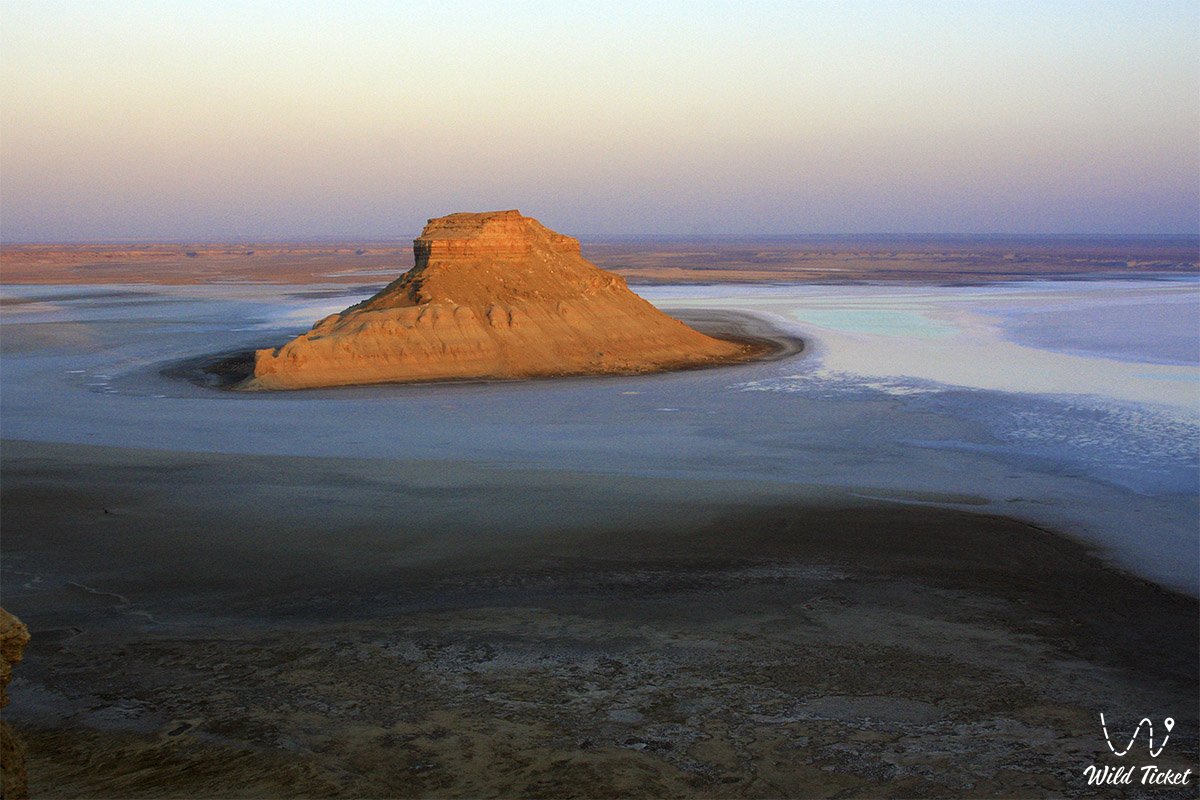
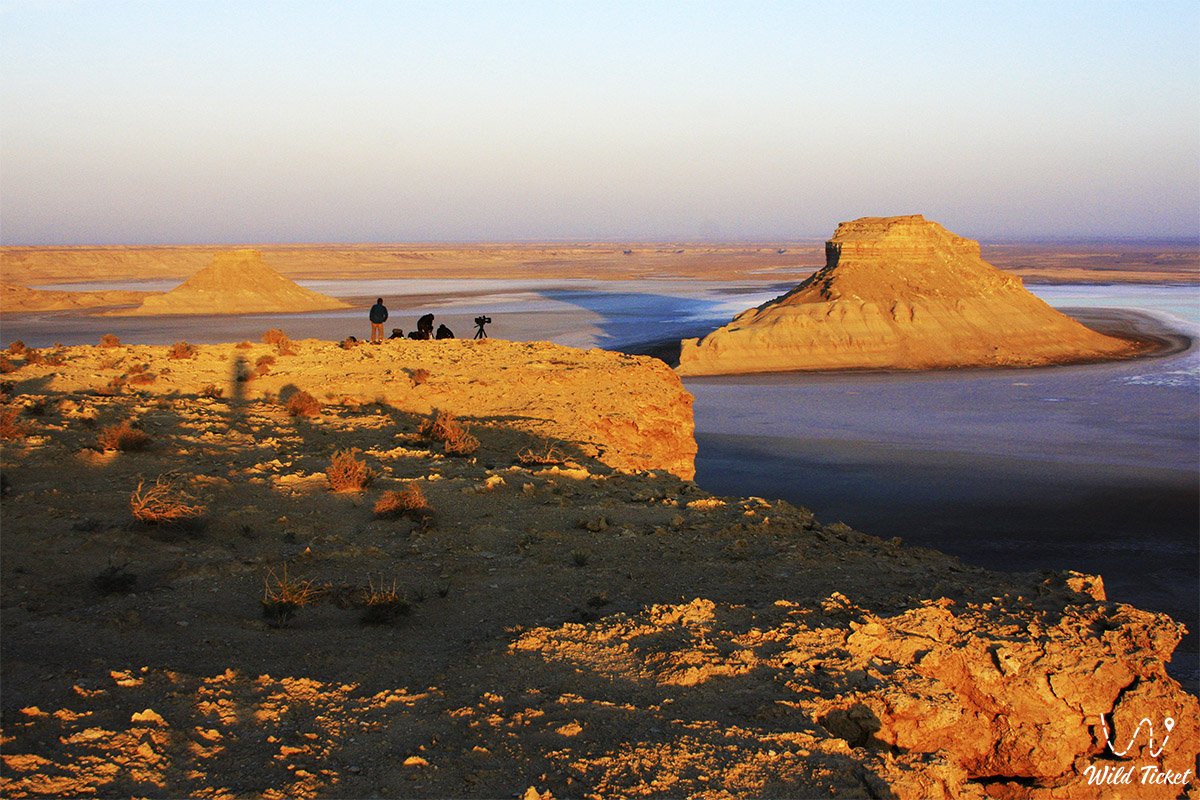
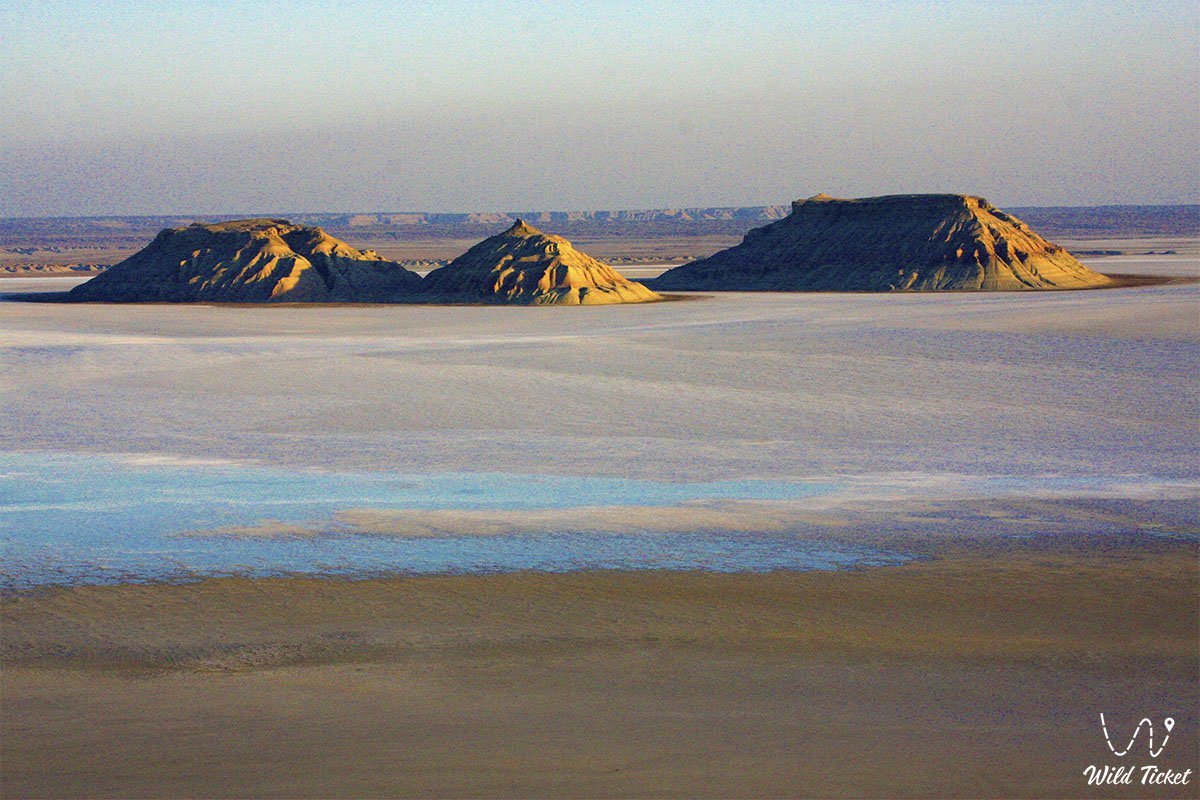
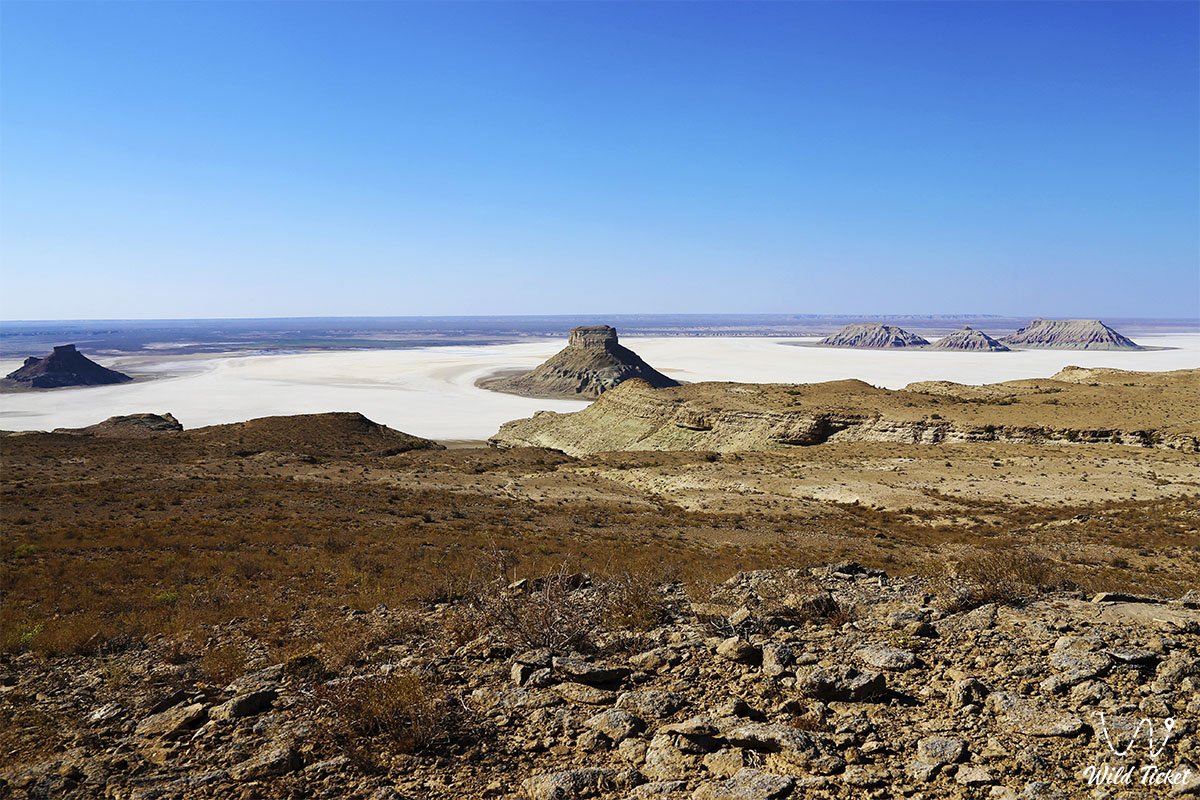
The primary visual centerpiece of the depression is the Kenderli salt flat (Kenderli sor) – the longest salt flat in Mangystau, spanning up to 80–92 kilometers in length and 10–15 kilometers in width. Amid this dazzling white sea of salt, five isolated remnant mountains of Onere rise like ghost ships to heights of 100 to 150 meters, composed of sedimentary strata from the Tethys Ocean (with absolute summit elevations between 61.4 and 116.7 meters).
Three central monoliths stand closely grouped together, historically known among Kazakhs as the "Three Brothers" or "Three Batyrs" (Kaz. Ush Aghayyndy). In the northern part of the depression stands the Karamaya mountain ridge – an anticlinal ridge up to 209.8 meters high and 15–17.3 kilometers long, formed roughly 70 million years ago as a result of a powerful magmatic event.
To the west, the eponymous Karynzharyk Desert borders the depression with sand ridges and hummocks 5–15 meters high, while to the east, the chinks of Ustyurt extend like an impregnable wall from the Kyzylsay mound to Cape Shakpakmurn. The depression lies just 25 kilometers from the border with Turkmenistan and forms part of the Ustyurt State Nature Biosphere Reserve, which covers over 223,000 hectares.
Today, the Karynzharyk Depression is recognized as the ultimate destination for self-sufficient off-road expeditions in Kazakhstan, drawing wildlife explorers with the cosmic aesthetic of its salt mirrors, mirages, and absolute wilderness seclusion.
--------------------------------------------
How to get there and visit –
The Karynzharyk Depression is located in the Karakiyan district of the Mangystau region, 24–25 km east of the Akkuduk settlement and weather station, 72 km east of the Basgurly depression, 145–180 km south of the city of Zhanaozen, and 310–340 km southeast of the city of Aktau, Republic of Kazakhstan.
GPS geographical coordinates: 42°41'26"N 54°17'31"E
The classic route from Aktau (around a 7-hour drive) runs on asphalt via Zhanaozen to the village of Kulandy or Senek village (165 km), after which it transitions onto a demanding steppe graded track and sandy-gravel ruts through the Akkuduk well (145 km). The famous Nurbergen Kalyshev Mausoleum is located in Senek village.
Another popular expedition itinerary sets off after an overnight camp in the Bozzhira tract: the southward route toward the chinks of Karynzharyk spans roughly 150 km along unpaved tracks (approximately 5 hours of driving). Before reaching the cliff edges overlooking the salt flat, it is recommended to stop by the Onere spring, which forms a small pond of turquoise brackish water where travelers can refresh themselves after the long drive.
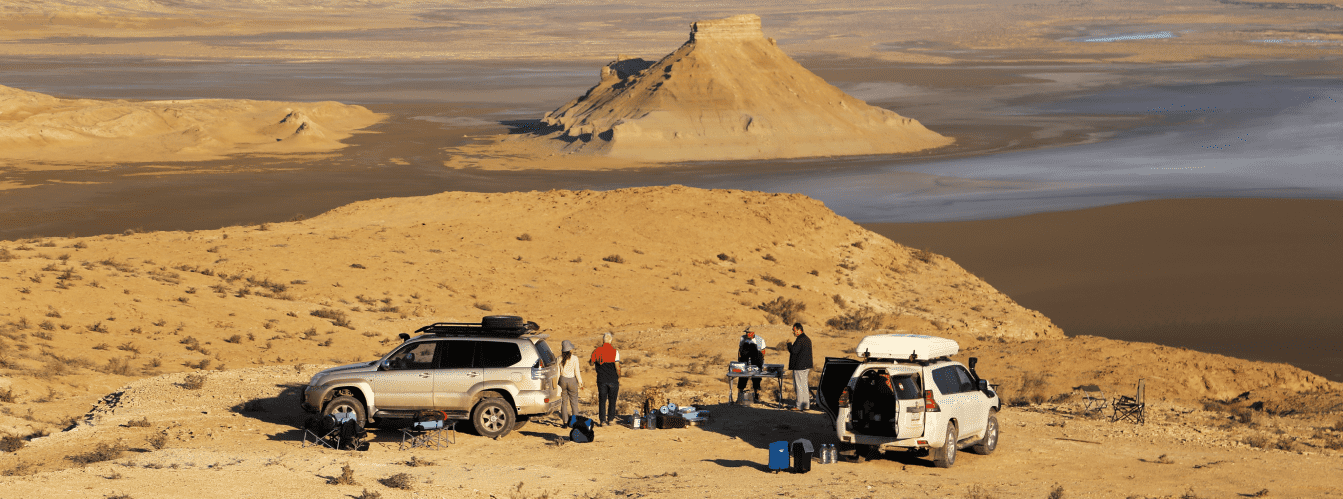
An expedition across the Karynzharyk Depression requires an exclusively prepared heavy-duty four-wheel-drive vehicle (4x4) with high ground clearance, skid plates, a winch, and durable mud-terrain or all-terrain tires (AT/MT). It is strictly advised to travel in a convoy of at least two vehicles: there are no public roads, and the sands and washouts are treacherous.
Driving onto the surface of the Kenderli salt flat is categorically forbidden and life-threatening: beneath a thin salt crust lies a multi-meter layer of viscous mud with a sharp hydrogen sulfide odor, capable of swallowing a vehicle instantly.
The territory lies within the Ustyurt Nature Reserve: entry is permitted only after obtaining an official permit and paying the environmental fee (at the reserve's office in Zhanaozen), often under the supervision of rangers or accompanied by an accredited guide (UAZ rentals are available at the reserve). Due to the proximity of the Kazakhstan-Turkmenistan border, original identification documents (passports, national ID cards) are mandatory.
Crews must carry a satellite phone, an autonomous GPS unit loaded with offline maps, a reserve fuel supply for at least 500–600 km, an air compressor, two spare wheels, a kinetic recovery rope, a shovel, and a daily drinking water reserve of no less than 7–8 liters per person.
Overnight camping in tents is preferable on the upper terraces of the Ustyurt chink, where visitors can watch sunsets over the salt flats and night constellations above the remnant peaks.
The best seasons are spring (April – May) and autumn (September – October). In July and August, the heat at the bottom of the basin exceeds +45...+55 °C.
--------------------------------------------
History
The geological chronicle of the Karynzharyk Depression spans tens of millions of years of tectonic transformation. Regarding its genesis, scientists have proposed several hypotheses: a number of early 20th-century geologists (Lichkov, Richter) considered the depression to be the ancient valley of an ancestral river flowing into Garabogazköl Bay. However, due to the rising elevations of the floor toward the south and the discovery of an anticlinal uplift, the modern theory (Fedorovich, Shlezinger, Pleshcheyev) prevailed, according to which the depression formed through regressive erosion, deep tectonic downwarping, and deflationary wind action.
During the Mesozoic and Cenozoic eras, this basin formed a deep-water gulf of the Tethys Ocean and later Late Pliocene Caspian transgressions. The receding waters left behind a thick mantle of lacustrine, alluvial, and marine sediments up to 100 meters thick: poorly sorted sands, gravels, conglomerates, sandy loams, dense clays, and gypsum. Mount Karamaya, situated in the north, originated more than 70 million years ago through an ancient volcanic explosive event that exposed seams of coal and rare minerals.
The "Three Brothers" remnant peaks (Onere) are classic witnesses of the ancient seafloor: denser siliceous-limestone monoliths resisted millions of years of salt leaching, while the softer surrounding host rocks were washed out and wind-deflated down to the salt bed. In antiquity, nomads constructed stone hunting corrals (arans) along the Ustyurt chink for game drives targeting saiga and argali, while trade caravans crossed the upper plateau toward Khiva and the Kara-Bogaz region.
In 1984, the Ustyurt State Nature Reserve was established to preserve this benchmark desert depression, the key habitats of the Ustyurt mouflon, and the unique hydrological complex of the Kenderli salt flat.
Information
Geomorphologically, Karynzharyk is an enclosed volcano-tectonic and deflationary depression lying between -63.3 and -75 meters below sea level. The length of the depression reaches up to 160 km with a width from 10 to 40 km. The catchment basin covers 152.26 sq. km, while the total area of the tract, including sand massifs and salt flats, approaches 2,000 sq. km.
From the east, the basin is bounded by the sheer Western Chink of the Ustyurt Plateau spanning 50 km (from the 128.6-meter Kyzylsay knoll to Cape Shakpakmurn), where the chink rises to absolute elevations of 104 to 197–340 meters above sea level. The western flank of the depression is gentle and occupied by the ridged-hummocky sands of the Karynzharyk Desert, stretching from north to south for over 100 km. To the east, the depression borders the Muzbel ridge, while to the north it transitions into the Karabaur plateau. The Kansu and South Kansu gas-bearing geological structures have been explored deep within the central zone.
The hydrological regime is governed by the dynamics of the Kenderlisor salt flat (80–92 km in length). The bottom of the sor consists of strata of liquid and semi-liquid saline silt exceeding 10 meters in depth, overlain by a durable salt crust. After spring downpours and snowmelt runoff from the chink, the floor of the depression transforms into a boundless shallow mirror reflecting the sky. In summer, the water evaporates, and the dried surface splits into polygonal plates. The brackish-fresh Onere spring surfaces near the salt flat, forming a small pond.
The climate is sharply continental and extremely arid. Summers are sweltering: the average July temperature is +27...+28 °C, with record surface and ambient air highs reaching +47...+55 °C. Winters are moderately cold, with an average January temperature of -5...-6 °C (absolute minimums drop to -34 °C). The average annual precipitation totals just 100–155 mm amid immense evaporation rates. Violent dust storms and sand whirlwinds develop regularly.
Detailed description of the venue
The landscape and protected natural complex of the Karynzharyk Depression comprises the following key features:
• "Three Brothers" Remnant Mountains (Ush Agayyndy Tau) – a monumental ridge of three adjacent table cliffs soaring over 150 meters high amid the sparkling salt flat.
• Remnant Peaks of the Onere Tract – a cluster of five isolated rock outliers on the floor of the sor (with elevations of 61.4 m, 79.7 m, 83 m, 104.7 m, and 116.7 m above sea level).
• Kenderlisor Salt Flat (Kenderli Sor) – a giant salt plain extending up to 92 km, covered with a crust of mirabilite, thenardite, and halite, which transforms into a mirror during spring.
• Western Chink of the Ustyurt Plateau – a sheer limestone precipice rising 280–300 meters above the bottom of the depression, featuring Cape Shakpakmurn and panoramic viewing ledges.
• Karynzharyk Desert – an aeolian sand massif of ridged hummocks with dunes ranging from 5 to 15 meters in height along the western perimeter of the depression.
• Volcanic Karamaya Ridge-Mountain – an anticlinal dark massif 200–209.8 meters high and 15–17.3 kilometers long in the north of the depression, displaying outcropping coal strata.
• Onere Spring and Turquoise Pool – a natural oasis of brackish water at the base of the chink.
• Ancient Hunting Corrals (Arans) – stone, arrow-shaped guiding walls built by nomadic hunters along the rim of the Ustyurt chink.
• Akkuduk Well and Tract – a historic pastoralist encampment and weather station on the fringe of the sand desert.
Flora and fauna
The plant world of the depression encompasses over 260 plant species adapted to high salinity and water scarcity (5 species are listed in the Red Book of Kazakhstan). Saltworts, European glasswort, Halocnemum strobilaceum, and tamarisk bushes survive on the floor of the salt flat. White saxaul, boyalych, gray-soil and Lerche's wormwood, biyurgun, and camelthorn grow on elevated terraces and sand dunes. In spring, ephemeral plants and wild tulips with brief vegetative cycles bloom at the foot of Mount Karamaya and along the stepped benches of the chink.
The wildlife includes numerous Red Book-listed species protected within the Ustyurt Reserve: 45 mammal species, 22 reptile species, 1 amphibian species (European green toad), and 111 bird species. The sheer cliffs of the chinks serve as the principal sanctuary for the largest population of the Ustyurt mountain sheep (mouflon/argali). Goitered gazelles, saiga antelopes, caracals, Pallas's cats (manuls), sand cats, badgers, honey badgers, marbled polecats, corsac foxes, and wolves roam the plains and sand ridges.
Avian species nesting on the ledges of the chinks include rare birds of prey: golden eagle, saker falcon, peregrine falcon, Egyptian vulture, cinereous vulture, short-toed snake eagle, and steppe eagle. During migration seasons, greater flamingos, black-bellied sandgrouse, and houbara bustards (MacQueen's bustard) rest around the salt flat and freshwater springs. Reptiles are represented by the desert monitor, toad-headed agama, steppe agama, sand boa, and arrow snake.
Legend
An ancient Kazakh legend concerning Three Batyr Brothers is associated with the three isolated remnant peaks on the floor of the Kenderli salt flat. In time immemorial, an overwhelming foreign host advanced upon the peaceful nomadic camps of Mangyshlak, far outnumbering the local defenders. Three batyr brothers volunteered to cover the retreat of their native auls, barring the enemies' path at the narrowest passage of the deep lowland.
For three days and nights beneath a blazing sun, the heroes held back the invading army, repelling furious charges without yielding a single step. When their arrows were spent and their swords grew blunt against enemy armor, foreign sorcerers cast a suffocating salt storm across the valley, trying to encircle the batyrs from the rear. Sensing their strength waning, the brothers raised their eyes to heaven and prayed to the Creator, asking to be turned into impenetrable stone to seal the path against the invaders forever. Heaven answered their plea: in an instant, the batyrs turned into three massive stone peaks standing shoulder to shoulder, while beneath their feet spread an impassable sea of salt that swallowed the terrified invaders. Ever since, the stone giants have stood amid the salt flat, safeguarding the southern frontiers of sacred Mangystau.
Conclusion
The Karynzharyk Depression is a grandiose masterpiece of Kazakhstan's primeval wilderness, uniting the dazzling expanse of the Kenderli salt flat, the proud silence of the Three Batyrs peaks, the volcanic enigmas of Mount Karamaya, and the bottomless majesty of the Ustyurt chinks. An expedition into Karynzharyk demands meticulous autonomous preparation, but rewards travelers with an incomparable experience of wild planetary nature, cosmic sunsets, and pristine starry skies over the protected expanses of Ustyurt.
Interesting sights nearby:
• Mount Sherkala;
• Chalk Outliers "Three Brothers";
• Karamaya Ridge;
• Onere Spring;
• Bozzhira Tract;
• Mount Bokty;
• Kyzylkup Tract;
• Karagiye Depression;
• Kauyndy Depression;
• Basgurly Depression;
• Beket-Ata Underground Mosque in Oglandy;
• Shopan-Ata Underground Mosque;
• Senek Village;
• City of Zhanaozen;
• City of Aktau.
Sacred sights and pilgrimage destinations:
• Otpantau Complex on Mount Otpantau;
• Kolbas Ishan Mosque;
• Koben Mosque;
• Zholaskan Mosque;
• Great Tulep Necropolis;
• Seydi Islam Ata Necropolis;
• Nurbergen Kalyshev Mausoleum;
• Zhaman Sauran Mosque;
• Ishan Khozha Mosque;
• Itolla Mosque;
• Akshora Mausoleum;
• Sonabay Underground Mosque;
• Masat-Ata Mosque;
• Uytoly-Ata Underground Mosque;
• Sanctuary of Bayte;
• Khanga Baba Necropolis;
• Sherkala Necropolis near Mount Sherkala.
Photogallery: