Ancient sacred pantheon of Sufis and stone architecture of the Aday clan –
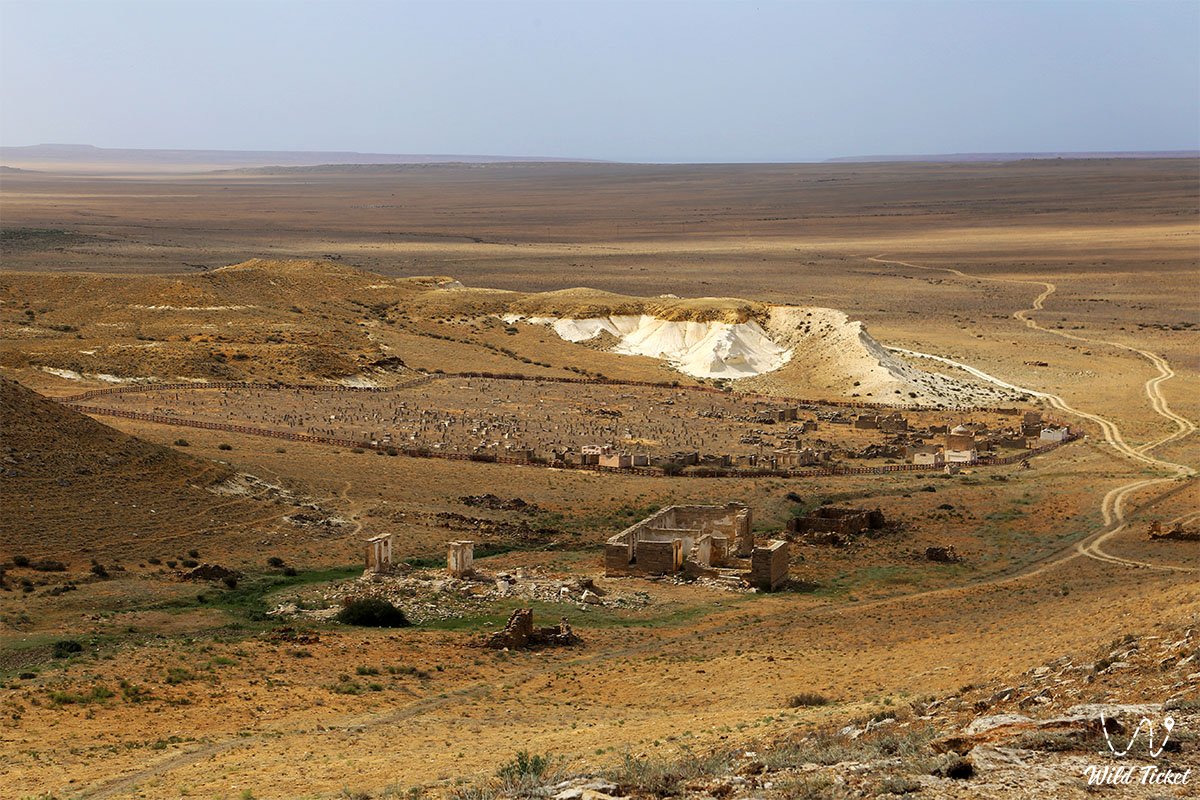
The Khanga Baba Necropolis (in historical documents also Kanga-Baba, Kangy-Baba, Kaz. Khan'ga baba qorymy, Qan'ga-Baba) represents a unique historical and architectural ensemble, an ancient burial ground, and a revered sacred complex dating from the 11th–12th to the early 20th centuries, situated in the southern part of the Tupkaragan Peninsula in the Mangystau region. The memorial complex is set within the eponymous shaded mountain-steppe Khanga Baba tract at the base of the chalk Kanga ridge, surrounded by freshwater springs, thickets of hawthorn, blackberry, wild poplar, elm, and centuries-old mulberry trees.
This grandiose open-air museum preserves an unbroken chronicle of Eurasian nomadic civilizations spanning nearly a thousand years. The necropolis sprawls along the caravan route of an ancient road that linked maritime harbors of the Caspian coast across the Ustyurt Plateau with the cities of Khwarazm and Khiva.
The valley served as a crucial oasis for resting caravans and dervishes, while the burial ground itself, according to Soviet archaeologist S. P. Tolstov, is genetically linked to the medieval city of Khanga, which served as the westernmost outpost and trade bastion of the Khwarazmian state.
The Khanga Baba complex represents a unique synthesis of medieval Turkmen and Kazakh stone-carving architecture of Mangystau: from archaic Oghuz-Turkmen stele-ferts engraved with curved sabres and Koranic verses to highly artistic Kazakh kulpytases of the Aday clan featuring ram horn motifs.
The heart of the ensemble is formed by the ruins of a monumental mosque with enfilades of chambers and the remains of a portal-domed mausoleum. Today, the necropolis is recognized as a monument of history and culture of republican significance and a vital center of pilgrimage in Western Kazakhstan.
--------------------------------------------
How to get there and visit –
The Khanga Baba Necropolis is located in the eastern section of the Tupkaragan district of the Mangystau region, 26.8–30 km southeast of the district center – the town of Fort-Shevchenko, 19 km northeast of the coastal settlement of Kyzylozen, approximately 25 km along the Fort-Shevchenko – Tauchik (Zhyngyldy) road, and 115–125 km northwest of the regional center – the city of Aktau, Republic of Kazakhstan.
GPS geographical coordinates: 44°27'22"N 50°35'38"E
The primary route from Aktau follows the paved highway of republican significance Aktau – Fort-Shevchenko. Approximately 25–30 km before entering Fort-Shevchenko, at the road sign pointing to the "Khanga Baba" complex (near the fork toward the settlement of Tauchik/Zhyngyldy), turn south. A compacted steppe dirt track about 2.1–3 km long descends along the gentle slope of the plateau straight to the ravine, freshwater springs, mulberry grove, and stone boundary enclosures of the necropolis.
In dry weather, access to the necropolis via the steppe graded road is feasible in a standard passenger car or crossover. However, navigating the branching ravines, driving to the historical Karakoz well, traversing the salt-marsh sections of the Oy tract, or continuing across the Tupkaragan plateau toward Kapamsay canyon, the Zhygylgan sinkhole, and Cape Tyub-Karagan requires a body-on-frame four-wheel-drive vehicle (4x4) with high ground clearance and all-terrain tires (AT/MT).
Infrastructure directly within the tract is absent: the site is an active sacred sanctuary under state protection. The nearest gas stations, hotels, tire repair services, pharmacies, grocery stores, and cafes are situated in Fort-Shevchenko and the village of Bautino (around 27–32 km to the west). Natural freshwater springs surface along the ravines; however, water for drinking should be boiled, or travelers should carry a bottled drinking supply of at least 3–4 liters per person per day.
When visiting the necropolis and the ruins of the mosque, sacred etiquette must be respected: clothing must cover shoulders and knees, and making noise, smoking, consuming alcohol, climbing upon gravestones, or damaging ancient trees is strictly forbidden.
Setting up tent camps is permitted only in the lower hollow of the oasis beneath the trees, well outside the cemetery boundaries.
The most favorable time to visit is spring (from mid-April to early June), when steppe shrubs are in bloom, the mulberry grove turns green, and clear springs flow through the ravines, as well as the warm autumn months (September – October). During peak summer (July – August), midday temperatures can climb beyond +38...+40 °C, though the canopies of ancient elms and mulberries provide welcoming shade.
--------------------------------------------
History
The history of the Khanga Baba Necropolis spans almost a millennium, originating in the Early Middle Ages when bustling caravan routes from Khwarazm and Khiva crossed Mangyshlak toward Caspian trade outposts. Soviet archaeologist and ethnographer S. P. Tolstov directly associated the origin of the burial ground with the ancient medieval city of Khanga, which served as a northwestern outpost and defensive bastion of the Khwarazmian state along the frontiers of the nomadic steppe.
The origin of the name of the complex has two primary historical interpretations. A participant in the 1851 Karatau expedition, B. Zaleski, recorded that the tract and cemetery were named in honor of the Turkmen Sufi saint and righteous elder Khanga Baba, whose resting place became a focal point for pilgrims. Concurrently, modern Kazakhstani historians and toponymists link the root "Khanga/Kanga" to the medieval Turkic tribal confederation of the Kangly (Qangli), who nomadized between the Aral and Caspian seas from the 5th to the 12th centuries.
Following the 13th-century Mongol conquest, the Kangly tribes integrated into the Oghuz (ancestors of the Turkmens, including the Teke clan) and the Kazakhs. In Old Turkic, the term "kanga" also designated a fortified border outpost or boundary station.
The studies of Taras Shevchenko hold a prominent place in the chronicle of the necropolis. While serving his military exile at the Novopetrovskoye fortification, the artist visited the Khanga Baba tract in May 1851 as part of the Karatau expedition led by Lieutenant A. I. Antipov. Captivated by the beauty of the oasis, Shevchenko described it as the "number one wonder of Mangyshlak" and executed a suite of drawings on toned paper alongside the watercolor "Khanga-Baba." The poet's artwork captured the monumental portal-domed mausoleum, stone steles, and the gnarled trunks of the mulberry grove.
In 1870, Colonel N. P. Lomakin of the Russian Imperial Army compiled a detailed military-statistical description of the tract during a reconnaissance of Mangyshlak. He documented a large Turkmen mosque, adjoining school chambers, a pilgrim hospice, alabaster deposits, and roughly 800 mulberry trees along the ravine slopes, which local inhabitants strictly guarded, considering it a sin to break even a slender branch.
In 1973, a comprehensive scientific survey of the necropolis was conducted by an expedition from the Kazakh Society for the Protection of Historical and Cultural Monuments under the guidance of Professor Malgabar Mendikulov. The researchers recorded the tripartite layout of the burial ground, measured the ruins of the mosque and mausoleum, and classified the typology of gravestones ranging from Oghuz steles to monuments crafted by Aday masters at the turn of the 19th and 20th centuries.
Information
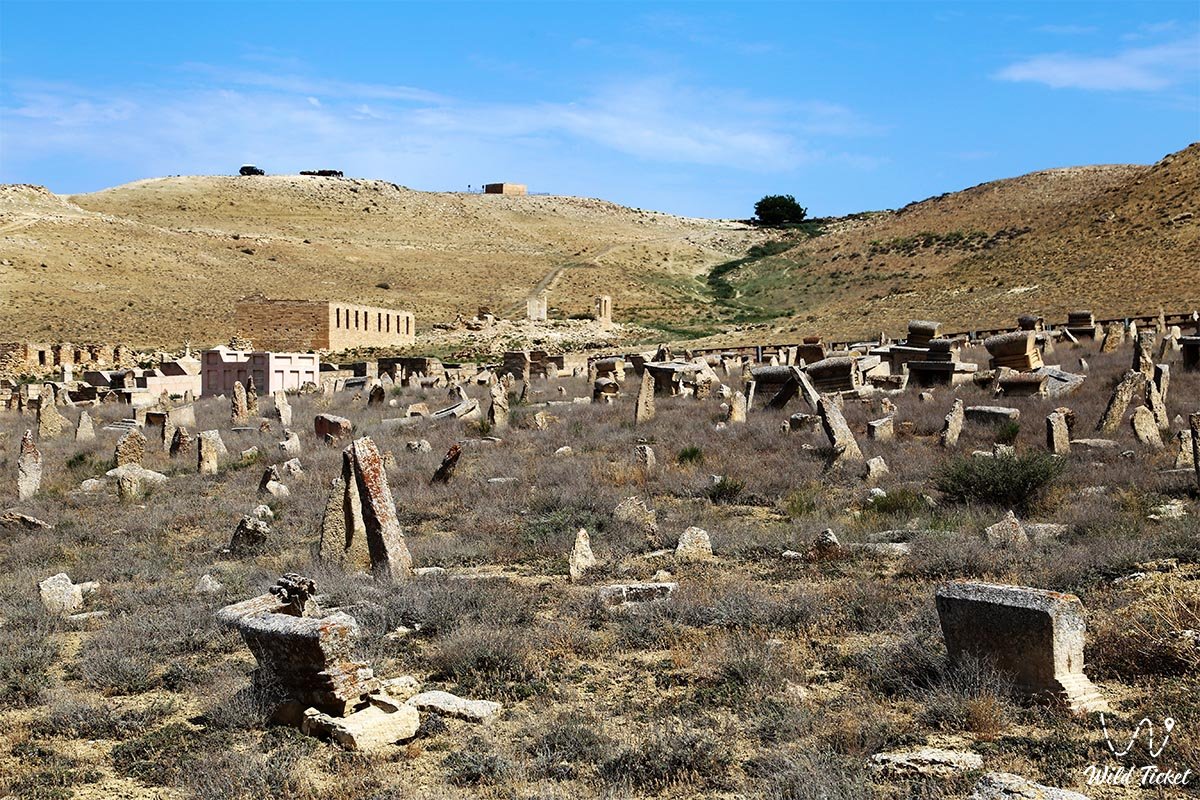
The Khanga Baba memorial complex is situated on a terraced scarp at the mouth of a deep spring ravine. The ravine naturally divides the expansive territory of the necropolis into several interconnected sectors.
The geological foundation of the tract consists of thick beds of Sarmatian coquina limestones, marls, and chalk, along with extensive deposits of natural gypsum (alabaster). Over the century and a half since Shevchenko's visit, the landscape has experienced natural weathering: the sharp pyramidal chalk hill has eroded into a rounded mound, the portal-domed mausoleum has collapsed down to its foundation walls, and the grounds of the historic mulberry avenue have partially filled with newer graves.
The spatial and ethno-cultural layout of the necropolis is divided into three primary groups:
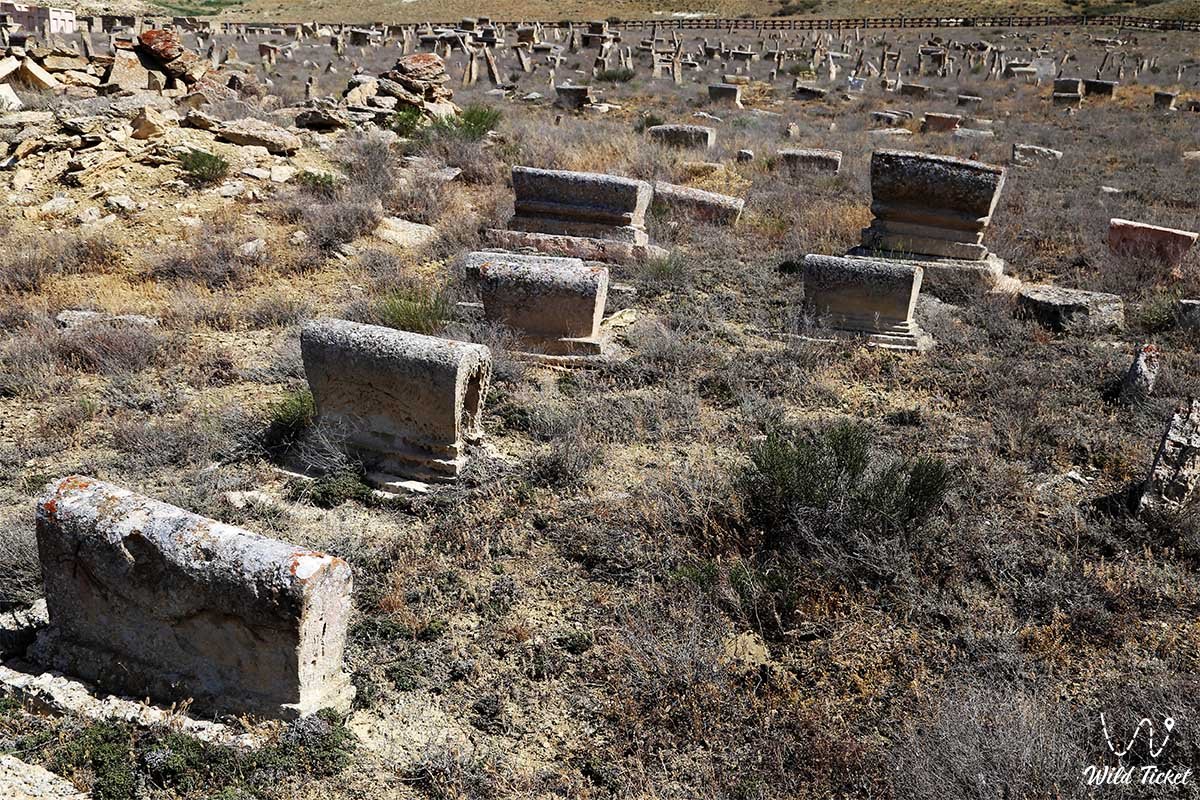
The first section comprises mixed burials where early Turkmen monuments stand alongside 18th–19th-century Kazakh graves.
The second section constitutes the central sector of the memorial, featuring the monumental ruins of a commemorative Turkmen mosque with an enclosed courtyard, the remains of the portal-domed mausoleum, and Kazakh saganatams of the Aday clan.
The third section represents an archaic sector of small architectural forms rendered in pure 14th–17th-century Turkmen style.
Architectural differentiation among the monuments reveals distinct cultural traditions:
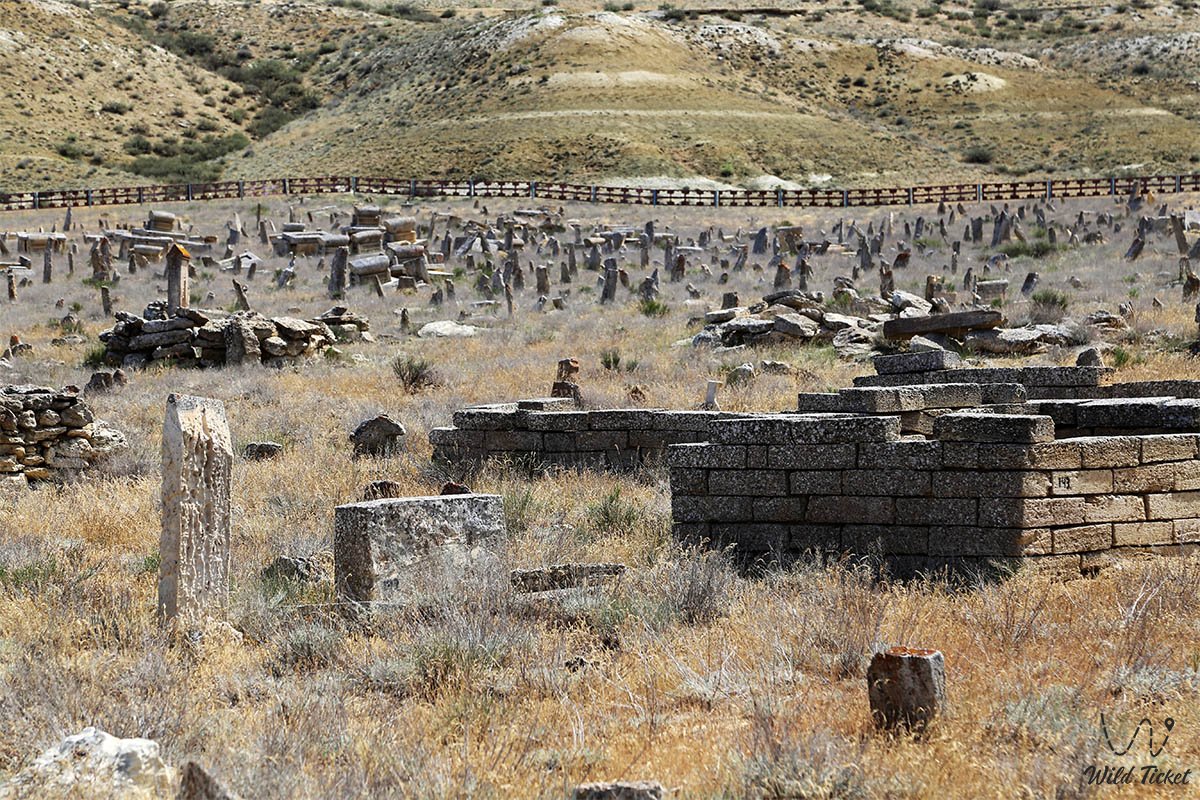
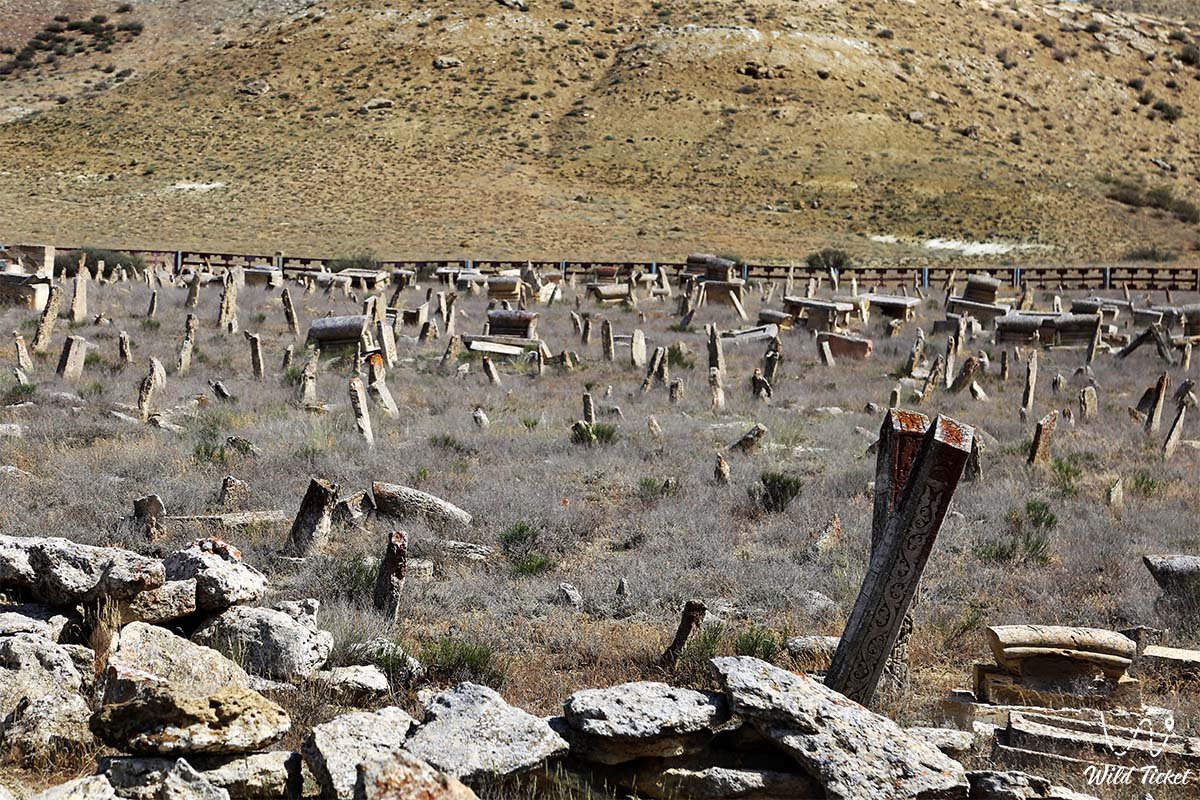
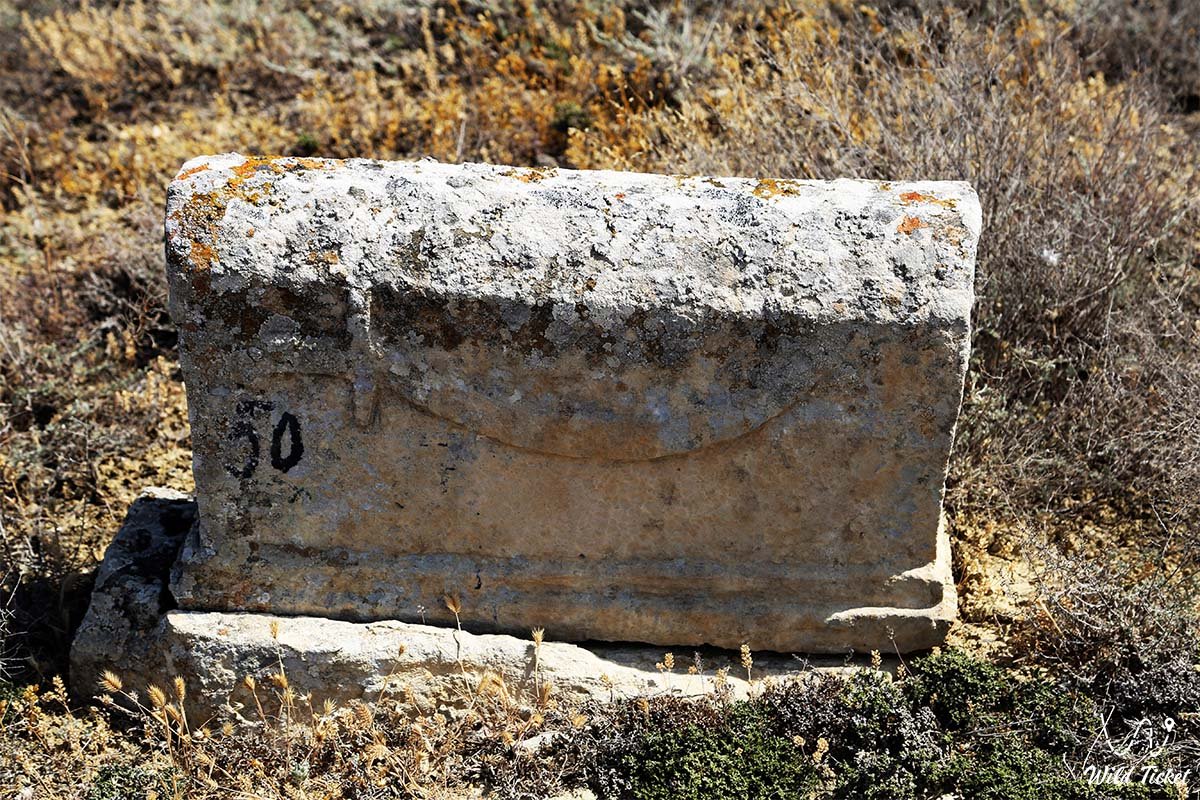
• Turkmen small forms (stele-ferts, sandyktases) are monolithic stone slabs of concise rectangular geometry. They lack elaborate relief carving but bear distinct engraved silhouettes of curved battle sabres, daggers, bows, and calligraphic Koranic verses rendered in the Naskh script.
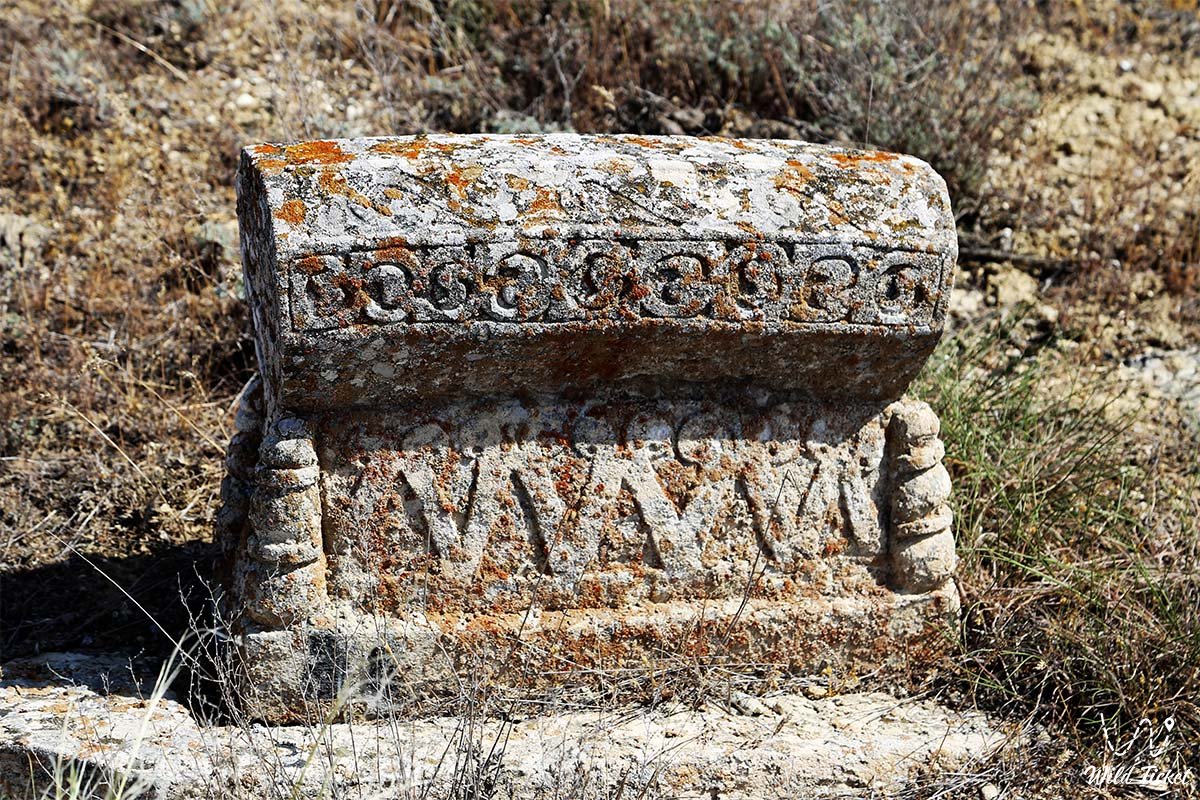
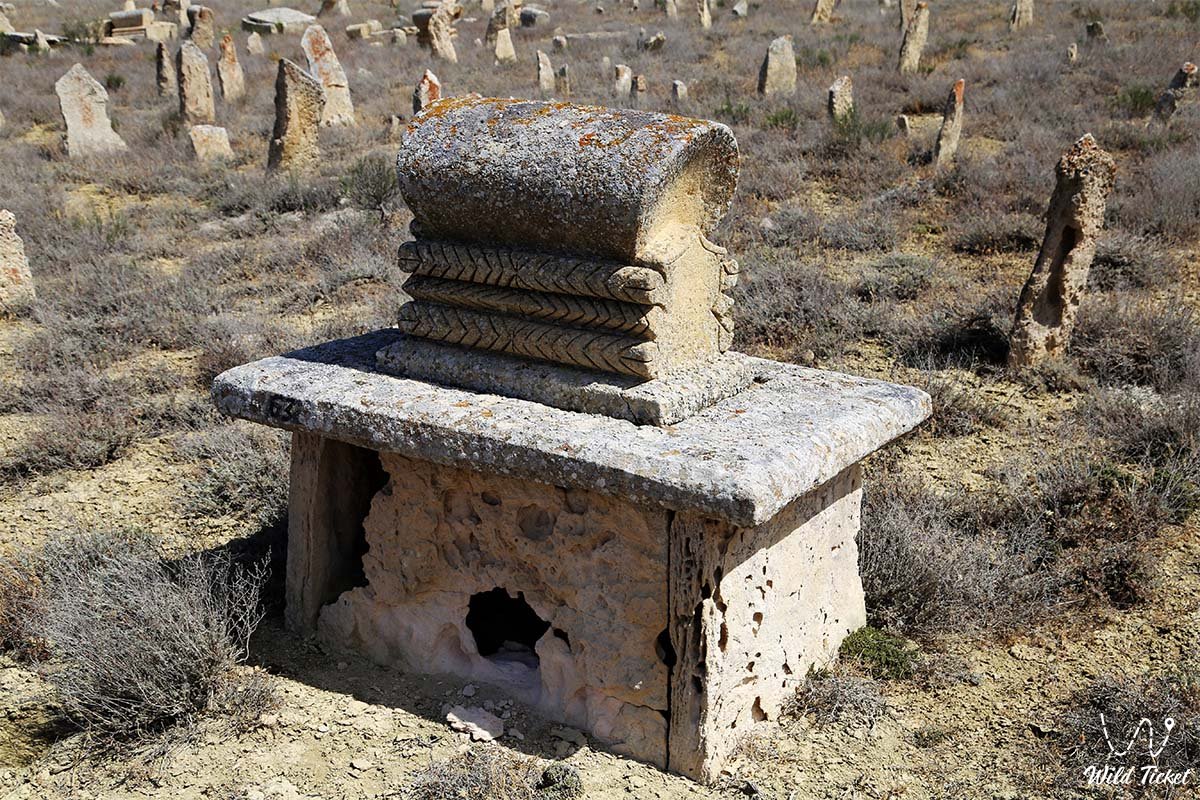
• Kazakh monuments (kulpytases, koytases, saganatams) display rich sculptural plasticity and complex ornamentation. The kulpytases resemble "horned pyramids," where the ram horn motif ("qoshqar muiiz") symbolizes prosperity, the sun, and nomadic vitality. The slab surfaces are densely adorned with polychrome carvings featuring geometric and floral patterns.
Detailed description of the venue
The architectural and archaeological ensemble of the Khanga Baba Necropolis includes the following key features:
• Ruins of the ancient Turkmen mosque – a monumental memorial complex of rectangular design, oriented along a longitudinal axis from southwest to northeast. The main facade faces an inner rectangular courtyard once enclosed by a clay-cob perimeter wall.
The building is arranged along two perpendicular axes: behind the northern arched entry portal was a square domed vestibule measuring 3.64 x 3.58 m. An enfilade of small square service chambers flanked the vestibule. Beyond the vestibule opens a spacious prayer hall, with the lower segment of a massive load-bearing column surviving at its center.
Residential quarters for attendants, guest cells for pilgrims, and narrow open iwans and utility storerooms on the eastern and western flanks were arrayed along the perimeter of the hall. The walls are built of dressed slabs of local coquina and alabaster.
• Ruins of the portal-domed mausoleum – the central mazar of the necropolis, which was fully intact during Taras Shevchenko's visit in 1851. Massive stone foundations, fragments of the entrance portal pylons, and the outline of a domed chamber built of dressed stone have survived to this day.
• Turkmen stele-ferts and warrior sandyktases – an archaic group of 14th–17th-century stone gravestones situated in the third sector of the burial ground. The slabs are distinguished by austere geometry without excess decoration; relief silhouettes of curved oriental sabres, protective amulets, and Koranic citations are carved into the smooth sandstone.
• Kazakh kulpytases in the form of "horned pyramids" – tall vertical carved steles from the 18th to the early 20th centuries crafted by masters of the Aday clan. The tops of the monuments are crowned with carved finials resembling curled argali horns, while the faces are covered in refined carving with solar disks, floral interlace, and clan tamgas.
• Kazakh saganatams of the Aday clan – monumental roofless rectangular mausoleums built from large slabs of sawn coquina, featuring profiled cornices and intricate carvings on the inner walls.
• Relict mulberry grove and ancient elms – a living natural and historical monument of the tract. Encompassing hundreds of mature mulberry trees (Morus) and elms (Ulmus pumila) along the ravine slopes, the grove continues to thrive thanks to constant feeding from freshwater springs.
• Complex of service buildings and madrasah – weathered remains of stone and cob walls of religious schools, a pilgrim hospice, and auxiliary 19th-century structures documented in Colonel N. P. Lomakin's accounts.
• Historical boarding school building of 1927 – a stone building located nearby in the Karakoz ravine from the era of the Adayev district, which served as the first school for Kazakh orphan children.
Flora and fauna
The plant world surrounding the Khanga Baba Necropolis is unique within the semi-deserts of Mangystau owing to continuous spring moisture. The centerpiece of the oasis is an ancient mulberry grove (black and white mulberry) comprising hundreds of trees, accompanied by spreading elms. The understory of the ravines features dense growths of hawthorn, prickly blackberry, Russian olive (Elaeagnus angustifolia), tamarisk, wild rose, and shoots of relict Populus diversifolia (turanga). The ravine floor is covered in lush mixed herbs: wild mint, licorice, reeds, bulrushes, and dense steppe vegetation. The open limestone slopes of the chink are dominated by Lerche's wormwood, biyurgun, boyalych, and camelthorn.
The wildlife of the oasis is drawn from across the steppe by the abundance of fresh water and cover. Numerous birds nest within the tree canopies and among the mosque ruins: hoopoes, European rollers, turtle doves, Eurasian scops owls, little owls, great grey shrikes, and chukar partridges. Birds of prey nest on the sheer chalk cliffs: long-legged buzzard, steppe eagle, common kestrel, and Eurasian eagle-owl.
Mammals include the tolai hare, corsac fox, steppe polecat, badger, and long-eared hedgehog. At night, wolves, small jerboas, and gerbils visit the springs to drink. Reptiles include the Central Asian tortoise, steppe agama, toad-headed agama, sand boa, and dione snake. European green toads inhabit the damp spring pools.
Legend
An ancient tradition concerning a great Sufi elder and the miraculous power of compassion is linked to the founding of the Khanga Baba sacred complex.
Legend recounts that in the Early Middle Ages, a caravan of pilgrims and merchants led by the holy elder Khanga Baba journeyed across the torrid, waterless steppes of Tupkaragan. Along the way, a severe drought overtook the travelers: the wells along the caravan trail ran dry, water in leather waterskins was exhausted, and the scorching sun threatened humans and camels with certain death.
Seeing the people's suffering, the elder Khanga Baba climbed a rocky ravine scarp, prostrated himself, and offered a fervent prayer to the Creator for the salvation of the caravan. Concluding his prayer, the sheikh struck the white limestone cliff three times with his wooden mulberry staff, proclaiming: "May heaven's blessing pour down upon this parched soil!" In that instant, the rock split open, and a rushing stream of cold fresh water burst from the fissure, filling the ravine.
Having slaked the thirst of the people and livestock, the holy man drove his dry staff into the damp earth by the spring, saying: "Let this tree take root and shelter beneath its leaves anyone who seeks refuge in the steppe." The saint's staff came to life and grew into a mighty mulberry tree, from which the shaded groves of the oasis expanded. The elder Khanga Baba remained in the tract, founded a hermitage, healed the sick, and provided spiritual guidance to the nomads. Following his passing, the site became an inviolable sanctuary. Ever since, a belief has endured: any traveler who steps across the threshold of Khanga Baba with pure intent and recites a prayer by the walls of the ancient mosque receives spiritual purification, healing from ailments, and the invisible protection of the saint on long journeys.
Conclusion
The Khanga Baba Necropolis is an outstanding sacred monument and architectural jewel of Tupkaragan, where the thousand-year history of the Silk Road is inextricably bound with the spiritual legacy of Sufism and the art of Taras Shevchenko. A visit to this remarkable place offers a rare opportunity to observe the contrast between austere Turkmen steles carved with sabres and ornate Kazakh kulpytases, touch the ancient walls of the mosque, and experience the coolness of historic mulberry avenues amidst the boundless desert of Mangyshlak.
Interesting sights nearby:
• Paleontological Guide to Mangyshlak;
• Town of Fort-Shevchenko and the Taras Shevchenko Monument;
• Seaport and Village of Bautino;
• Tamshaly Canyon and Oasis;
• Saura Canyon and Turtle Lake;
• Kapamsay Canyon;
• Fossilized Animal Footprints in the Zhygylgan Tract;
• Saline Lake Kuzdykary;
• Medieval Settlement of Ketikkala;
• Akmysh Tract and Valley;
• Mount Sherkala (Lion's Lair);
• Village of Senek.
Sacred sights and pilgrimage destinations:
• Shakpak-Ata Rock Mosque;
• Sultan-Epe Underground Mosque;
• Kenty-Baba Necropolis-Mausoleum;
• Karaman-Ata Underground Mosque;
• Otpan Memorial Complex on Mount Otpantau;
• Shopan-Ata Underground Mosque;
• Beket-Ata Underground Mosque in the Oglandy Tract;
• Ancient Koshkar-Ata Necropolis;
• Pantheon of Kazakh Batyrs Sisem-Ata Necropolis;
• Uytoly-Ata Underground Mosque;
• Nurbergen Kalyshev Mausoleum.
Photogallery: