Largest pantheon of Mangyshlak near the cave hermitage of the holy Sufi –
Karaman-Ata necropolis is one of the largest, oldest, and most sacred funerary complexes of the Mangyshlak peninsula. The monument is situated in the Mangystau district of western Kazakhstan, occupying the gentle slopes of a marl elevation in the Kandybas tract at an altitude of approximately 220 meters above sea level.
This monumental memorial ensemble developed over more than a thousand years – from the 8th–9th centuries to the second half of the 20th century, becoming a unique open-air museum of folk architecture and stone carving.
The necropolis owes its emergence and unquestioned authority to the sacred hermitage: its western sector houses the famous rock-cut Karaman-Ata underground mosque of the 12th–13th centuries containing the tomb of the holy Sufi. In the folk memory of Mangystau, the Karaman-Ata necropolis went down in history as the supreme ground for purifying oaths and resolving the most complex inter-clan disputes.
The soil of the necropolis was considered sacred: under penalty of divine curse, shedding blood was strictly forbidden here, battleaxes were lowered, swords were sheathed, and an unbreakable oath of allegiance to the clan was sworn.
The total protected territory of the monument covers 7.2 hectares, of which a central core of 4 hectares is enclosed by a protective metal fence. Approximately 1,000 burials of various eras are concentrated within the necropolis, and comprehensive scientific expeditions have recorded and placed under state protection 473 distinctive architectural objects.
The layout of the necropolis clearly reflects the succession of nomadic epochs: the southwestern section, outside the main enclosure, contains 40 archaic headstones of the 8th–9th centuries belonging to the Oghuz-Kipchak horizon; the western sector preserves medieval Turkmen stelae-kulpytases and the ruins of a hexagonal mausoleum; while the central and northeastern zones are occupied by the extensive Kazakh pantheon of the Aday tribal confederation from the second half of the 19th to the early 20th century, showcasing magnificent domed mausoleums, saganatams, and carved compositions with koytases.
Among the masterpieces of memorial architecture, prominent highlights include the domed mausoleum of Shoinbai (Shoyynbai) built in 1914 with an original parapet made of a row of sculpted koytases, crafted by the famous Aday folk architects Omir Karauly and Nazar Omiruly, as well as the monumental domed mausoleum of Seisen Kenebaev, erected in 1970 by master Tolegen Kaunaruly.
Since 1982, the necropolis has been protected by the state as a monument of national significance, and in 2026, together with the rock-cut mosque, it was inscribed on the UNESCO World Heritage List as part of the serial nomination "Rock-cut Mosques and Associated Sacred Sites of Mangystau."
--------------------------------------------
How to get there and visit –
Karaman-Ata necropolis is located in the central part of the Mangyshlak peninsula within the Mangystau district in the Kandybas tract, Mangistau Region. The distance from the regional administrative center of the city of Aktau is around 140–145 km to the east (via highways) and approximately 63.5 km in a straight line to the northeast; from the district center of the settlement of Shetpe – about 35 km to the southwest; from the settlement of Zhetybai – about 38.5 km to the northwest; from the village of Beki – around 16 km to the south; and from the lacework Ybykty-Say canyon (Kabyrga tract) – about 15 km to the east via steppe tracks (7.5 km in a straight line to the northeast).
GPS geographic coordinates of Karaman-Ata necropolis:
43°54'00"N 51°52'33"E
43.900000, 51.875278
Route from Aktau: departure from the city proceeds along the paved national highway eastward toward the settlements of Munayshy, Zhetybai, and Shetpe. After covering about 125 km of asphalt surface (approximately 1.5 hours of driving), proceed to the village of Beki (Beki necropolis). Near Beki, leave the highway: turn right onto a well-traveled graded steppe road and a stony-clay track heading south across the plain of the Kandybas tract. The final 16 km are driven along an unpaved road with natural terrain undulations. The total travel time from Aktau takes about 2–2.5 hours.
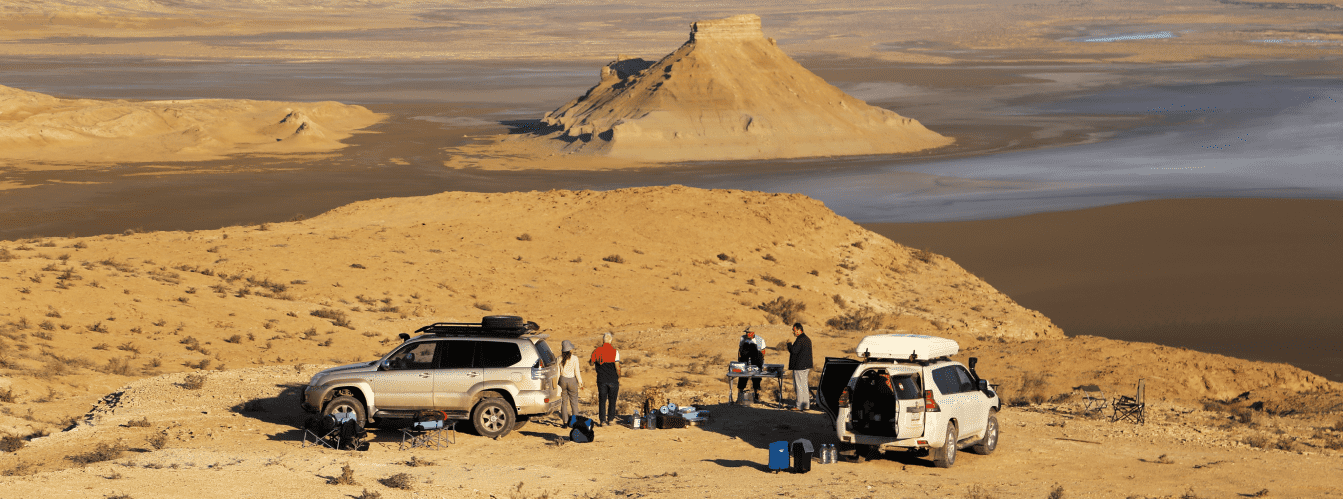
Vehicle requirements: the steppe section from Beki village to the necropolis is full of ruts, washouts, and exposed marl beds. In dry summer periods, transit is possible in standard passenger cars with careful driving; however, the recommended and safe vehicle choice is a crossover or a body-on-frame 4x4 off-road vehicle with high ground clearance. During prolonged spring or autumn rains, the clayey marl softens, presenting impassable obstacles for single-axle vehicles.
Pilgrimage etiquette and visitor rules:
Karaman-Ata necropolis is an ancient active sacred pantheon of the steppe, demanding strict observance of spiritual traditions:
– clothing must be modest and conservative: women require a headscarf, covered shoulders, and a long skirt or dress; men are prohibited from visiting the cemetery in shorts and open tank tops;
– stepping on burial mounds, grave slabs, or walking across graves is strictly prohibited;
– climbing the walls of saganatams or domes of mausoleums for photography is forbidden;
– touching, shaking, or leaning on fragile, weathered limestone kulpytas stelae and carved koytases is prohibited;
– quiet reverent behavior must be maintained across the necropolis; loud talk, laughter, smoking, and alcohol consumption are prohibited;
– all domestic litter and plastic bottles must be carried away.
Infrastructure: adjacent to the necropolis and underground mosque stands a well-equipped pilgrim house (shyrakshy / mihmankhana) featuring canopies and open verandas. The lodge offers shared dormitory rooms for overnight stays, a prayer hall, and an equipped kitchen with a dining area where travelers can cook meals, drink tea, and rest after a long steppe journey. Sanitary blocks are located on the adjacent grounds.
The nearest fueling stations, grocery shops, tire repair services, and eateries are located in the settlements of Zhetybai (38.5 km) and Shetpe (35 km). Cellular coverage near the pilgrim house is intermittent depending on the mobile provider.
Seasonality: visits to the necropolis are possible throughout the year. The most favorable seasons for a thorough exploration of the monuments and photography are spring (April – May) and early autumn (September – October). During the summer months, outdoor temperatures on the exposed marl highlands rise up to +40 °C, so sightseeing is best planned for morning hours or late afternoon, when the low sun accentuates the delicate relief of the stone carvings.
--------------------------------------------
History
The history of the Karaman-Ata necropolis spans more than twelve centuries of continuous funerary tradition among the nomadic societies of the Aral-Caspian watershed.
Archaeological studies indicate that the earliest burials on the gentle marl hill of the Kandybas tract appeared as early as the 8th–9th centuries AD. During this era, the eastern coast of the Caspian and the plains of Mangyshlak were traversed by early medieval Oghuz-Kipchak tribes, who interred their kin beneath archaic stone clusters, enclosures, and chest-like sarcophagus slabs. The convenient terrain, natural watercourses, and proximity to caravan routes connecting the Caspian with Khwarezm turned the hill into a traditional clan burial ground.
A new era in the development of the necropolis began in the 12th–13th centuries, when the Sufi missionary Karaman-Ata expanded the natural cavities of the hill and founded the underground mosque. According to 19th-century Aday oral lore, Karaman-Ata was the son of Saint Yesen-Ata and the grandson of Shopan-Ata, the patron of shepherds. Another legend holds that Karaman-Ata and his brother Akman-Ata were favorite murids of the great Khoja Ahmed Yasawi in Turkistan, but following a theological dispute with their mentor, led their clans to Mangyshlak. The presence of the holy Sufi sanctified the Kandybas tract. Burial near the hermitage of Karaman-Ata came to be seen by nomads as an assurance of spiritual intercession by ancestral spirits (aruakhs).
Between the 14th and 18th centuries, the cemetery was used by Turkmen nomadic groups, who left behind refined carved stelae-kulpytases and hexagonal mausoleums. From the late 18th century and continuing through the 19th and 20th centuries, the necropolis served as the primary clan pantheon of the Kazakh Aday tribal confederation. During this period, Mangyshlak stonemasons reached the pinnacle of their craftsmanship, developing a unique school of carving in sandstone and coquina limestone. Entire guilds of folk masters erected portal domed mausoleums and saganatams, adorned with floral, geometric, and zoomorphic ornaments, as well as narrative engravings of weapons, horses, and everyday gear.
The sacred status of the necropolis as the supreme tribunal of the steppe endured for centuries. The tradition of "Swearing an Oath at Karaman-Ata" precluded falsehood: before the tomb of the saint, suspects brought forward purifying oaths, while clan leaders ratified peace treaties, extinguishing the flames of internecine conflict.
History of scientific research:
The Karaman-Ata necropolis was first scientifically documented and surveyed in 1951–1952 by an architectural expedition of the Academy of Sciences of the Kazakh SSR under the direction of the prominent scholar Malbagar Mendikulov. In 1973, an expedition of the Society for the Protection of Monuments, again led by Mendikulov, carried out precise measurements of the necropolis, cataloging 473 valuable monuments. In 1977 and 1979, research teams from the Ministry of Culture of the Kazakh SSR (led by A. O. Itenov and M. Nurkabaev) conducted further studies on the site.
By Resolution No. 38 of the Council of Ministers of the Kazakh SSR on January 26, 1982, the Karaman-Ata necropolis was granted state protection of national significance. The boundaries of the 7.2-hectare protective zone were confirmed by decree of the Akimat of the Mangistau Region No. 414 on December 8, 2010. In 2005 and 2015–2017, the enterprise "Mangyshlakrestavratsiya" completed extensive conservation and restoration work across the complex. In 2026, at the 48th session of the UNESCO World Heritage Committee, the Karaman-Ata necropolis was inscribed on the World Heritage List among the sacred sites of Mangystau.
Information
Architecturally and typologically, the Karaman-Ata necropolis is a multi-layered open-air memorial complex spanning an area of 7.2 hectares at an elevation of 220 meters above sea level.
Morphometric parameters of the complex:
– total protected area: 7.2 hectares;
– fenced area within metal enclosure: 4 hectares;
– total number of burials: approximately 1,000 units;
– number of monuments registered under scientific catalog: 473 architectural objects;
– count of archaic 8th–9th-century headstones: 40 monuments beyond the southwestern fence;
– absolute elevation: 220 m above sea level;
– primary construction materials: local marl, sandstone, and coquina limestone.
Architectural typology of funerary structures:
Virtually all forms of nomadic memorial sculpture of Western Kazakhstan are represented across the necropolis:
– domed mausoleums (tam): square-plan monumental structures on elevated plinths, crowned by helmet-shaped or conical domes resting on faceted and cylindrical drums;
– saganatams: rectangular roofless stone enclosures whose facades are covered in carpet-like relief carving and polychrome decorative paint;
– sandyktases: massive stone box-slabs and stone sarcophagi, typical of the early medieval horizon;
– koytases: sculpted zoomorphic and block-form headstones with stylized ram horns (koshkar-muyiz), reflecting an ancient pastoral cult of fertility and abundance;
– kulpytases: vertical carved stone stelae ranging from 1.5 to 3 meters in height with engraved Arabic epitaphs, clan tamgas, and bas-relief weaponry;
– ushtases and beltases: stepped three-tiered pyramidal plinths, symbolizing the traditional tripartite vertical structure of the nomadic universe.
Prominent monuments of the necropolis:
The crown jewel of the necropolis is the domed mausoleum of Shoinbai (Shoyynbai), constructed in 1914 by the workshop of master Umir Karin (Omir Karauly). The main facade of the mausoleum features a distinctive parapet executed as a rhythmic row of sculpted stone koytases.
In the northeastern sector of the necropolis stands the mausoleum of Seisen Kenebaev, built in 1970 by folk master Tolegen Kaunaruly: a austere cubic block on an elevated stylobate crowned by an expressive helmet-shaped dome on a drum, illustrating the persistence of stonemasonry traditions even through the Soviet era.
Detailed site description
The historic memorial complex of the Karaman-Ata necropolis includes the following key architectural zones, historical structures, and sacred elements:
• Archaic sector of the 8th–9th centuries – a cluster of 40 early Oghuz-Kipchak headstones situated outside the southwestern fence, consisting of mossy slabs and primitive stone enclosures.
• Western Turkmen memorial sector – a historic zone containing stone kulpytas stelae and the remains of a hexagonal medieval mausoleum located near the cave mosque.
• Shoinbai mausoleum (1914) – a masterpiece of folk architecture built by Umir Karin's guild, distinguished by its unique parapet on the main facade adorned with a series of stone koytases.
• Seisen Kenebaev mausoleum (1970) – a cubic domed tomb by master Tolegen Kaunaruly set on a high base with a helmet-shaped dome.
• Aday carved saganatams of the 19th–20th centuries – monumental rectangular stone enclosures displaying intricate relief carvings, weapon motifs (sabers, rifles), and horse tack.
• Colony of sculptural koytases – stylized zoomorphic stone markers with carved argali horns, symbolizing prosperity and pastoral heritage.
• Carved kulpytas stelae – upright stone obelisks bearing clan tamgas of Aday lineages and poetic epitaphs written in Old Kazakh using Arabic script.
• Stepped pyramidal ushtases and beltases – three-tiered stone bases embodying nomadic concepts of cosmic order.
• Sacred swearing ground – a ceremonial open area before the mosque where clan leaders historically pronounced cleansing oaths of peace, ending bloody feuds.
• Pilgrim lodge (Mihmankhana) – an equipped guest house by the entrance offering shaded verandas, a kitchen, and rest quarters for travelers.
• Four-hectare protective metal enclosure – a boundary perimeter installed during restoration to safeguard the historic core of the cemetery.
Legends
Central epic traditions of the Kazakhs and Turkmens of Mangystau are linked with the Karaman-Ata necropolis, demonstrating its status as an altar of justice and spiritual truth.
The Legend of the Great Court and the Unbreakable Oath:
Elders of Mangystau recount how the sanctuary of Karaman-Ata put out the fiercest fires of feud. Whenever long-standing disputes over grazing lands, stolen horse herds, or blood grievances reached a deadlock, and the counsel of biys and aksakals failed to restore harmony, tribal chieftains proceeded to the Karaman-Ata necropolis. Here, facing the holy sanctuary, battle-ready swords were sheathed and combat spears (naiza) lowered to the earth.
The accused was called upon to swear a purifying oath in the name of the saint. No sound-minded person dared speak a lie beneath this sky: people believed that swift divine retribution would strike down a perjurer – his lineage would wither, and he would not live past the next moon. Many wrongdoers preferred to confess their transgressions right at the gates of the necropolis, bowing their heads to preserve their souls.
The Legend of the Aday-Turkmen Dispute and the Miracle of Beket-Ata:
In ancient times, a bitter dispute flared between Turkmen and Aday clans, threatening to escalate into war. Seeking a peaceful resolution, the elders gathered at the tomb of Karaman-Ata. In keeping with steppe custom, the dispute was staked on the life of an only son: the Kazakhs brought forward 9-year-old Koshan – the only son of batyr Kozha-Nazar – and called upon Saint Beket-Ata to serve as judge.
Beket-Ata mounted the boy upon a black steed, drove a sharp awl into the saddle, and raised a prayer: "O holy Karaman-Ata! If the fault is ours – punish us; if the fault is the steed's – strike down the black horse!". At that instant, the horse fell dead, while the awl shot out of the saddle several paces away without touching the child, whom Beket caught mid-air. When the Turkmens hesitated, suspecting favoritism, the saint arranged to meet them the next day at the Shekepar tract, immediately transformed into a white swan, and soared into the sky. Stunned by the miracle, the Turkmen elders accepted the ruling and concluded an eternal truce over the tomb of Karaman-Ata.
The Tale of the Two Brothers Akman and Karaman:
Another narrative relates that the holy brothers Akman and Karaman were prominent teachers of faith and close companions of Khoja Ahmed Yasawi. When a private dispute arose between them, the brothers, wishing to avoid strife among their followers, led groups of Oghuz nomads to the Mangyshlak peninsula. Over the site where Karaman-Ata first set foot and began teaching righteous life, this sacred necropolis gradually arose, becoming an enduring shield of peace across the land of Mangystau.
Conclusion
Karaman-Ata necropolis is an enduring treasury of folk architecture and a testament to the moral strength and spiritual justice of the steppe nomads. Its inclusion on the UNESCO World Heritage List underscores its universal cultural significance. Walking among the carved saganatams of masters Omir Karauly and Nazar Omiruly, viewing the dome of the Shoinbai mausoleum, and experiencing the quiet of the marl heights leaves a lasting impression on every traveler exploring the sacred heritage of ancient Mangyshlak.
Nearby attractions:
• Karaman-Ata underground rock-cut mosque;
• Ybykty-Say canyon (Kabyrga tract);
• Otpan-Tau historical and cultural complex with the Aday-Ata memorial;
• Kyzylkala settlement site;
• Sherkala residual butte;
• Airakty-Shomanai mountains (Valley of Castles);
• Samal rock canyon with a freshwater stream;
• Relict oasis of the Akmysh tract;
• Temir-Abdal underground mosque;
• Zhaman Sauran underground mosque;
• Settlement of Shetpe;
• Settlement of Zhetybai;
• City of Aktau on the coast of the Caspian Sea.
List of other necropolises in Mangystau:
• Shopan-Ata necropolis;
• Shakpak-Ata necropolis;
• Sisem-Ata necropolis;
• Masat-Ata necropolis;
• Kenty-Baba necropolis;
• Koshkar-Ata necropolis;
• Yesen-Ata necropolis;
• Karatobe necropolis;
• Seydi Islam Ata necropolis;
• Great Tulep necropolis;
• Senek necropolis;
• Kydyrsha Ata necropolis;
• Toksan necropolis;
• Tobekuduk necropolis;
• Kyrgyn necropolis;
• Beltoran necropolis;
• Beki necropolis;
• Akuyek necropolis;
• Kamysbai necropolis;
• Karagashty necropolis;
• Kyzylsu necropolis;
• Oglandy-Ata necropolis;
• Shili necropolis;
• Ushtam necropolis;
• Demeu necropolis;
• Zhambaul necropolis;
• Sherkala necropolis;
• Beisenbay necropolis;
• Kalyn Arbat necropolis;
• Kalipan necropolis;
• Esmambet Ata necropolis;
• Doly Apa necropolis;
• Old Beyneu necropolis;
• Uali necropolis.
Photogallery: