Secluded monument of memorial architecture in the Tupkaragan district –
Ushtam Necropolis represents an ancient historical, architectural, and sacred complex in the northeast of the Tyub-Karagan peninsula (the western part of the Mangyshlak peninsula) in the Tupkaragan district. Located approximately 55 kilometers northeast of the city of Fort-Shevchenko and 40–42 kilometers northwest of Tauchik village, this monument of memorial architecture spans the period from the 10th–14th to the 19th century.
The complex received its name – "Ushtam" (translated as "Three Houses" or "Three Mausoleums") – thanks to the three main monumental domed structures of Mangystau, also popularly known by the name Ushshonkol. According to the traditions of local elders, these buildings formed a unified spiritual and ancestral center: one building served as an ancestral crypt, the second as a madrasah (religious school), and the third as an above-ground mosque. The mausoleums are built from massive blocks of yellowish and rare pink shell-rock limestone – a sedimentary rock formed millions of years ago on the floor of the ancient Tethys Ocean and the Sarmatian Sea.
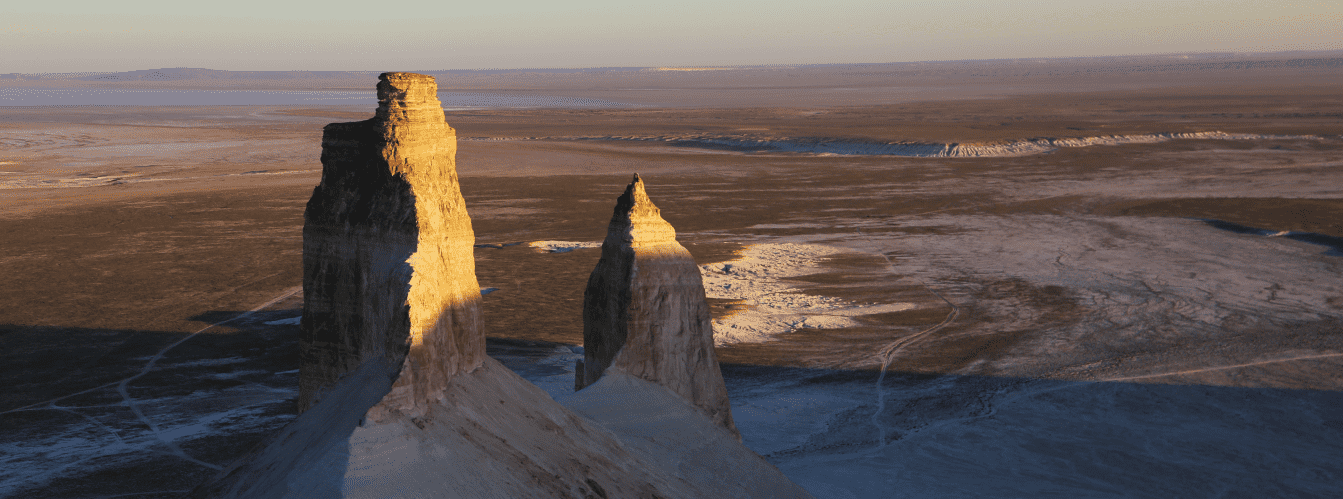
Surrounded by the boundless, quiet steppe, the Ushtam necropolis impresses with the preservation of its medieval stone carving, original koytas tombstones, and sandyktas sarcophagi. Visiting the complex organically complements pilgrimage and excursion routes across the northeast of the peninsula and Cape Tyub-Karagan.
Within the geographic and sacred space of the district, the Ushtam necropolis sits in close proximity to iconic sanctuaries and natural monuments along the coast of the Caspian Sea:
– just 3 kilometers to the northeast rises the famous Kenty-Baba necropolis with its open-air steppe mosque, while 4.5–5 kilometers away, hidden inside a picturesque ravine, lies the underground Sultan-Epe mosque;
– to the northwest and west along the Caspian coast lie the narrow chalk canyon Kapamsay, the gigantic geological collapse of the Zhygylgan sinkhole, and the green oasis of Tamshaly canyon;
– to the east on the shore of Sarytas Bay stands the unique rock-cut Shakpak-Ata mosque, as well as ancient monuments – the Akshora mausoleum, the Beltoran mausoleum-necropolis, and the Karakoz mausoleum within the territory of the Aktau-Buzachi Nature Sanctuary.
--------------------------------------------
How to get there and visit –
Ushtam Necropolis is located in the northeastern part of the Tyub-Karagan peninsula in the Tupkaragan district of the Mangistau Region, far from settlements and paved highways. The distance from the city of Aktau is around 145–155 km via motor roads and steppe tracks, from the city of Fort-Shevchenko – about 55 km northeast, and from Tauchik village – approximately 40–42 km northwest.
GPS geographic coordinates of the Ushtam necropolis:
44°27'16"N 50°57'38"E
44.454444, 50.960556
Route from Aktau: the drive from the city of Aktau takes about 3.5–4 hours. The first leg of the route runs along the paved highway toward Tauchik village (via the Kyzan / Kiyakty settlement area). Beyond Tauchik village, the asphalt ends, and the onward journey stretching about 40 km follows worn steppe dirt tracks northwest toward the Sultan-Epe gorge, the Kenty-Baba necropolis, and the Ushtam necropolis located 3 km away. The site can also be approached from the direction of Fort-Shevchenko along the steppe roads of the Tyub-Karagan plateau (about 55 km). Public transport does not serve the necropolis.
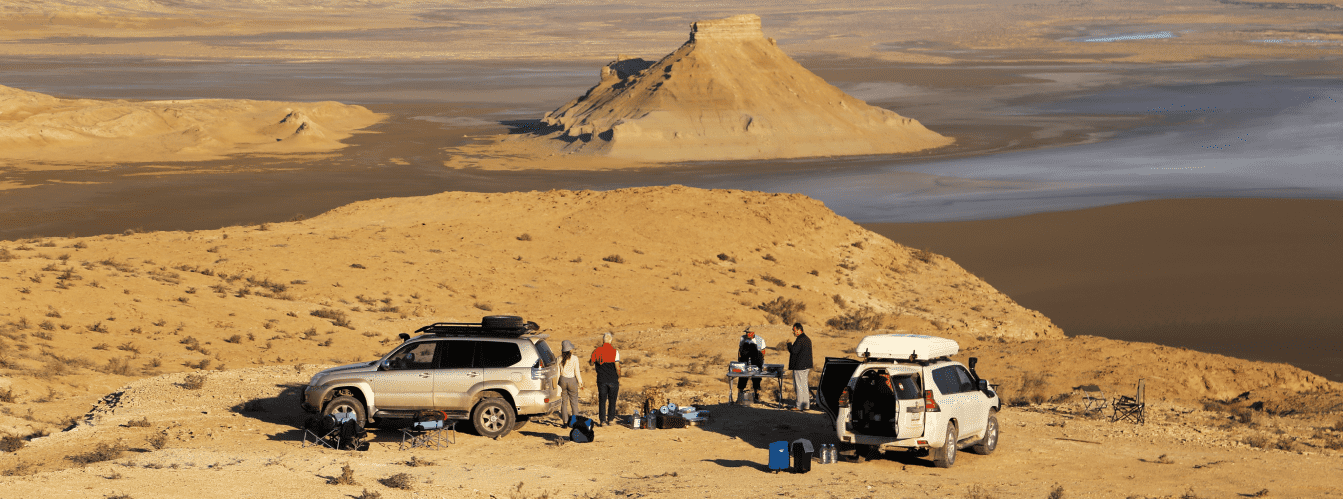
Vehicle requirements: a trip to the Ushtam necropolis requires a four-wheel-drive 4x4 off-road vehicle with high ground clearance. All access routes consist of country dirt tracks with stony sections, washouts, and clay lowlands that become difficult for standard passenger cars to pass after rains and during spring snowmelt.
Safety rules and pilgrimage etiquette:
Ushtam Necropolis is a revered sacred monument and a site of cultural heritage:
– when visiting the necropolis grounds, maintain silence, respect pilgrim traditions, and wear modest, covered clothing (covered shoulders and knees, and a headscarf for women);
– climbing onto the walls and domes of the ancient mausoleums, leaning against carved koytas tombstones, or moving burial stones is strictly prohibited;
– mobile reception and internet are virtually absent across this stretch of steppe, so download offline maps in advance and bring a supply of drinking water;
– all household litter must be carried back with you.
Infrastructure: directly beside the Ushtam necropolis, any tourist infrastructure, shops, cafes, and gas stations are absent. The nearest caretaker's lodge (shyrakshy) and basic facilities for pilgrims are located 5 km away at the underground Sultan-Epe mosque, while the last gas stations and stores along the route from Aktau are in Tauchik village.
Seasonality: visiting the monument is possible year-round. The most favorable times for pilgrimage and architectural sightseeing are spring (April – May) and autumn (September – October), when comfortable temperatures prevail and the steppe is painted in fresh greenery. In summer, air temperatures warm up to +38...+42 °C, while in winter cold winds blow from the Caspian Sea.
--------------------------------------------
History
The history of the Ushtam necropolis spans roughly a thousand years and is inextricably linked with the medieval settlement of the Mangyshlak peninsula, the spread of Islam, and the ancestral burial traditions of Western Kazakhstan's nomads.
The emergence of the earliest burials and stone structures of the complex dates back to the 10th–14th centuries – the heyday of caravan trade between Khwarezm, the port city of Ketik-Kala on Cape Tyub-Karagan, and the Lower Volga region. Over subsequent centuries (up until the 19th century), ancestral tombstones continued to be erected around the three central mausoleums.
According to the accounts of local elders and regional historians, the three main structures of the ensemble fulfilled important spiritual and educational functions in olden times: one mausoleum served as an honored ancestral crypt, the second building was used as a madrasah for teaching literacy and the fundamentals of faith, and the third represented an above-ground mosque with a narrow corridor from which the mullah called students and travelers to communal prayer.
During the Soviet and modern periods, the necropolis was surveyed by archaeologists and restoration architects, included in the list of monuments of history and culture of the Mangistau Region, and today ranks among the significant sites of pilgrimage tourism in the region.
Information
Ushtam Necropolis is a monument of history and culture located within the Tupkaragan district of the Mangistau Region of the Republic of Kazakhstan.
Main historical and geographic parameters:
– status: historical, cultural, and sacred monument;
– dating: 10th–19th centuries (the main domed mausoleums date to the 10th–16th centuries);
– geographic location: northeastern part of the Tyub-Karagan peninsula (Mangyshlak peninsula), 55 km northeast of the city of Fort-Shevchenko, 40–42 km northwest of Tauchik village, 3 km from the Kenty-Baba necropolis, and 5 km from the underground Sultan-Epe mosque.
Geology and building material:
– all structures and tombstones of the necropolis are built from local sedimentary rocks (yellowish and pink shell-rock limestone), formed during the multi-million-year epoch of the ancient Tethys Ocean and the Sarmatian Sea that covered the territory of modern Mangystau;
– owing to its softness when worked and durability after weathering, this marine limestone enabled medieval craftsmen to create delicate contour and bas-relief carving.
Detailed site description
The architectural ensemble of the Ushtam necropolis is shaped by the following key structures and monuments:
• Main domed mausoleum of pink limestone – the most expressive structure of the complex (originally reaching up to 6 meters in height) with a tall portal facade and a hemispherical dome behind it; each wall is adorned with a large blind door topped by a decorative curtain arch and pointed flutes (grooves) along the sides.
• Two traditional mausoleums (buildings of the former madrasah and mosque) – domed buildings of more austere silhouette constructed from massive blocks of yellowish shell rock, forming the Ushshonkol triad together with the central mausoleum.
• Koytases and sandyktases – funerary monuments from various periods surrounding the mausoleums: stylized stone sculptures of a ram (koytases) and rectangular stone sarcophagi (sandyktases) covered with intricate carving, ornaments, and tamgas.
• Saganatams and stone enclosures – later 18th–19th-century memorial structures demonstrating the continuity of the Mangystau stone-carving school.
Legends
The three solitary domes of the Ushtam necropolis, rising above the steppe a few kilometers from the sanctuaries of Sultan-Epe and Kenty-Baba, have inspired numerous folk legends since antiquity.
The Tale of the Three Brother-Mentors and the White Stone of Ushtam:
Elders recount that in times long past, three wise brother-mentors lived on the Tyub-Karagan peninsula, dedicating their lives to teaching children literacy, aiding travelers, and digging wells in the waterless steppe. When the time came for them to depart this world, grateful kinsmen carved three majestic domed houses out of pale and pink shell rock – the stone preserving the memory of the ancient sea: one became their eternal resting place, the second a madrasah school where the voices of pupils rang out, and the third a mosque from which the mullah's call carried across many versts. Elders say that at sunset, the pink limestone of the main mausoleum ignites with a warm golden glow, as if reminding travelers of the hospitality and wisdom of the ancient sages.
--------------------------------------------
Conclusion
Ushtam Necropolis is a distinctive and secluded monument of memorial architecture on the Mangyshlak peninsula, offering a glimpse of authentic medieval carving on shell-rock limestone and the unhurried rhythm of the sacred steppe. By combining a visit to Ushtam with exploring the neighboring Kenty-Baba necropolis and the underground Sultan-Epe mosque, travelers gain a holistic understanding of the spiritual history of the Tyub-Karagan peninsula.
Nearby attractions:
• Tyub-Karagan Peninsula;
• Cape Tupkaragan;
• Tupkaragan Bay;
• Sultan-Epe Canyon;
• Kapamsay Canyon;
• Fossilized Tracks in the Zhygylgan Tract;
• Zhygylgan Sinkhole;
• Tamshaly Canyon;
• Underground Sultan-Epe Mosque;
• Kenty-Baba Necropolis;
• Shakpak-Ata Mosque;
• Beket-Ata Mosque;
• Shopan-Ata Mosque;
• Karaman-Ata Mosque;
• Sisem-Ata Necropolis.
Photogallery: