Travel to Uralsk from Almaty -
Uralsk City Tour -
Uralsk is a large city in Kazakhstan. It is located in the west of the country at the northern edge of the Caspian lowland near the border with Russia, about 250 km south of Samara and 300 km west of Orenburg. The city is located on the right bank of the Ural River and geographically belongs to Europe. It is the administrative center of the West Kazakhstan region and, with a population of 259,776, its largest city.
---------------------------------------------
History
The city was founded in 1584 under the name Yaitsky gorodok (also Yaitsk), since the Ural River was then called Yaik by the Ural Cossacks who lived there and received city rights in 1613. In 1772, the first Cossack uprising took place against the local commander, General Traubenberg, who, along with several other officers, was killed on February 12 of the same year. Traubenberg insisted on shaving Cossack beards and eventually carried it out "on the public market"; after suppressing the uprising and punishing the instigators, several hundred rebels fled to the surrounding marshes.
On September 17, 1773, Cossacks, Tatars and serfs in Yaitsk, led by Don Cossack and army deserter Yemelyan Pugachev, who pretended to be a miracle survivor of the murderers, but in fact Peter III, who was killed in 1762, rebelled against Catherine II (Pugachev Uprising) and with an army of up to 9,000 people, they took, among others, the cities of Orenburg and Ufa.
On January 15, 1775, Catherine ordered the renaming of both the Yaik River to the Urals and the city of Yaitsk to Uralsk. In the 19th century, the city also had several smaller-scale Cossack uprisings suppressed by Russian troops. The settlement developed as a shopping center and in 1894 was connected to the Ryazan-Ural Railway.
During the Russian Civil War, the city was the scene of fierce fighting and in 1919 it was besieged by the White Army for several months. After Kazakhstan gained independence from the Soviet Union, the city was renamed Oral. Uralsk is the capital of Kazakhstan's Western Kazakhstan region (Batys Kazakhstan).
Alexander Pushkin came here to collect materials for his works, and this is the only city in Kazakhstan that he visited personally. At various times, Gabdulla Tukai, Mikhail Sholokhov, Leo Tolstoy, Fyodor Chaliapin, Vladimir Dahl and other prominent personalities lived or visited here. All this has turned Uralsk into a real cultural crossroads of epochs.
Culture, sights and architecture
Uralsk is one of the oldest cities in Kazakhstan, the development of which took place mainly along the current Nazarbayev Avenue (until 2019 – Dostyk Avenue). Although many of the city's churches were destroyed at the beginning of the 20th century, most of the preserved historical buildings are still located along Nazarbayev Avenue.
One of the oldest civilian buildings in Uralsk is the Ataman's House. Built in 1825, it has long been the residence of the chieftains of the Ural Cossack army. Famous Russian writers such as Alexander Pushkin, Vasily Zhukovsky and Leo Tolstoy also stayed here during their visits to the city.
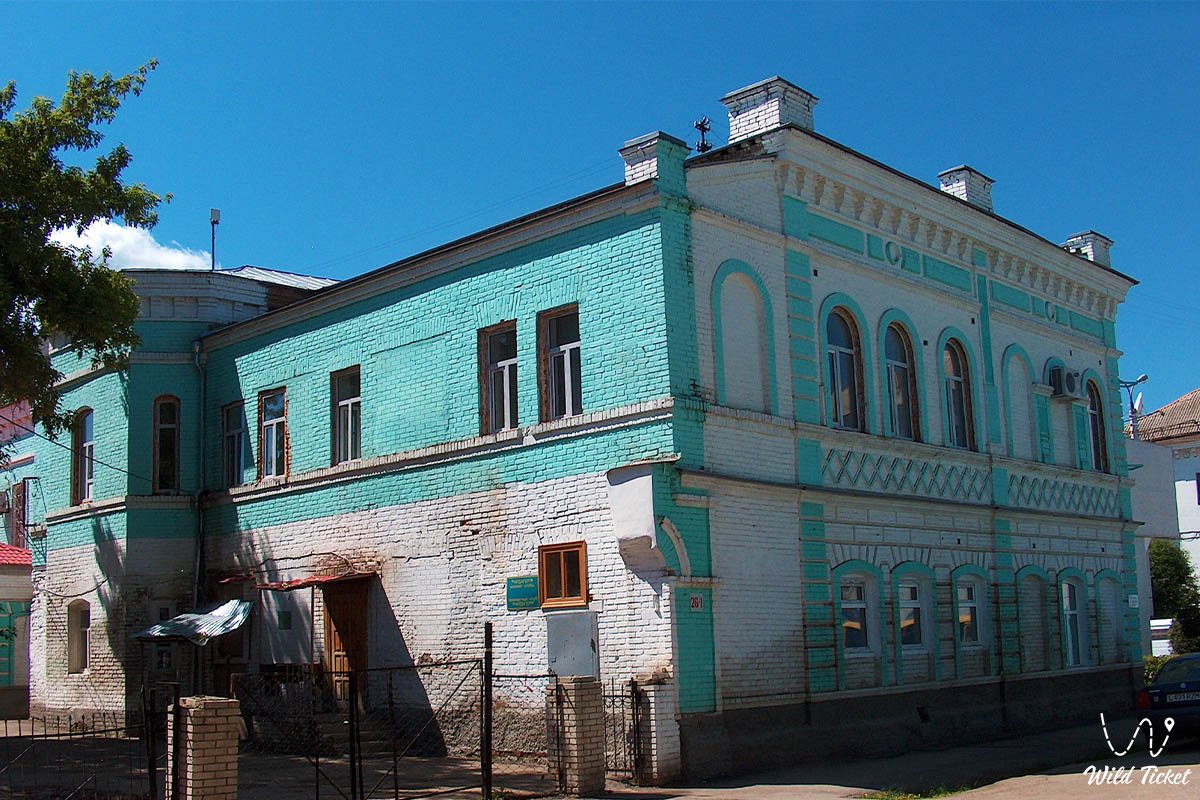
One of the most famous buildings is the house of merchant Alexander Trifonovich Karev, built around 1900. Originally built as an apartment building, it also housed shops and a hotel until the 2000s. Today it houses the Kurmangaza Philharmonic Society and the library.
---------------------------------------------
Churches and mosques
One of the oldest buildings in Uralsk is the St. Michael the Archangel Cathedral. After ten years of construction, the church building was completed in 1751 and consecrated in honor of Archangel Michael, the patron saint of the Cossacks.
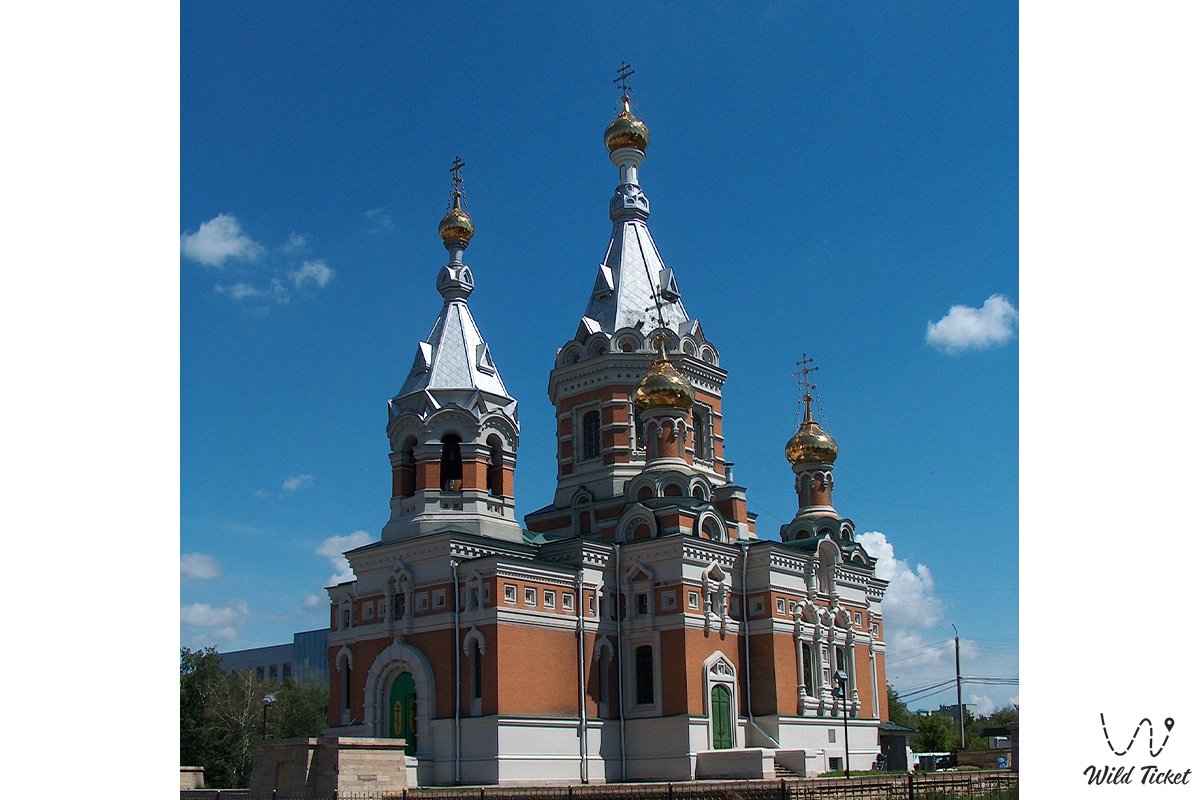
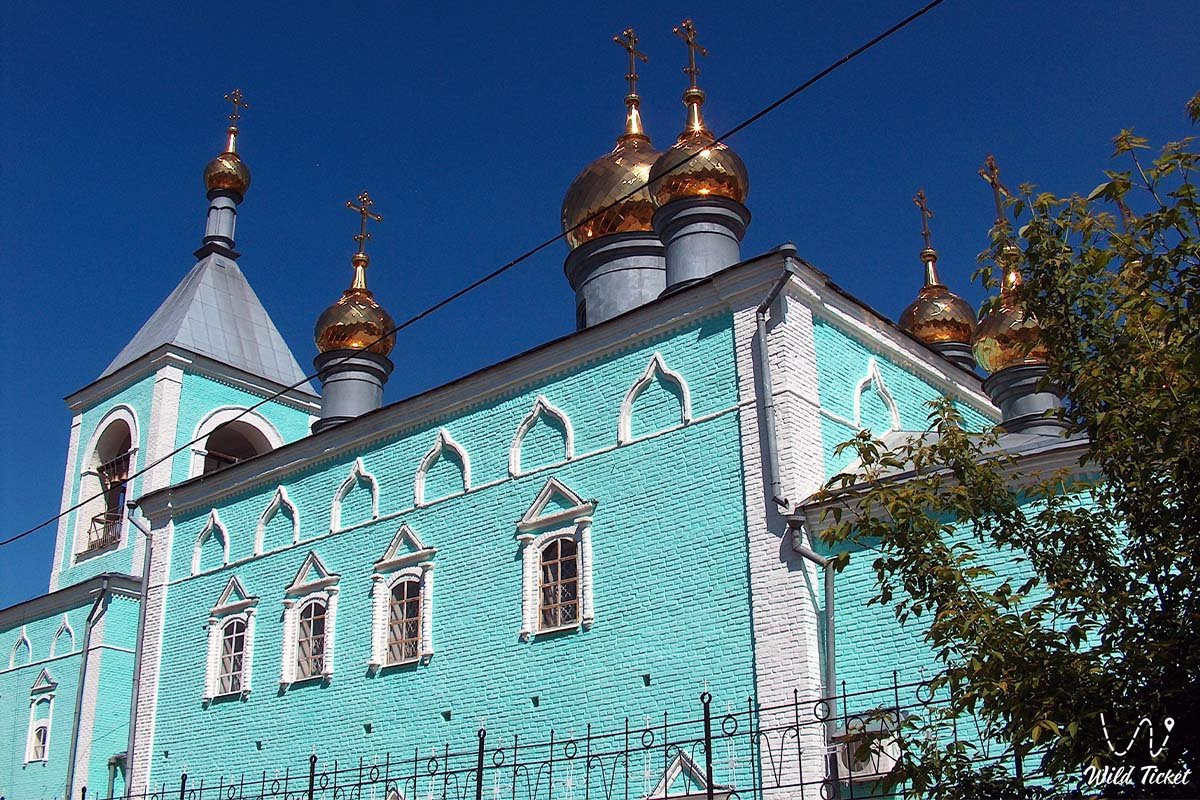
Another significant church is the Cathedral of Christ the Savior, or popularly the "Golden Church", in the center of Uralsk. This church was built from 1871 to 1907 and has eight rectangular towers, each of which is topped with a small golden dome.
The Transfiguration Church is located in the north of the city in a former cemetery. This church building, like most in Uralsk, was built in the 19th century; the consecration of the building took place on July 31, 1888.
There are also several mosques in Uralsk. The Red Mosque was built in 1871 and is the oldest Islamic religious building in Uralsk.
In November 2005, with the financial support of Mangistaumunaigas and KazMunaiGas companies, as well as foreign sponsors, was built New Mosque (Central Mosque). The modern building, equipped with two minarets, can accommodate 1,500 people.
---------------------------------------------
Museums
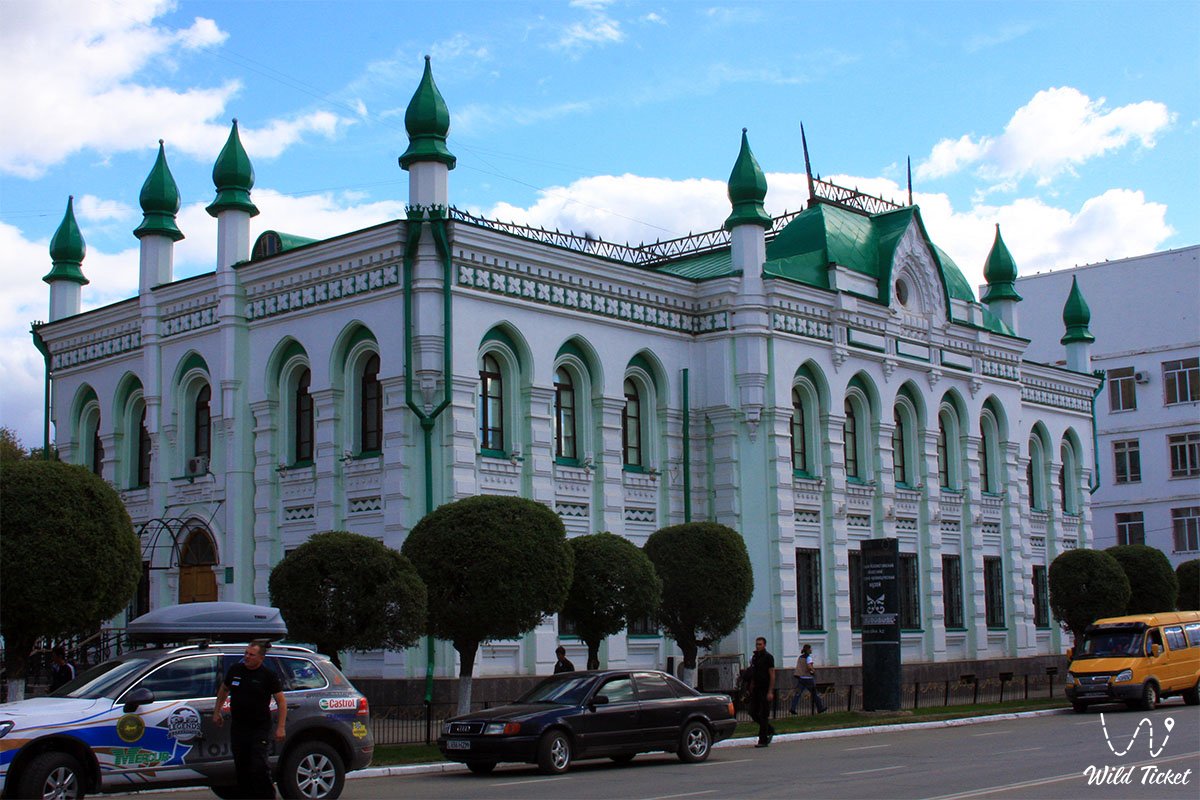
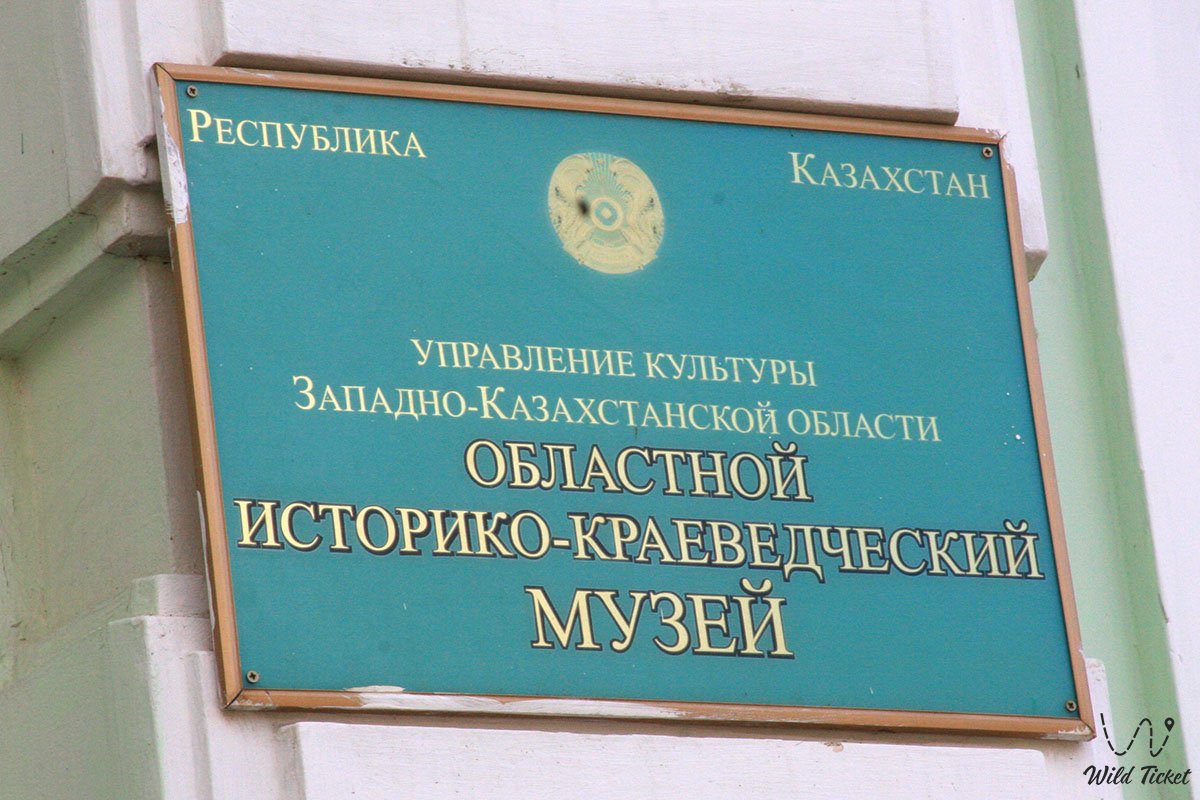
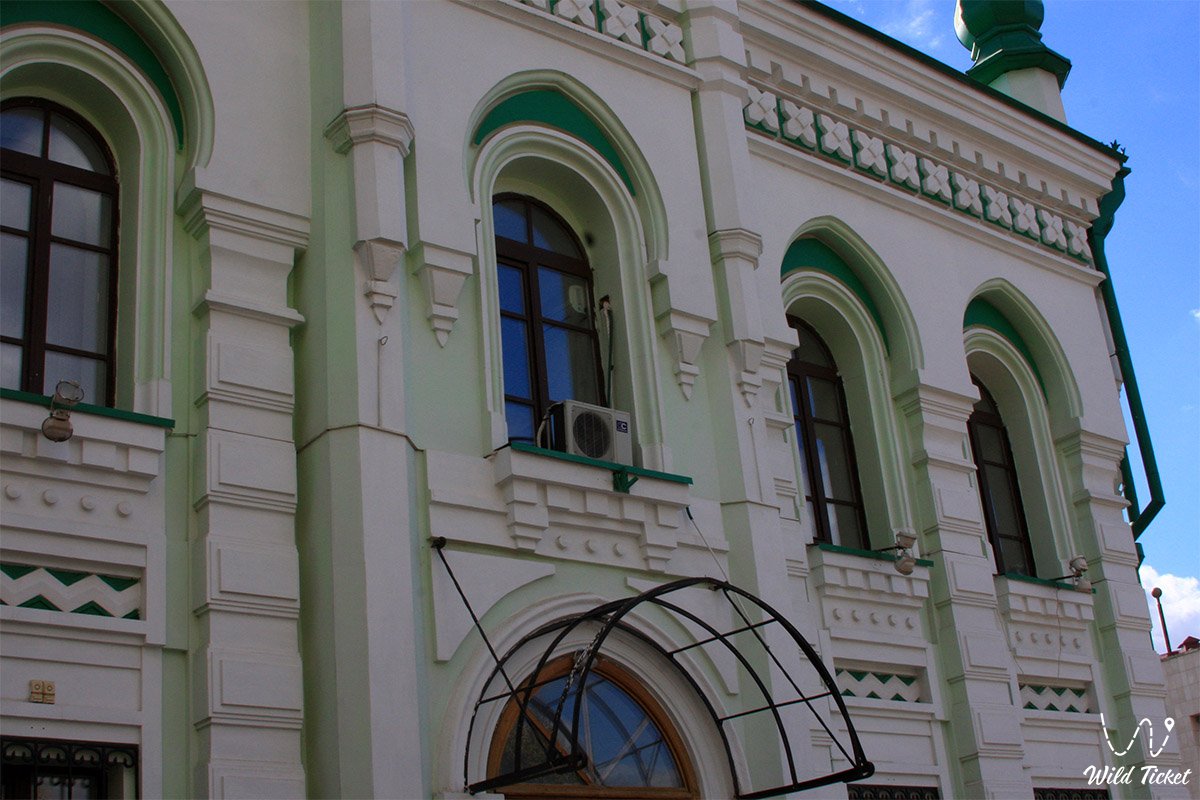
As the cultural center of Western Kazakhstan, Uralsk has several significant museums. First of all, we should mention The Uralsk Regional Museum of Local Lore, founded in 1831 and housed in an oriental-style building. Among the 102,917 exhibits there are folk art objects, military armor, horse harness and household items of the inhabitants of the Urals. The museum includes such thematic sections as archeology, history, the history of the Soviet period, the history of art, literature, science and education in Western Kazakhstan, the ethnography of the Kazakh people and the history of the Republic of Kazakhstan.
Like most of the city's museums, The Museum of Nature and Ecology is part of the Regional Museum of Local Lore of the West Kazakhstan region and, with about 10,500 exhibits, is one of the largest museums in the city. Minerals and bones of ancient animals, including a mammoth molar tooth, and insects are presented to visitors on an area of 150 square meters in three halls. In addition, dioramas on steppe and forest themes are part of the exhibition.
Russian literature Alexander Sergeyevich Pushkin is dedicated to the Museum of Alexander Sergeyevich Pushkin. It is located in the building where Pushkin lived during his stay in Uralsk in the autumn of 1833. Among other things, you can see old editions of The Captain's Daughter and The History of the Pugachev Rebellion, as well as manuscripts, photographs and other documents of the writer.
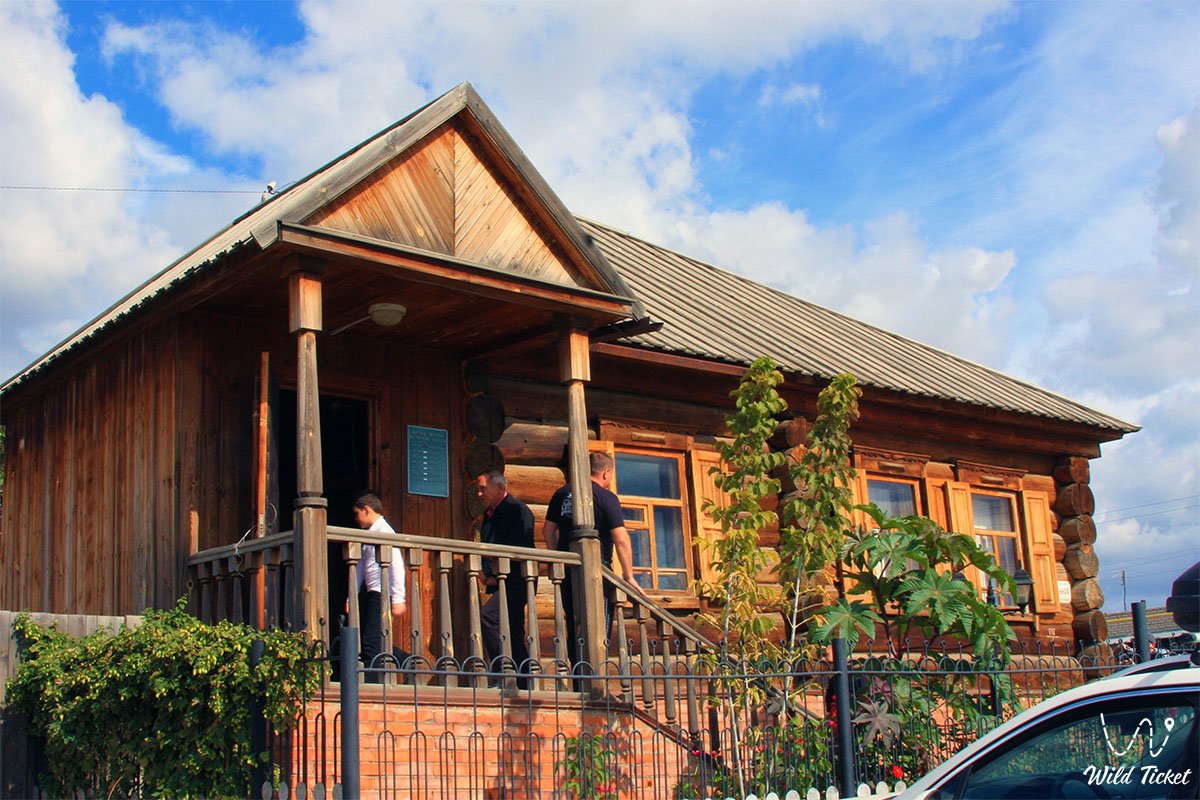
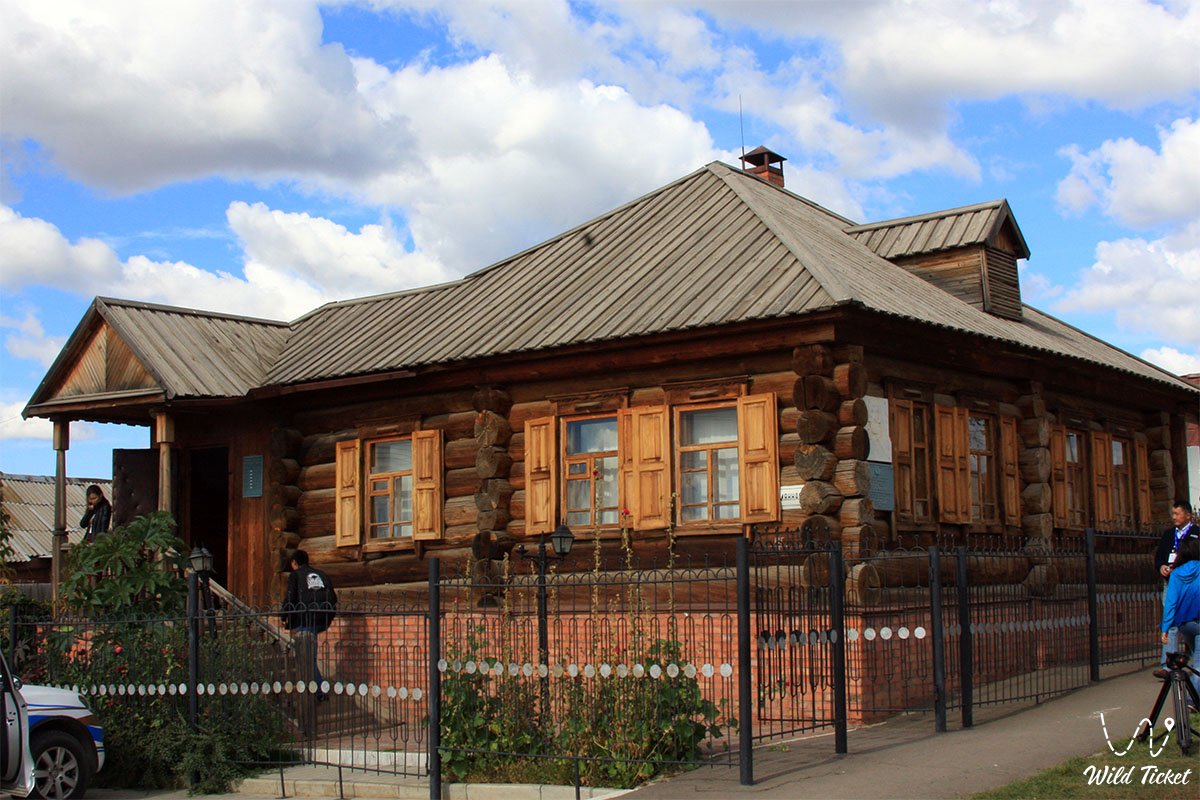
Famous museums in Uralsk include the Yemelyan Pugachev House Museum. The museum building itself, which is a wooden Cossack hut, is a historical monument. Since 1991, the house has exhibited exhibits about the Don Cossack Yemelyan Ivanovich Pugachev and the history of the Ural Cossacks.
Manshuk Mametova Hero of the Soviet Union Museum – the memory of Manshuk Mametova, the first Kazakh woman awarded the title Hero of the Soviet Union, is immortalized here. Since its opening in 1982, the museum has been housed in the house where the Mametov family lived from 1932 to 1934, and displays various photographs, documents and personal belongings of the Mametova family.
Directly opposite the Manshuk Mametova Museum, there is the house museum of the artist Saken Gumarov. They call him a philosopher with a brush, his paintings are deep, with a mystical mood. About 20 works are on display in the museum, which was organized right in his workshop. The museum also displays the artist's personal belongings, brushes, sketchbook, books, tell about him no less eloquently than the official biography.
It is definitely worth visiting the folk museum "Old Uralsk". Exhibits were collected all over the world here: antique photos, coins, kitchen utensils, Soviet radios, children's toys and yellowed newspapers. Together they create a special feeling, as if the past becomes close and tangible.
The city also houses the museum of Gabdulla Tukai, the great Tatar poet who spent thirteen years of his life in Uralsk (from 1894 to 1907). The museum is located in the house of the imam of the Red Mosque, at which the madrasa worked, where young Tukai studied. The exhibition presents not only the poet's life story, but also the spirit of that time: antique furniture, manuscripts, household items at the turn of the 19th–20th centuries.
You can visit the Dombira, ulttyk Rukh Museum. This is the first museum in Kazakhstan dedicated entirely to the Kazakh national instrument. Dombra for every taste is collected here: from simple, folk, to exquisite, decorated with carvings and inlays. The personal belongings of famous composers such as Kurmangazy's chain mail and Dina Nurpeisova's chapan are also kept here.
Next to the Pushkin Museum, there is the museum of the first Uralsk fire department. Surprisingly, the fire station, which was opened more than 160 years ago, is still working! A fire tower built in 1865 has been preserved here, and in the museum, you can see copper hoses, firemen's helmets from the middle of the 20th century, and even a complete set of uniforms from the 1960s. Uralsk, which has long been a city of wooden buildings, has suffered from large fires more than once, so firefighters have always been on special account here.
In the village of Darinskoye, about 30 kilometers from Uralsk, there is a Mikhail Sholokhov Museum, opened in the house where the writer and his family lived during the evacuation in 1942-1943. In this modest house, Sholokhov worked on the novel "They Fought for their Homeland," and in 1965 it was here that the telegram about awarding him the Nobel Prize arrived. Sholokhov himself asked the museum to talk primarily about the history of the Urals, and not just about him. The copy of The Quiet Don with the author's inscription looks especially touching: "To the Daryins with gratitude for the shelter and hospitality ...". A new two-storey museum building has been built next to the memorial house, where everything has been preserved as in the war years.
---------------------------------------------
Concert halls and theaters
The theatrical tradition of Uralsk is rooted in the history of the Ostrovsky Russian Drama Theater, the first professional theater in Kazakhstan. His stage, which has hosted many generations of viewers, today offers a diverse repertoire: from immortal classics to modern plays, from psychological dramas to light comedies.
Directly opposite is the Kazakh drama Theater named after Hadisha Bukeeva, whose poster reflects the richness of the national culture. Here you can see both productions based on the works of Kazakh authors and adaptations of world drama, allowing you to experience the universality of human stories through the prism of the Kazakh language and traditions.
The Atameken Concert Hall has been built in the city for large-scale musical events. Its architecture, designed in a monumental style, creates a special solemn atmosphere. Symphony orchestras sound under its arches, opera singers perform, famous musicians tour and state prizes are awarded.
The First President Square adjacent to the hall has become a modern public space where citizens like to spend time. The central element of the cultural cluster is the amphitheater of the Kadyr Myrza Ali Cultural Center, an open–air summer playground where festivals, concerts of folklore groups and festive events take place.
Other significant objects are located nearby: The House of Friendship, which unites various ethnocultural associations, the wedding palace, as well as modern shopping and entertainment complexes. This makes it easy to combine cultural leisure with walking, dining at a restaurant or shopping, creating a complete plan for the whole day.
---------------------------------------------
Parks and recreation areas
The heart of Uralsk is considered to be the oldest Park of Culture and Recreation, founded in the middle of the 19th century. This territory preserves the memory of important historical events.: Leo Tolstoy was a guest here, and later the future Emperor Nicholas II was received, for whom the young Fyodor Chaliapin gave a concert.
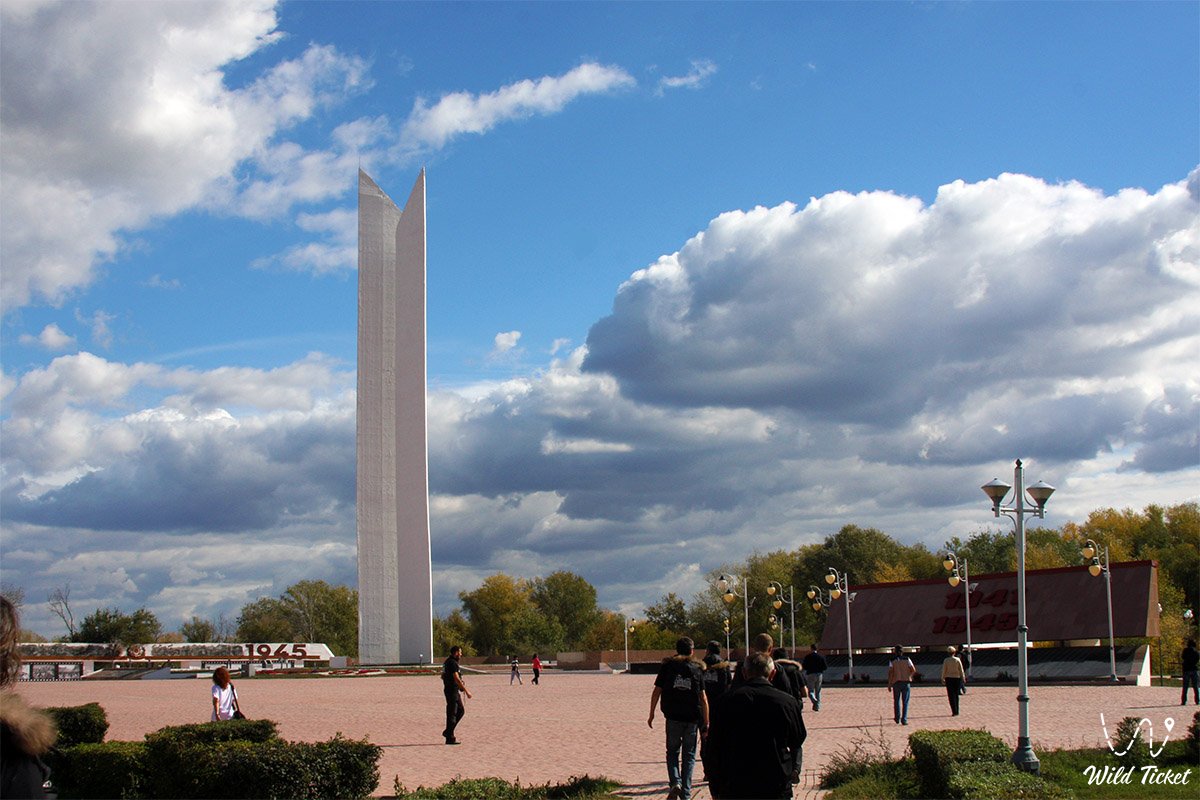
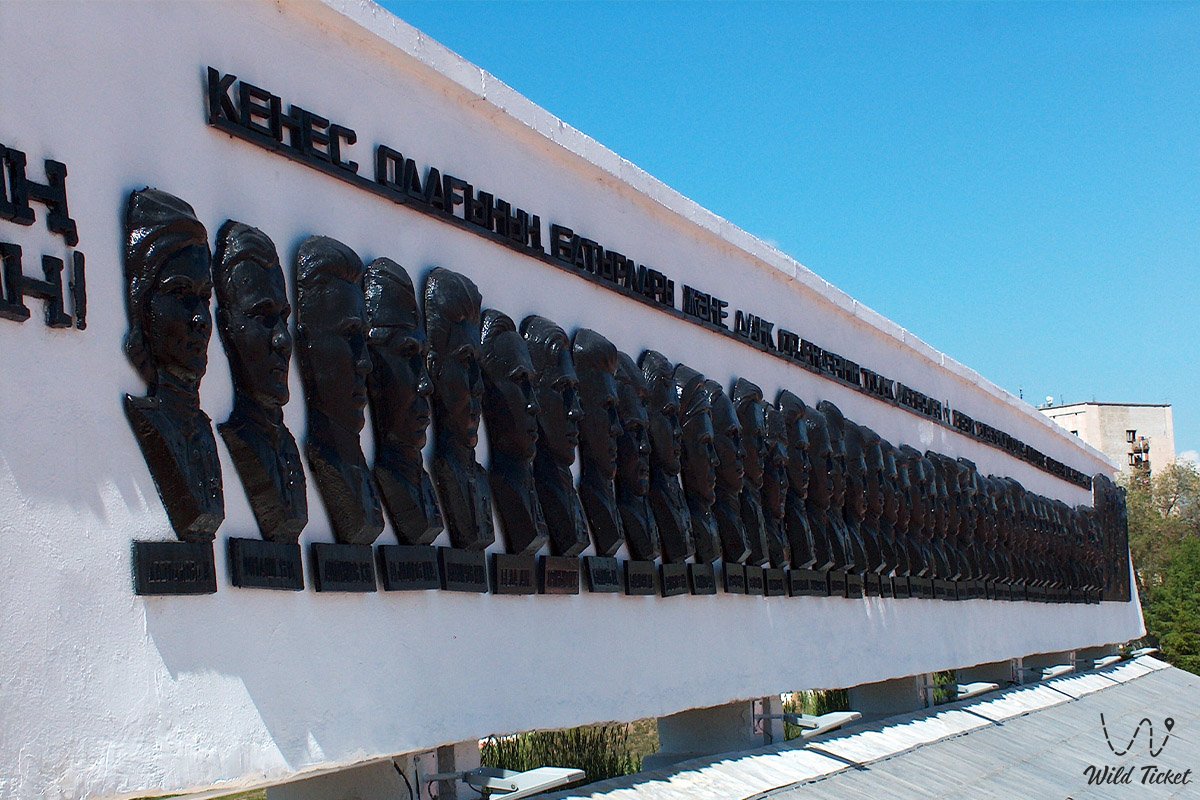
For quiet reflections and memories of the past, Victory Park on the shores of the Urals is ideal. There are memorial sites, samples of military equipment and an Eternal Flame burning here – the place is filled with an atmosphere of respect and gratitude, and its location by the water makes walking especially pleasant.
Not far from the central park there is a children's zoo, where about 90 species of animals are represented, from predators to reptiles and birds. This is a great opportunity to introduce children to the diversity of fauna in the city.
---------------------------------------------
Old buildings
The building of the Commercial and Industrial Bank is one of the most elegant buildings in the historical center, a striking example of Art Nouveau with neoclassical elements. Built in the early 20th century for financial transactions, it attracts attention with its asymmetrical facade, elegant stucco decoration and large arched windows. This building symbolized the economic heyday of pre-revolutionary Uralsk.
Merchant Karev's mansion is an architectural gem of the city, a real palace house in miniature. Built at the turn of the 19th–20th centuries, it combines brick style with lush Baroque elements: curly pediments, rusticated columns and a complex cornice. The mansion demonstrated the status and taste of its owner, and today it is a monument of civil architecture.
The Rossiya Hotel – built in 1888, the monumental building in the style of Stalinist neoclassicism, for many years was the main hotel of the city. It is distinguished by its symmetrical facade, high ceilings, massive columns and restrained but representative decor. For several generations of Uralsk citizens and visitors, this place has been synonymous with comfort and solidity.
The house of architect Delmedino is a unique example of wooden architecture with carved architraves, openwork cornices and figured pillars. This house, built at the end of the 19th century by its owner, an architect, resembles a tower and serves as a living testimony to the high skill of Ural carpenters and architects of that time.
The building of the former military economic administration is a solid stone building of the second half of the 19th century in the style of rational classicism. Its strict, almost ascetic facade with the correct rhythm of the windows and a minimum of decoration reflected the business and administrative nature of the institution in charge of the affairs of the Ural Cossack army. The Khamza Yesenzhanov Library is now located in the building.
The mansion of P.V. Obnenev is an impressive example of eclecticism, where Renaissance and Baroque motifs are mixed. The house stands out for its scale, symmetry, rustication of the ground floor and elegant window openings. It clearly shows the ambitions and viability of the Ural merchant elite.
The House of merchants Vanyushins is a large brick building in the so–called "brick style", where the main decorative element is the patterned masonry itself. The facades are decorated with arched belts, figured attics and other details created directly from bricks. This house epitomized the practicality and prosperity of the trading dynasty.
---------------------------------------------
How to get there and visit -
The city of Uralsk is located on the territory of Western Kazakhstan in the West Kazakhstan region, not far from the border with Russia, on the Ural River, the outskirts of the Caspian lowlands, the Republic of Kazakhstan.
GPS coordinates: 51°14'36"N 51°24'16"E
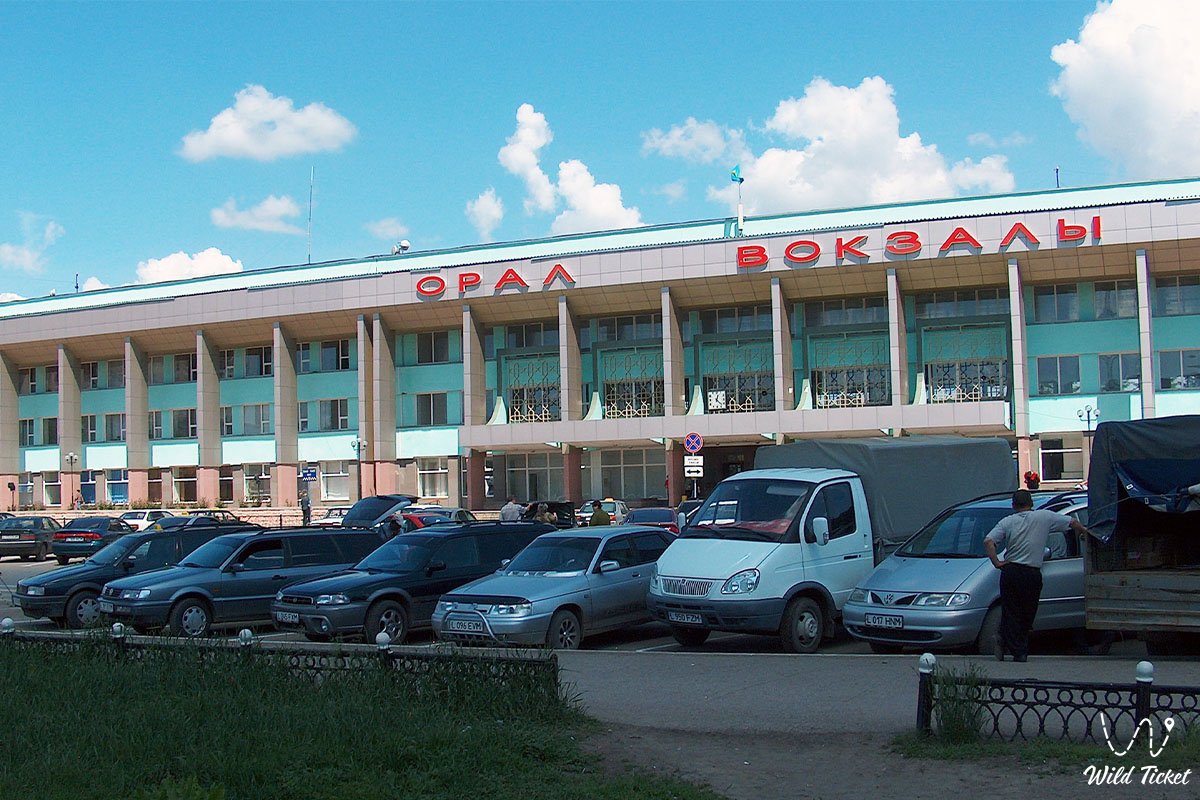
It is convenient to get to Uralsk by flights from Almaty, Astana and other cities of Kazakhstan, as well as by train and highways from Russia and neighboring regions. The city serves as a starting point for trips across Western Kazakhstan, along the Ural River and to the steppe regions of the region. It is best to plan a trip from spring to autumn, when the climate is most comfortable for walks and excursions.
---------------------------------------------
The city of Uralsk is a city where history is not hidden in museums, but lives right on the streets. Here, old mansions, mosques, theaters and parks form a single living story about the merchant era, Cossack freedom, great literature and dramatic events of the past. Traveling around Uralsk, you don't just look at buildings and monuments – you follow in the footsteps of Pushkin, Pugachev, Tukai and Chaliapin, feel the breath of Europe in the heart of Kazakhstan and understand why this city cannot be confused with any other.
Photogallery: