Breakfast. Early departure:
Basshi village – Shagan ranger post – Mynbulak ranger post –
Aigaikum (Singing Dune) (48 km).
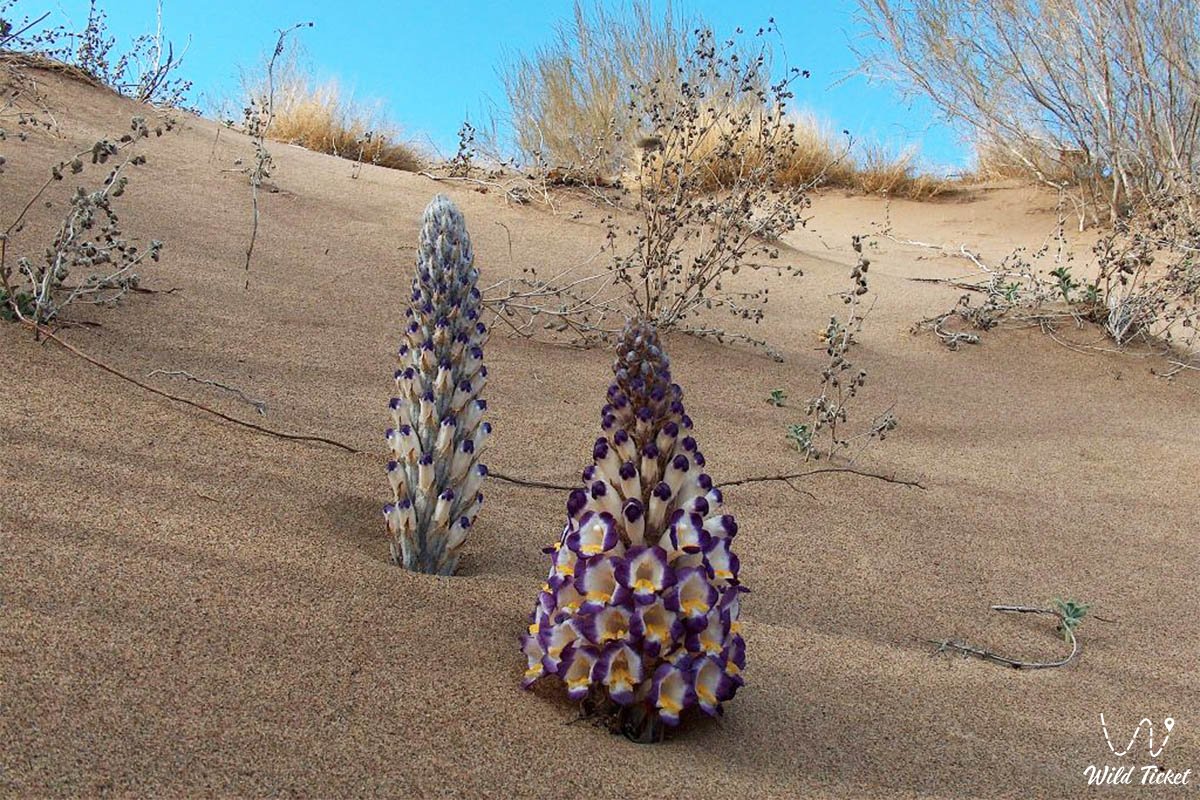
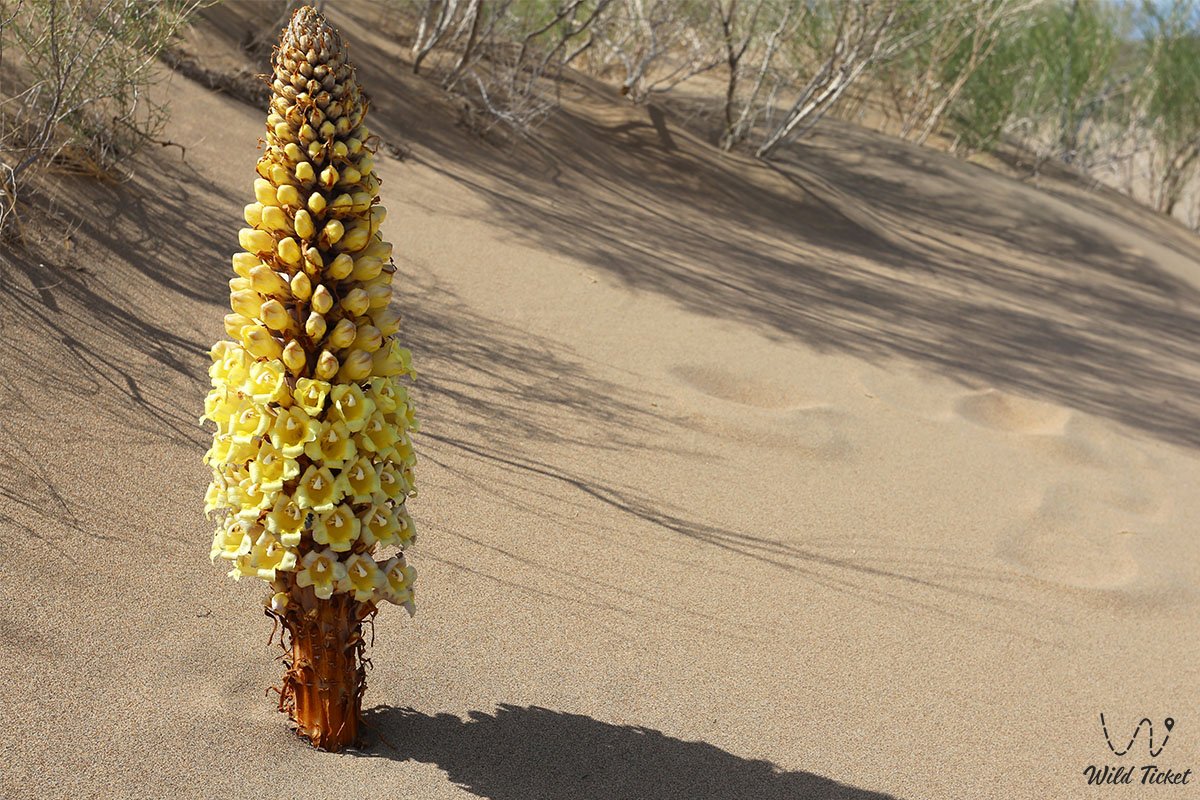
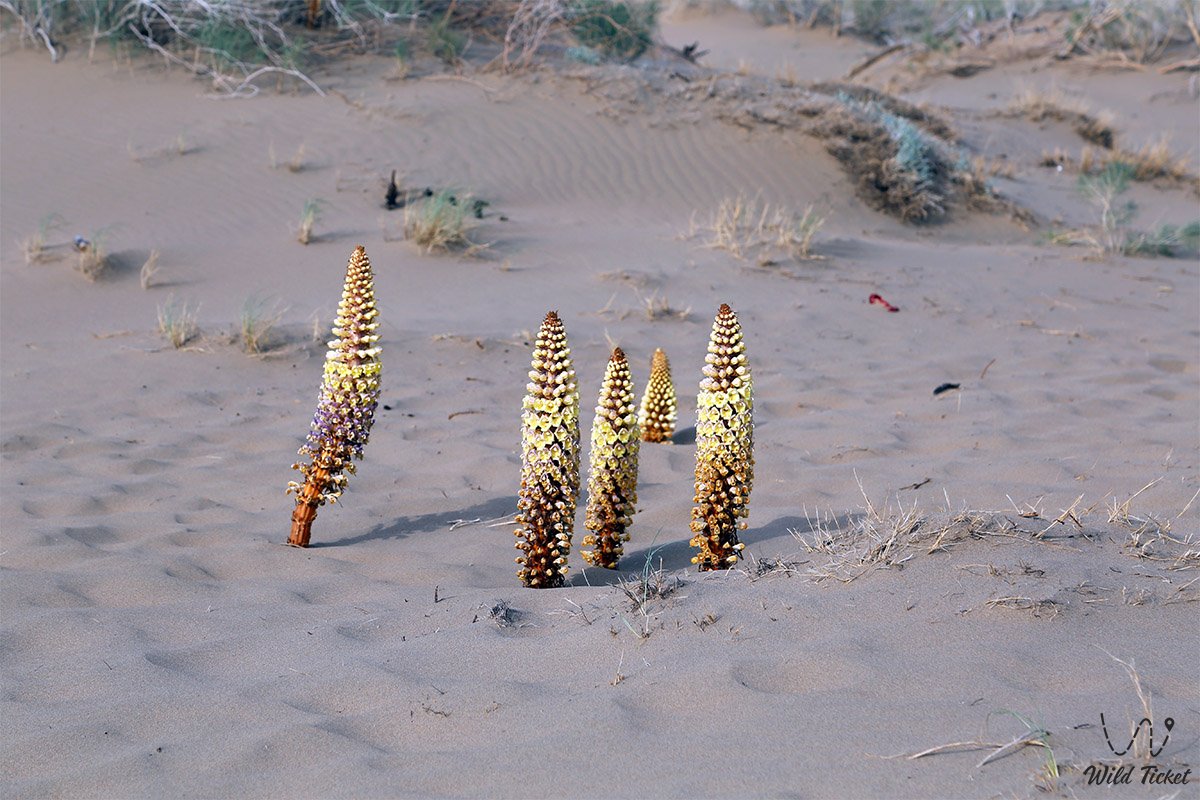
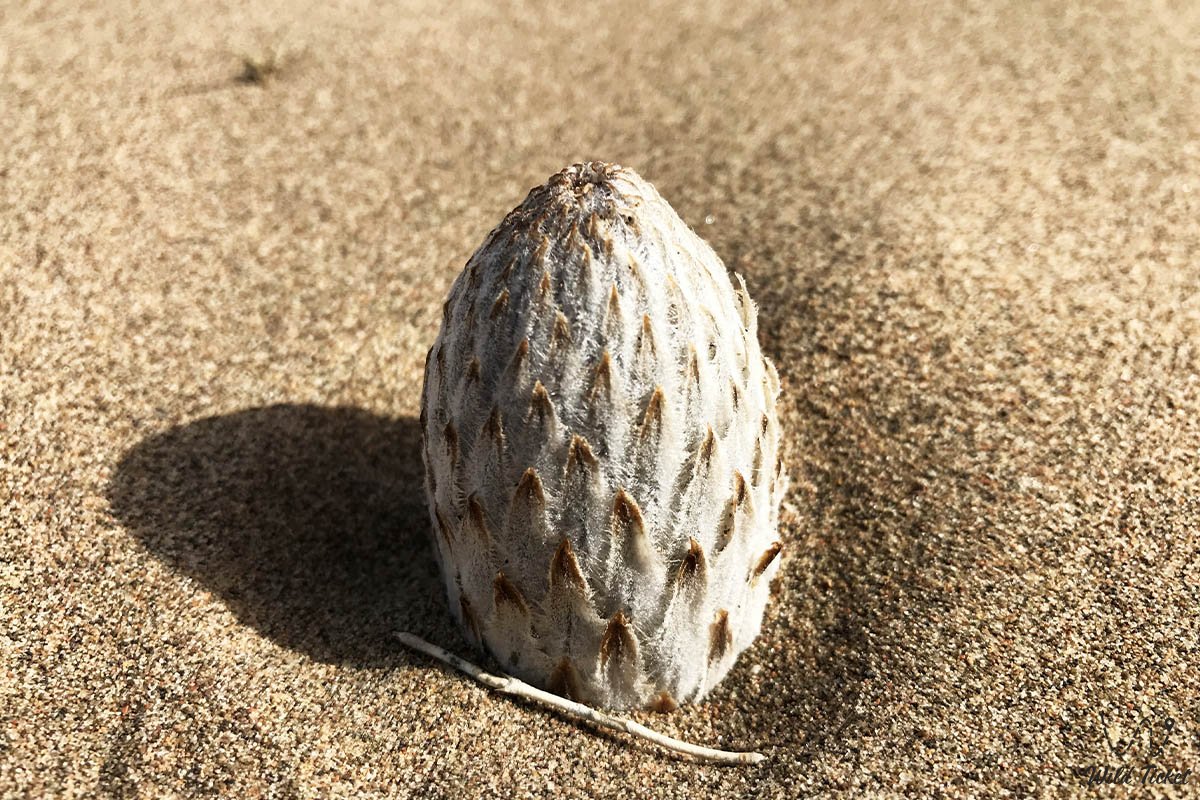
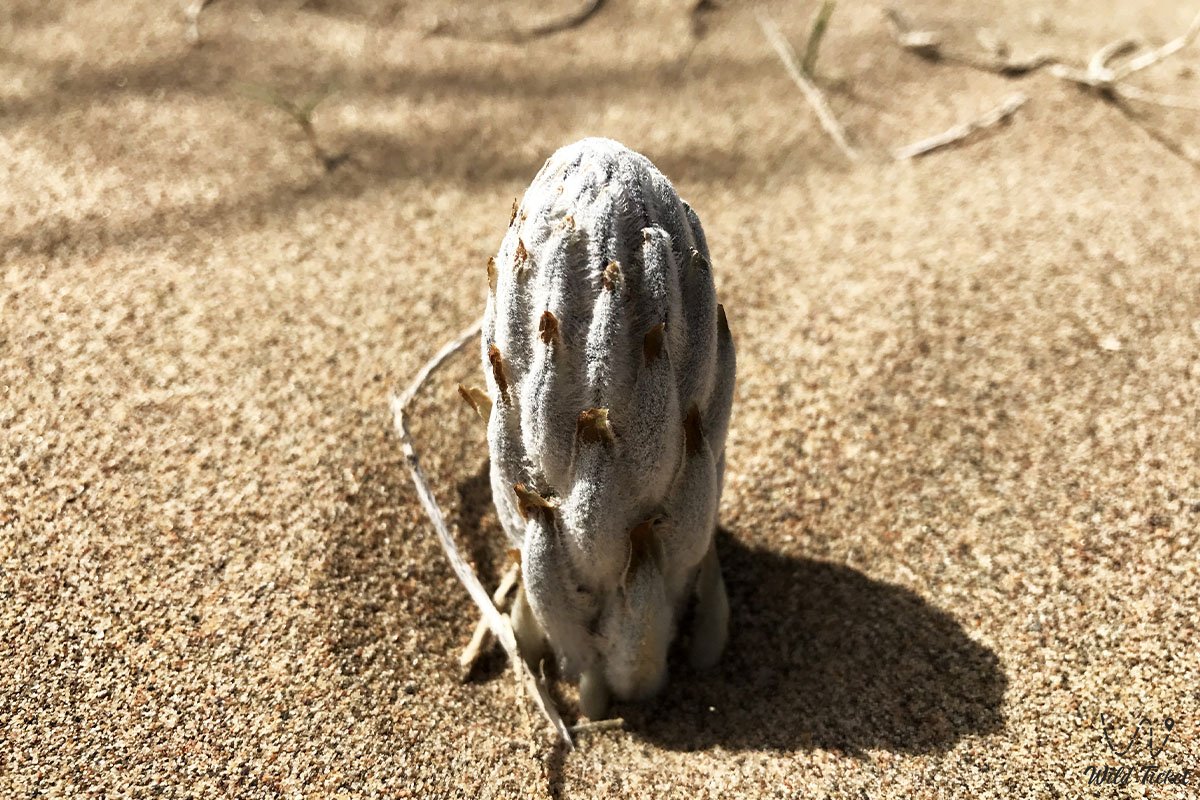
A botanical excursion targeting the yellow cistanche (Cistanche flava) in the sands at the foot of the famed Singing Dune in
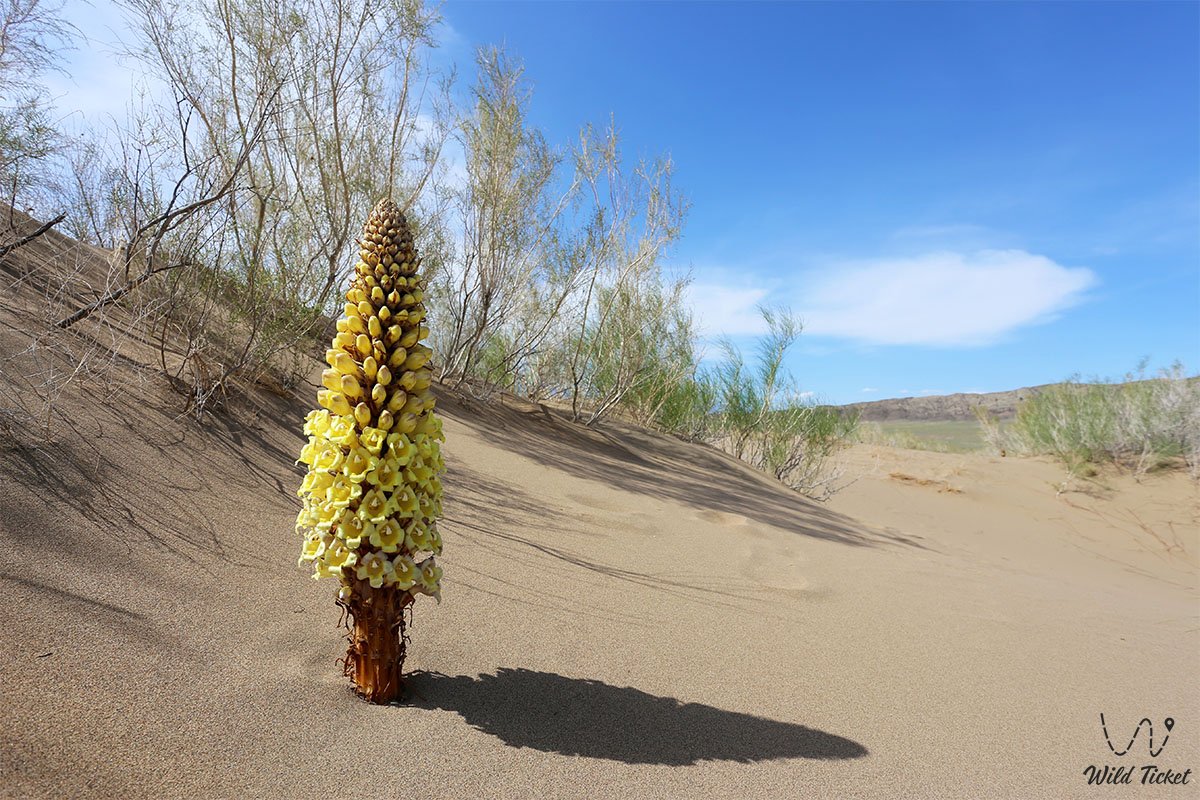
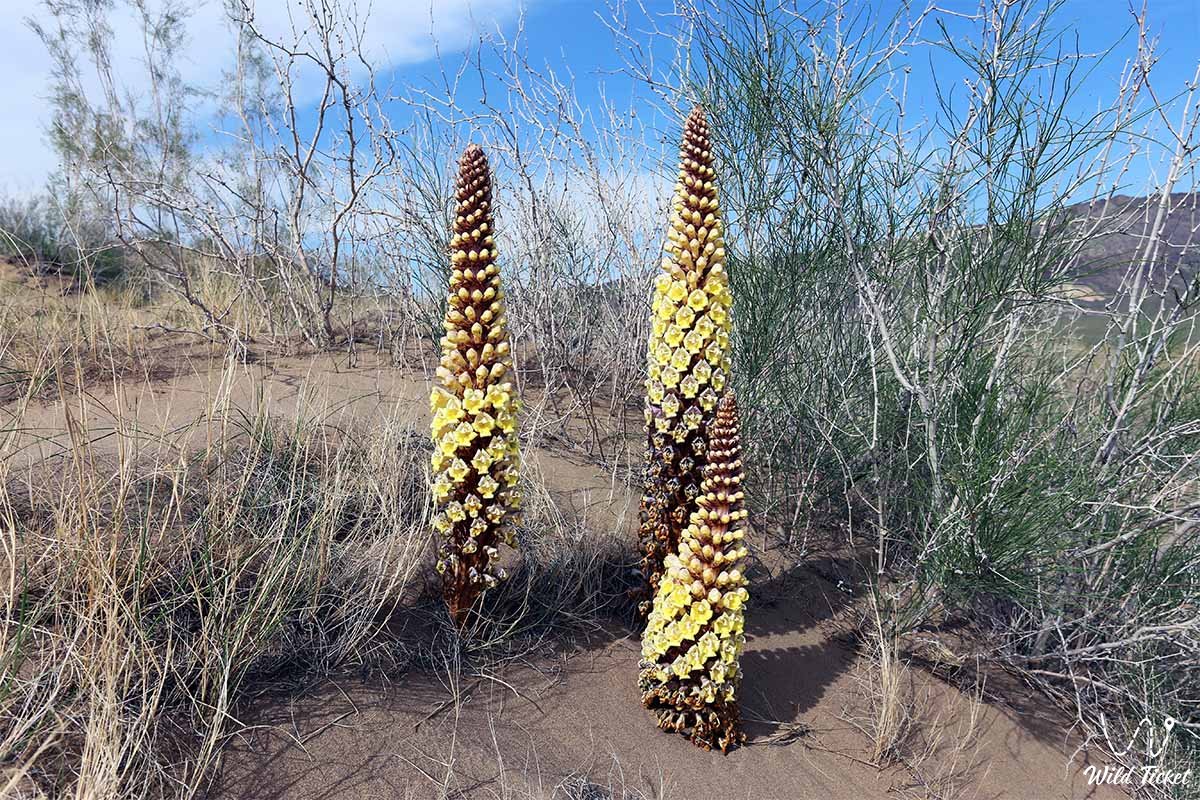
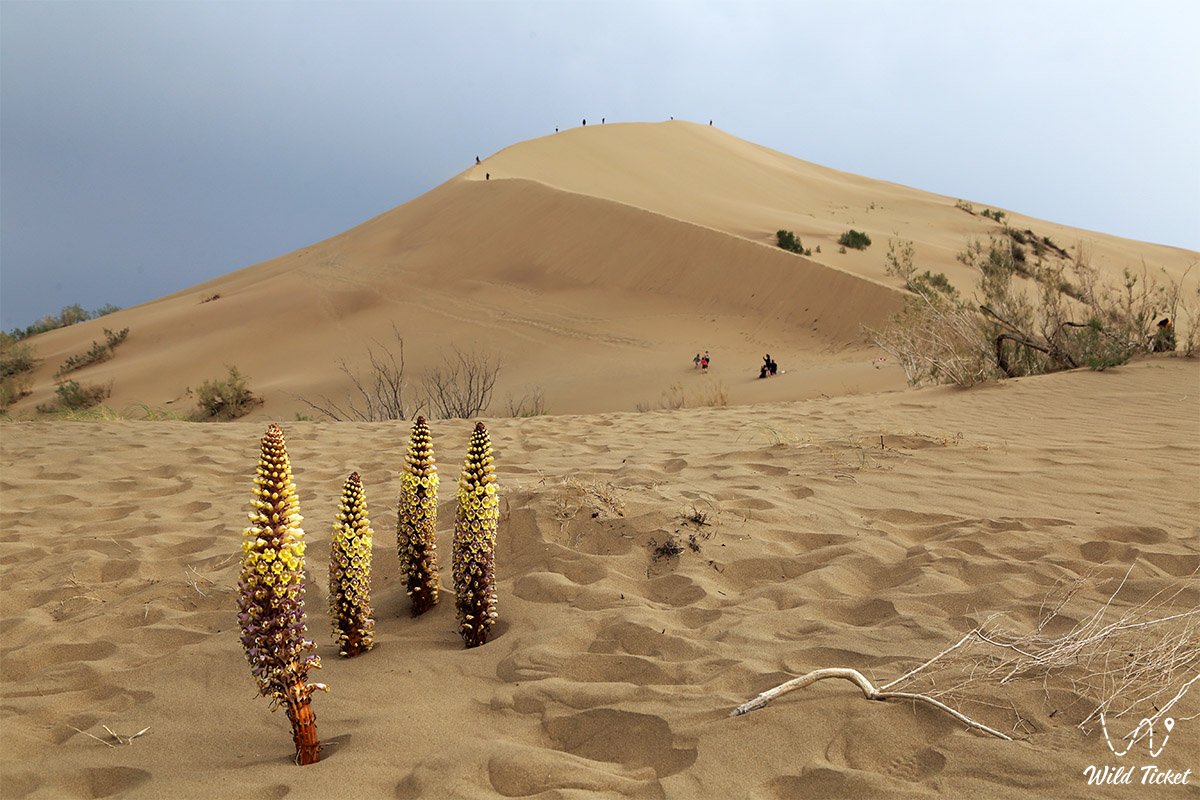
Altyn-Emel National Park is an expedition into the hidden world of desert adaptations. In the shifting sands on the western flank of the dune, we encounter the yellow cistanche (Cistanche flava).
Here one distinctly senses the living breath of
Akkum-Kalkan (the Singing Sands). The morning sun is just beginning to trace the ridgelines of the
Dzungarian Alatau, washing the foothills in soft rose-colored light. The air is clear and fragrant with warm quartz sand and bitter wormwood.
Our path runs along an unpaved graded track beside the right bank of the
Ili River toward the mass of the 150-meter sand ridge. Step by step, we leave conventional tourist paths behind. Out here, where wind-shaped sand forms rhythmic waves, time feels suspended.
The dune lies quiet, but as a gentle morning breeze rises, a deep, resonant vibration emerges in the stillness – as if an ancient organ were being tuned far beneath the earth. This is the singing voice of the desert, welcoming its few wandering guests.
Our goal is not merely the ridge itself, but its silent, astonishing inhabitants. We are searching not for green foliage (this plant contains no chlorophyll whatsoever), but for a bold flare of sunny gold set against the faded ochre sand. In a depression between the dune and scattered saxaul shrubs, our target comes into view.
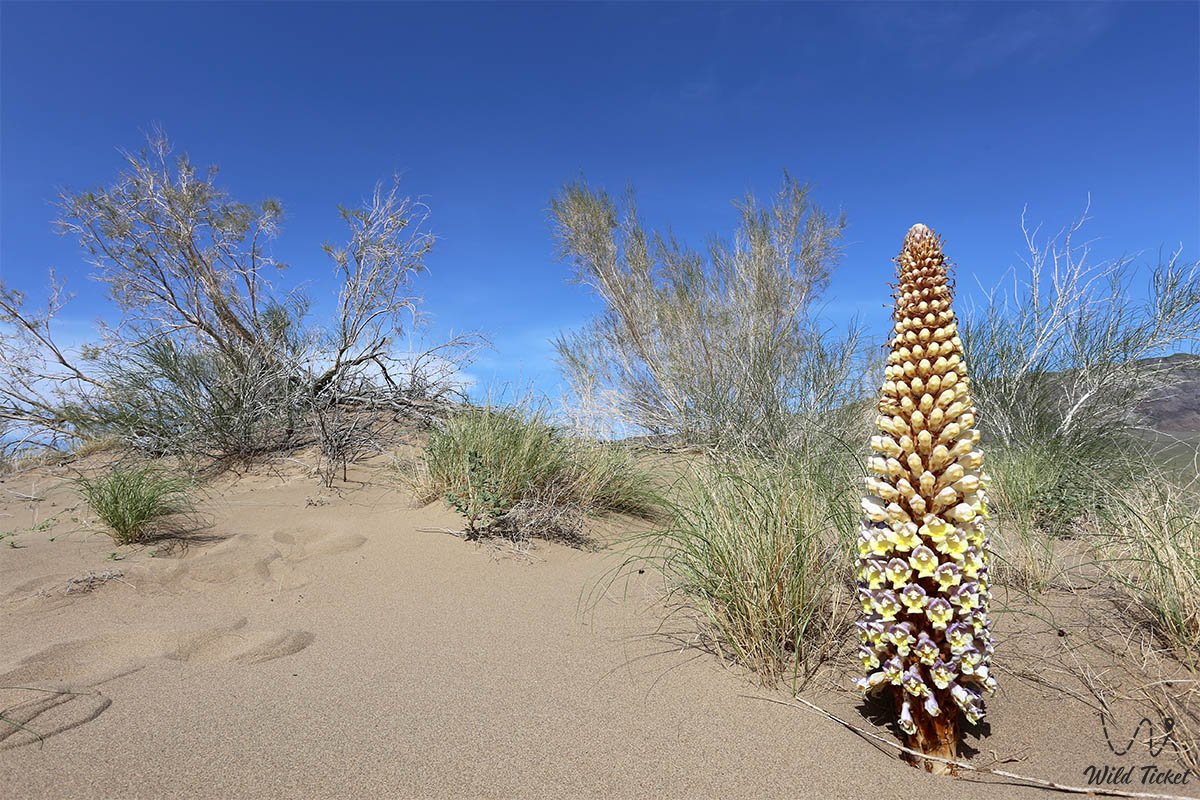
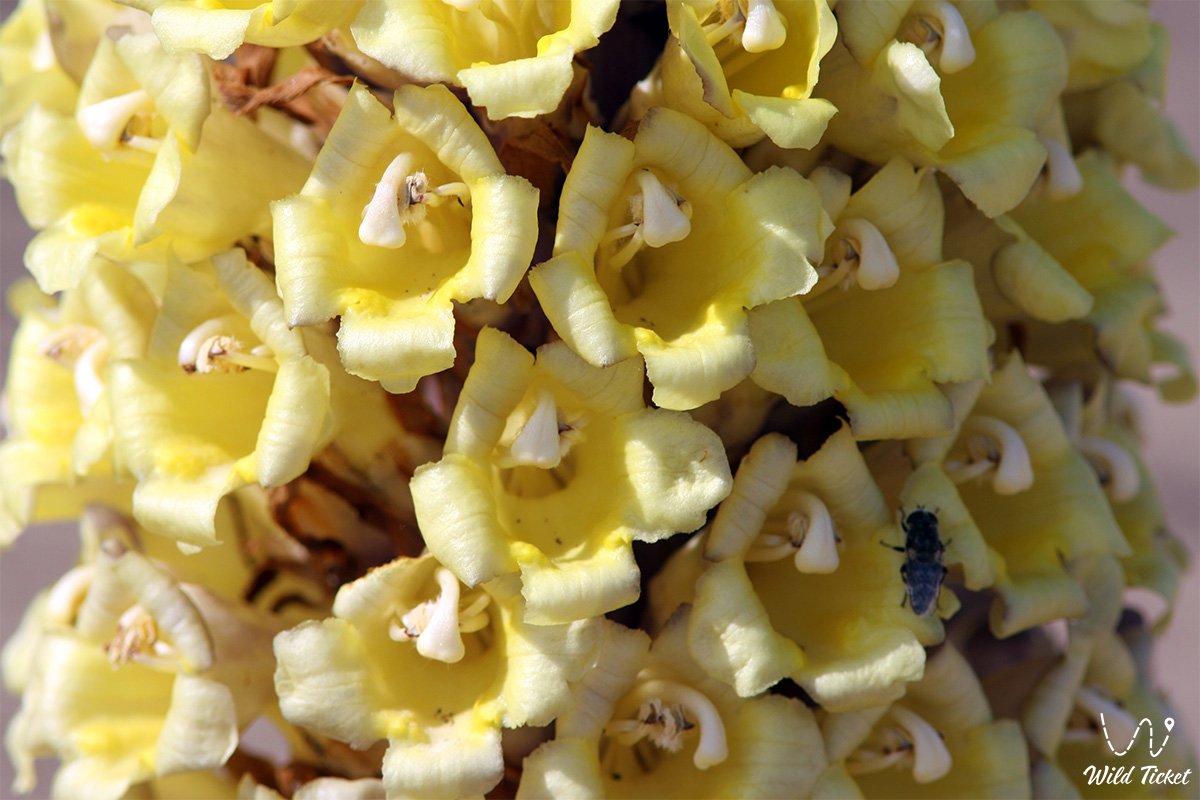
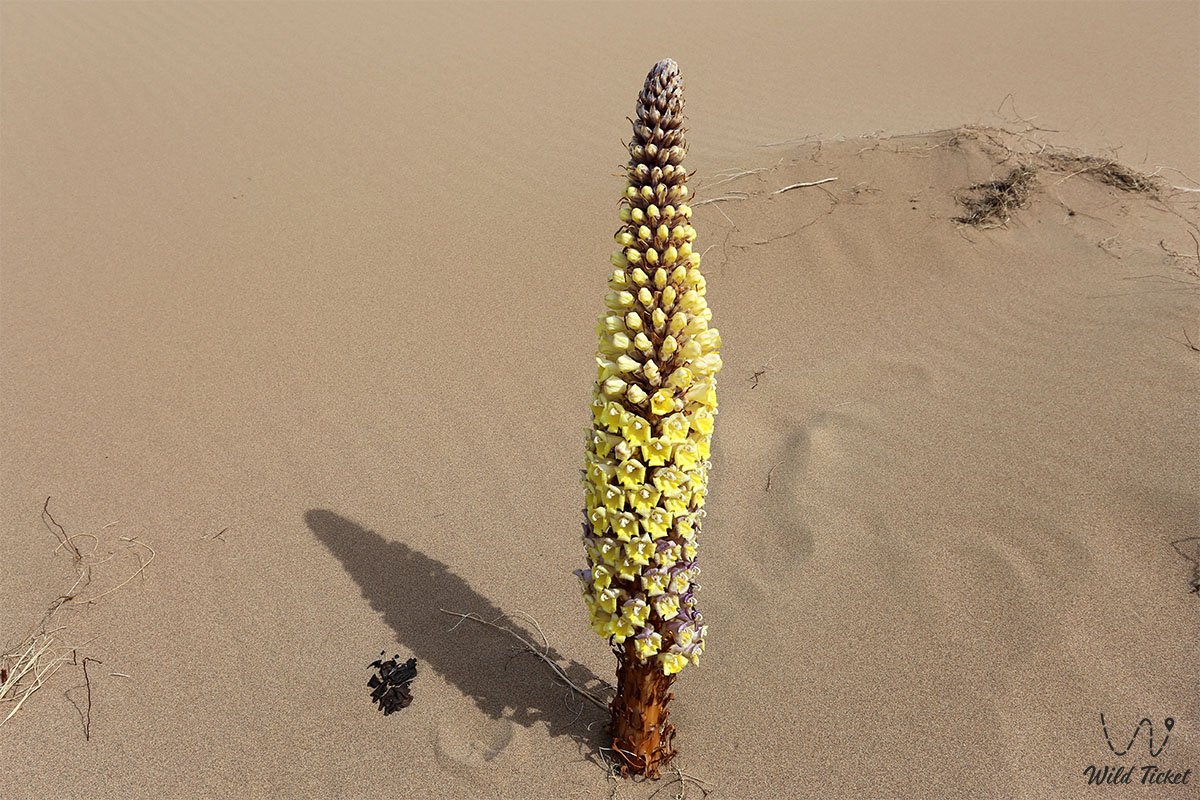
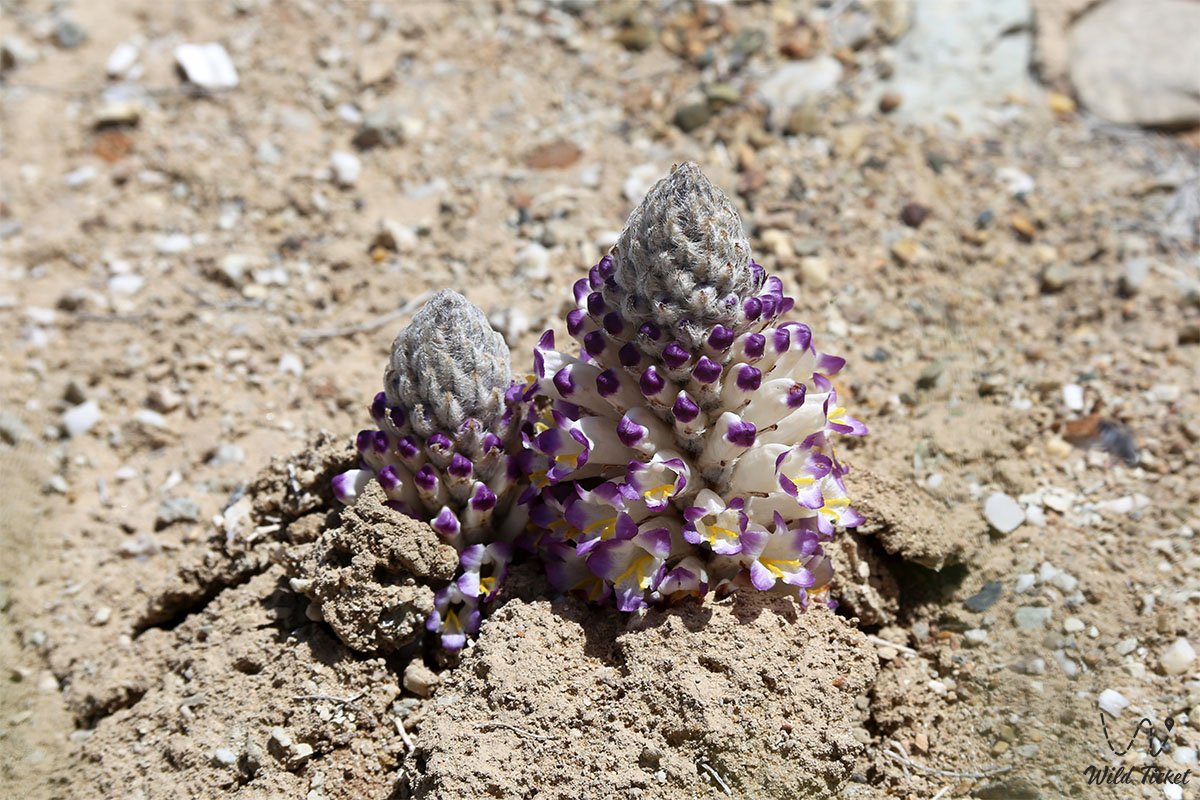
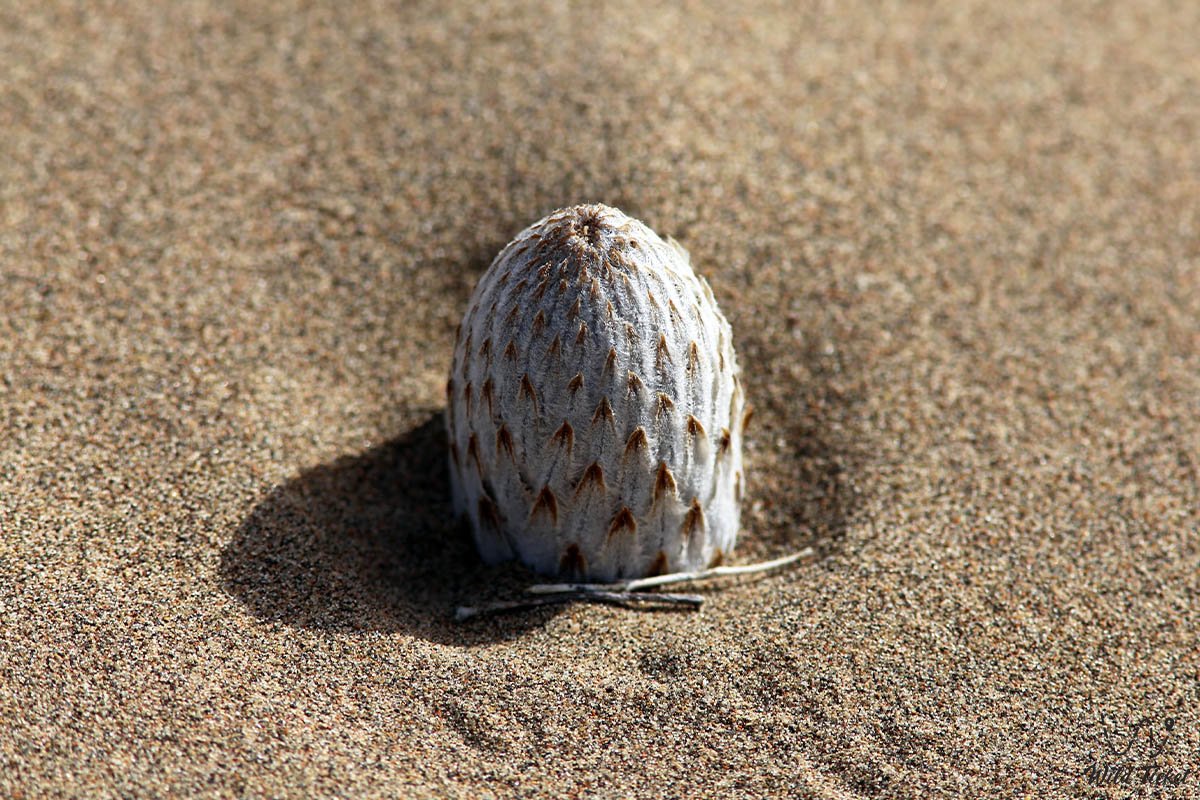
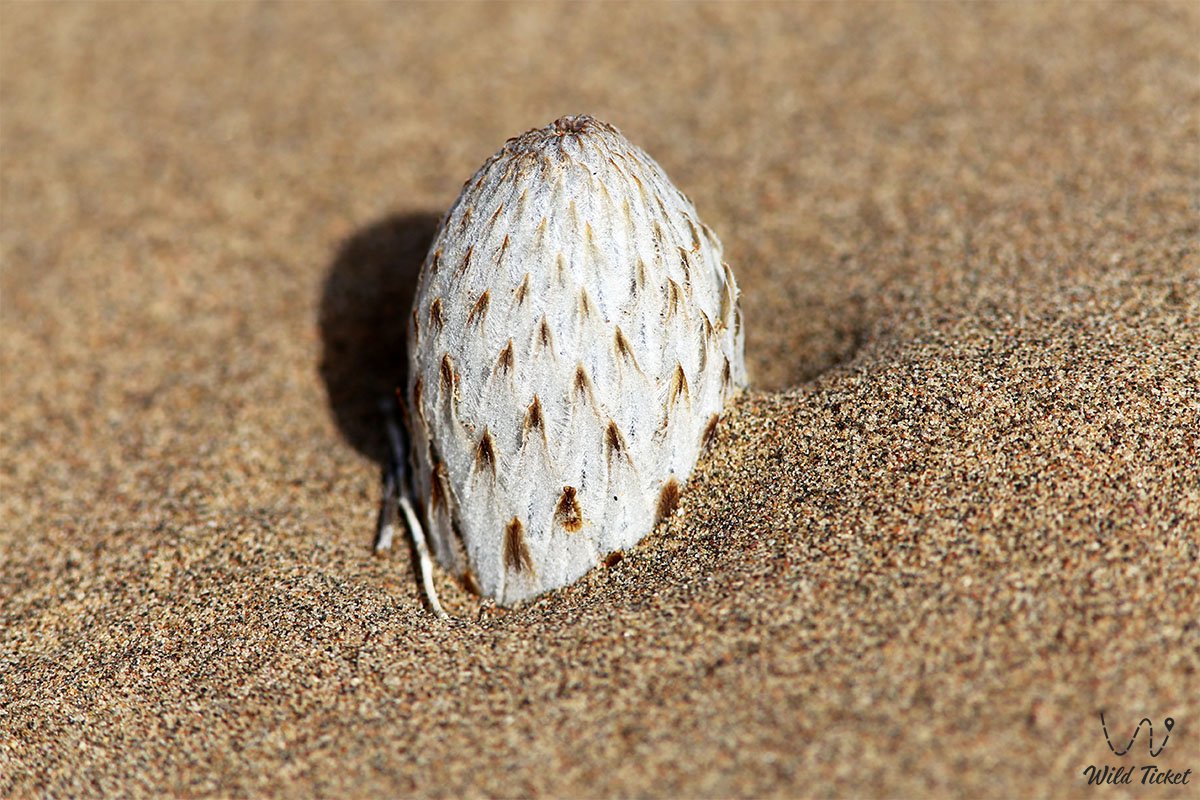
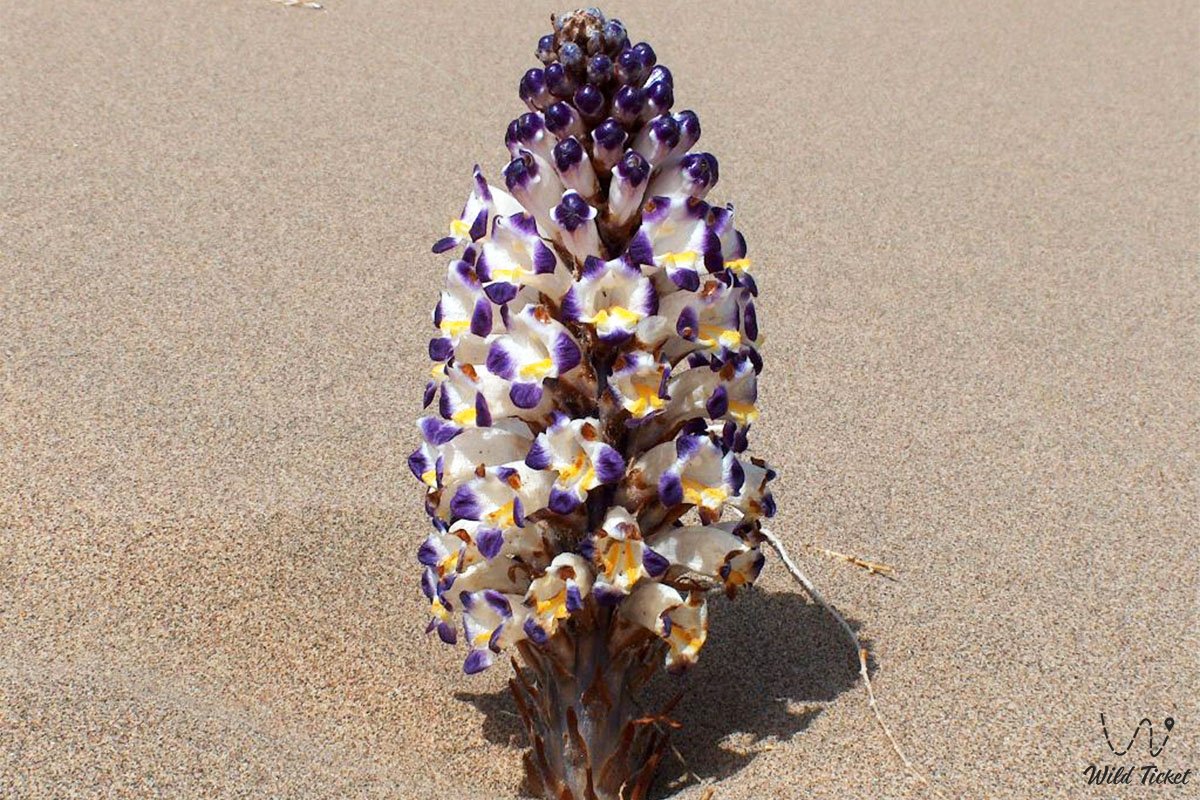
Rising straight from the warm sand toward the April sky is a stout, fleshy stem standing knee-high, densely layered with scales and topped with a compact cone of brilliant golden-yellow flowers. This is Cistanche flava, an obligate holoparasite.
It has no green leaves to absorb sunlight. Living a concealed subterranean life, it extends its haustorial root connections into the root system of a host plant, typically juzgun (or sand acacia), drawing sustenance and fluid from its host.
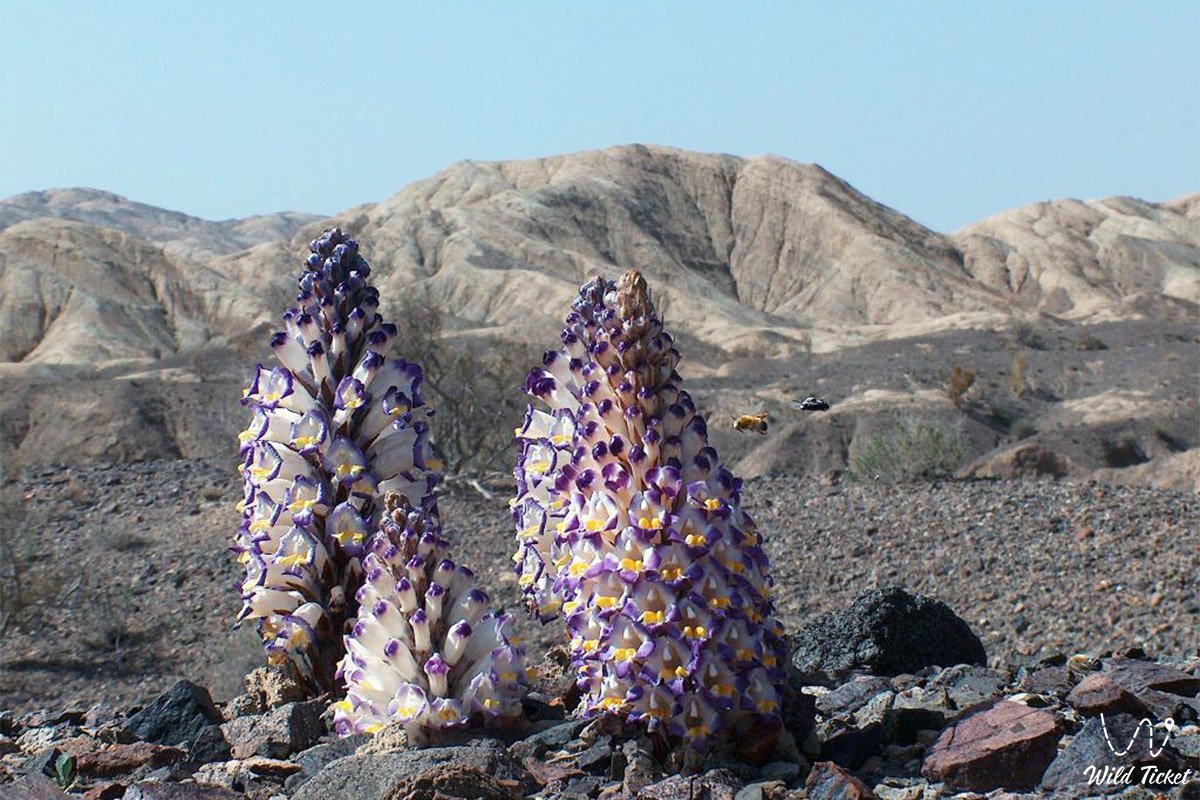
The desert is austere with resources, and cistanche takes precisely what it needs, transforming a harsh sand floor into a brilliant floral candle. Sitting quietly beside it, one can hear the gentle drone of desert bees and wasps drawn to the sweet nectar of the flower head.
They carry out their daylight pollination rounds, moving from one "desert beacon" to another. For centuries, local people and Asian herbalists have referred to cistanche as the "ginseng of the desert" for the vigorous vitality concealed deep within its tuberous underground roots beneath the sand.
Sunset approaches and sounds carry once again. By late afternoon, the sun turns the crest of the dune crimson. Sitting on the slope of the Singing Dune, we watch the shadows lengthen, while the yellow flower heads of cistanche below at the dune's base resemble miniature golden embers left behind by Silk Road caravans.
At times, the deep sound of Aigaikum stirs again, vibrating with shifting sands underfoot. The desert moves by its own unhurried, rigorous, yet deeply poetic rhythm. We take time to walk the perimeter of the great sand mountain, with an optional ascent through the loose sand to the crest of the dune.
Associated plant species around the Aigaikum dune:
Yellow cistanche (Cistanche flava), desert cistanche (Cistanche salsa), white saxaul (Haloxylon persicum), rayless cancrinia (Cancrinia discoidea), spotted arnebia (Arnebia guttata), sand dendrostellera (Dendrostellera ammodendron), unequal-winged desert-candle (Eremurus anisopterus), Dzungarian iris (Iris songarica), Dzungarian ammothamnus (Ammothamnus songoricus), few-paired milkvetch (Astragalus paucijugus), feathered sandgrass (Stipagrostis pennata), Przewalski's jointfir (Ephedra przewalskii), pungent camel-thorn (Agriophyllum pungens).
Transfer: Aigaikum (Singing Dune) – Mynbulak ranger post – Shagan ranger post – Nurum village – Aktobe village – Zhayylbayli tract – Saxaul ravine –
Aktau mountains (107 km).
Past the Shagan ranger post, we travel past two small settlements, after which our route continues east toward the Aktau mountains along the right bank of the Ili River. Gradually, the country track leads toward the mountains, continuing along the southern slopes of the
Katu-Tau mountains and onward to Aktau.
Leaving the singing sands of Aigaikum behind, we drive eastward toward horizons where the steppe shimmer gives way to an alien landscape. The Aktau mountains present a starkly different, otherworldly terrain, providing an extraordinary backdrop for encountering desert cistanche (Cistanche salsa). Lunch.
In the midday heat on the bed of the ancient Paleotethys Ocean.
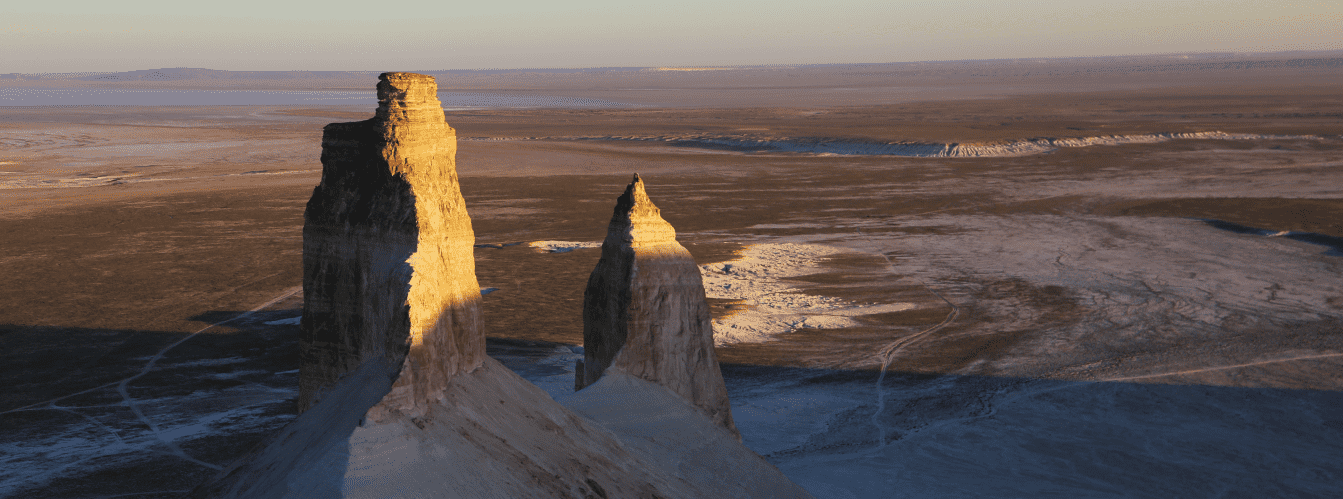
Driving into the Aktau canyons feels like crossing into an unearthly realm. Ahead rises a layered geological mass of white chalk, bluish-grey sandstone, and intense red clays.
This exposed floor represents the bed of the
ancient Tethys Ocean. Over millions of years, wind and precipitation carved these slopes into labyrinthine passages, towers, and bastions. There is none of the usual desert silence here; hot midday gusts channel through the canyon passages, and the white chalk walls reflect sunlight with blinding intensity.
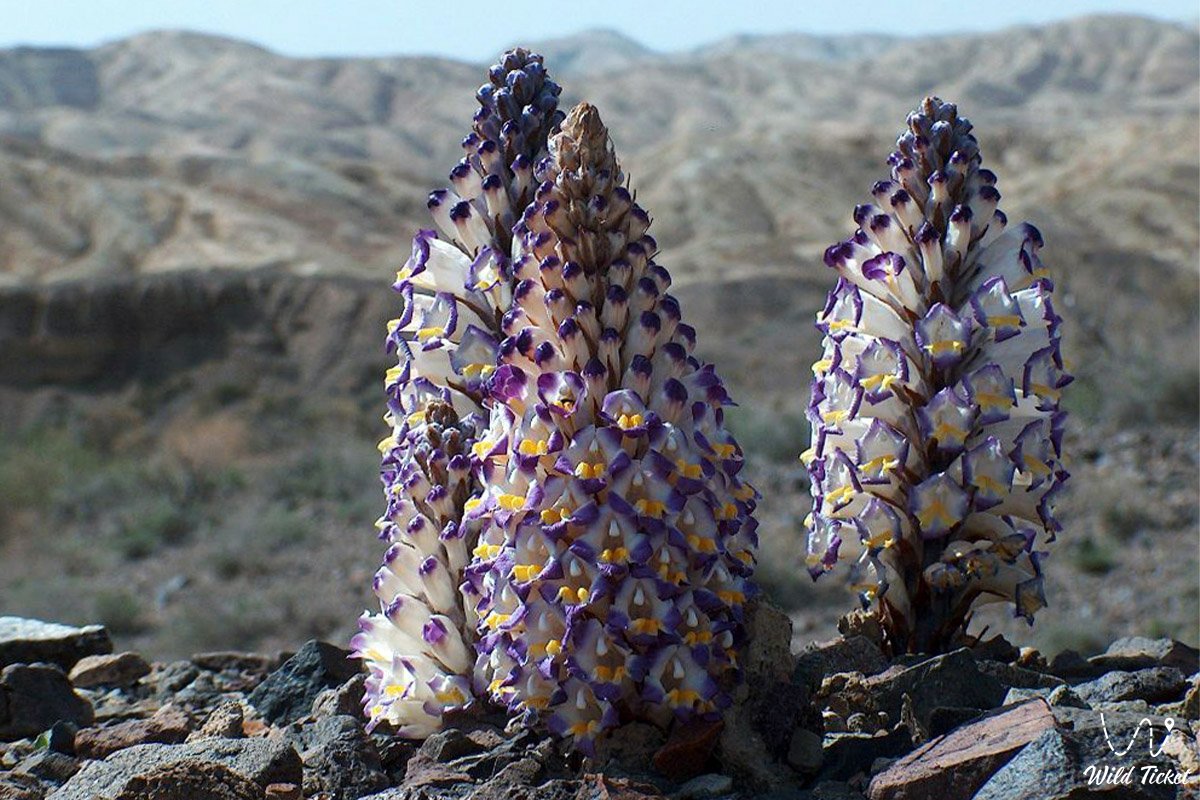
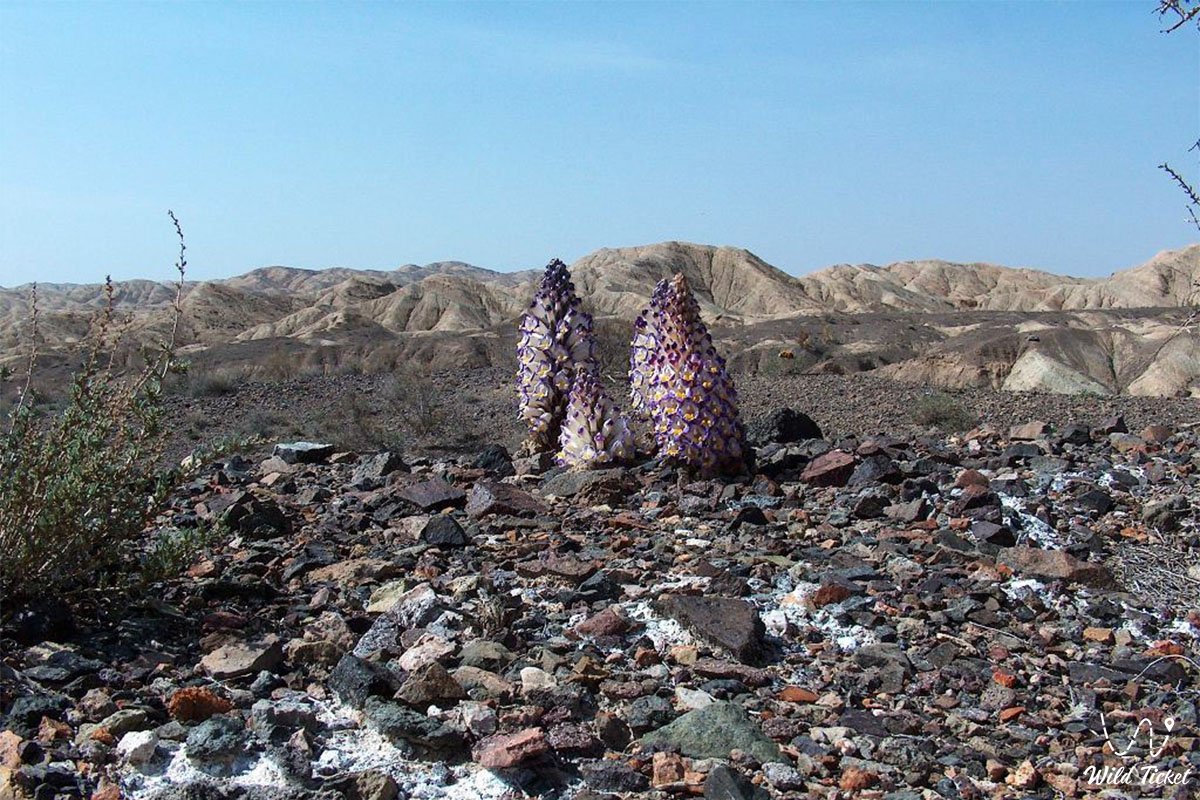
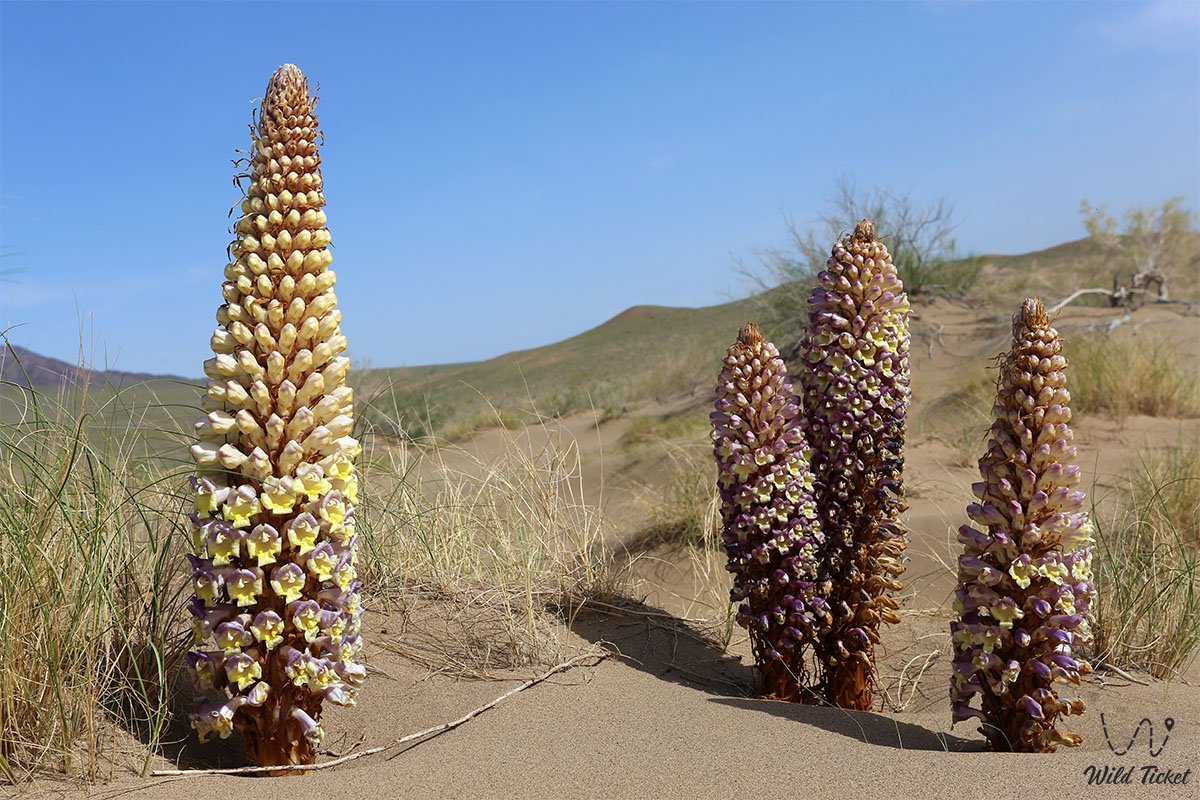
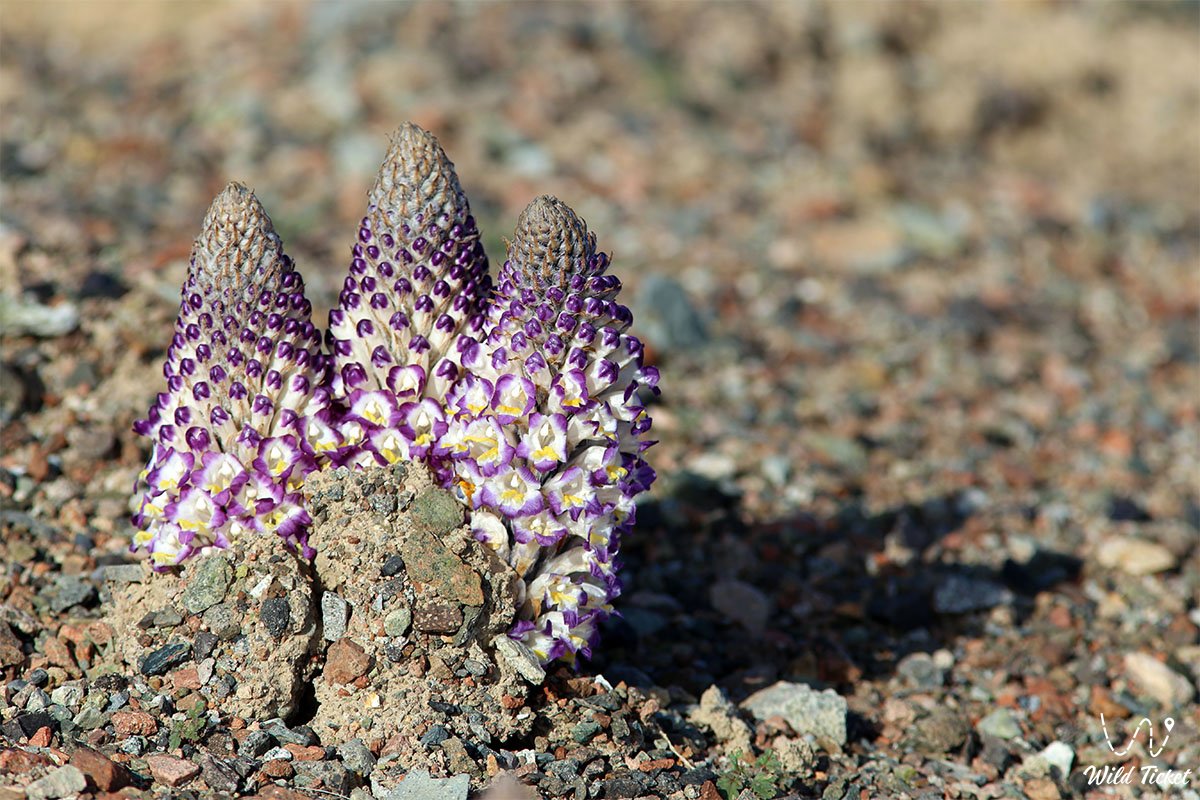
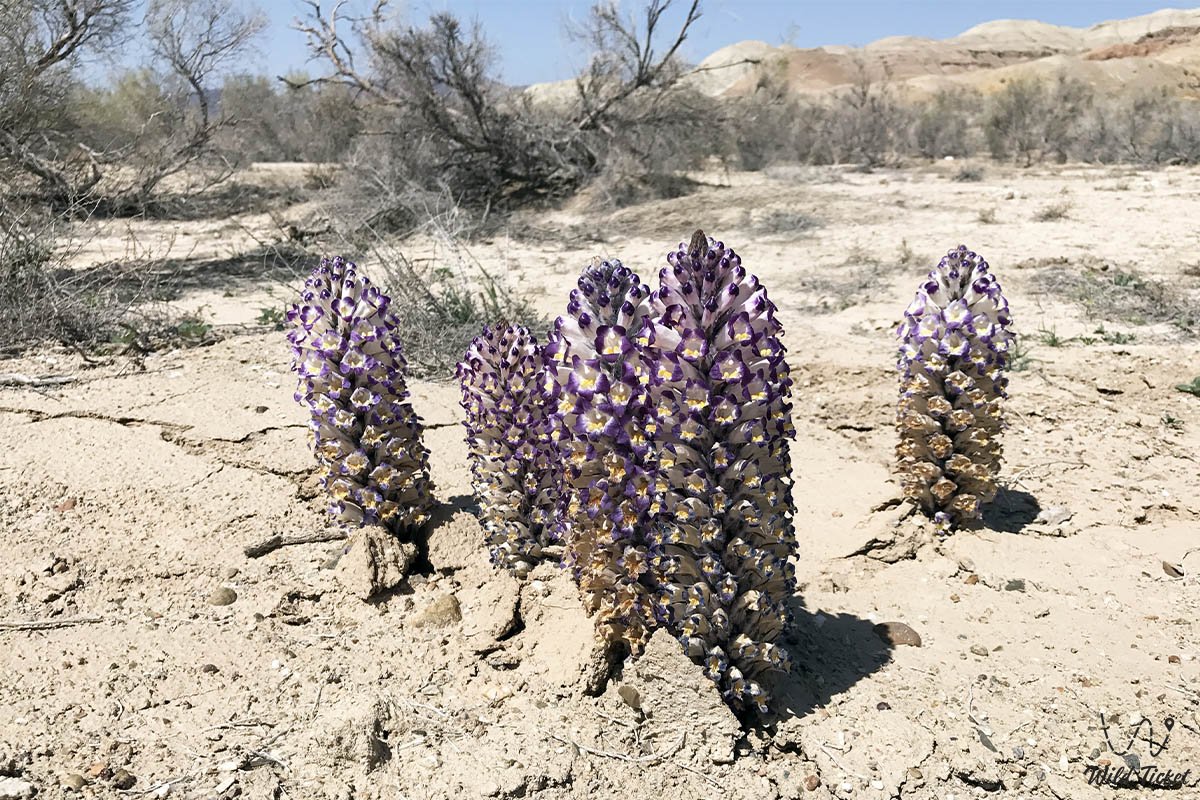
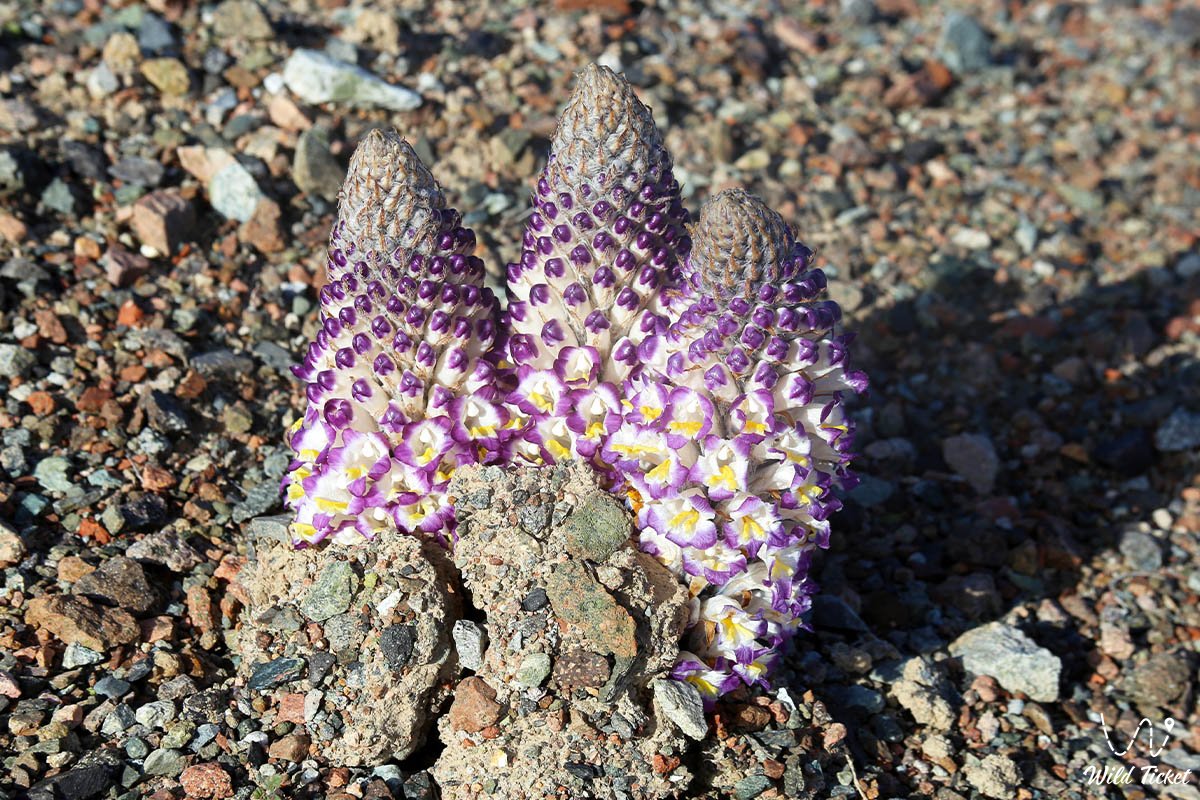
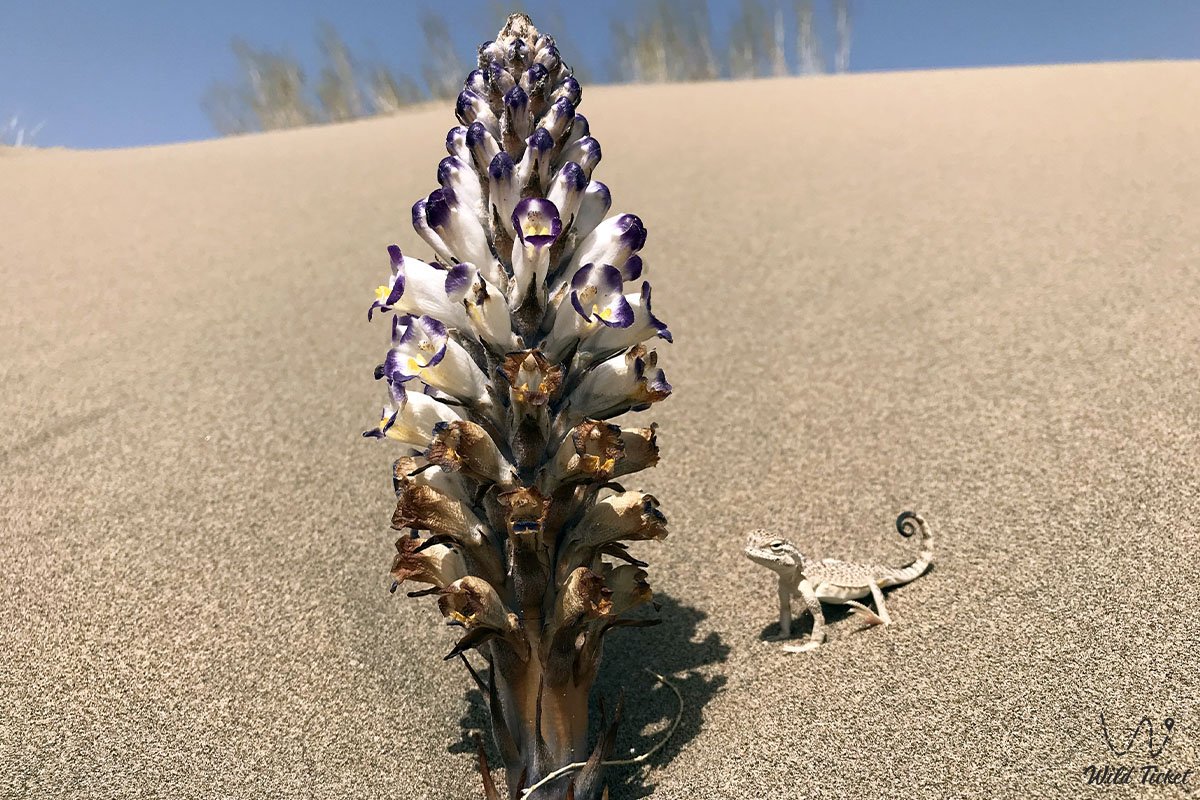
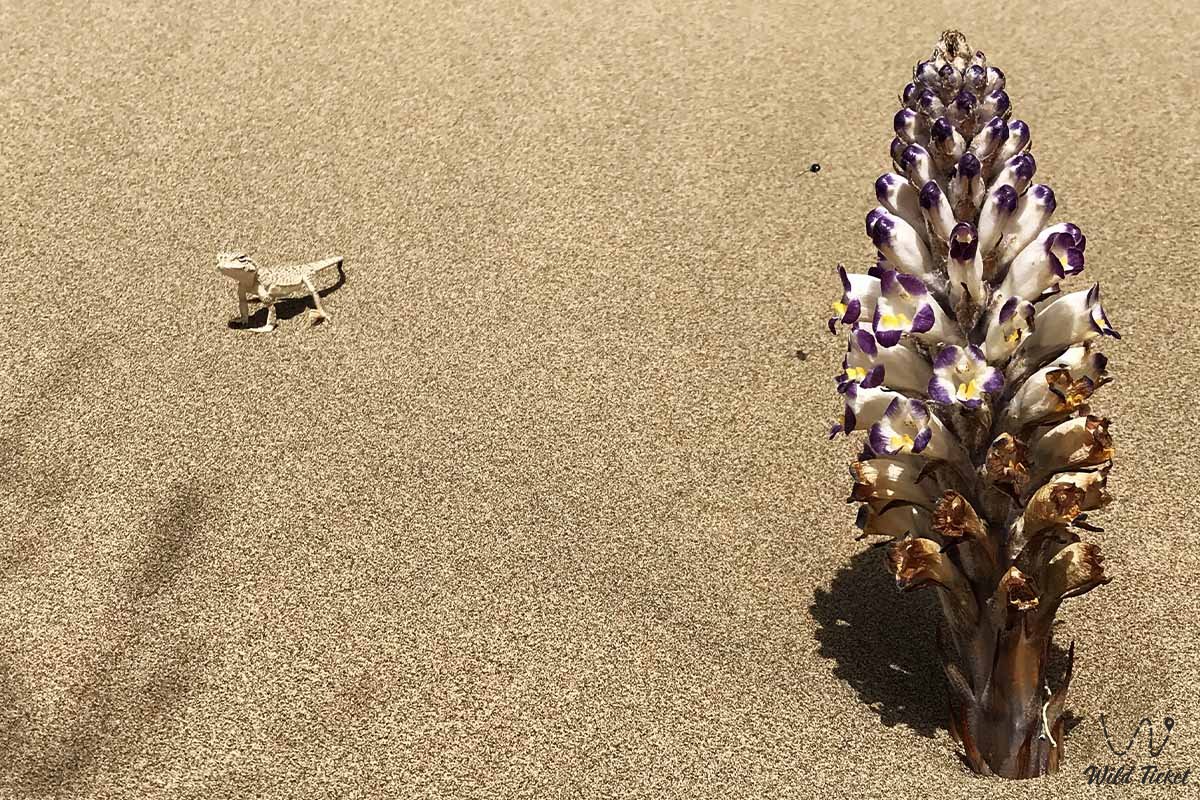
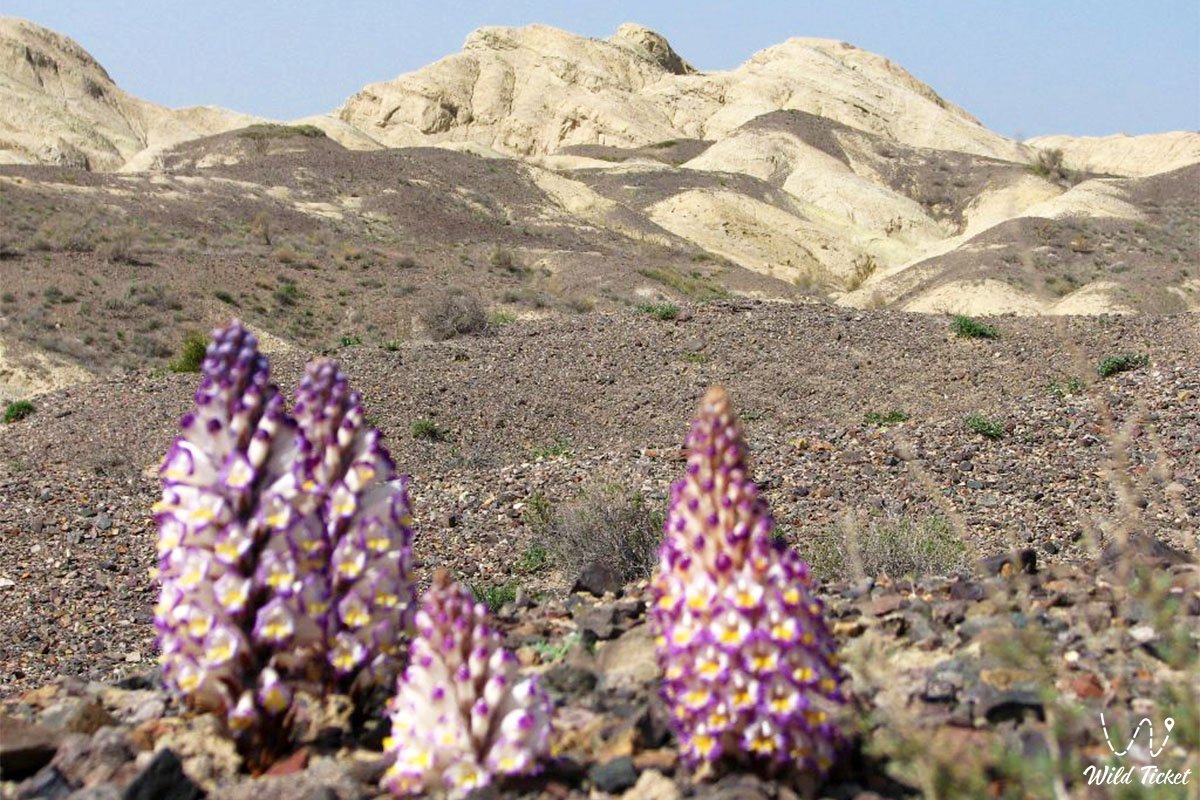
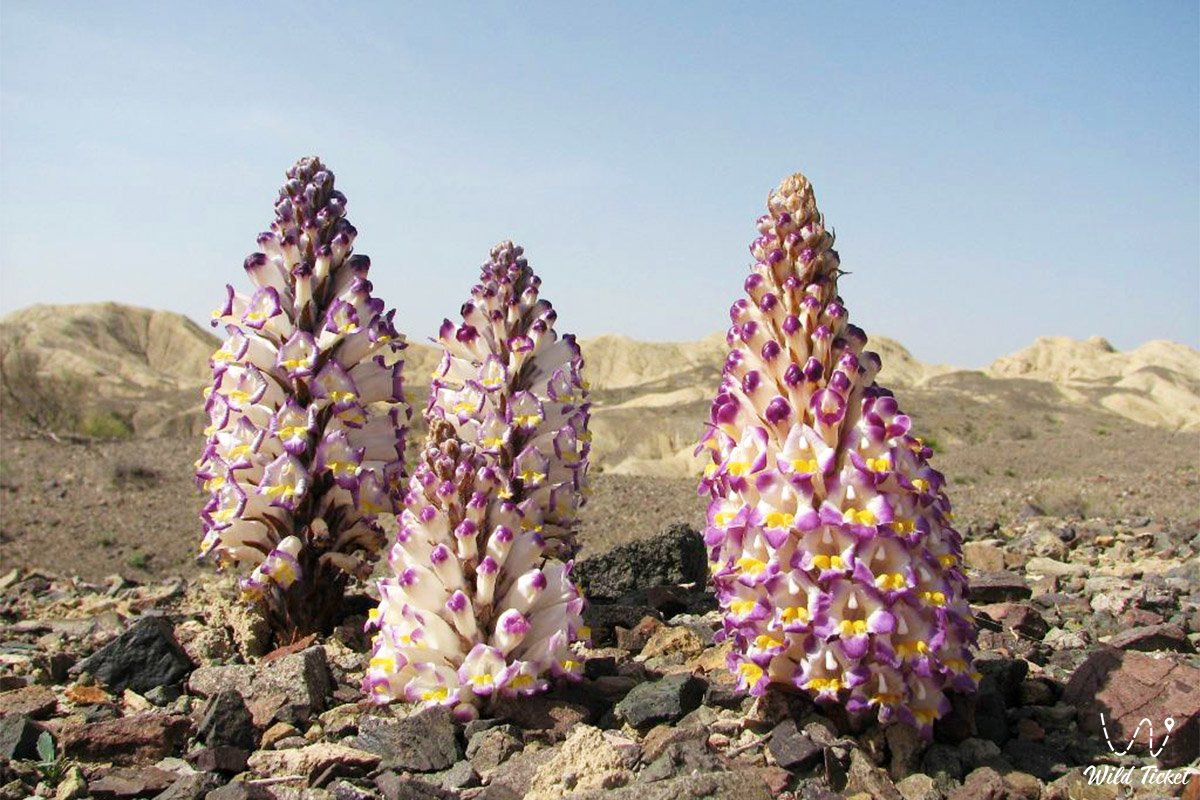
Across these barren, cracked takyrs and saline clays, it seems impossible for plant life to establish roots. Yet field botany frequently reveals the quiet tenacity of life. Then comes the encounter – amethyst points of color against white cliffs. We descend into the bottom of a dry wash where the clay is surfaced with a pale saline crust (solonchaks).
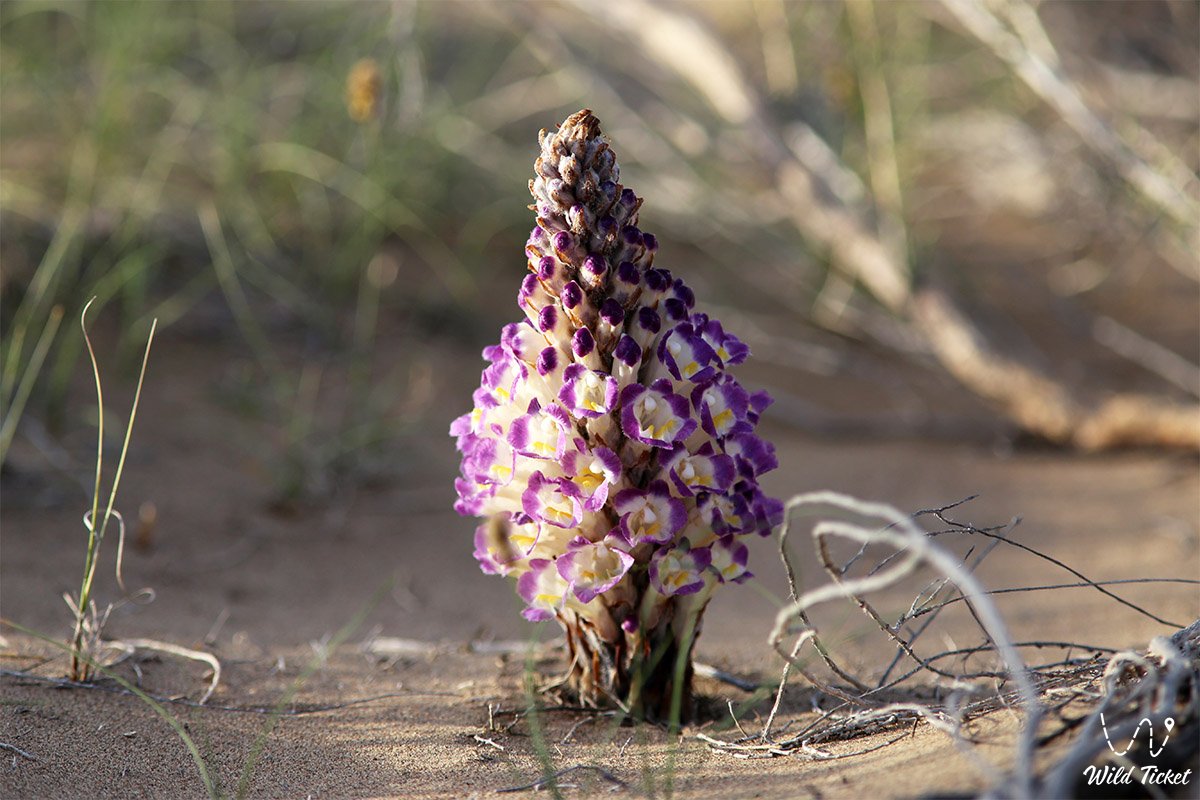
In such severe conditions, juzgun yields to hardier local hosts – black saxaul and various saltworts. At their roots, deep beneath the baked salt surface, lies our target. While Cistanche flava resembles a golden wand, Cistanche salsa appears like an amethyst gem set against white salt.
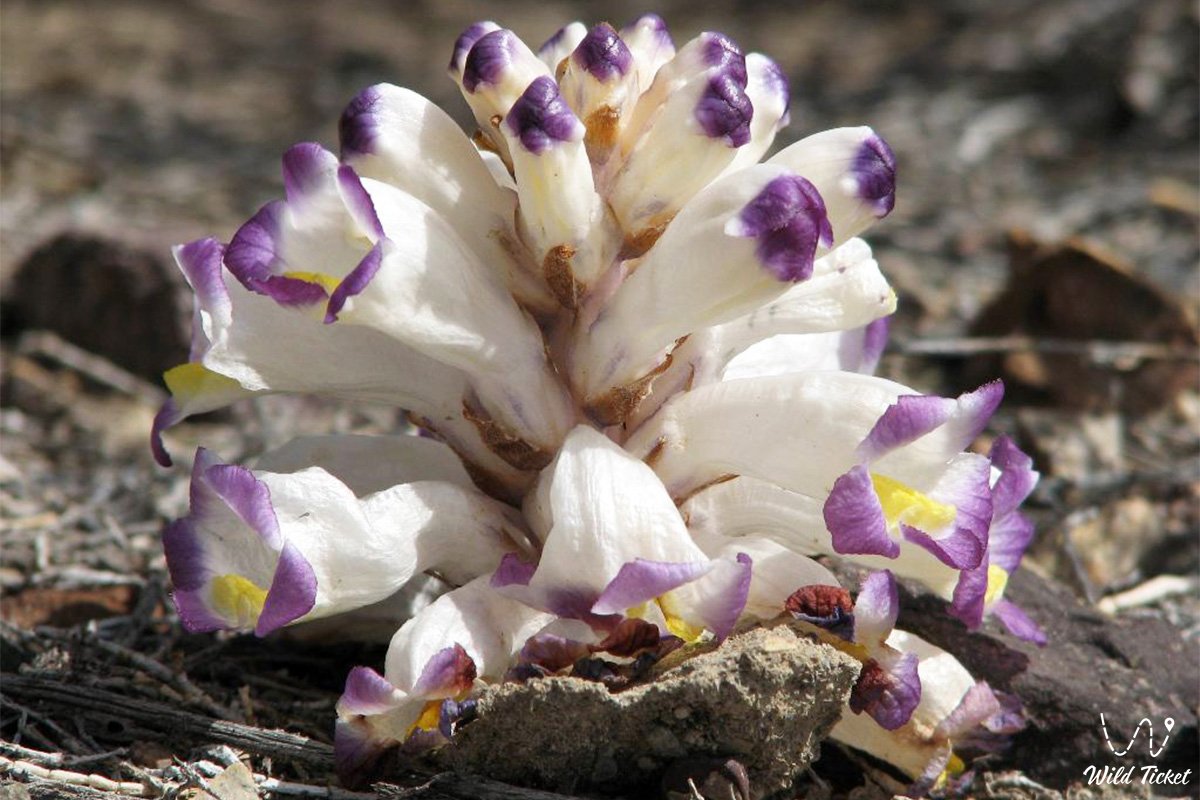
Along the fractured clay, dense, remarkably succulent shoots emerge through the earth. Its scale-covered stem is shorter and stockier than that of its sandy relative, yet the flower head displays an exquisite color palette. The tubular flowers sit clustered in a dense, heavy spike.
The pale yellowish base of each corolla merges into a deep violet or lavender-purple limb. The contrast is striking: framed by the blinding white chalk and martian red clays of Aktau, these violet beacons look like glowing neon markers.
Lacking foliage, Cistanche salsa draws moisture and dissolved minerals directly from the roots of saxaul, producing a fresh, vivid display where even the surrounding stones bake in the sun. Evening approaches, bringing the cooler stillness of the clay badlands.
As the sun descends, the Aktau mountains transform. The white chalk scarps turn soft pink, and the red strata glow crimson. In the gathering dusk, the violet blooms of Cistanche salsa appear to radiate a subtle inner luminescence.
We make our way out of the canyons, carrying the aroma of desert wormwood and the impression of this resilient wild plant that chose one of the most uncompromising, beautiful corners of Semirechye as its home.
Associated plant species in the Aktau mountains (Altyn-Emel Nature Park):
Rozov's bean-caper (Zygophyllum rosowii), white saxaul (Haloxylon persicum), Caspian nonea (Nonea caspica), Songorian cynomorium (Cynomorium songaricum), dwarf globe-thistle (Echinops nanus), knapweed plagiobasis (Plagiobasis centauroides), tumbleweed saltwort (Salsola tragus), Karelin's giant-fennel (Ferula karelinii), wavy wild lettuce (Lactuca undulata), Lehmann's bean-caper (Zygophyllum lehmannianum), elliptic heliotrope (Heliotropium ellipticum), Ili false-saxaul (Arthrophytum iliense), rush-like juzgun (Calligonum junceum), sharp-beaked stork's-bill (Erodium oxyrhynchum), Przewalski's jointfir (Ephedra przewalskii), sharp acanthophyllum (Acanthophyllum pungens), black saxaul (Haloxylon aphyllum), spotted arnebia (Arnebia guttata).
Transfer: Aktau – Katu-Tau gorge (26 km).
Arrival at the
Katu-Tau rock massif, exploring the surrounding landscape.
The Katu-Tau mountains (originally known simply as Katu) are situated in the eastern portion of Altyn-Emel National Park, south of the
Altyn-Emel ridge, between the Ili River valley and the park's desert plains. They lie approximately 47 km from Basshi village and about 25 km from the Aktau mountains.
This substantial mountain block extends from southwest to northeast, spanning roughly 40 km in length and 25–30 km in width. Peak elevations reach approximately 1,876.7 m a.s.l. in the northwestern section.
In contrast to Aktau, dominated by pale clays and softer erosional contours, Katu-Tau presents a rugged, dark, stone-strewn appearance that looks fire-baked. The slopes are dissected by ravines, dry washes, and narrow valleys. Among brown, deep red, chocolate, and purplish cliffs stand bizarre rock formations that resemble solidified volcanic flows.
The name Katu-Tau is commonly translated as "harsh mountains" or linked to the concept of frozen, petrified heights – terms that fit their appearance accurately. Furthermore, the geological origins of Katu-Tau reach much further back in time than those of neighboring Aktau.
At the core of the massif lie Carboniferous rock strata formed roughly 300 million years ago, when this region existed in a vastly different geographic setting.
Marine basins connected to the ancient Paleotethys Ocean covered the land. Marine sedimentary deposits preserve evidence of early organisms, including foraminifera and algae.
Certain strata also contain tracks of early amphibians, indicating that prior to volcanic activity, marine environments covered the territory of future Katu-Tau as part of an ancient seabed.
Over geological time, the environment transformed completely. Marine basins gave way to periods of intense tectonic movement and magmatism. During the Permian period, approximately 299–252 million years ago, the Katu-Tau region became an active volcanic zone.
Crustal fractures allowed magma to rise, erupting onto the surface in places while elsewhere solidifying within subterranean fissures and older strata.
These processes laid down extensive sequences of volcanic rock:
– lavas;
– volcanic tuffs;
– breccias;
– volcanic bombs and lapilli;
– intrusive igneous bodies.
Volcanic tuffs, composed of ejecta expelled during explosive eruptions, are particularly noteworthy. Ash, rock fragments, and larger magma clots were thrown airborne, eventually settling, consolidating, and lithifying into dense stone.
This geological past accounts for the distinctive range of coloration across Katu-Tau. Pink, lavender, red-brown, and chocolate shades correspond to distinct volcanic lithologies. Researchers identify two ancient volcanic centers in the western section of the massif.
Preserved structures here include volcanic conduits and vents packed with pyroclastic material, along with lava domes and numerous igneous dikes that filled subterranean fractures.
Radial dikes branching outward from ancient magmatic centers are especially visible, traceable for considerable distances across the terrain – enduring evidence of how magma penetrated the upper crust.
Although volcanic activity ceased long ago, erosional forces continue. Over millions of years, wind, thermal expansion, rainfall, and surface runoff have broken down and reworked the volcanic rock.
More resistant formations endured as buttresses and rocky hoodoos, while softer materials weathered away quickly, producing sheer stone walls, isolated monoliths, narrow defiles, and shallow grottos.
In various areas, surfaces evoke frozen waves or chaotic piles of colossal stone fragments. The present-day relief of Katu-Tau reflects both ancient volcanism and extensive, ongoing weathering.
What remains today are heavily altered remnants of ancient volcanic structures. The volcanic lithologies of Katu-Tau also provide significant mineralogical interest; descriptions note agate and quartz geodes where crystalline mineral formations developed within gas cavities.
Toward the east of the massif, layers of black vitrophyres – volcanic rocks with a glassy groundmass – occur. Vitrophyres indicate rapid cooling of magma melts that prevented full crystal formation.
These mineral occurrences exist within a strictly protected national park; natural objects are protected by law and intended for visual appreciation, not collection.
Katu-Tau carries an elemental atmosphere. It lacks typical alpine features of snow-capped peaks, glaciers, dense forests, or roaring rivers, presenting instead an austere stone world where each cliff preserves records of ancient planetary processes.
First came ancient marine waters, followed by volcanic vents, flowing lava, falling ash beds, and cooling igneous veins. Across millions of years, shifting climates and weathering shaped the stone into its contemporary outlines.
Later, early human inhabitants arrived, carving petroglyphs of wild animals and scenes of life upon the rock faces. Traveling through Katu-Tau feels like walking through consecutive chapters of Earth's history, spanning an ancient ocean to a high-desert plateau.
Katu-Tau stands as a primeval stone record of ancient
Zhetysu.
Associated plant species in the Katu-Tau mountains (Altyn-Emel Nature Park):
Pungent acanthophyllum (Acanthophyllum pungens), flat-calyx hare's-lip (Lagochilus platyacanthus), Ili stone-parsley (Seseli iliense), salt-tree juzgun (Calligonum), spotted arnebia (Arnebia guttata), small-flowered catmint (Nepeta micrantha), elegant sunburst lichen (Rusavskia elegans), yellow cobblestone lichen (Pleopsidium flavum), xanthoparmelia (Xanthoparmelia).
Transfer: Katu-Tau mountains – Basshi village (56 km). Arrival in Basshi, hotel check-in, dinner, overnight stay.