Unique monument of medieval architecture -
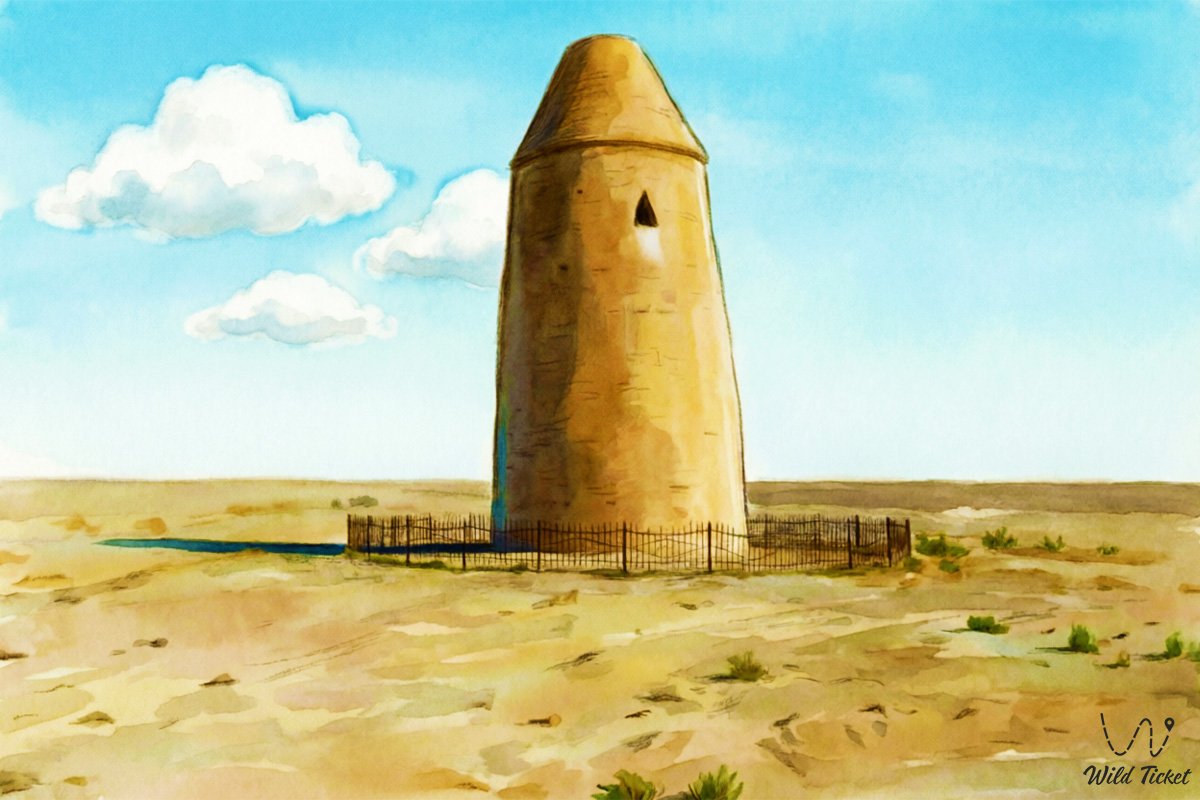
Saraman-Kosa Tower (also known as Sarman-khodzha or Saryaman) is an outstanding monument of medieval architecture and one of the early examples of tower-mausoleums on the territory of Kazakhstan. This majestic cone-shaped structure dates back to the 11th century (some researchers attribute it to the 9th–11th centuries) and is an essential historical and cultural landmark of the Kazaly district of the Kyzylorda region.
The construction of this monumental object, taken under state protection, took place in the pre-Islamic period. The exact purpose of the tower still causes discussion among scientists: it cannot be called a classic tomb, since no burials have been found inside. Researchers agree that the monument played the role of a pagan ritual building or a kind of temple for honoring the spirits of ancestors (aruakhs), and could also serve as a watchpost and a signal beacon in the southwestern part of the Karaozek tract. The structure is located on a plain 1.6 kilometers from the Kundarya riverbed, contrasting sharply with the steppe horizons. It is best to travel to the tower from the city of Kazalinsk or the village of Ayteke Bi.
Today, the Saraman-Kosa Tower is recognized as a sacred site of national significance and attracts historians, archaeologists, and pilgrims. The monument demonstrates a high level of engineering thought of the early Middle Ages and is a unique example of pre-Islamic memorial culture preserved in the middle of the harsh steppe expanses of the Aral region.
---------------------------------------------
How to get there and visit -
Saraman-Kosa Tower is located 3 kilometers northeast (according to other sources – southeast) of Kaukey village, Kazaly district, Kyzylorda region, Republic of Kazakhstan.
GPS coordinates: 45°15'23"N 61°47'48"E
The transport logistics of this secluded steppe area completely exclude urban public transport. No regular buses or city taxi services operate here. You can reach the medieval tower from the Kaukey village in just 10–15 minutes, covering about 2–3 kilometers along well-trodden dirt roads.
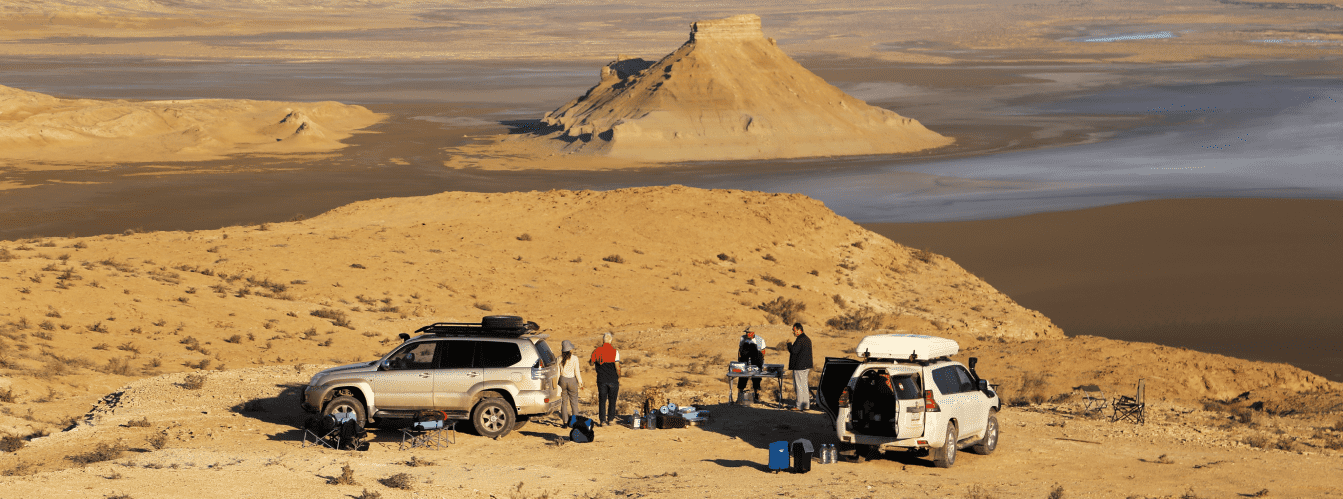
For a trip to the monument, it is recommended to use a four-wheel-drive SUV, since the paths pass through a semi-desert area and sandy sections of the Karaozek tract, which can be difficult to traverse after rare precipitation or during winds. Travelers must carry a supply of drinking water, navigators, and communication devices.
Opening hours: The territory around the monument is open for visits by tourists around the clock and all year round. Access to the site is completely free; there are no ticket offices, admission fees, or paid excursion posts here.
It is better to plan a trip to this region for the spring period (April — May) or early autumn to avoid the extreme summer heat characteristic of the Aral region. All tent sites and expedition camps are organized by tourists independently in field conditions, with mandatory adherence to the rules of respectful behavior on the territory of cult and historical monuments.
---------------------------------------------
History
The history of this sacred structure spans about a thousand years. In popular memory, the names of masters Dzhaba and Aydos, who lived in the 9th–11th centuries, have been preserved as possible builders of the tower, but the official author of the project remains unknown. In local tradition, there was a steady and important custom: pilgrims and residents of surrounding nomadic camps came here to spend nights inside the tower for the purpose of spiritual communication with their ancestors — aruakhs.
The first detailed studies and documentation of the architectural features of the tower began in the 20th century. In 1982, by decree of the Council of Ministers of the Kazakh SSR, the Saraman-Kosa Tower was officially included in the list of historical and cultural monuments of republican significance and taken under strict state protection.
Given the harsh and arid climate of the Aral region, as well as the venerable age of the building, by the end of the 20th century the structure was under threat of destruction: the external cladding had crumbled in places, and the entrance opening was severely damaged. In this regard, a large-scale state restoration and reconstruction of the site was carried out in 1984, which made it possible to strengthen the ancient walls and preserve the unique tower-mausoleum for future generations.
Information
The Saraman-Kosa Tower is organized as a vertical three-tiered memorial-ritual space with a total height of 15 meters. In plan, the structure has the shape of a perfect circle, and data on the base diameter vary in studies from 7 to 12 meters. The architectural composition of the tower has strict proportions: the ratio of the lower diameter to the total height is 1/2, and the height of the final domed part equals 1/4 of the entire height of the object. The slope of the walls towards the center is about 5 degrees.
The internal space of the tower is divided vertically into three vaulted chambers (floors). The lower tier is the largest and is completely isolated from the rest of the rooms; the second and third tiers communicate with each other by means of an original internal spiral staircase.
Tour organizers and local historians recommend that tourists inspect the monument with caution, move around the adjacent territory on foot, and treat the vulnerable elements of medieval masonry with care.
Detailed description of the venue
The well-thought-out infrastructure of the historical complex includes the following original locations and geographical features:
• Massive plinth – a rounded base of the tower with a wall thickness from 1.6 to 1.81 meters, holding a colossal vertical load.
• First tier – the lower isolated chamber of the tower, covered with a durable hemispherical dome and equipped with a rectangular window opening.
• Second tier – the middle vaulted chamber, also covered with a dome and communicating with the upper floor through a special zenith window.
• Third tier – the upper room without a blind ceiling, equipped with two (in some descriptions — three) guard holes on the north and south sides.
• Spiral staircase – an internal connecting element of the structure, providing access to the upper observation windows of the tower.
• Truncated tent dome – the final upper part of the structure, crowning the cone-shaped shaft of the tower.
Architecture
The architectural solution of the Saraman-Kosa Tower is based on a combination of two types of building materials. The main body of the walls is built of massive raw mudbrick (adobe), and the outer side is completely clad with durable square fired brick with dimensions of 24x12x7 cm (elements with dimensions of 24x24x5 cm are also found). The masonry was carried out on a high-quality clay mortar, while the thickness of the inter-brick joints reaches 2 cm.
Thanks to its cone-shaped form, tapering upwards, and powerful walls at the base, the engineering structure successfully resists strong steppe winds and sandstorms for many centuries, being a masterpiece of pre-revolutionary architecture.
Legend
A beautiful and tragic legend lives among the residents of the Kyzylorda region, connecting the appearance of the tower with a story of great love. Saraman was the son of a wealthy ruler of the ancient city of Zhent and went on a journey with his faithful friend from among the poor named Kosa. On the bank of the Taldysay mountain river, Saraman met a beautiful girl and fell in love with her, and this feeling was mutual. However, the girl had already been betrothed to another for a large bride price.
Unwilling to resign themselves to fate, the lovers and Kosa fled under the cover of night. On the sixth day of the journey, at the mouth of the Syr Darya, a pursuit of armed nukers sent by the girl's brothers overtook them. Saraman stayed behind to accept an unequal battle to give his friend the opportunity to save the girl, but the nukers brutally killed all three fugitives.
According to legend, they were buried together, and the inconsolable father of Saraman erected this majestic tower-mausoleum on the site of their death, combining the names of the faithful friends and lovers in the title.
Conclusion
The Saraman-Kosa Tower is a unique historical bridge connecting the pre-Islamic religious traditions of the Oghuz era with the modern cultural and scientific life of Kazakhstan. The monument is of colossal importance for studying the evolution of memorial architecture in Central Asia and demonstrates the continuity of the nomads' construction technologies.
The structure remains an important site for historical, local history, and expedition tourism in the Kyzylorda region. Research routes definitely include a visit to this tower, allowing travelers to touch the ancient mysteries of the Aral steppes and honor the memory of the heroes surrounded by legends.
Interesting sights nearby:
• Syr Darya River;
• Kuttybai Mausoleum;
• Zhankent ancient city (Yangikent).
Photogallery: