Tastubek village
Unique example of lake fishery restoration -
Tastubek village is a unique settlement in the Aral district of the Kyzylorda region of Kazakhstan, part of the Mergensay rural district. Located on the Koktyrnak peninsula near the southeastern coast of Butakov Bay in the northern part of the Small Aral Sea, this authentic fishing village attracts travelers, geographers, and ethno-tourists.
The village clearly demonstrates the striking resilience of local residents. Despite harsh climate changes, the coastal community did not leave their ancestral hearths, preserved their centuries-old trade, and today successfully develops lake fishery, turning their secluded village into an essential point on the map of modern ecological tourism. It is best to travel to the village from the city of Aralsk.
The main calling card and pride of the settlement is the restoration of the fishery. The village itself is located on an elevation, and a fishing camp is equipped on the coast 3 kilometers away from it. The working day of local residents begins early in the morning: they go out to sea on motorboats and set nets, and in the afternoon they return to the shore with a rich catch.
Today, Tastubek village is recognized as a key point for adventure expeditions and ethnographic jeep tours in the Aral region. Travelers seeking to get acquainted with the traditional lifestyle of coastal residents and capture the harsh beauty of the Small Aral and the Aral Sea regularly head here. In the eastern part from the Koktyrnak peninsula, 29 kilometers away, is the picturesque Zhalanash bay, and in the southern part of the peninsula lie the low hills of Bultuk and Ushshoky.
Via this link, you can view the description of the program "Around the Small Aral Sea".
---------------------------------------------
How to get there and visit -
Tastubek village is located on the Koktyrnak peninsula, Butakov Bay, Aral district, Kyzylorda region, Republic of Kazakhstan.
The route to the village from the city of Aralsk runs in a northwestern direction, and the total distance to the village is about 90–100 kilometers.
GPS geographical coordinates: 46°36'15"N 60°49'26"E
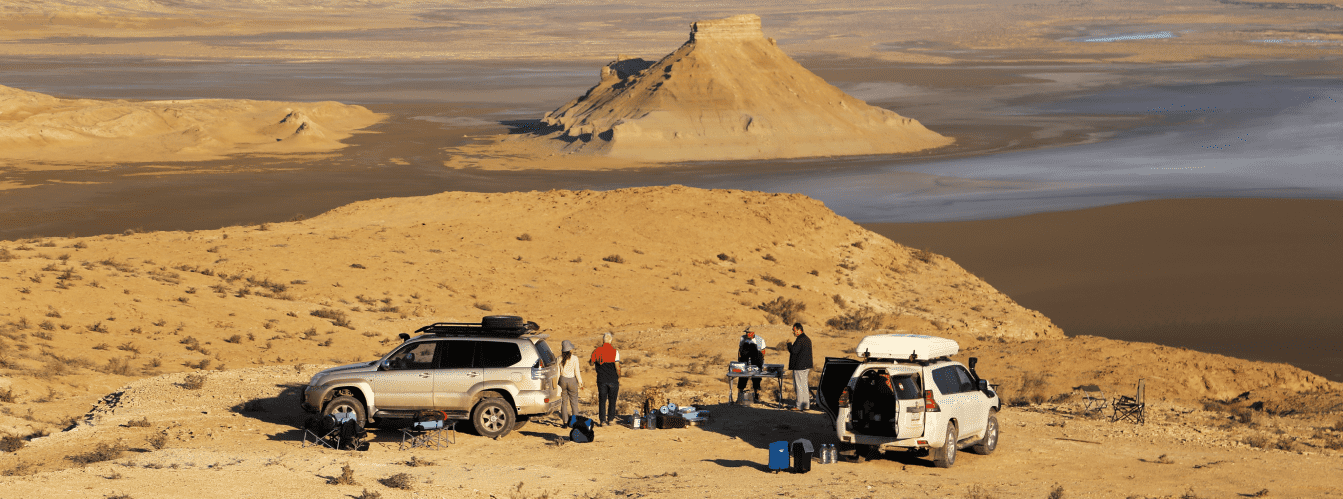
The transport logistics of this isolated area completely exclude urban public transport. You can get here as part of a popular three-day off-road route.
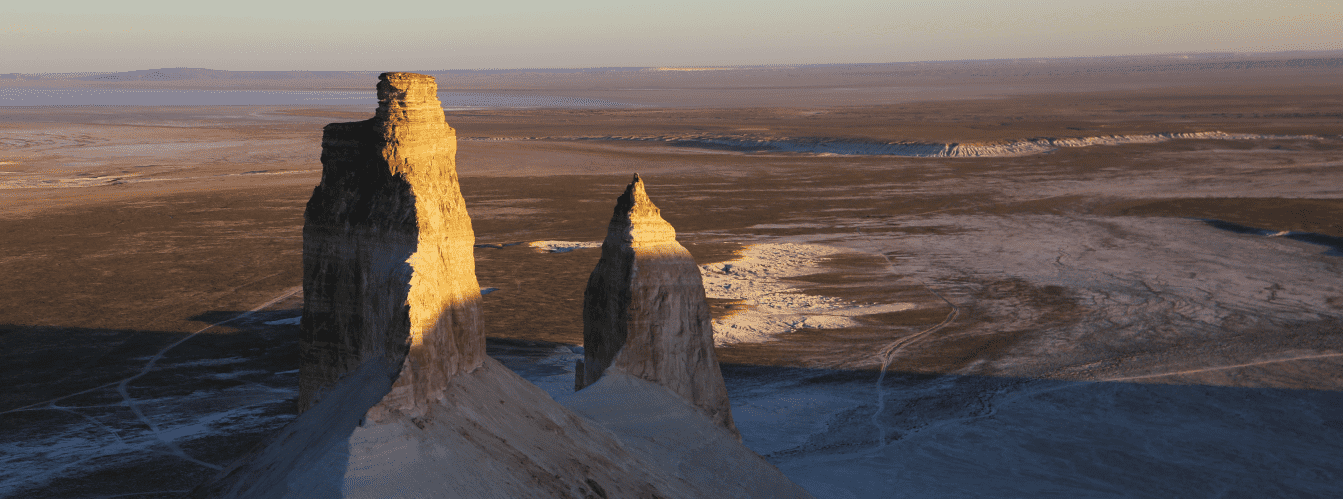
When leaving Aralsk, the first 5 kilometers of the way pass on asphalt, after which the road to the Zhalanash village (63 km from the city) is a grader. 27 kilometers before Zhalanash, the picturesque cliffs of the Saryshoky tract (the Eastern chink of the Ustyurt plateau) open up to the left of the road, where tourists make a stop for a walk.
From the Zhalanash village to Tastubek, you will have to overcome another 25 kilometers along dirt roads. Independent tourists without a car can reach Aralsk by train, and hire local drivers with four-wheel-drive vehicles at the station.
Only a prepared four-wheel-drive 4x4 SUV with high cross-country capability is suitable for a trip in your own car, since the steppe roads consist of deep sand ruts, takyrs, and salt marshes. It is categorically not recommended to go to this desert area alone in a single car – for safety and mutual assistance, there must be at least two vehicles in the group.
Drivers must have satellite navigators, reliable shovels, tow ropes, spare fuel canisters, and a large supply of fresh drinking water.
Opening hours: the residential village, the hilly surroundings of the coast, and the fishing camp are open for visits by travelers around the clock and all year round. Access to the coastal zone is free; there are no ticket offices, tickets, or paid checkpoints here.
It is recommended to plan a trip to this region for the spring period (April – May) or early autumn (September – October). In the summer months, extreme heat holds in the steppe. All tent camps are organized by tourists independently. A popular place for the first night in tents after visiting Tastubek is the Kaltybay chink and the Shoshkaly tract, located 30 kilometers north of the fishing camp. Travelers can also stay overnight directly in the village, arranging it with the local residents.
---------------------------------------------
History
The history of Tastubek village is inextricably linked with the complex chronicle of the Aral Sea and the ecological changes of the 20th century. Initially, it was a prosperous coastal village whose residents from generation to generation were engaged in catching fish and raising livestock. The surrounding steppe lands served as good pastures for breeding camels and horses, and the sea provided a stable income and food security for the region.
With the beginning of the rapid drying up of the Aral Sea, Butakov Bay began to recede, and the water left Tastubek for many kilometers, turning the former seabed into a salty desert. Fishing became impossible, coastal piers were abandoned, and the village faced the threat of complete disappearance and a sharp outflow of population. The residents showed incredible courage and refused to leave their homes: in the hardest years, they switched to camel breeding and continued to believe in the return of the water.
The historical turning point in the fate of the village was the completion of the construction of the Kokaral Dam in 2005. The hydrotechnical structure blocked the discharge into the Large Aral, thanks to which the water level in the Small Aral Sea rose. The water returned to the borders of the Koktyrnak peninsula, which allowed fully reviving the fishing trade, launching boats onto the water, and restoring the economic stability of the fishing village.
Information
A sharply continental, cold steppe and semi-desert climate prevails in the region. The surroundings are characterized by a hilly relief with a predominance of salt marshes and desert plains. Reeds and chee grass grow on the coast, and the surrounding steppe expanses are used for cattle grazing.
Tastubek village and its adjacent coastal water area are organized as an open ethnographic and ecological space. Excellent conditions are created here for conducting ornithological observations, landscape photo sessions, and filming documentary materials about the ecology of Kazakhstan.
The highlight of this area is the striking contrast between the endless semi-desert steppe, where herds of camels graze, and the panorama of the blue Small Aral, along which modern motorboats of fishermen cruise. Guides of the Barsakelmes State Nature Reserve regularly include the village in their ecological tours, urging tourists to respect the traditions of local residents, treat the fragile coastal fauna with care, and maintain cleanliness on the coast.
The population dynamics reflect the gradual revival of the village. According to the 1999 census data, only 53 people lived here (29 men and 24 women), but by 2009 the population of the village increased to 90 people (44 men and 46 women). The core of the community consists of families of hereditary fishermen and livestock breeders who carefully preserve the historical continuity of the region.
Detailed description of the venue
The well-thought-out infrastructure of the coastal fishing complex includes the following original locations and geographical features:
• Residential sector of the village – the hilly residential zone of the Mergensay rural district, consisting of authentic houses of local fishermen and livestock breeders.
• Coastal fishing camp – an equipped mooring zone on the Koktyrnak peninsula 3 kilometers from the residential houses, from where boats go out to sea.
• Bultuk and Ushshoky hills – low hilly elevations located in the southern part of the Koktyrnak peninsula and forming the local relief.
• Zhalanash bay – a picturesque water sector of the Small Aral Sea, located 29 kilometers east of the Tastubek village.
• Kaltybay chink and Shoshkaly tract – majestic cliffs of the Eastern chink of Ustyurt, starting 2 kilometers from Butakov Bay and serving as a popular place for tent sites of auto tourists.
• Deep-water zone of the bay – the coastal sector of the Small Aral 3 kilometers east of the fishing camp, recognized as the deepest place in Butakov Bay with a mark of 45 meters.
Legend
Touching stories and traditions about loyalty to the native land are passed down from generation to generation among the residents of Mergensay and adjacent rural districts. The most popular story in Tastubek is the tale of the "fishermen who outsmarted the desert." The elders remember that in the hardest years, when the sea left and the hot winds brought only salt and sand, many advised the villagers to abandon the village and move to cities.
However, the aksakals gathered a council and decided that leaving meant betraying the memory of their ancestors. They began to raise camels, and did not cut their boats for firewood, but carefully greased and hid them under sheds, assuring the children that the sea would definitely return to those who know how to wait.
When in 2005 the barriers of the Kokaral Dam raised the water level and the blue waves of the Small Aral struck the shore of Tastubek again, the old boats were launched into the water. Local residents sincerely believe that the sea returned to the village as a reward for their patience, courage, and unbending loyalty to the Aral steppe.
Conclusion
Tastubek village is a magnificent historical bridge connecting the memory of the former full-flowing greatness of the Aral Sea with the modern successful economic, ecological, and tourist development of the Kyzylorda region. A visit to this village allows travelers to personally see the results of the unique restoration of the hydrographic balance of the Small Aral, appreciate the unbending character of local fishermen, and enjoy the pristine beauty of wild coastal nature.
The village remains an essential reference point for adventure, ethnographic, and scientific-local history tourism in the Aral district. Expedition routes invariably include this fishing point in their programs, giving every guest the opportunity to feel the living energy of revival and witness a new chapter in the history of the great steppe sea.
Interesting sights nearby:
• Akespe village;
• Barsakelmes Nature Reserve;
• Shevchenko Bay;
• Zhalanash village.
• Akkuduk village;
• Karabulak village.