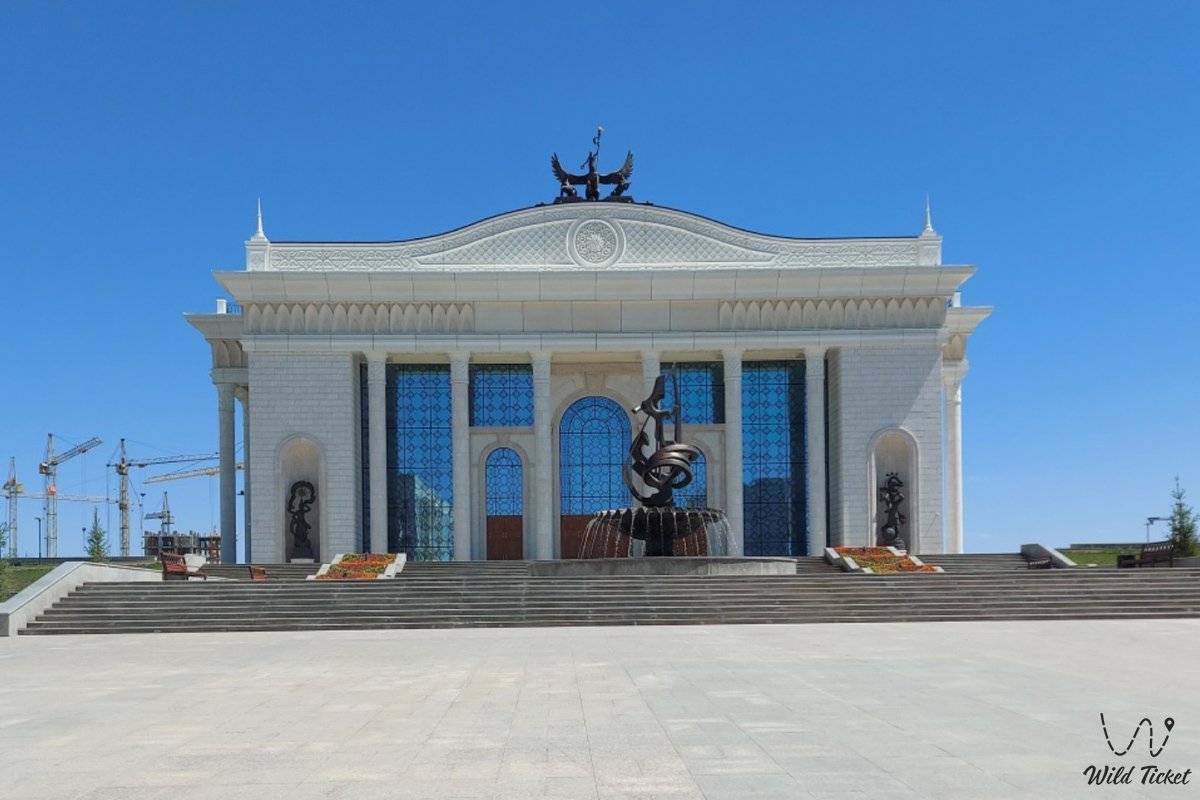
The main stage of Kazakh drama and an architectural adornment of central Astana -
The Kazakh National Musical Drama Theatre, named after the legendary actor Kalibek Kuanyshbayev, is not just a creative venue but a peer of the country's independence. Founded in the pivotal year of 1991 by the talented director Zhakyp Omarov, the theatre has grown from a small ensemble to achieving "National" status, granted in 2024 by the decree of President Kassym-Jomart Tokayev.
The theatre's modern building, opened in 2020, is rightfully considered an architectural gem of the capital, combining the elegance of classical lines with the majesty of steppe traditions. Located near the theatre are Independence Square and the Kazakh Eli Monument. Additionally, the theatre is surrounded on two sides by a beautiful park where you can stroll and rest before or after a performance.
The troupe, known among fans as "Kalleki," is recognized as one of the strongest in Central Asia. The theatre's stage has seen triumphs at international festivals and productions that have become classics—from tragedies by Gabit Musrepov to psychological works by Chingiz Aitmatov.
Here, every performance turns into a deep exploration of the human soul, while the luxurious interiors and impeccable acoustics of the halls create an atmosphere of complete immersion in the magic of art. Today, the Kuanyshbayev Theatre is an intellectual and cultural center of Astana, where the heritage of ancestors is carefully preserved while boldly experimenting with modern formats.
---------------------------------------------
How to get there and visit -
The new theatre building is located at: 8/1 K. Kuanyshbayev Street, right bank of the Ishim River, Sarayshyk district, Astana city, Republic of Kazakhstan.
GPS coordinates: 51°07'13"N 71°28'48"E
This is a prestigious area on the right bank, surrounded by iconic objects: the Palace of Independence and the Hazret Sultan Mosque.
You can reach the theatre via various bus routes connecting the cultural center with other parts of the city. Buses running to the nearest stops include: No. 50, 43, 32, 21, 14, 3.
For those preferring private transport, a convenient parking area is equipped in front of the theatre with entrances from Tauelsizdik and Koshkarbayev avenues. You can also use taxi services via a special mobile application.
Opening hours: Monday – Sunday from 09:00 to 19:30 (break from 13:00 to 14:00)
Contacts: +7 7172 27 02 35 (reception); +7 7172 24 8323 (box office)
Email: [email protected]
Official theatre website
---------------------------------------------
History
The "Kalleki" theatre opened its first season on November 15, 1991, with the legendary production "Akan Seri – Aktokty." The founder and first director, Zhakyp Omarov, laid a powerful foundation that allowed the theatre to win prizes at major festivals in its early years, including a victory in Ufa with the play "Aldar Kose."
In 1996, after the master passed away, his name was immortalized in the name of the street where the theatre was located for many years. The troupe received Academic status in 2011, confirming its high artistic level.
A new era in the theatre's life began in 2020 when the ensemble moved from the old center to a grand modern building on the left bank (geographically situated near the new center area). This project, implemented at the initiative of Nursultan Nazarbayev, allowed for the expansion of the troupe's creative possibilities.
In 2024, the theatre was granted the highest "National" status, solidifying its role as the primary guardian of the Kazakh stage language and the nation's spiritual values.
Information
The modern theatre complex is impressive in scale: its total area exceeds the size of three football fields (over 22,000 sq. m). Inside are two high-tech halls: a Grand Hall with 635 seats and a Chamber Hall with 202 seats. Both rooms are designed with complex acoustic requirements in mind, allowing for both dramatic performances and symphony music concerts.
The theatre's infrastructure is thought out to the smallest detail: guests can enjoy a luxurious restaurant, an art gallery with exhibitions by contemporary artists, and a special hall for ceremonial meetings. The repertoire includes both gems of national classics (M. Auezov, S. Zhunisov) and masterpieces of world drama.
Most productions are staged in the Kazakh language with the option of simultaneous translation. For young viewers, the theatre regularly prepares musical fairy tales, turning a trip to "Kalleki" into a true family holiday.
Detailed description of the object
The theatre building is a true work of art, where every detail of the facade and interior is permeated with aesthetics. The exterior finish of light stone is complemented by elegant stained-glass windows and monumental columns.
In front of the entrance, guests are greeted by a unique sculpture of a kobyz set in the center of a fountain, symbolizing the theatre's unbreakable bond with the musical roots of the people. The interior decoration resembles palace interiors: marble floors, crystal chandeliers, and rich hall finishes create a solemn mood.
A special place in the theatre is occupied by a museum zone, where relics related to the life of Kalibek Kuanyshbayev and the history of the first capital productions are kept. The three-story building is designed as an open space—wide staircases lead to a foyer with panoramic windows offering a view of the Presidential Park.
The "Kalleki" theatre has become a place of power for the creative intelligentsia, where modern comfort serves as a frame for the great Kazakh word.
Architecture
The architectural style of the new building can be described as "national neoclassicism." The facade is decorated with sculptures and fine carvings imitating Kazakh ornaments in stone. Large glazed stained-glass surfaces give the building lightness despite its impressive size.
Thoughtful internal logistics include separate entrances for spectators and artists, spacious rehearsal halls, and workshops. This building has become an important link in Astana's cultural axis, uniting the National Museum and the pyramid of the Palace of Peace and Reconciliation into a single ensemble.
Legend
In Astana's theatrical circles, there is a legend of the "Kobyz singing at twilight." They say if you linger by the fountain in front of the theatre after sunset, you can hear a quiet melody of a kobyz coming not from speakers but seemingly from the earth itself. Old-timers believe it is the voice of Zhakyp Omarov blessing young actors for a successful performance.
Another legend is linked to the first play "Akan Seri – Aktokty": it is believed that the spirit of the great akyn Akan watches over the theatre, and if a rainbow appears in the sky or light snow falls on the day of a premiere, the production is destined for a long life and global success. For many, "Kalleki" is a place where the shadows of ancestors come to life, reminding descendants of the power of art to unite generations across decades and centuries.
Interesting sights nearby:
• Observation deck in the Presidential Park;
• Kazakh National University of Arts;
• Triathlon Park;
• Park named after Bauyrzhan Momyshuly;
• Park of Peace and Reconciliation.
• Akorda;
• Zheruyyk Park.
Additional information:
• Useful information about Astana;
• Where to go and what to see in Astana;
• Akmola region - information and photos.
Photogallery: