The main cultural symbol of the right bank and the guardian of centuries-old scenic traditions -
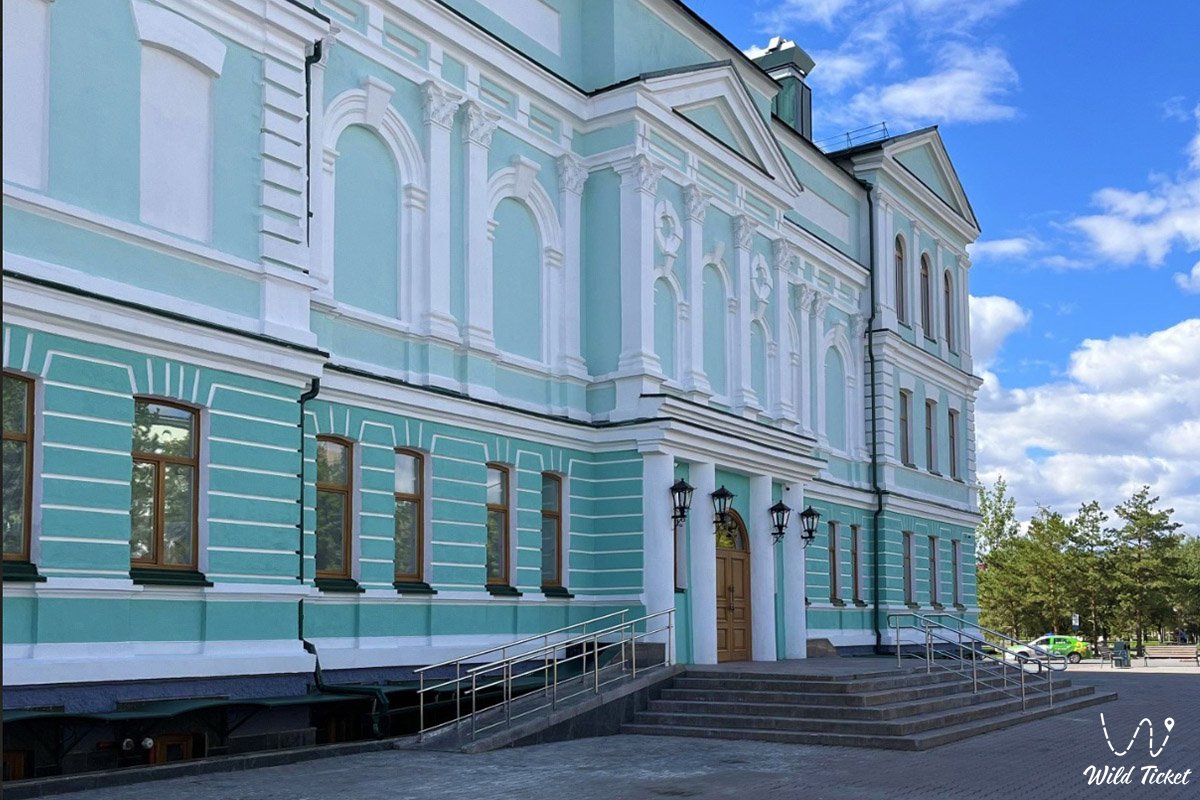
The Maxim Gorky Russian Drama Theatre is a unique architectural and spiritual site in the city of Astana. The building, which has a rich history, impresses with its beauty and grandeur: its classical merchant style stands out advantageously among the modern skyscrapers and business centers of the old center near the famous Astana Arbat and the Makhambet Utemisov Schoolchildren's Palace.
The construction of this unique center, founded at the end of the nineteenth century, was carried out with the support of the city council and local merchants, becoming a clear confirmation of care for developing the potential of cultural life in the republic, which is emphasized by its location near the majestic Monument to Khan Kenesary.
This complex serves as the main methodical and creative core of the city's theatrical system, coordinating important artistic projects. Through the functioning of such a legendary institution, an example of openness and respect for world and national dramatic traditions is demonstrated.
The light facades of the complex perfectly complement the historical appearance of the district. The building is located near the ancient Trading House of Merchant Matvey Kubrin, and its windows offer a view of the lively pedestrian zones that lead to the Ishim River Embankment. At this point of the right bank, two different eras harmoniously intertwine.
The building occupies a central place in the cultural landscape, being located in a convenient transport and pedestrian corridor near the picturesque Central Park and the ancient House of Merchant Vasily Kubrin. The historical heritage is carefully preserved here. The administration connects the theatrical center with the main walking areas. It naturally neighbors the nearby recreational spaces of the City Square, where every spectator can find their guiding star.
---------------------------------------------
How to get there and visit -
The State Academic Russian Drama Theatre named after M. Gorky is located at the address: 11 Zheltoksan Street, (the reception office also occupies house 13), right bank of the Ishim River, Saryarka district, Astana city, Republic of Kazakhstan.
GPS coordinates: 51°09'54"N 71°24'59"E
The transport accessibility of the site is ideal. Buses No. 9, 21, 25, 31 go to the nearest stop "T. Bigeldinov Street". You can also reach the stop "K. Munaitpasov Stadium" on routes No. 1, 17, 32, then walk along Kenesary Street and turn onto Zheltoksan Street.
Free parking zones are provided for drivers along Zheltoksan Street. Also, to get to the drama theatre, you can use taxi services via a special mobile application.
Ticket office opening hours: from Tuesday to Sunday from 10:00 to 21:00, lunch break from 14:00 to 15:00. Monday is a day off for the ticket office. The administration works on weekdays from 09:00 to 18:00.
Morning children's performances usually start at 11:00, and evening productions for adult audiences start at 18:30 or 19:00.
Contacts: ticket office +7 7172 57 23 75, management reception +7 7172 57 23 55.
Entrance to the square in front of the theatre is free. Reviewing the billboard is free of charge, and attending performances is done by tickets.
The cost of tickets for morning fairy tales is 600–700 tenge (premieres – 800 tenge), for evening performances – from 1000 to 1500 tenge (premiere screenings – 2000 tenge). For children under 3 years old, admission is free without providing a separate seat.
Official website of the theatre
The theatre's page on Instagram
---------------------------------------------
History
The history of the theatre's creation began in 1899, when in Akmolinsk, following an official statement from local lovers of dramatic art, the City Council allocated the first 100 rubles to create a permanent troupe. The famous merchant-patron Matvey Kubrin contributed the same amount, giving the residents of the provincial steppe town true freedom of choice in the world of art. The first performed representation was Fedorov's vaudeville "A Flash at the Domestic Hearth" and the joke "A Scandal in a Noble Family".
In the 1920s–1930s, active staffing was underway, and director T. Sergeeva taught the actors diction and art history. For a long time, the troupe roamed between the People's House, the Summer Theatre, and the closed Alexander Nevsky Cathedral, as their native building was occupied by city courts. Only in 1939 were the historical premises fully returned to the collective.
The theatre did not stop working during the years of the Great Patriotic War, when the troupe was replenished by evacuated masters and exiled actresses from the "ALZHIR" camp. K. Simonov's war plays "Wait for Me" and "Russian People" enjoyed popularity. In 1943, the Kazakh department opened, debuting with the play "Zharys" by G. Mustafin. In 1959, the theatre was named after the great Soviet writer Maxim Gorky, and in 2012, for its huge contribution to culture, the collective was awarded the high status of "Academic".
Over its century-long history, the theatre survived the eras of perestroika and the difficult 1990s, when, despite financial difficulties, the triumphant national productions "Khan Kene" and "Genghis Khan" were born. Today, this center is proud of a living success story that continues to open the way to friendship and creativity for the younger generation.
Information
The M. Gorky Theatre is an authoritative multifunctional cultural space combining historical heritage and bold artistic experiment. Within the structure of the complex, ideal conditions have been created for the intellectual, aesthetic, and spiritual growth of each visitor.
A wide choice of directions is available to spectators: ancient tragedies, Russian and foreign classics, psychological dramas, thrillers, comedies, and farces. The collective consists of 33 highly professional actors with huge creative potential, among whom are honored figures of Kazakhstan.
For the intellectual development of the public, a rich theatre museum is open, where old photographs, newspaper clippings, elements of the first decorations, and stage costumes of the great masters of past years (E. Orel, E. Marusina, S. Prilutskaya) are kept. The theatre actively cooperates with guest directors from Russia and Europe (J. Vaitkus, Y. Kvyatkovsky).
The collective is a member of the Association of Russian Theatres and was the first in Kazakhstan to be awarded the prestigious Kirill Lavrov Prize in St. Petersburg. The complex is fully equipped with modern materials, professional lighting and sound equipment to ensure a complete stage process.
Detailed description of the object
The creative infrastructure of the theatre includes specialized areas and halls:
• Main auditorium – a chamber, cozy space with 250 seats, consisting of 17 rows, which is decorated with graceful stucco molding and national ornament, where stage mastery is born.
• Main stage – a technically equipped platform in a two-story building with modern decorations, mechanisms, and a sound system for the implementation of any directorial ideas.
• Rehearsal core – specialized classrooms and halls located in the one-story wing of the building, intended for daily training and readings of new plays.
• Exhibition foyer and museum – spaces on the first and second floors where portraits of the troupe, archival materials, costumes, and a unique artistic stained-glass window above the grand staircase are presented.
• Administrative wing – management offices, accounting department, ticket office unit, and utility workshops (makeup, radio workshop, sewing workshops), ensuring clear coordination of all work.
Architecture
The architectural appearance of the Gorky Theatre represents a rare example of historical buildings for the capital, combining two periods. The first one-story red brick building was laid in 1899 in an elegant Pseudo-Russian style and was intended for merchant needs and a ticket office.
The second adjacent structure is two-story and is made in the strict traditions of Russian classicism with an elegant front facade. The city received a reliable, durable structure made of brick and granite, which harmoniously fitted into the panorama of the right bank, neighboring quiet squares and the embankment of the Ishim River.
Legend
Among the actors and devoted theatregoers lives an old legend about the "Guiding Star": they say that during the first historical performance in 1899, an invisible spark of inspiration lit up over the roof of the merchant building, and every artist who sincerely seeks their talent within these walls is sure to find their true calling.
Another legend is connected with the ancient stained-glass window on the stairs: they believe that if you make a wish between the morning and evening bells, looking at the play of light in the multi-colored glass, then the spirit of courage and honor of the great masters of the past will surely bring good luck and a creative voice to the young actor or sensitive spectator.
Conclusion
The M. Gorky Theatre is a bridge between the glorious past of Akmolinsk and the innovative future of Kazakhstan. A visit to this memorial center of creativity allows one to feel the spirit of continuity and care that surrounds the country's dramatic art.
Thanks to its location near the Monument to Khan Kenesary, the Astana Arbat, and the Central Park, the theatre remains the main landmark for family and cultural leisure on the right bank. Tourist routes invite everyone to come here to be inspired by the energy of youth and creation.
Interesting sights nearby:
• “Tree of Life” Fountain;
• Amphitheater on the Esil River;
• Zher-Ana Monument;
• Ataturk Park;
• Central Square;
• City Beach on the Esil River;
• Monument to Kerey and Zhanibek;
• Y. Rakhmadiyev Philharmonic.
Additional information:
• Information about Astana;
• Where to go and what to see in Astana;
• Akmola region - places for recreation.
Photogallery: