Unique sample of early medieval architecture and a symbol of female fidelity -
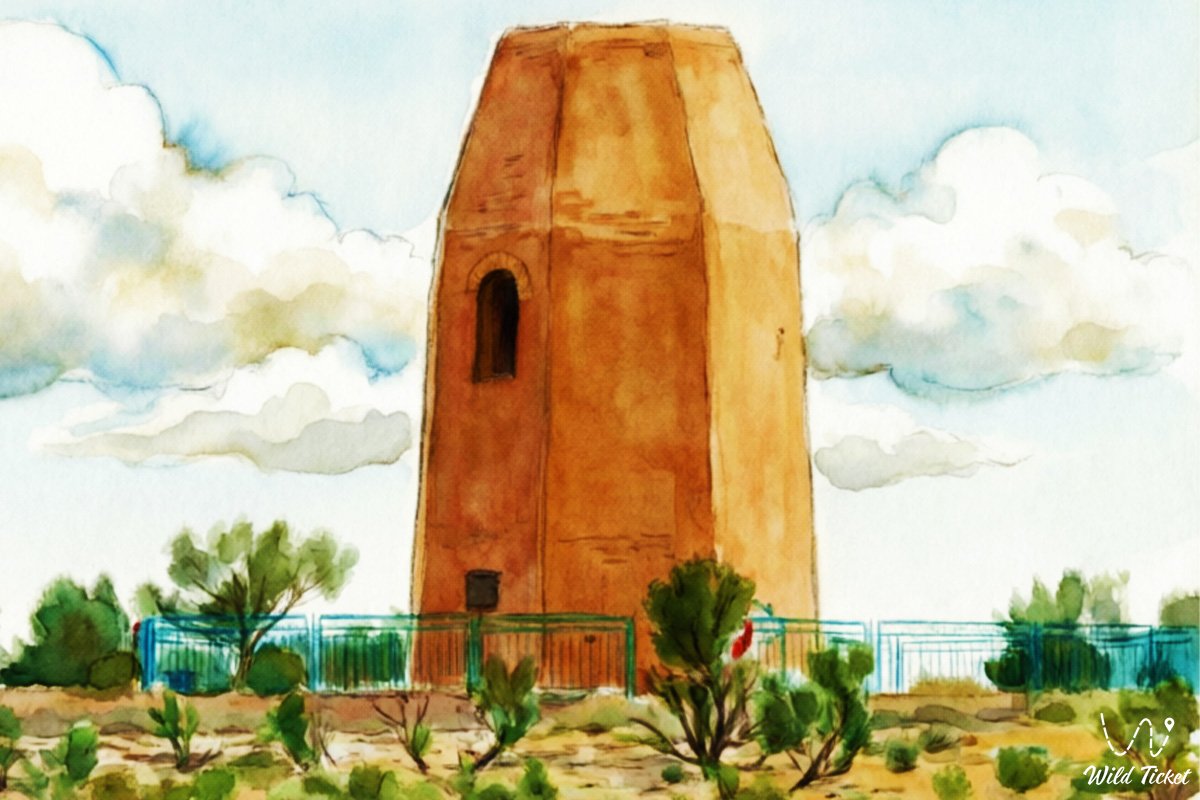
Begim-Ana Tower is an outstanding monument of architecture and one of the early examples of tower-mausoleums on the territory of Kazakhstan. This majestic octagonal structure in the Kyzylorda region dates back to the 11th century and is an object of national significance, symbolizing the rich pre-Islamic culture and unique building traditions of the lower reaches of the Syr Darya River.
The monument is located on a natural hill at an altitude of 68 meters above sea level, standing out sharply against the flat steppe landscape of the Aral region. The exact purpose of the tower still causes discussion among scientists: it cannot be called a classic mausoleum, since there is no burial inside.
According to the famous researcher Malgabar Mendikulov, the great height of the structure and the presence of a special platform under the dome definitely indicate the watchtower purpose of the object, although ritual functions were attached to it later.
Today, the Begim-Ana Tower is considered an essential point of pilgrimage, especially popular among women. There is a belief that if you go around the tower 12 times, your most cherished dream will come true. The surrounding territory attracts historians and travelers from all over the world, since such types of structures are unique for Kazakhstan and Central Asia (in the mouth of the Syr Darya there are only two similar towers – Uzun-tam and the Saraman-Kosa Tower), whereas monuments of this kind are more widely distributed in Iran and Turkey.
---------------------------------------------
How to get there and visit -
Begim-Ana Tower is located 5.1 kilometers northeast of the Zhuppike tract, 28.4 kilometers southeast of the Karateren village, and 21.7 kilometers northwest of the Zhanatalap village, Aral district, Kyzylorda region, Republic of Kazakhstan.
GPS coordinates: 45°45'32"N 61°13'46"E
The transport logistics of this secluded steppe area completely exclude urban public transport. No regular passenger buses or city taxi services operate to the monument. You can reach the medieval tower from the nearest settlements exclusively along well-trodden steppe roads and tracks.
Only a prepared four-wheel-drive SUV is suitable for a trip to the site, since dirt and sand paths in this part of the Aral steppe can be difficult to traverse after rare precipitation or heavily covered with sand during dust storms. Drivers must carry satellite navigators, a supply of drinking water, and reliable communication devices.
Opening hours: The territory around the monument is open for visits by travelers around the clock and all year round. Access to the adjacent zone is completely free; no ticket offices, paid checkpoints, tickets, or excursion fees are provided here.
Trips to this region are highly recommended to be planned for the spring period (April – May) or early autumn to avoid the extreme summer temperatures of the Aral region. All tent camps and overnight stay sites are organized by expedition groups independently in wild conditions, with mandatory adherence to the rules of respectful behavior on the territory of cult monuments.
---------------------------------------------
History
The history of this amazing monument goes deep into the centuries and is closely connected with the era of the existence of Oghuz cities. No reliable information about the history of construction and the author of the structure has been preserved, but in 1982, by decree of the Council of Ministers of the Kazakh SSR number 38, the Begim-Ana Tower was officially included in the list of historical and cultural monuments of republican significance and taken under state protection. The monument was studied in detail by specialized expeditions, including those under the leadership of A. O. Ospanov.
Over the long centuries of its existence, the upper part of the dome was destroyed by strong winds and rare but destructive precipitation. Since the main building material of the tower was unbaked raw brick, the walls gradually thinned.
To save this rarest specimen of pre-Islamic architecture, during the Soviet period, namely in 1984, a large-scale state restoration was carried out. The walls of the tower were reinforced and clad with durable fired brick, which made it possible to preserve the stability of the building against the harsh climate of the Aral region.
Information
The Begim-Ana Tower is organized as a monumental two-tiered engineering and memorial space with a diameter at the base of 16 meters, and the total height of the preserved part of the tower today is 10 meters. Excellent conditions are created here for conducting historical lectures and field archaeological workshops. The structure is an octagonal building, which, due to its intensive tapering upwards, is perceived as tall, stable, and majestic.
Historians and architects pay special attention to the unique design elements of the building: its internal plan is a perfect circle, and the walls are covered with adobe plaster. The entrance doorway is oriented strictly to the northeast. Tour organizers recommend that tourists move around the tower exclusively on foot, strictly forbid climbing the fragile ancient walls, and urge them to treat the vulnerable medieval masonry with care.
Detailed description of the venue
The well-thought-out infrastructure of the historical complex includes the following original locations and geographical features:
• Coastal elevation – a natural steppe hill 68 meters above sea level, chosen by ancient engineers for maximum visibility.
• Octagonal plinth – a massive stable base of the tower with a diameter of 16 meters, holding the entire vertical load.
• First tier – a blind lower monolith made of durable raw material, completely isolated and serving as a solid foundation for the building.
• Second tier – the upper inhabited chamber of the tower, which can be accessed through a doorway of lancet shape.
• Doorway – a rectangular or arched entrance to the second tier, oriented according to ancient canons to the northeast.
• Destroyed dome – the final upper part of the structure, under which a special watch platform was previously located.
Architecture
The architectural solution of the Begim-Ana Tower was based on the authentic principles of fortification and memorial architecture of the Aral tribes of the late first millennium AD. The main volume of the walls is built of massive raw mudbrick, and the outer side is completely clad with square fired brick with dimensions of 23x23x5 cm on a durable clay mortar.
The highlight of this medieval engineering was the intensive tapering of the structure upwards at an angle, which made it possible to minimize wind load. During the modern restoration works of 1984, specialists applied durable ceramic brick to protect the base from the destructive effects of salts, preserving the harsh appearance of the ancient era.
Legend
A beautiful and sad legend about the origin of the tower is passed down from generation to generation among the residents of the Kyzylorda region. The ruler of the city of Zhankent, Sanzhar Khan, fell in love with the beautiful Begim, the daughter of the famous batyr Karabura. After the wedding, the khan became very jealous.
Once while hunting, he remembered that he had forgotten his armor and sent a batyr to the palace, where he saw Begim with an open face and fell unconscious from her beauty. Deciding that his wife had cheated on him, the furious Sanzhar Khan cut off Begim's hand, cut her braids, and exiled her into the steppe, where she took refuge in a tower by the Aral Sea. Following the prayers of her father Karabura, the girl's hand and braids grew back in a single night, proving her purity, but she did not return to her husband.
There is another version, recorded in 1867 by the artist Vasily Vereshchagin. According to it, the khan suspected his wife of infidelity and decided to kill her, but his father-in-law, who was a powerful sorcerer (baksy), sent snakes upon Zhankent that devoured the khan and all his subjects, after which Begim built this tower and lived there for the rest of her days.
Conclusion
The Begim-Ana Tower is a magnificent historical bridge connecting the semi-legendary events of the medieval period with the modern scientific and tourist life of the Kyzylorda region. A visit to this landscape monument allows guests of the Aral region to touch the origins of the birth of memorial culture on the Syr Darya and appreciate the striking durability of medieval buildings.
The tower remains an essential reference point for historical, local history, pilgrimage, and adventure tourism in the Aral district. Expedition routes invariably include this ancient point in their guidebooks, giving everyone the opportunity to personally see the silent guardian of great steppe history.
Interesting sights nearby:
• Tolybay Batyr Mausoleum;
• Beketay Mausoleum;
• Kokaral Dam;
• Northern Aral Sea (Small Aral);
• The city of Kazalinsk;
• Ayteke Bi village;
• Barsakelmes Nature Reserve.
Photogallery: