Senek Village
Historical oasis of Mangystau on the border of golden sands and ancient caravan routes –
Senek village (Kaz. Senek) represents an authentic settlement and administrative center of the Senek rural district in the Karakiyan district of the Mangystau region, founded over half a century ago. The settlement, with a population of just over two thousand people, is snugly nestled 30 kilometers east of the village of Kyzylsay at the foot of the Ustyurt Plateau.
This place possesses a unique geographical color: on one side, snow-white chalk chinks and the sparse greenery of an oasis approach the residential streets, while on the other rises a true sandy desert – the Tuyesu massif (Senek sands), whose golden barchans stretch to the horizon, evoking the landscapes of the Sahara.
The primary historical and cultural pride of the village is the ancient 19th–20th-century Senek necropolis located one kilometer to the east, standing on the ancient trade route to Khwarazm. This memorial complex is recognized as a monument of republican significance and includes the unsurpassed domed Nurbergen Kalyshev mausoleum, built in 1900 by renowned masters of folk architecture Dutbay Zhandauletov and Nurniyaz Izbasarov.
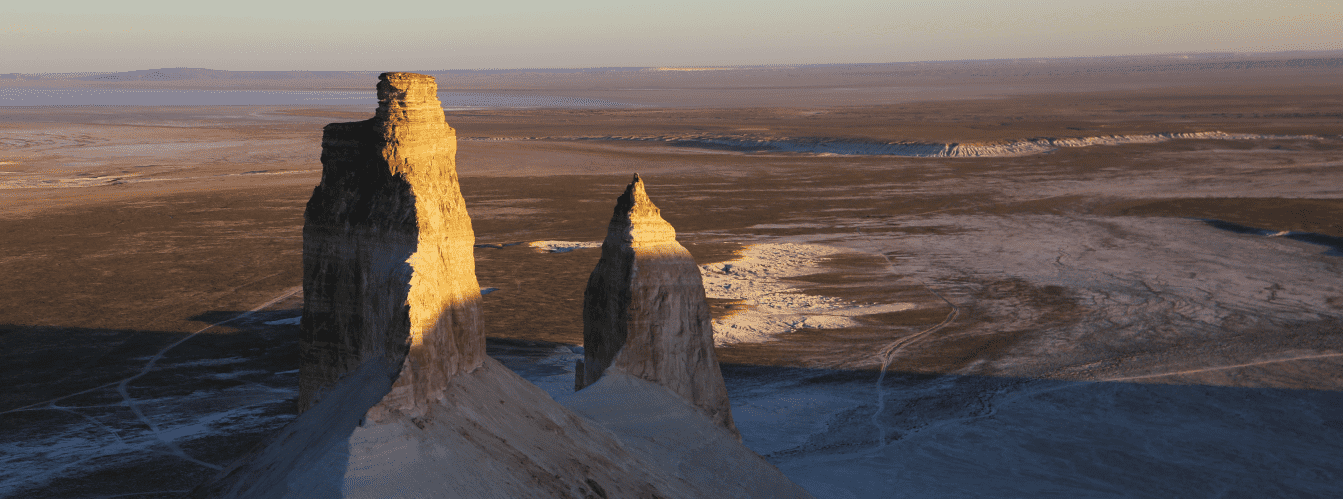
A visit to the village of Senek serves as a natural gateway and a key connecting hub for journeys across the iconic sights of Mangyshlak: from here, direct routes open to the sacred rock-hewn Shopan-Ata underground mosque, the striped pyramid mountain Bokty, the multi-colored layered hills of the Kyzylkup tract ("Tiramisu"), the Martian cliffs of the Bozzhira tract, and the sacred Beket-Ata pilgrimage complex in Oglandy.
For decades, the shifting sands of Tuyesu attempted to engulf residential buildings, making the village a symbol of humanity's steadfast struggle against the desert. Today, Senek attracts travelers with the opportunity to see sandy ridges rare for clay Mangystau, feel the atmosphere of a caravan oasis, and touch masterpieces of traditional stone carving.
--------------------------------------------
How to get there and visit –
Senek village is located approximately 195–200 kilometers southeast of the regional center – the city of Aktau (about 2.5 hours en route), and 50 kilometers east of the city of Zhanaozen. The location of the settlement allows it to be conveniently incorporated into a large loop route across the region: through Senek, tourists travel to the Fangs of Bozzhira, then proceed eastward past Mount Borly-Tau in the Karynzharyk depression and Mount Shomanay.
GPS geographical coordinates: 43°21'56"N 53°23'15"E
The route from Aktau runs south along the A-33 highway through the industrial city of Zhanaozen, continuing toward the village of Kyzylsay and Senek. The road surface approaching the village consists of old asphalt with potholes and gravel sections; therefore, an off-road vehicle is preferable for a comfortable trip.
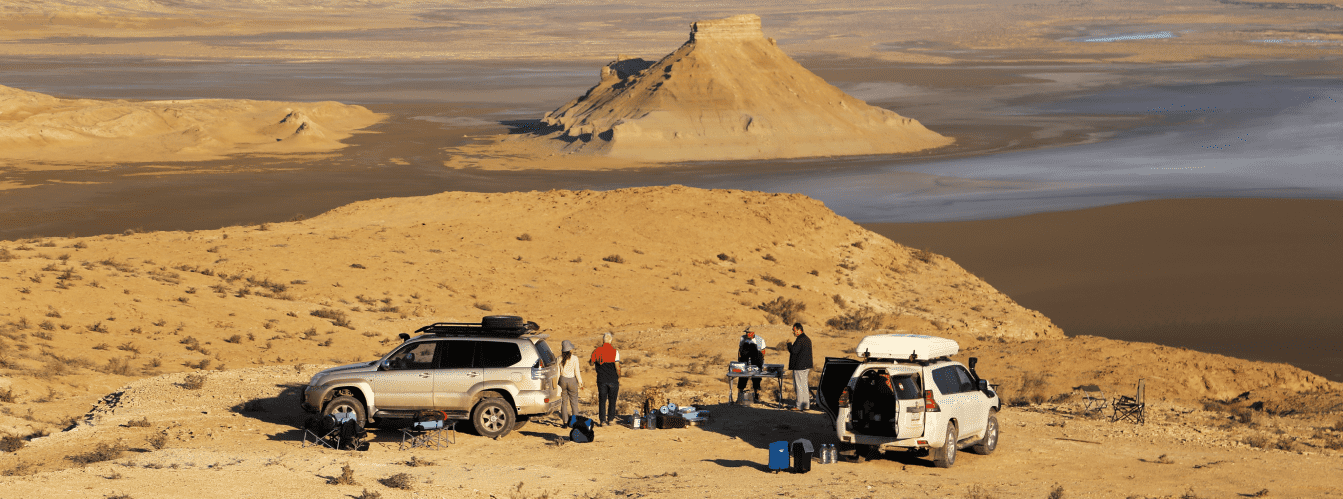
If plans include driving directly onto the Tuyesu barchans, touring the necropolis, or making a long run to the chinks of Bozzhira, a frame-based four-wheel-drive off-road vehicle (4x4) with good ground clearance is required.
For safe driving across the loose sandy massif, it is necessary to lower tire pressure to 0.8–1.0 atmospheres, and carry an air compressor, a dynamic tow strap, and a shovel. Venturing alone off established dirt tracks deep into the barchans is strongly discouraged: fine shifting sand is treacherous, and the wheels of heavy vehicles bog down instantly.
In the village of Senek itself, there is a rural outpatient clinic, a community center, a couple of small grocery shops, and a network of water standpipes fed from underground artesian wells. Cellular reception in the village is stable, but disappears completely among the sandy ridges of Tuyesu.
The optimal time to visit is spring (from mid-April through May, early June) and warm autumn (late August, September – October). In July and August, the sand on the barchans heats up above +60 °C in the sun, and strong midday winds cause sandstorms. Overnight stays are possible in tents within barchan hollows sheltered from the wind or by returning to hotels in Zhanaozen.
--------------------------------------------
History
The historical development of the Senek locality was determined by the passage of an ancient northern branch of the Great Silk Road connecting the lower reaches of the Volga and the shores of the Caspian Sea with the cities of the Khwarazm oasis. In this arid zone at the foot of Ustyurt, travelers found precious springs and wells with clean fresh water.
In the 18th–19th centuries, Senek became a traditional wintering ground and gathering site for nomadic camps of the Aday clan. During this era, the Senek burial complex formed on the old caravan route east of the campsite. Local masters created an exceptional school of steppe memorial architecture here. The primary monument of the necropolis – the majestic mausoleum of the bai Nurbergen Kalyshev – was erected in 1900 by renowned architects Dutbay Zhandauletov and Nurniyaz Izbasarov.
The modern settlement of Senek was officially founded over 50 years ago as the livestock-breeding center of the district. In 1965, hydrogeologists discovered a colossal deposit of the purest artesian water beneath the barchans of the Tuyesu massif, which played a key role in the water supply of the Uzen oil fields and the growing city of Zhanaozen.
In the late 20th and early 21st centuries, the village faced a serious ecological disaster: cutting down shrubs for firewood and intensive livestock overgrazing destroyed the fragile sod layer, transforming the Tuyesu sands into "drifting" sands. Sand dunes began rapidly encroaching on residential structures, burying yards and gardens.
State measures to rescue the settlement began in 2005 alongside neighboring villages Ushtagan and Tushchyqudyq: mechanical barriers were erected along the perimeter of the barchans, protective shelterbelts of shrubs were planted, and slopes were stabilized with grasses, which succeeded in halting sand migration.
Information
The Tuyesu sand massif (Senek sands) represents an aeolian landscape rare for the Ustyurt Plateau. The north-south length of the sand massif is about 8 kilometers, while its width varies from 6–8 to 11 kilometers. The height of the barchan ridges increases from south to north: in the southern part, ridge heights are 10–12 meters, while in the north they reach 15–20 meters.
The sands impress with their purity and regular aeolian ripple marks sculpted by steppe winds. Sand grains in the central part are of medium fraction; gravelly hill outcrops and deep endorheic deflation basins occur in places.
The Senek necropolis consists of two distinct memorial sections:
• The first section (area of 1.5 ha) includes 3 domed tombs, 31 rectangular saganatam enclosures, as well as carved kulpytas stelae and sculptural koytas gravestones with depictions of argali sheep.
• The second section (area of 1 ha) contains 2 domed mausoleums and about 20 saganatams and kulpytases.
A deep aquifer of fresh artesian waters lies beneath the sands, supplying a pipeline into the settlement with strong water pressure that contrasts sharply with the desert environment.
The climate of the area is sharply continental, semi-desert. Annual atmospheric precipitation does not exceed 130 mm. In summer, air temperatures hover at +38...+43 °C, while in winter strong piercing winds are frequent at temperatures down to -20 °C.
Detailed description of the venue
The cultural and landscape ensemble of Senek village includes the following key attractions:
• Tuyesu Barchans (Senek sands) – a grandiose massif of pristine golden dunes up to 20 meters high featuring graceful crests and undulating wind-blown ripples.
• Nurbergen Kalyshev Mausoleum (1900) – the central masterpiece of the Senek necropolis, a centric domed tomb made of white coquina limestone with exquisite polychrome carving and oriental ornamentation by masters Dutbay and Nurniyaz.
• Saganatam Ensemble of the Senek Necropolis – stone rectangular unroofed enclosures decorated with geometric patterns, tamgas, and Arabic script.
• Protective Sand Fences – a complex of mechanical shields, mesh screens, and protective saxaul plantations on the outskirts of the village containing the dune onslaught.
• Active Artesian Boreholes – hydraulic engineering installations amid the sands pumping water from the depths of the Tuyesu stratum for the needs of the settlement.
• Observation Points on the Barchans – dune crests at sunset offering a contrasting vista: a golden desert on one side and white chink cliffs with village houses on the other.
Flora and fauna
Vegetation in the vicinity of Senek village is adapted to the arid climate and divided into flora of the sands and the clay plain. Shifting barchans are stabilized by psammophytic shrubs: black and white saxaul, dzhuzgun (kandym), sand acacia, tamarisk (saltcedar), and Carex physodes. Artificial shelterbelts contain wormwood stands and protective grasses holding tons of sand with their root systems.
In spring, the plains and foothills briefly turn green with ephemerals: desert poppies, irises, and small grasses bloom, withering away by early summer.
The animal kingdom of the desert is surprisingly rich, though the barchans seem completely desolate during the day. Herds of domesticated two-humped camels (Bactrians) graze everywhere in the village and on pastures. At dawn, the entire surface of the dunes is covered with tracks of nocturnal inhabitants.
A unique dweller of the sands is the plate-tailed gecko (skink gecko), an entirely harmless nocturnal lizard; if a flashlight is shone at eye level in the dark, its eyes reflect light with bright whitish glints. By day, sand toad-headed agamas, steppe agamas, and rapid fringe-toed lizards constantly dart underfoot.
Mammals include the long-eared hedgehog, tolai hare, gerbils, and jerboas. Among predators, the corsac fox and steppe polecat hunt in saxaul thickets. Steppe eagles, long-legged buzzards, and desert shrikes soar in the sky.
Legend
An ancient Kazakh legend about a lost golden ark and the eternal wind is linked to the sands of Senek. Lore recounts that in immemorial times, an exceptionally wealthy caravan carrying the treasures of great khans passed through the oasis. The caravaneers broke the steppe law of hospitality and refused a sip of water to a tired hermit elder, splashing water from their skins onto the parched ground.
The elder raised his hands to heaven, and at that very instant the steppe trembled with the wrath of spirits. The sky darkened, and a sand vortex of unprecedented power arose, raging for seven days. When the wind subsided, colossal golden barchans had grown on the campsite, burying the caravan and its gold forever. Nomads believed that the Tuyesu massif (Kaz. Tuyesu – "camel water") hides countless riches, and that the drifting dunes attempting to cover Senek are an eternal reminder to humanity that water in the desert is more precious than any gold, and the laws of mercy are inviolable.
Conclusion
Senek village is a remarkable site in the Mangystau region, where the pristine golden desert of Tuyesu, the majesty of ancient stone architecture, and humanity's courageous defense of its home have interwoven into a single harmonious knot. The contrast between the white chalk cliffs of the chink and the sandy waves of the barchans leaves vivid impressions in the heart of every traveler.
A visit to Senek serves as an excellent starting point before venturing into the wild expanses of Ustyurt, opening the way to sacred mosques, stratified hills, and the fantastic chalk canyons of Bozzhira.
Interesting sights nearby:
• Ustyurt State Nature Reserve;
• Fort Shevchenko;
• Karagiye Depression;
• Mount Otpan-Tau and Aday-Ata Monument;
• Shomanay Mountains;
• Akespe Tract on Mangyshlak;
• Mount Sherkala;
• Shatkal Canyon;
• Mount Shokytau;
• Silicon Valley in Mangistau;
• Mount Ushkirtaw;
• Utebay Tract;
• Kokala Tract;
• Kenderli Steppe Salt Marsh.