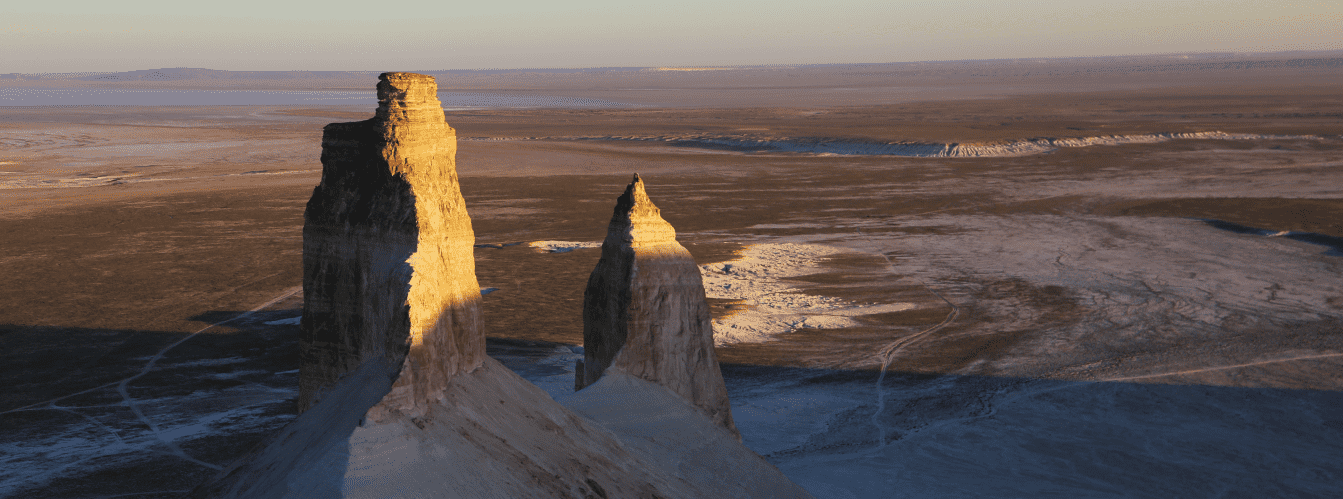
Tolegen-Aulie underground mosque is a unique monument of rock-cut cave religious architecture of the 17th–19th centuries, hewn into the bedrock massif of western Kazakhstan. The sanctuary is situated in the Mangystau district, occupying the northern rim of a chink in the renowned Torysh tract, famous for its fields of giant spherical concretions, within the northwestern spurs of the Western Karatau ridge.
The monument is administered by the Mangystau State Historical and Cultural Reserve and is venerated among pilgrims as a blessed sanctuary of secluded prayer, spiritual healing, and remembrance of the regional Sufi masters.
The hermitage owes its origin to the venerated Islamic ascetic Ishan Tolegen (Tyulegen), who preached Sufi values among the nomad camps of the peninsula. According to folk traditions, the holy hermit chose the difficult-to-reach slope of the Taszhol (Tash-yuly) tract for secluded spiritual contemplation (khilwat).
The architectural design of the mosque is remarkably harmonious: it is hewn into the sandy-marl strata of Mangystau at an elevation of 123 meters above sea level and comprises a single prayer hall measuring 2.96 × 2.47 meters. The interior space is skillfully stylized after the framework of a traditional Kazakh yurt: the lower sections of the walls are vertical and taper smoothly upward, forming a pronounced trapezoid that culminates in a spherical dome carved with a relief representation of the shanyrak – the crown wheel of a yurt.
An elegant protruding cornice is carved along the perimeter of the walls, while the center of the northern wall features a prayer niche (mihrab) measuring 82 × 47 cm, housing an ancient portable lamp (shyrak) skillfully carved from a single block of sandstone by medieval craftsmen. The entrance to the mosque is framed by a pointed arch 1.10 m in height with a rock wall thickness of 0.9 m. Lapidary Arabic-script epitaphs and memorial inscriptions are preserved on the portal and the walls of the hall.
The earliest scientific topographical record of the monument was made in 1900 by the surveyor Gaspar Nasibyants, who documented a cave with painted vaults at the foot of the rock cliff and a sacred pole (tu) set at the entrance crowned with an iron hand – an ancient Sufi and nomadic symbol of the divine hand and spiritual protection. In recent times, significant contributions toward locating and describing the sanctuary were made by the veteran of war and labor Kylysh Otetiluov.
--------------------------------------------
How to get there and visit –
Tolegen-Aulie underground mosque is located in the northern part of the Mangystau district along the chink of the Torysh tract in the Mangistau Region (Taszhol area, northwestern spurs of the Western Karatau). The distance from the regional administrative center of the city of Aktau is approximately 115–120 km to the northeast (via motor roads); 20.2 km east-southeast of Taushyk settlement; 15.8 km northwest of Zhangyldy village; and about 20 km northwest of Shaiyr (Shair) village via steppe tracks.
GPS geographic coordinates of Tolegen-Aulie mosque:
44°19'20"N 51°36'08"E
44.322222, 51.602222
Route from Aktau: departure from the city heads north along the paved highway toward Taushyk settlement (about 95–100 km of asphalt). Passing Taushyk, the route turns east onto well-worn steppe graded tracks and unpaved country roads that cross the plateau toward the Torysh tract (Valley of Ball Concretions) and the spurs of the Taszhol ridge. The final section follows a rough clay-and-gravel track along the chink up to the rock terrace. Total driving time from Aktau takes about 2–2.5 hours.
Alternative route: travel is also possible through the district center of Shetpe to the village of Shaiyr, where a 20-kilometer unpaved dirt road leads northwest across the Karatau mountains toward the foot of the chink.
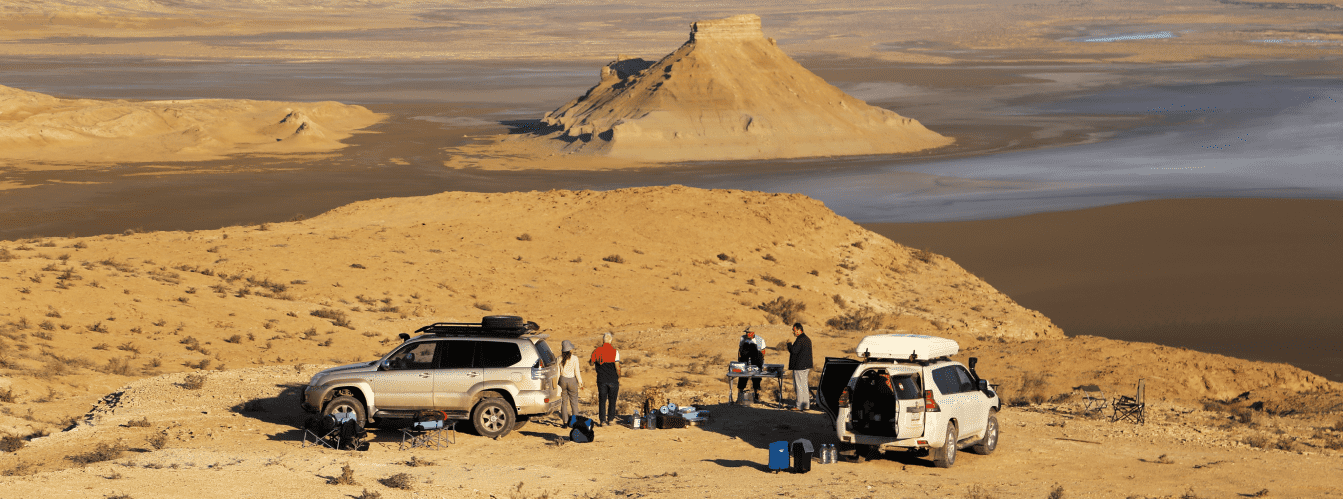
Vehicle requirements: access to the Tolegen-Aulie mosque involves off-road terrain, rocky washouts, and clay slopes of the Karatau foothills. For a safe and comfortable trip, a high-clearance vehicle – a crossover or a body-on-frame 4x4 off-road vehicle – is strongly recommended. During the dry summer season, an experienced driver can reach the base of the chink in a standard passenger car with careful handling; however, during spring snowmelts or autumn rainstorms, the softened marl clays become impassable for two-wheel-drive vehicles.
Pilgrimage etiquette (ziyarat) and visiting rules:
Tolegen-Aulie mosque is a venerated sacred site requiring respectful conduct:
– visitor attire must observe spiritual customs: men are prohibited from entering in short shorts or sleeveless shirts; women must wear a headscarf, cover their shoulders, and wear a long dress or skirt below the knees;
– outdoor shoes must be completely removed before stepping across the threshold of the low arched doorway (the floor of the cell is lined with prayer felts and carpets);
– the entrance opening is only 110 cm high, so visitors should enter with a respectful, low bow, exercising caution to avoid striking the stone ceiling;
– complete prayerful silence must be maintained inside the rock cell; loud speech, laughter, phone calls, and smoking are strictly forbidden;
– carving names, graffiti, or scratches into the soft sandy-marl walls, cornices, and the mihrab is strictly forbidden;
– touching or moving the ancient sandstone oil lamp in the northern niche is prohibited;
– all personal litter must be taken away to preserve the pristine state of the sacred tract.
Infrastructure: the monument is set within the untouched wilderness of the Torysh tract. There are no on-site caretakers or permanent guest facilities at the cave. Full tourism infrastructure, lodging in felt yurts, meals, and fresh drinking water supplies are available at the Kogez ethno-village (approximately 25–30 km to the east).
Gas stations, general stores, tire repair shops, and pharmacies are situated in the settlements of Taushyk (20 km), Shaiyr (20 km), and Shetpe (about 45 km). Cellular coverage along the elevated chinks is erratic, while inside the rock chamber mobile signals are completely blocked by the marl formation.
Seasonality: visits to the mosque are possible throughout the year. The best periods for pilgrimage and sightseeing are spring (April – May), when the Torysh tract is in bloom, and autumn (September – October), when the severe steppe heat subsides. In July and August, outdoor temperatures on the plateau reach above +38...+40 °C, yet a steady, refreshing cool (+15...+17 °C) is maintained within the cave mosque. The viewing terrace by the entrance offers panoramic vistas over the open expanses of the Torysh tract.
--------------------------------------------
History
The history of the excavation and religious life of the Tolegen-Aulie underground mosque is woven into the centuries-long spread of Sufism and the development of sacred landmarks among the nomadic clans of Mangyshlak.
Geomorphologically, the rock sanctuary emerged during the 17th–18th centuries. Throughout this era, the foothills of Western Karatau and the plateau surfaces of the Torysh valley served as traditional nomadic migration corridors and wintering pastures for Oghuz-Turkmen and later Kazakh clans of the Junior Zhuz. The workable yet stable sandy-marl strata of the Taszhol chink, deposited tens of millions of years ago in the sedimentary basin of the ancient Tethys Ocean, provided an ideal material for manual excavation of durable underground chambers.
Spiritual tradition attributes the creation of the sanctuary to the Sufi teacher Tolegen (Ishan Tyulegen). Choosing the sheer edge of the chink for ascetic isolation (khilwat), the holy teacher carved a prayer room out of the rock by hand, giving its vaults the sacred form of a nomadic yurt. The mosque served not only for nighttime vigils and the ishan's personal devotions, but also as a spiritual school (madrasa) for local pastoralists, where nomads were taught literacy, Quranic reading, and Islamic ethics. Following the passing of the holy ascetic, his tomb within or directly adjacent to the cave became an object of veneration, and the tract itself was recognized as an aulie (sacred ground).
History of scientific research:
The first documented account of the site dates to 1900. Russian military explorer and surveyor Gaspar Nasibyants recorded the location during a cartographic reconnaissance of the Taszhol area:
"At the very foot of Tash-yuly lies a cave measuring three square arshins. The walls and ceiling of this cave are decorated with multicolored paints; at its entrance stands a pole with an attached iron hand. This is the tomb of Ishan Tyulegen."
The presence of an iron palm (panja / hand of Fatima) on the pole at the entrance confirms the sanctuary's connection to Sufi tradition, where the open palm signifies the five pillars of faith, justice, and divine protection over the righteous. Traces of polychrome painting on the ceiling pointed to the refined aesthetic skill of its builders.
During the Soviet era, the monument was overlooked by official academia, remaining preserved through the reverence of local elders. A significant contribution to its re-documentation, measurement, and initial regional historical description was made by the war and labor veteran Kylysh Otetiluov.
Protected status:
Pursuant to Resolution No. 35 of the Akimat of the Mangistau Region in 2005 (formally reaffirmed in 2006), the Tolegen-Aulie underground mosque was registered under state protection and added to the State List of Historical and Cultural Monuments of Local Significance under the auspices of the Mangystau State Historical and Cultural Reserve.
Information
Architecturally and structurally, Tolegen-Aulie mosque is a single-chamber artificial cave temple carved into a solid stratum of dense Upper Cretaceous marl and sandstone at an elevation of 123 meters above sea level.
Morphometric and structural parameters of the complex:
– absolute elevation above sea level: 123 m;
– excavation depth: solid stratum of the Taszhol chink;
– ground plan configuration: regular rectangle with trapezoidal upward tapering;
– chamber dimensions: length 2.96 m, width 2.47 m;
– portal rock wall thickness: 0.9 m;
– entrance doorway dimensions: height 1.10 m, width 1.20 m, terminating in a low-rise arch;
– ceiling structure: stepped-corbelled vault reproducing the dome of a Kazakh yurt;
– interior architectural decoration: relief cornice along the upper edge of the walls; carved ceiling rosette at the apex depicting a shanyrak;
– spatial orientation: entrance faces south; mihrab is cut into the center of the opposite northern wall;
– mihrab niche dimensions: height 82 cm, width 47 cm (proportioned for a single kneeling worshipper);
– relics: an ancient stationary oil lamp (shyrak) carved from a solid sandstone block, preserved on the shelf of the mihrab niche;
– epigraphy: fragments of carved Arabic inscriptions on the northern jamb of the entrance portal and on interior wall faces.
Architectural concept of the "rock-cut yurt":
The primary artistic feature of the Tolegen-Aulie interior is the deliberate departure from rigid rectangular cave geometry in favor of nomadic architecture. The inward inclination of the walls toward the ceiling creates the spatial impression of a felt yurt dome, enhancing the natural acoustic resonance during Quranic recitation while conveying an enduring sense of shelter.
Detailed site description
The architectural ensemble of the Tolegen-Aulie underground mosque includes the following structural components, engineering elements, and sacred features:
• Arched entrance portal – a low rock doorway (1.10 × 1.20 m) with a vaulted head, cut through a 0.9 m thick rock wall and oriented south.
• Prayer hall (2.96 × 2.47 m) – a rectangular subterranean room with trapezoidal tapering walls, carpeted with traditional felt mats.
• Yurt-shaped vaulted dome – a stone ceiling with softened facets that replicates the interior dome of a nomadic dwelling.
• Carved stone shanyrak – a circular relief medallion carved at the center of the domed ceiling, symbolizing the hearth, cosmic unity, and the sun.
• Perimeter projecting cornice – a horizontal stone band separating the inclined planes of the walls from the vaulted dome.
• Northern prayer niche (mihrab) – an arched recess measuring 82 × 47 cm in the northern wall, crafted for solitary kneeling prayer by the imam.
• Ancient sandstone lamp – a monolithic oil bowl (shyrak) dating to the 17th–18th centuries, preserved on the shelf of the mihrab niche.
• Arabic wall epigraphy – carved Quranic passages, devotional blessings, and names of historical pilgrims inscribed into the marl rock.
• Historical site of the sacred pole (tu) – the forecourt by the entrance where surveyor Nasibyants documented a ritual pole bearing an iron hand in 1900.
• Taszhol chink lookout platform – a natural stone terrace above the doorway that commands panoramic views across the Torysh tract.
Legends
Folk legends shared by elders of the surrounding villages remain associated with the name of Saint Ishan Tolegen and his cave hermitage.
The Legend of the Iron Hand of Ishan Tolegen:
An ancient tradition relates that Ishan Tolegen possessed the gift of spiritual foresight and defended the poor against the oppression of local bais. When nomads sought his counsel to resolve disputes, the elder would raise his right hand, inspiring mutual reconciliation and quelling hostility. Before departing this life, the ishan instructed that a pole bearing a forged open iron palm (panja) be erected at the entrance of his carved sanctuary. It was believed that as long as this iron hand rose above the Taszhol chink, the Torysh tract would remain protected from winter livestock starvation (zhut), raids, and pestilence. Passing travelers would halt their horses, touch the pole, and ask for a blessing on their journey.
The Tale of the Stone Yurt for Celestial Wayfarers:
Another narrative explains why the cave mosque was sculpted in the likeness of a yurt with a shanyrak. When Saint Tolegen began chiseling the stone, his disciples asked: "Master, why do you not make the walls straight, like the palaces of Khiva?" The ishan replied: "A nomad is born in a yurt, lives beneath the shanyrak, and stands before the Creator as a free child of the steppe. A prayer offered from a stone yurt ascends straight toward the vault of the heavens through the stone shanyrak, unobstructed by earthly pride." Local lore maintained that during the spring equinox, the morning sunbeams shine through the entrance directly onto the stone lamp inside the mihrab, symbolically rekindling the spiritual fire of faith.
The Tradition of the Healing Lamp:
Local inhabitants recount that the sandstone lamp inside the mihrab niche holds a healing blessing (barakah). In earlier times, pilgrims would pour a drop of pure sesame oil into the vessel, light the wick, and draw their palms through the fragrant smoke, gently touching their eyes and aching joints. Sincere prayer offered beside the lamp of Saint Tolegen was believed to bring relief from chronic ailments and restore inner peace.
--------------------------------------------
Conclusion
Tolegen-Aulie underground mosque stands as a striking testament to the union of nomadic worldviews, Sufi asceticism, and vernacular architecture in Mangystau. Sculpting bedrock into the symbolic form of a yurt with a shanyrak highlights the original ingenuity of steppe builders. Visiting this secluded hermitage on the edge of the Taszhol chink provides pilgrims and travelers with pristine tranquility, bringing together the geologic wonder of the Torysh tract and the spiritual heritage of this ancient land.
Nearby attractions:
• Torysh tract (Valley of Ball Concretions);
• Western Karatau mountain ridge;
• Taushyk settlement;
• Kogez ethno-village with traditional yurts;
• Isolated Mount Sherkala residual butte;
• Relict oasis of the Akmysh tract;
• Medieval fortified town of Kyzylkala;
• Airakty-Shomanai mountains (Valley of Castles);
• Otpan-Tau historical and cultural complex with the Aday-Ata memorial;
• City of Aktau;
• Caspian Sea;
• Kapamsay chalk canyon;
• Usak tract;
• Koshak bay;
• Sarytash bay;
• Taszhol rock massif and pass;
• Shaiyr village;
• Zhangyldy settlement.
Pilgrimage sites in Mangyshlak:
• Beket-Ata underground mosque;
• Shopan-Ata underground mosque;
• Shopan-Ata necropolis;
• Karaman-Ata underground mosque;
• Karaman-Ata necropolis;
• Sisem-Ata necropolis on the Ustyurt plateau;
• Shakpak-Ata rock-cut mosque;
• Shakpak-Ata necropolis;
• Sultan-Epe underground mosque;
• Temir-Abdal underground mosque;
• Zhaman-Sauran underground mosque;
• Masat-Ata underground mosque;
• Masat-Ata necropolis;
• Sonabay underground mosque;
• Uytoly-Ata underground mosque;
• Kenty-Baba necropolis;
• Koshkar-Ata necropolis;
• Bayte sanctuary;
• Kolbas Ishan mosque.
Photogallery: