Ancient Retreat of Yasawi's Disciples with Secret Galleries and Lightwells –
Sultan-Epe Underground Mosque (historically also known as Sultan-Upi or Sultan Khubbi) represents an outstanding monument of rock-hewn sacred architecture from the 9th–13th centuries, a spiritual hub of Sufism, and a national sanctuary located in the Tupkaragan District of Kazakhstan. Hundreds of millions of years ago, this entire territory constituted the bed of the colossal prehistoric Tethys Ocean.
In the warm, shallow bays of the ancient sea, biogenic carbonate sediments—mollusk shells, sea organism carapaces, and calcareous muds—accumulated continuously. During the Cenozoic era, these deposits were compacted into thick, easily carved strata of Pontian and Sarmatian shell limestone intercalated with marly clays. When the waters of the ancient ocean permanently retreated, natural erosional processes combined with the craftsmanship of Sufi stonemasons to sculpt this natural rock fissure into a grand subterranean sanctuary complete with prayer chambers, cells, and skylights.
The shrine is dedicated to the legendary saint Sultan-Epe, son of the prominent mystic poet Hakim-Ata (Suleiman Bakirgani) and a devoted murid of the renowned Sufi sheikh Khoja Ahmed Yasawi. In regional tradition, Sultan-Epe is venerated as the ruler of water, a miracle worker, patron of fishermen, and protector of all who face peril or shipwreck across the Caspian Sea.
In 1982, the religious and memorial complex was placed under state protection, and in 2026, at the 48th session of the UNESCO World Heritage Committee, the Sultan-Epe Underground Mosque was inscribed on the World Heritage List as part of the serial property "Rock-hewn Mosques and Associated Sacred Sites of Mangystau."
Within the expeditionary and pilgrimage itineraries of Mangyshlak, the Sultan-Epe complex stands as an essential spiritual landmark of the Tupkaragan Peninsula, set at an altitude of 158 m above sea level just 4–4.5 km from the shores of Mangyshlak Bay.
The mosque lies approximately 149 km northwest of the regional center of Aktau, 57–60 km northeast of the museum town of Fort-Shevchenko, and 30 km from the settlement of Tauchik.
The site is intrinsically connected with key historical and natural wonders of the peninsula: it crowns the upper head of the five-kilometer green Sultan-Epe Canyon, fed by its freshwater brook and tugay thickets. Just 25–30 km to the west lies the massive Zhygylgan collapse with its fossilized footprints of Neogene sabertooth cats. Nearby lie Kapamsay Canyon with its relict woodland, Shakpaktysay Canyon with the famous rock-cut Shakpak-Ata Mosque, Kokbulaksay and Tamshaly canyons, the ancient necropolises of Kenty-Baba, Ushtam, and Karakoz, the mausoleums of Akshora and Beltoran, as well as the broad beaches of Sarytash Bay.
One-day tour to the Sultan-epe Mosque from Aktau
--------------------------------------------
How to Get There and Visit –
The underground mosque and necropolis of Sultan-Epe are located in the Tupkaragan District of the Mangistau Region, on the northeastern side of the Tupkaragan Peninsula, atop the western rim of Sultan-Epe Canyon. The distance from the city of Aktau is about 145–149 km, from the town of Fort-Shevchenko approximately 57–60 km, from the village of Tauchik roughly 30 km, and from the Zhygylgan Sinkhole around 25–30 km.
GPS geographic coordinates of the Sultan-Epe Underground Mosque:
44°28'17"N 51°00'37"E
The route from the city of Aktau leads north along the paved highway through the suburban village of Akshukur to the major settlement of Tauchik (about 95–100 km of good asphalt). Immediately after the turn to Tauchik (or along the stretch between Kiyakty and Tauchik), the route turns northwest onto a well-traveled gravel and rocky steppe track crossing the Tupkaragan Plateau toward Sultan-Epe Canyon and Sarytash Bay (an additional 45–50 km on unpaved roads).
When traveling from Fort-Shevchenko or the Zhygylgan Tract, the route heads east across the rocky coastal plateau (around 25–30 km along dirt tracks). Total travel time from Aktau by SUV is roughly 2.5–3 hours (or up to 4–5 hours when driving within an expedition convoy).
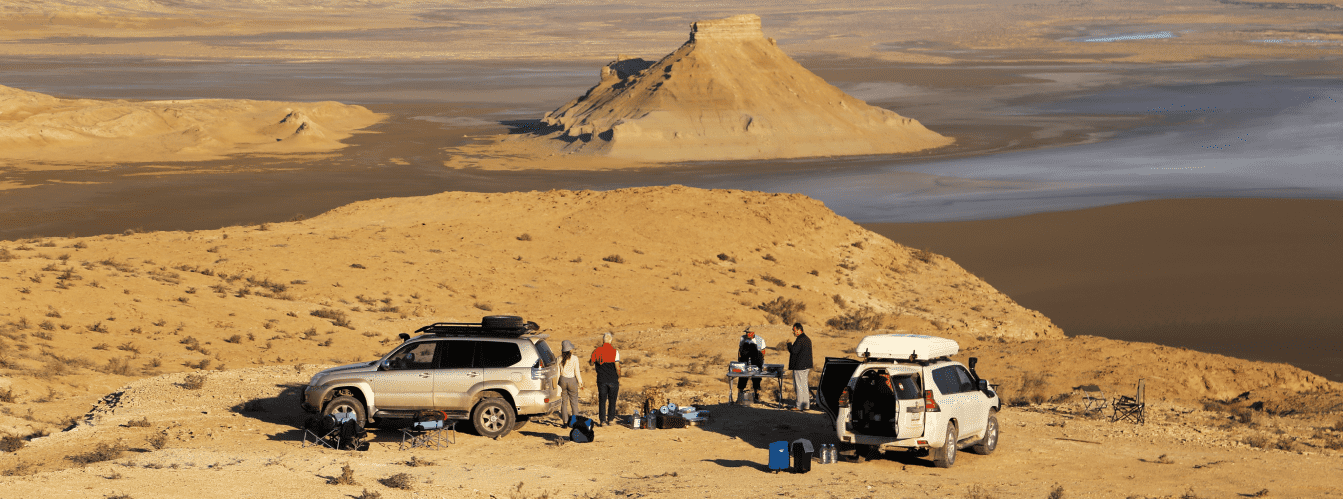
Access roads and vehicle requirements: There is no public transit to the mosque. Standard passenger vehicles can reach Tauchik without difficulty, but negotiating the remaining 45–50 km of rocky plateau characterized by limestone shelves, washouts, and dry ruts strictly demands a capable 4x4 off-road vehicle with minimum ground clearance of 200 mm.
Jagged pieces of shell limestone and flint present high risk of tire cuts: vehicles should be equipped with reinforced All-Terrain (AT) tires, a functional full-size spare, a compressor, and a puncture repair kit. Following spring or autumn rainfall, sections of the plateau loam become muddy and slippery, requiring all-wheel drive.
Visiting regulations and safety tips: Touring the complex starts at the circular symbolic burial of Saint Sultan-Epe, encircled by a stone enclosure with tall wooden poles where pilgrims traditionally tie white ribbons with prayers for protection.
The underground mosque itself lies northeast of the necropolis. Entrance is via a steep 2-meter stairway constructed from dry-laid fieldstone slabs. Venturing into the deeper chambers and the Sufi khalwat demands care: the ceiling height in the corridors ranges from 1 to 2 meters, and portions of the ground are covered in dry clay, requiring visitors to walk stooped or crawl through lower passages on hands and knees. Closed footwear with non-slip treads and a headlamp are indispensable.
Etiquette and sacred regulations: Sultan-Epe is an active Islamic sanctuary and a UNESCO World Heritage property.
When visiting the sanctuary, guests are STRICTLY REQUIRED to:
– Dress modestly: shoulders and knees must be fully covered for both men and women;
– Women must wear a headscarf covering their hair;
– Remove outdoor footwear prior to stepping into the subterranean prayer chambers;
– Maintain reverent silence, refrain from disturbing worshippers, and keep audio devices off;
– Strictly abstain from consuming alcohol or smoking anywhere within the memorial zone;
– Avoid defacing the ancient limestone walls with inscriptions or damaging carved grave monuments across the necropolis.
Infrastructure: Near the memorial entrance stands a traditional pilgrim hostel (shirakshy) where guests can rest, drink tea, and draw potable water from an ancient 5–6 meter deep well situated only 6 meters from the canyon rim. Commercial hotels, dining venues, and grocery stores do not exist here. The nearest fuel stations, tire repair services, and medical shops are found in Tauchik (30 km) and Fort-Shevchenko (57 km).
For self-sustained camping on the coast of Sarytash Bay (4.5 km from the shrine), bring enough drinking water (at least 5 liters per person per day), camp stoves, and storm-proof tents secured with wind-stakes. Mobile network reception is dependable across open parts of the plateau near the cemetery, but disappears completely once inside the carved limestone halls or down in the canyon.
The best season to visit is spring and autumn. The most favorable window lasts from late April through early June, when daytime temperatures hover around +20...+25 °C, the canyon is filled with blooming mulberry and hawthorn, and the spring stream runs steady.
September and October offer calm autumn weather, ripe wild sloes, and fresh marine air.
During July and August, temperatures on the exposed plateau regularly climb past +38...+40 °C, although the subterranean halls of the mosque retain an even natural temperature of +12...+14 °C year-round.
--------------------------------------------
History
The history of the Sultan-Epe Underground Mosque traces back to the Early Middle Ages, intertwining archaic pre-Islamic water cults, the mystical practices of the Yasawiyya Sufi order, and centuries of nomadic heritage on Mangyshlak.
Humans settled these fertile grounds bordering the deep gorge as early as the Stone Age: archaeologists have unearthed Paleolithic and Neolithic flint tool workshops around the necropolis. The presence of a perennial freshwater brook amidst arid chalk plateaus just kilometers from the Caspian coast turned the canyon into an indispensable oasis.
Close to the mosque lie the remains of a circular stone structure built with embedded upright slabs, whose upper layers have deteriorated over time; researchers link this ancient ritual site to Bronze Age steppe archaeoastronomy and solar worship. In the 8th–9th centuries, a fortress guarded the canyon entrance, controlling the maritime trading route.
With the spread of Sufi philosophy in the 9th–13th centuries and its renewed expansion during the 14th–16th centuries, Mangyshlak became a haven for wandering dervishes and ascetic scholars. Adhering to strict ideals of asceticism (zuhd), Sufis excavated their hermitages directly out of solid limestone bedrock, creating cave sanctuaries structurally akin to early Christian rock monastic complexes found in Cappadocia or the Crimean peninsula.
Historical tradition links the sanctuary to Sultan-Epe (Khubbi). According to a prominent 19th-century source—the book Collection of Information on Caucasian Highlanders / Traditions of the Aday Clan Regarding Hanafi Saints Who Lived and Died in Mangyshlak (Tiflis, 1873)—Sultan-Epe was the youngest of three sons born to the Central Asian mystic poet Hakim-Ata (Suleiman Bakirgani) and the pious Anbar-Ana. Hakim-Ata was a renowned student of the venerated Khoja Ahmed Yasawi.
The Soviet ethnographer Gleb Snesarev demonstrated that the name Sultan (Sultan Khubbi) derives directly from the ancient Khwarezmian term ob/khubbi—the water spirit revered throughout Central Asia and southern Kazakhstan. In the collective mindset of the nomadic steppe population, this belief crystallized into the image of a patron saint who comes to the rescue of fishermen and mariners facing shipwreck.
Sultan-Epe exhibited supernatural gifts from early childhood. Legends tell how he delivered vessels from shipwreck on the Caspian Sea, returning to his father with soaked garments and deep chafing on his shoulders from the tarred ropes he used to haul vessels to dry land. Another narrative recounts the miraculous overnight transportation of the Kaaba from Mecca to Bakirgan to greet his father's dawn prayer. Jealousy and doubt displayed by Hakim-Ata eventually led the young saint to withdraw into the unseen world. Upon learning of this, Khoja Ahmed Yasawi reproached Hakim-Ata, prophesying that the waters of the Amu Darya River would flood over the father's grave for forty years as retribution, and that Bakirgan would fall.
A century later, during the Nogai migrations across Mangyshlak, a tale unfolded concerning the lame orphan Kheirullah. Suffering beatings at the hands of an unjust teacher, the boy retreated to the open steppe to end his life. In a dream, Sultan-Epe appeared to him, endowed him with profound wisdom, and instructed: "Go into the steppe, and where a white eagle alights, build a mosque. Whenever you must lift immovable boulders, call out: O, Sultan-Epe!" Awakening, the boy astonished his teacher with newfound insight and traveled to the designated cliff. Invoking the saint's name while handling massive shell limestone blocks, the boy placed the heavy slabs into the vaults of the mosque, subsequently earning veneration as Kheirullah-Sufi.
In 1870, Colonel N. P. Lomakin, commander of the Mangyshlak detachment, documented the refreshing freshwater springs of Sultan-Epe in his reports. By the late 19th century, a well equipped with a stone coping was built at the cliff edge.
The site received formal state protection in 1982, and in 2003, specialists from the Mangystau State Historical and Cultural Reserve, under the direction of archaeologists A. Astafyev and M. Kalmenov, carried out rescue excavations.
In 2004, restorers from the state enterprise Mangystaurestoration, headed by M. Nurkabayev, completed scientific conservation work, stabilizing shifting rock slabs. Global recognition culminated in 2026, when the UNESCO World Heritage Committee officially inscribed the mosque on the World Heritage List during its 48th session.
Architecture and Information
Architecturally and geologically, the Sultan-Epe Underground Mosque is a semi-subterranean rock-karst complex carved into the flank of an ancient erosional gully along the contact boundary of two distinct Tethys sedimentary strata: an upper layer of durable Pontian shell limestone roughly 2 m thick, underlain by a layer of ductile marly clay varying from 0.1 to 1 m in thickness.
Ancient builders utilized an ingenious excavation method: they extracted the softer marly clay from underneath the solid rock layer, creating natural underground rooms without compromising ceiling stability. Where limestone slabs had previously settled under their own weight, their edges formed the walls of the chambers; to avert further shifts, the builders shored them up using dry masonry and massive load-bearing pillars of rough shell-rock blocks.
The subterranean layout contains 9 primary interconnected rooms (or up to 11 when including outer vestibules), joined by a longitudinal central hallway. The entrance sits in the southwestern sector, featuring a covered passage with a steep 2-meter staircase made from unhewn rock slabs. This flight descends into the central rectangular prayer chamber, which features vaulted ceilings and wall heights reaching up to 3 m.
Of particular importance is an enclosed chamber tucked deep within the complex with no through-passage—the Sufi khalwat (khilwet), used for forty-day secluded prayer vigils and meditation (closely resembling the khalwat at the Mausoleum of Khoja Ahmed Yasawi in Turkistan).
Natural daylight and ventilation are provided by three vertical lightwells cut through the rock roof: two are circular, while the third is square. The floors of the underground galleries consist of packed reddish clay mixed with crushed limestone, or the exposed surface of the underlying bedrock.
Positioned 6 meters from the canyon rim is the historic well yielding pure fresh water. Hydrochemical analysis indicates a calcium-hydrocarbonate profile with low mineralization, representing an extraordinary hydrological anomaly for the arid coastal semi-deserts of Mangyshlak.
Detailed Description of the Site
The religious, memorial, and landscape complex of Sultan-Epe includes the following key components:
• Nine-room subterranean rock mosque – a 9th–13th-century rock-cut sanctuary excavated from Tethys shell limestone, featuring connecting halls, structural pillars, and ceiling lightwells;
• Sufi seclusion cell (khalwat) – an isolated rear chamber intended for forty-day ascetic vigils, matching the spiritual role of Yasawi's khalwat;
• Carved entrance portal with stone staircase – a two-meter descent of rough limestone flags leading down into the coolness of the subterranean prayer hall;
• Symbolic grave of Saint Sultan-Epe – a circular stone enclosure with elevated timber masts hung with prayer ribbons left by pilgrims;
• Historic well with healing water – a traditional stone-mouthed well set 6 meters from the precipice, tapping a unique freshwater aquifer;
• Expansive Sultan-Epe necropolis – a heritage burial ground featuring carved stone stelae (kulpytases), stone chest-sarcophagi (sandyktases), and ancestral nomadic crypts;
• Five-kilometer Sultan-Epe coastal canyon – a verdant gorge dropping to depths of 150 meters, draining toward the shores of Mangyshlak Bay on the Caspian Sea.
Legend
A collection of ancestral Mangystau traditions, recorded by chroniclers of steppe lore, centers around the underground mosque of Sultan-Epe and its patron saint.
The principal legend tells of the miraculous deliverance of mariners. The saint's mother, Anbar-Ana, bore three sons: Muhammad-Khoja, Asker-Khoja, and Khubbi (Sultan-Epe). While the older brothers studied in madrasas, the father, Hakim-Ata, tutored the youngest alongside his dedicated pupil, Sheikh-Sayat.
One day, testing the devotion of his disciples, the father called them into his presence. Sheikh-Sayat arrived immediately, whereas Sultan-Epe arrived hours later, his clothes drenched with sea water and his shoulders bruised by rope burns. Rebuked by his father, the youth explained: "Father, I heard the pleas of fishermen whose boats were foundering in a violent storm on the Caspian. I plunged into the waves and hauled the sinking ships onto dry land with ropes across my shoulders." The mariners promised to bring their rescuer ten thousand tenge within five months, fulfilling their vow. Ever since, it is believed that any mariner or traveler caught in a tempest who invokes Sultan-Epe will be guided to safety.
Another legend commemorates the miracle of the Kaaba. Discovering that his father journeyed miraculously each day to Mecca for dawn prayers, Sultan-Epe sought to spare him the arduous spiritual transit: the following morning, as Hakim-Ata crossed the threshold of the mosque in Khwarezm, he found the holy Kaaba standing before him, surrounded by throngs of worshippers. During the festival of Qurban, Sultan-Epe brought back to life nine oxen slaughtered and eaten by his father's disciples by touching their heaped bones with his staff, subsequently disappearing into the spirit realm following unmerited scolding.
A century later, the saint bestowed his favour upon the lame orphan Kheirullah, who was subjected to cruel treatment by his schoolmaster. Wandering into the wilderness to end his life, Kheirullah was visited in a dream by Sultan-Epe, who granted him divine wisdom and commanded: "Go into the steppe, and wherever a white eagle perches, erect a mosque. Whenever you lift impossible boulders, proclaim: O, Sultan-Epe!" Waking with deep understanding, the youth went to the chosen cliff. Moving massive slabs of shell limestone with ease while chanting the saint's name, he built the vaults of the mosque, earning lasting reverence as Kheirullah-Sufi.
It is held that any pilgrim suffering from persistent headaches or bodily ailments who circles the saint's tomb seven times, drinks from the well, and prays within the cool chambers of the subterranean sanctuary will receive healing and inner peace.
Conclusion
The Sultan-Epe Underground Mosque is a profound cultural treasure of Mangistau and global spiritual history, where the malleable shell limestone of the ancient Tethys Ocean became an enduring home for Sufi thought. Inscribed on the UNESCO World Heritage List, this rock-cut sanctuary, accompanied by the restorative waters of its historic well and the greenery of the gorge overlooking the Caspian Sea, offers every traveler a quiet encounter with ancient steppe faith, heritage, and peace.
Interesting Nearby Attractions:
• Sultan-Epe Canyon;
• Caspian Sea and Sarytash Bay;
• Zhygylgan Sinkhole;
• Kenty-Baba Necropolis;
• Shakpak-Ata Underground Mosque;
• Kapamsay Canyon;
• Tamshaly Canyon;
• Samal Canyon;
• Akshora Mausoleum;
• Fort-Shevchenko Museum Town;
• Cape Tyub-Karagan;
• Torysh Valley of Spherical Concretions;
• Sultan-Epe Necropolis;
• Kokbulaksay Canyon;
• Beltoran Mausoleum.
Other Pilgrimage Sites in Mangyshlak:
• Beket-Ata Underground Mosque;
• Karaman-Ata Underground Mosque;
• Shopan-Ata Underground Mosque;
• Masat-Ata Underground Mosque;
• Koben Mosque;
• Zholaskan Mosque;
• Kolbas Ishan Mosque;
• Sonabay Underground Mosque;
• Uytoly-Ata Mosque;
• Ishan Khoja Mosque;
• Zhaman Sauran Mosque;
• Sanctuary of Bayte.
Photogallery: